|
|
Español
Italiano
Português
Русский
Polish site
Gnu Regression, Econometrics and Time-series Library

Is a cross-platform software package for econometric analysis,
written in the C programming language. It is free, open-source software.
You may redistribute it and/or modify it under the terms of the GNU
General Public License (GPL) as published by
the Free Software Foundation.
gretl conference
The most recent biennial gretl conference (the ninth) took place
at the University of Birmingham on June 19-20, 2025. Previous
conferences took place in Gdańsk (2023), via Zoom (2021), in Naples
(2019), Athens (2017), Berlin (2015), Oklahoma City (2013), Toruń
(2011) and Bilbao (2009). For further info
see gretlconference.org.
Our thanks go to all the organizers of these conferences.
Features
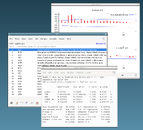
Intuitive graphical interface (now in French,
Italian, Spanish, Polish, German, Basque, Catalan, Galician,
Portuguese, Russian, Ukrainian, Turkish, Czech, Traditional Chinese,
Albanian, Bulgarian, Greek, Japanese and Romanian as well as
English) Command-line program, gretlcli, for
batch or interactive use and dedicated script editor,
gretl_edit,
for working on complex scripts. A wide variety of estimators: least squares, maximum likelihood,
GMM; single-equation and system methods; regularized least squares
(LASSO, Ridge, elastic net) Time series methods: ARIMA, a wide variety of
univariate GARCH-type models, VARs and VECMs (including structural
VARs), unit-root and cointegration tests, Kalman filter,
etc. Limited dependent variables: logit, probit,
tobit, sample selection, interval regression, models for count and
duration data, etc. Panel-data estimators, including instrumental
variables, probit and GMM-based dynamic panel models Output models as LaTeX files, in tabular or equation format Integrated powerful scripting language (known
as
hansl),
with a wide range of programming tools and matrix
operations GUI controller for fine-tuning
Gnuplot graphs Facilities for easy exchange of data and results
with GNU R,
GNU Octave,
Python,
Julia,
Ox and
Stata Parallelization via MPI
(details) Support for mixed time-series frequencies
(MIDAS)
(details)
Support for machine learning via
LIBSVM
(details)
Besides gretl's core functionality, several addons
and numerous
contributed function
packages are available. Take a look at the new
function package catalog; also see
Contributing to gretl below.
New: Python users may want to take a look at the new facility,
gretl4py, (gretl for python).
Data formats
Supported formats include: own XML data files; Comma Separated
Values; Excel, Gnumeric and Open Document worksheets;
Stata .dta files; SPSS .sav files; Eviews workfiles;
JMulTi data files; own format binary databases (allowing mixed data
frequencies and series lengths), RATS 4 databases and PC-Give
databases. Includes a sample US macro database. See also
the gretl data page.
Download
Gretl for MS Windows can be found here,
and gretl for macOS here.
For Linux, you have:
If you want to compile gretl from source, the current source
package
is gretl-2026d.tar.xz,
and you may want to check out gretl's
dependencies. However, if you're on Linux and want to build
current gretl, the
tarball buildgretl.tar.gz will
automate most of the work (we assume you know what you're doing, but
a README file is included).
The time-series analysis programs X-13-ARIMA and TRAMO/SEATS
are available in a form suitable for use with gretl on Linux, as follows.
Look here for system requirements and installation guide.
Gnuplot
Gretl calls gnuplot to generate graphs. We require gnuplot
version 5.2 (released in September 2017) or higher. See
gnuplot.sourceforge.net.
The gretl packages for MS Windows and OS X include a gnuplot version
that works well with gretl. Reasonably current Linux distributions should
also offer a suitable version of the program.
Manual
The gretl manual comes in three PDF files, a User's Guide,
a Command Reference and a Hansl primer. English
versions of these, formatted for U.S. letter-size paper, are included
in the gretl source package and binary distributions. Gretl will
access other available versions on demand, via the Internet. You can
also find the manual files
here.
In addition the
Gretl Command Reference and
Gretl Function Reference are
available in HTML format.
Getting help, reporting bugs
If you use gretl you may wish to join the
gretl-users mailing list.
This is a moderate-volume list where people request and offer help, discuss
new features and so on.
There's also a gretl-announce list;
this is a read-only list which sends out announcements on the occasion of new releases of
gretl.
You can submit
bug reports
and
feature requests
using the SourceForge Tracker system.
Contributing to gretl
Do you have ideas or code that you'd like to contribute to gretl? If so,
we'd be very pleased to hear from you. You should probably join the
gretl-devel mailing
list.
The most obvious way of contributing your expertise to gretl
development is by writing
a function
package (using gretl's scripting language,
hansl).
You can see a listing of current packages
here.
A quick Guide
to producing function packages is available (thanks, Stefano Fachin!).
If by any chance you're a C coder then contributions to the
underlying gretl library would also be welcome. The only
non-negotiable requirement on C code that can be contributed to
gretl is that you must be willing to have it appear under
the GNU General
Public License (GPL), that is, you must be comfortable with
having the source released.
Another way to support the gretl project is to join the
gretl Association.
Git access and browsing
You can find the gretl git repository
here.
Notes on basic usage of git are available
here
and full documentation at
git.scm.com.
Acknowledgements
First of all, thanks to Ramu Ramanathan (1936-2013). Ramanathan was
Professor of Economics at UCSD and author of
Introductory
Econometrics. Gretl's origins lie in Ramanathan's
open-sourcing of the C code for his econometrics program "ESL".
Many people have sent in useful bug reports and suggestions for gretl's
development. We are particularly indebted to Ignacio Díaz-Emparanza,
Tadeusz Kufel, Pawel Kufel, Dirk Eddelbuettel, Sven Schreiber and
Andreas Rosenblad. A. Talha Yalta plays a helpful role in scrutinizing
and reporting on gretl's numerical accuracy.
Many thanks to Ignacio Díaz-Emparanza, Susan Orbe, Michel
Robitaille, Florent Bresson, Cristian Rigamonti, Tadeusz and Pawel
Kufel, Markus Hahn, Sven Schreiber, Hélio Guilherme, Henrique Andrade,
Alexander Gedranovich, Talha Yalta, Y. N. Yang, Pavla Nikolovova, Jan
Hanousek, Artur Bala, Manolis Tzagarakis, Ioannis Venetis, Vitalie
Ciubotaru, Mihaela Nicolau, Oleh Komashko and Juan Estévez for
their work in translating gretl.
Thanks to William Greene, author of Econometric
Analysis, for his permission to include in the gretl package
some datasets relating to interesting examples in his text.
Thanks to the good people on the comp.lang.c of old and
[email protected] for expert advice on many
issues. Thanks to Richard Stallman of the Free Software Foundation
for all his work in developing and promoting free software, and more
specifically for agreeing to "adopt" gretl as a GNU program.
Allin Cottrell, Wake Forest University
Riccardo "Jack" Lucchetti, Università Politecnica delle Marche
Last modified: 2026-10-29
|


 Follow us on Mastodon