CWE-1189: Improper Isolation of Shared Resources on System-on-a-Chip (SoC)
|
Weakness ID: 1189
Vulnerability Mapping:
ALLOWED
This CWE ID may be used to map to real-world vulnerabilities
Abstraction:
Base
Base - a weakness that is still mostly independent of a resource or technology, but with sufficient details to provide specific methods for detection and prevention. Base level weaknesses typically describe issues in terms of 2 or 3 of the following dimensions: behavior, property, technology, language, and resource.
|
View customized information:
Shows the description and diagram, platforms, mitigations, consequences, relationships, memberships, and content history.
For users who are interested in more notional aspects of a weakness. Example: educators, technical writers, and project/program managers.
For users who are concerned with the practical application and details about the nature of a weakness and how to prevent it from happening. Example: tool developers, security researchers, pen-testers, incident response analysts.
For users who are mapping an issue to CWE/CAPEC IDs, i.e., finding the most appropriate CWE for a specific issue (e.g., a CVE record). Example: tool developers, security researchers.
For users who wish to see all available information for the CWE/CAPEC entry.
For users who want to customize what details are displayed.
More information is available — Please edit the custom filter or select a different filter.
Description
The System-On-a-Chip (SoC) does not properly isolate shared resources between trusted and untrusted agents.
Extended Description
A System-On-a-Chip (SoC) has a lot of functionality, but it may have a limited number of pins or pads. A pin can only perform one function at a time. However, it can be configured to perform multiple different functions. This technique is called pin multiplexing. Similarly, several resources on the chip may be shared to multiplex and support different features or functions. When such resources are shared between trusted and untrusted agents, untrusted agents may be able to access the assets intended to be accessed only by the trusted agents.
Dimensions
 The Dimensions table provides information about the
different dimensions associated with this weakness. The Type identifies the dimension type,
while the Value provides the specific value for that dimension.
| Type | Value |
|---|
| Behavior-Property | Improper | | Behavior-Type | Isolation | | Resource-Property | Shared | | Resource-Type | Resources | | Technology | System-on-a-Chip | | Acronym | (SoC) |
Common Consequences
This table specifies different individual consequences
associated with the weakness. The Scope identifies the application security area that is
violated, while the Impact describes the negative technical impact that arises if an
adversary succeeds in exploiting this weakness. The Likelihood provides information about
how likely the specific consequence is expected to be seen relative to the other
consequences in the list. For example, there may be high likelihood that a weakness will be
exploited to achieve a certain impact, but a low likelihood that it will be exploited to
achieve a different impact.
| Impact |
Details |
|
Bypass Protection Mechanism
|
Scope: Access Control
If resources being used by a trusted user are shared with an untrusted user, the untrusted user may be able to modify the functionality of the shared resource of the trusted user.
|
|
Quality Degradation
|
Scope: Integrity
The functionality of the shared resource may be intentionally degraded.
|
Potential Mitigations
| Phase(s) |
Mitigation |
|
Architecture and Design
|
Strategy: Separation of Privilege
When sharing resources, avoid mixing agents of varying trust levels.
Untrusted agents should not share resources with trusted agents.
|
Relationships
This table shows the weaknesses and high level categories that are related to this
weakness. These relationships are defined as ChildOf, ParentOf, MemberOf and give insight to
similar items that may exist at higher and lower levels of abstraction. In addition,
relationships such as PeerOf, Overlaps, and CanAlsoBe are defined to show similar weaknesses that the user
may want to explore.
|
Relevant to the view "Complete Weakness Hierarchy" (View-1000)
|
|
Nature |
Type |
ID |
Name |
|
ChildOf |
 Class - a weakness that is described in a very abstract fashion, typically independent of any specific language or technology. More specific than a Pillar Weakness, but more general than a Base Weakness. Class level weaknesses typically describe issues in terms of 1 or 2 of the following dimensions: behavior, property, and resource. |
653
|
Improper Isolation or Compartmentalization
|
|
ChildOf |
Class - a weakness that is described in a very abstract fashion, typically independent of any specific language or technology. More specific than a Pillar Weakness, but more general than a Base Weakness. Class level weaknesses typically describe issues in terms of 1 or 2 of the following dimensions: behavior, property, and resource.
|
668
|
Exposure of Resource to Wrong Sphere
|
|
ParentOf |
 Base - a weakness that is still mostly independent of a resource or technology, but with sufficient details to provide specific methods for detection and prevention. Base level weaknesses typically describe issues in terms of 2 or 3 of the following dimensions: behavior, property, technology, language, and resource. |
1303
|
Non-Transparent Sharing of Microarchitectural Resources
|
|
PeerOf |
Base - a weakness that is still mostly independent of a resource or technology, but with sufficient details to provide specific methods for detection and prevention. Base level weaknesses typically describe issues in terms of 2 or 3 of the following dimensions: behavior, property, technology, language, and resource.
|
1331
|
Improper Isolation of Shared Resources in Network On Chip (NoC)
|
|
|
Relevant to the view "Hardware Design" (View-1194)
|
|
Nature |
Type |
ID |
Name |
|
MemberOf |
 Grouping - a CWE entry that contains a set of other entries that share a common characteristic. |
1198
|
Privilege Separation and Access Control Issues
|
|
PeerOf |
Base - a weakness that is still mostly independent of a resource or technology, but with sufficient details to provide specific methods for detection and prevention. Base level weaknesses typically describe issues in terms of 2 or 3 of the following dimensions: behavior, property, technology, language, and resource.
|
1331
|
Improper Isolation of Shared Resources in Network On Chip (NoC)
|
|
Modes
Of Introduction
The different Modes of Introduction provide information
about how and when this
weakness may be introduced. The Phase identifies a point in the life cycle at which
introduction
may occur, while the Note provides a typical scenario related to introduction during the
given
phase.
| Phase(s) |
Note |
|
Architecture and Design
|
|
|
Implementation
|
|
Applicable Platforms
This listing shows possible areas for which the given
weakness could appear. These
may be for specific named Languages, Operating Systems, Architectures, Paradigms,
Technologies,
or a class of such platforms. The platform is listed along with how frequently the given
weakness appears for that instance.
| Type |
Applicable Platforms |
Notes |
| Languages |
Class: Not Language-Specific
(Undetermined Prevalence)
|
|
| Technologies |
Class: System on Chip
(Undetermined Prevalence)
|
|
Demonstrative Examples
Example 1
Consider the following SoC
design. The Hardware Root of Trust (HRoT) local SRAM is memory mapped in the core{0-N}
address space. The HRoT allows or disallows access to private memory ranges, thus
allowing the sram to function as a mailbox for communication between untrusted and
trusted HRoT partitions.
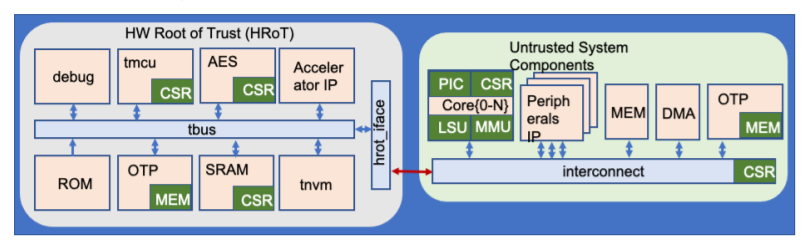
We assume that the threat is from malicious software in
the untrusted domain. We assume this software has access
to the core{0-N} memory map and can be running at any
privilege level on the untrusted cores. The capability
of this threat in this example is communication to and
from the mailbox region of SRAM modulated by the
hrot_iface. To address this threat, information must not
enter or exit the shared region of SRAM through
hrot_iface when in secure or privileged mode.
Selected Observed
Examples
Note: this is a curated list of examples for users to understand the variety of ways in which this
weakness can be introduced. It is not a complete list of all CVEs that are related to this CWE entry.
| Reference |
Description |
|
|
Processor has improper isolation of shared resources allowing for information disclosure.
|
|
|
Baseboard Management Controller (BMC) device implements Advanced High-performance Bus (AHB) bridges that do not require authentication for arbitrary read and write access to the BMC's physical address space from the host, and possibly the network [ REF-1138]. |
Weakness Ordinalities
| Ordinality |
Description |
|
Primary
|
(where the weakness exists independent of other weaknesses)
|
Detection
Methods
| Method |
Details |
|
Automated Dynamic Analysis
|
Pre-silicon / post-silicon: Test access to shared systems resources (memory ranges, control registers, etc.) from untrusted software to verify that the assets are not incorrectly exposed to untrusted agents. Note that access to shared resources can be dynamically allowed or revoked based on system flows. Security testing should cover such dynamic shared resource allocation and access control modification flows.
Effectiveness: High
|
Vulnerability Mapping Notes
|
Usage
|
ALLOWED
(this CWE ID may be used to map to real-world vulnerabilities)
|
| Reason |
Acceptable-Use
|
|
Rationale
|
This CWE entry is at the Base level of abstraction, which is a preferred level of abstraction for mapping to the root causes of vulnerabilities.
|
|
Comments
|
Carefully read both the name and description to ensure that this mapping is an appropriate fit. Do not try to 'force' a mapping to a lower-level Base/Variant simply to comply with this preferred level of abstraction.
|
Related Attack Patterns
| CAPEC-ID |
Attack Pattern Name |
| CAPEC-124 |
Shared Resource Manipulation |
Content
History
| Submissions |
| Submission Date |
Submitter |
Organization |
2019-10-15
(CWE 4.0, 2020-02-24)
|
Arun Kanuparthi, Hareesh Khattri, Parbati Kumar Manna, Narasimha Kumar V Mangipudi |
Intel Corporation |
|
|
| Contributions |
| Contribution Date |
Contributor |
Organization |
2022-04-18
(CWE 4.9, 2022-10-13)
|
Hareesh Khattri |
Intel Corporation |
|
changed detection method
|
2021-10-22
(CWE 4.6, 2021-10-28)
|
Hareesh Khattri |
Intel Corporation |
|
provided observed example
|
2021-07-16
(CWE 4.5, 2021-07-20)
|
|
Cycuity (originally submitted as Tortuga Logic) |
|
Provided Demonstrative Example for Hardware Root of Trust.
|
| Modifications |
| Modification Date |
Modifier |
Organization |
2026-10-28
(CWE 5.0, 2026-10-28)
|
CWE Content Team |
MITRE |
|
updated Dimensions
|
2025-09-09
(CWE 4.18, 2025-09-09)
|
CWE Content Team |
MITRE |
|
updated Relationships
|
2025-04-03
(CWE 4.17, 2025-04-03)
|
CWE Content Team |
MITRE |
|
updated Demonstrative_Examples
|
2023-06-29
(CWE 4.12, 2023-06-29)
|
CWE Content Team |
MITRE |
|
updated Mapping_Notes, Relationships
|
2023-04-27
(CWE 4.11, 2023-04-27)
|
CWE Content Team |
MITRE |
|
updated Observed_Examples, Relationships
|
2022-10-13
(CWE 4.9, 2022-10-13)
|
CWE Content Team |
MITRE |
|
updated Detection_Factors
|
2021-10-28
(CWE 4.6, 2021-10-28)
|
CWE Content Team |
MITRE |
|
updated Description, Observed_Examples, References, Relationships, Weakness_Ordinalities
|
2021-07-20
(CWE 4.5, 2021-07-20)
|
CWE Content Team |
MITRE |
|
updated Demonstrative_Examples
|
2020-12-10
(CWE 4.3, 2020-12-10)
|
CWE Content Team |
MITRE |
|
updated Relationships
|
2020-08-20
(CWE 4.2, 2020-08-20)
|
CWE Content Team |
MITRE |
|
updated Common_Consequences, Description, Name, Potential_Mitigations, Related_Attack_Patterns, Relationships
|
| Previous Entry Names |
| Change Date |
Previous Entry Name |
| 2020-08-20
|
Improper Isolation of Shared Resources on System-on-Chip (SoC) |
More information is available — Please edit the custom filter or select a different filter.
|


