GeezerVisonThe World Wide Web, restored to 800 pixels of glory. |
| Home|About|Gaming cabinet|Archives|How it works|Starter sites |
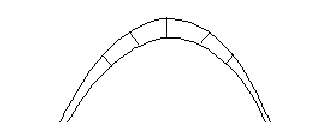
GeezerVison is showing developer.apple.com — Converting Outlines to TrueType - TrueType Reference Manual - Apple Developer This section considers some of the issues involved in converting outlines from other outline formats to the quadratic splines supported by the TrueType format. A key issue in any outline font design is how closely must the curves used to represent a glyph shape resemble the intended glyph design. For designs developed directly in the TrueType format the curves used define the design exactly. A more complex problem arises when converting from some other format or when digitizing a paper design. Here the problem is one of determining an acceptable error or tolerance value. Once this number is established, conversion becomes merely a matter of finding a set of quadratic curves that describe the original design within the stated tolerance. While a given curve may not be exactly representable in the quadratic spline format, that curve can always be represented as accurately as required. The tricky parts in this process are determining the degree of accuracy needed and then deciding how to establish whether a given font meets the accuracy guidelines. How much error is acceptable?If the possible error in an outline description is less than the error inherent in the most sensitive rendering device expected to be used, none of the attainable accuracy in the typeface design is lost. As a rule of thumb, an error that is less than 1/1000 of the em square will generally meet this guideline. In attempting to decide whether the chosen error tolerance is acceptable, it is necessaryto look at the output produced. The quality obtained with the letter "s" is often a good indicator of the acceptability of that tolerance, asthere are many curves and transition points. How to measure error?There is more than one way to measure the error involved in curve approximation. All of the available methods have associated pitfalls. This book can only suggest some approaches that might be taken and warn against some of the pitfalls.In looking at the original curve and the curve intended to approximate it, it might be tempting to measure the error of approximation by looking at the curve value for each of the two parametric equations specifying the two curves at the same value for t. This method may not work, however, as the two curves will most likely have different velocities making it necessary to reparameterize the two curves in terms of arc length. In looking at the original curve and the curve intended to approximate it, it might be tempting to measure the error of approximation by looking at the curve value for each of the two parametric equations specifying the two curves at the same value for t. This method may not work, however, as the two curves will most likely have different velocities making it necessary to reparameterize the two curves in terms of arc length. A better method for determining the error would be to measure the distance for the original curve to the new curve along a perpendicular line as shown in FIGURE 1 below. FIGURE 1 Measuring the error in a curve approximation
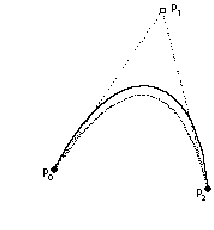
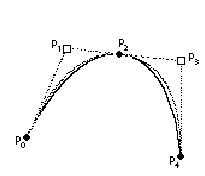
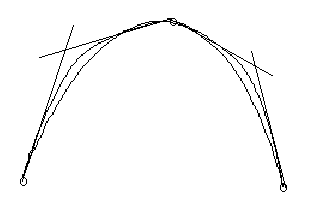
Converting from other formatsIf the paper design is digitized directly as quadratic splines the major work of describing outlines in the TrueType format is done. If, however, the art work is digitized as some other type of curve, it will be necessary to convert those curves to quadratic splines. If you are converting from another format your goal should not be an exact match between the original curves and the new curves. Depending upon the original format, this goal may be impossible to achieve. In addition, an exact match is not necessary to obtain a high quality outline. A more suitable goal is to render the original design with sufficient accuracy that additional efforts toward making the outline more closely resemble the original design will result in no difference in the final output. From cubics to quadratics It is possible that the outlines you obtain will be described as cubic curves. If so, it is not possible to perform an exact conversion between the two formats. It is, however, possible to convert the curve descriptions to the degree of accuracy required. That is, you can reduce any error in the translation to an arbitrarily small tolerance. The paragraphs that follow sketch out a method for converting between these two formats.
|
| You are visitor 01402503 — GeezerVison does not store the pages you look up. Best viewed with Netscape Navigator 4.7 or Internet Explorer 6 at 800×600. No cookies required. |