GeezerVisonThe World Wide Web, restored to 800 pixels of glory. |
| Home|About|Gaming cabinet|Archives|How it works|Starter sites |
GeezerVison is showing developer.mozilla.org — Introduction to CSS syntax: declarations, rulesets, and statements - CSS | MDN Introduction to CSS syntax: declarations, rulesets, and statementsThe basic goal of the Cascading Stylesheet (CSS) language is to allow a browser engine to paint elements of the page with specific features, like colors, positioning, or decorations. The CSS syntax reflects this goal and its basic building blocks are:
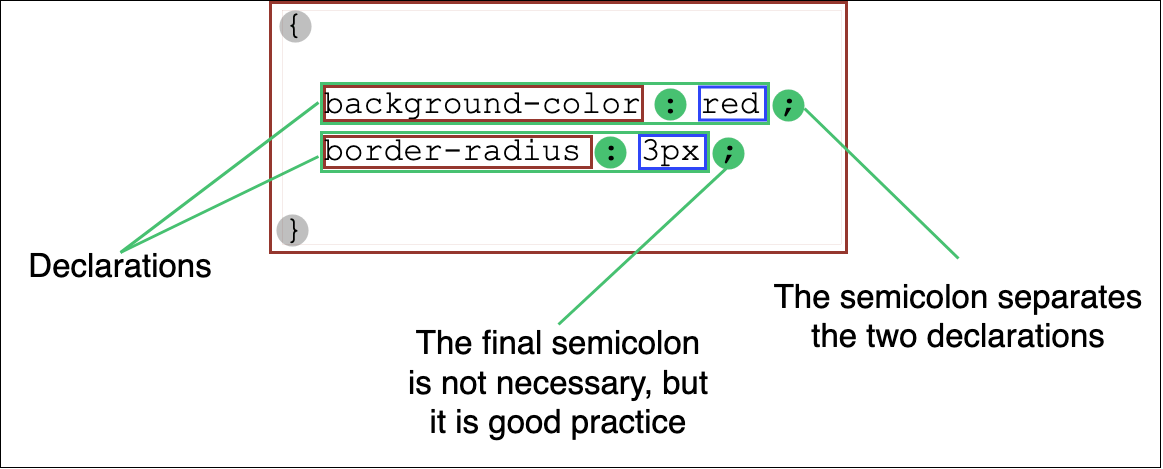
CSS declarationsSetting CSS properties to specific values is the core function of the CSS language. A property and value pair is called a declaration, and any CSS engine calculates which declarations apply to every single element of a page in order to appropriately lay it out, and to style it. Both properties and values are case-insensitive by default in CSS. The pair is separated by a colon,
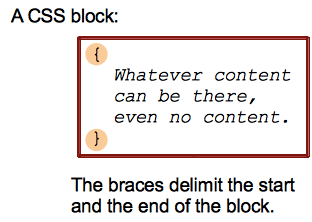
There are hundreds of different properties in CSS and a practically endless number of different values. Not all pairs of properties and values are allowed and each property defines what are the valid values. When a value is not valid for a given property, the declaration is deemed invalid and is wholly ignored by the CSS engine. CSS declaration blocksDeclarations are grouped in blocks, that is in a structure delimited by an opening brace,
Such blocks are naturally called declaration blocks and declarations inside them are separated by a semicolon, A CSS declaration block is visualized in the diagram below.
Note:
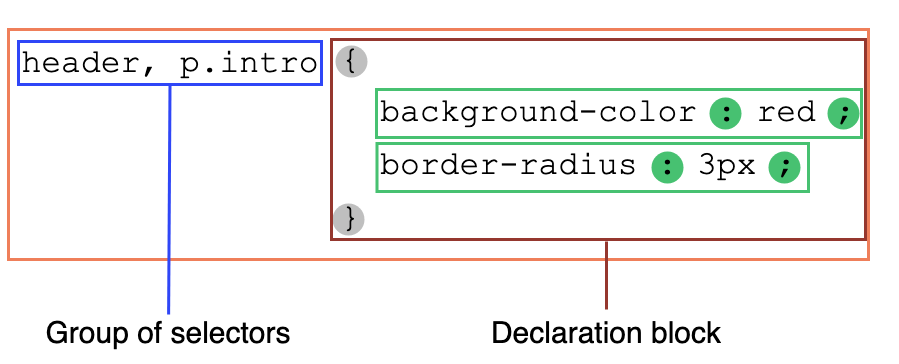
The content of a CSS declaration block, that is a list of semicolon-separated declarations, without the initial and closing braces, can be put inside an HTML CSS rulesetsIf style sheets could only apply a declaration to each element of a Web page, they would be pretty useless. The real goal is to apply different declarations to different parts of the document. CSS allows this by associating conditions with declarations blocks. Each (valid) declaration block is preceded by one or more comma-separated selectors, which are conditions selecting some elements of the page. A selector list and an associated declarations block, together, are called a ruleset, or often a rule. A CSS ruleset (or rule) is visualized in the diagram below.
As an element of the page may be matched by several selectors, and therefore by several rules potentially containing a given property several times, with different values, the CSS standard defines which one has precedence over the other and must be applied: this is called the cascade algorithm (see Handling conflicts). Note: It is important to note that even if a ruleset characterized by a group of selectors is a kind of shorthand replacing rulesets with a single selector each, this doesn't apply to the validity of the ruleset itself. This leads to an important consequence: if one single basic selector is invalid, like when using an unknown pseudo-element or pseudo-class, the whole selector is invalid and therefore the entire rule is ignored (as invalid too). CSS statementsRulesets are the main building blocks of a style sheet, which often consists of only a big list of them. But there is other information that a Web author wants to convey in the style sheet, like the character set, other external style sheets to import, font face or list counter descriptions and many more. It will use other and specific kinds of statements to do that. A statement is a building block that begins with any non-space characters and ends at the first closing brace or semicolon (outside a string, non-escaped and not included into another {}, () or [] pair).
There are two kinds of statements:
Any statement which isn't a ruleset or an at-rule is invalid and ignored. Nested statementsThere is another group of statements – the nested statements. These are statements that can be used in a specific subset of at-rules – the conditional group rules. These statements only apply if a specific condition is matched: the See also |
| You are visitor 01402503 — GeezerVison does not store the pages you look up. Best viewed with Netscape Navigator 4.7 or Internet Explorer 6 at 800×600. No cookies required. |