GeezerVisonThe World Wide Web, restored to 800 pixels of glory. |
| Home|About|Gaming cabinet|Archives|How it works|Starter sites |
GeezerVison is showing developer.nvidia.com — Computer Vision Software Computer VisionComputer vision (CV) is a field of artificial intelligence that lets computers and systems derive meaningful information from digital images, videos, and other visual inputs. It enables devices like smart cameras to acquire, process, analyze, and interpret images and videos. CV applications—such as intelligent video analytics, image/video detection and recognition, and 3D reconstruction—have had a massive impact on companies across industries. From retail, security, healthcare, and construction to manufacturing, consumer internet, and automotive, there are tremendous benefits in computers recognizing and analyzing items in photos and videos in the same way that people do. NVIDIA’s high-performance, low energy-consumption solutions let developers speed up every part of the computer vision pipeline for deployment in production, from the edge to the cloud and data centers. They can now quickly build and deploy cutting edge-models that deliver the high-throughput and low-latency solutions needed for real-time image and video processing. A Wide Range of Use CasesAutonomous Vehicles and RoboticsIdentify potential collisions and take preventative actions to avoid accidents, enhancing the safety and efficiency of autonomous vehicles and robotics systems. Smart Cities and Urban PlanningDetect and segment various urban features like roads, buildings, parks, and public facilities, providing valuable insights to city planners and architects. Healthcare and Life SciencesAnalyze and interpret complex medical data like radiology images and genomic sequences, enabling more precise diagnoses, personalized treatment plans, and innovative research. RetailOptimize store layouts by analyzing customer traffic patterns, reduce shrinkage at point of sales through intelligent alert, and personalize shopping experiences with AI-powered recommendation systems Media and EntertainmentAutomate content analysis, utilize motion capture for more lifelike animations, and craft immersive virtual reality experiences to enhance artistic expression and deepen audience engagement. Industry-Changing Benefits
Intelligent AutomationUse computer vision to interpret and understand visual data, allowing machines to perform tasks traditionally done by humans. 
Improved Quality ControlEnhance quality control processes by using computer vision to identify defects, anomalies, or inconsistencies in manufacturing lines, leading to better product quality and reduced waste. 
Object Detection and TrackingMonitor and analyze traffic flow, detecting vehicles, pedestrians, and cyclists. This data helps optimize traffic signals, manage congestion, and improve overall transportation efficiency. 
Public Safety and SecurityDetect and track objects in real time to alert authorities to potential safety hazards for pedestrians—such as jaywalkers or obstructions on sidewalks—promoting safer walking environments. End-to-End Computer Vision Solutions
Computer Vision SDKs and LibrariesNVIDIA offers a range of accelerated CV SDKs and libraries that speed up every part of the pipeline for deployment in production, from the edge to the cloud. Our SDKs and libraries are production-ready and can be easily adapted to fit your unique needs. This gives you the flexibility and reliability to integrate powerful visual perception capabilities into your application. Learn More 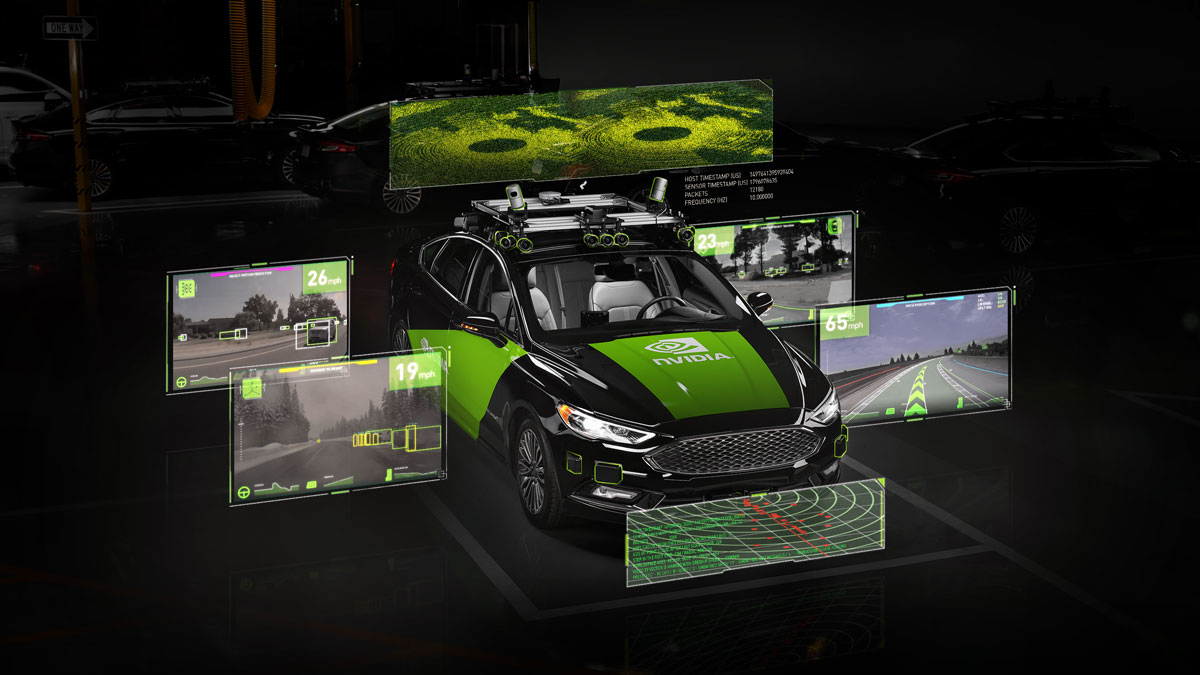
Industry SolutionsNVIDIA offers multiple industry-specific computer vision software products and platforms. Whatever your application, there’s an SDK to meet your challenge.
Computer Vision ResearchLearn what problems our computer vision research engineers and data scientists have been solving. Read our Latest Publications
USD for Computer VisionNVIDIA Omniverse™ is the data factory for AI that can be used to generate synthetic data and validate AI models in a simulation environment using Omniverse Replicator. This modular development platform is built on (OpenUSD), an extensible and open framework for 3D. OpenUSD lets developers use the power of 3D simulation environments and build AI applications that power robots, autonomous vehicles, and more. Learn More About Omniverse ReplicatorComputer vision techniquesMost techniques begin with a model–or a mathematical algorithm–that’s been trained with volumes of data to accomplish a specific task. Some of the common techniques include: 
ClassificationClassification involves identifying what object is in an image or video frame. These models are usually trained with a large dataset to identify simple objects like dogs, cats, chairs, or very specific ones like the type of vehicles in a road scene. The quality of the classification output depends on the training data used. The more the quantity and diversity of the training data, the higher the degree of precision. 
DetectionDetection involves locating and localizing an object or multiple objects within an image or a video frame. The algorithm outputs a rectangular bounding box around the detected object to indicate its location in the image. Object detectors may be trained to detect cars, road signs, people, or other objects of interest within an image or a video frame. 
SegmentationSegmentation involves locating objects or regions of interest precisely in an image by assigning a label to every pixel in an image. This way, pixels with the same label share similar characteristics, such as color, or texture. Segmentation models are very commonly used in medical imaging for performing tasks like automatically detecting tumors in Magnetic Resonance Imaging (MRI) scans. Your World, Powered by Computer VisionFind Answers to Frequently Asked QuestionsComputer vision is more than research. It delivers practical, real-world solutions that change lives. NVIDIA’s deep expertise in artificial intelligence and high-performance computing provides endless opportunities to meaningfully impact the world. Get Your CV Questions Answered 

Get Started With Image SegmentationNew to computer vision? Get started with this free two-hour course on image segmentation offered by the NVIDIA Deep Learning Institute (DLI). You’ll learn how to segment MRI images to measure parts of the heart by comparing image segmentation with other computer vision challenges. We’ll be experimenting with TensorFlow tools such as TensorBoard and the TensorFlow Keras Python API, as well as learning to implement effective metrics for assessing model performance. Get Started See What’s NewExperience Computer Vision in ActionNo challenge is too small and no company too big for computer vision. See innovative solutions in action—from startups to global manufacturers. Partnering for SuccessGlobal challenges take a community. We support you in tackling challenges with powerful solutions to meet your exact needs.             |
| You are visitor 01402503 — GeezerVison does not store the pages you look up. Best viewed with Netscape Navigator 4.7 or Internet Explorer 6 at 800×600. No cookies required. |