GeezerVisonThe World Wide Web, restored to 800 pixels of glory. | ||||||||||||||||||||
| Home|About|Gaming cabinet|Archives|How it works|Starter sites | ||||||||||||||||||||
GeezerVison is showing docs.github.com — Preventing code quality issues from reaching your default branch - GitHub Docs Preventing code quality issues from reaching your default branchMove through Code Quality findings on your pull request, including understanding severity labels, when each finding is best fixed, delegated, or dismissed, and how those choices shape your repository's code health. Who can use this feature?Users with write access GitHub Team or GitHub Enterprise Cloud In this articleUp nextPhase 3: Launch your pilotIntroductionIn this tutorial, you'll follow a single pull request through Code Quality's analysis, from first comment to merge. You'll learn:
By the end, you'll have resolved every blocking finding on the example pull request and merged it with a clean Code Quality check, and you'll understand why you made each choice. This is a guided walkthrough, so it favors understanding over speed. For basic steps on how to commit an autofix or dismiss a finding, see the companion how-to: Fixing code quality findings on a pull request. Before you start
Throughout this tutorial, we'll use a running example: a pull request that refactors some code will introduce several code quality issues into the default branch if it's merged as it is. A Code Quality scan has automatically run on the pull request and has reported several findings as comments. Why the pull request is the best place to fix a findingEvery finding you don't resolve at the pull request stage becomes an action item in your repository's backlog, and technical debt is often more expensive to pay down later than to address now. Right now, while the pull request is open, the code's context and intent are still fresh in your mind, which makes each finding, and its autofix, faster to assess, apply, or confidently dismiss. Resolving findings at the pull request stage means your team spends less time triaging remediation work against feature work, and avoids the overhead of extra pull requests just to burn down a backlog. Step 1: Find the Code Quality comments on your pull requestWhen you open a pull request, Code Quality uses CodeQL to scan your changes against a set of rules and posts findings as comments by In our example, we'll look at three comments from Step 2: Read the severity label to decide what mattersEvery finding from
The label is doing two jobs for you at once:
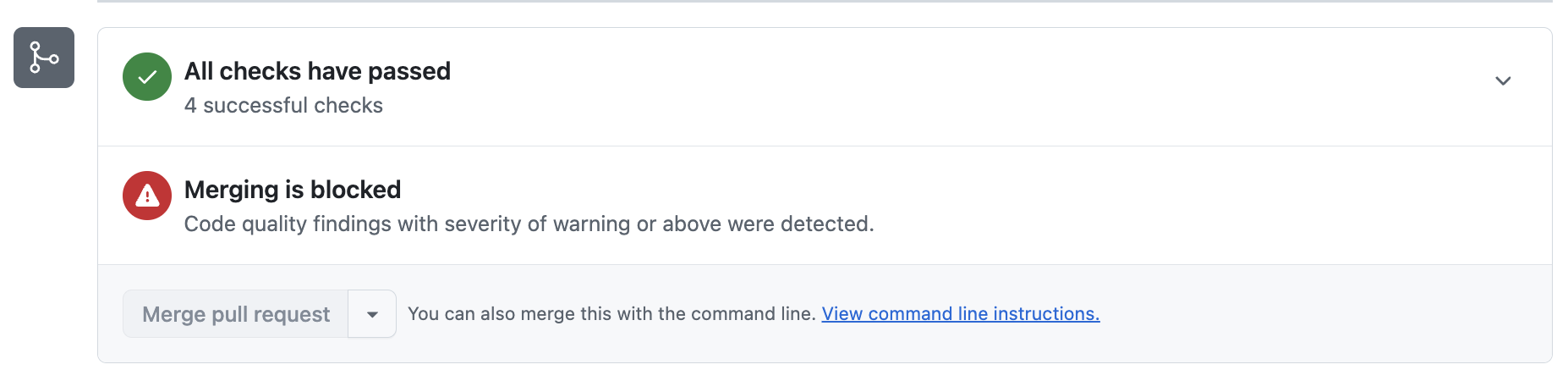
To see whether a gate is in effect, scroll to the Checks section at the bottom of the pull request. If your changes fall below the required threshold, you'll see a merge block banner: "Merging is blocked: Code quality findings were detected."
In our example the gate is set to "Warning and above", so the banner is present: the Error and the Warning are blocking the merge, and the Note is not. That tells you what you have to clear before this pull request can be merged. If the merge block banner doesn't specify a severity level, you must clear all findings in order to merge your pull request. Step 3: Resolve each findingFor every finding, decide whether it applies to your code and, if it does, how to fix it. That leads you to one of three actions.
Apply the practice to your own pull request, working in severity order. In our example:
Step 4: Confirm your pull request is unblocked (optional)If you do have blocking findings, once you've fixed or dismissed the relevant findings, return to the Checks section at the bottom of the pull request. In our example, with the Error and Warning findings resolved, the merge block banner disappears. Your pull request is now clear to merge. If the banner is still there, it means a finding at or above the blocking severity is still open. How this connects to the rest of your code healthThe pull request you just cleared is part of a bigger picture:
The healthiest teams combine all three: deliberate triage and remediation at the pull request stage, periodic backlog work, and enforced thresholds at the merge boundary. Troubleshooting
ConclusionIn this tutorial, you've worked through Code Quality comments on a pull request, used severity to prioritize remediation, and resolved each finding intentionally before merging your pull request. By treating each finding, and its autofix, as a small, in-context decision, you prevented code quality debt from reaching your default branch. Next steps
| ||||||||||||||||||||
| You are visitor 01402503 — GeezerVison does not store the pages you look up. Best viewed with Netscape Navigator 4.7 or Internet Explorer 6 at 800×600. No cookies required. |