GeezerVisonThe World Wide Web, restored to 800 pixels of glory. | |||||||||||||||
| Home|About|Gaming cabinet|Archives|How it works|Starter sites | |||||||||||||||
GeezerVison is showing docs.python.org — hashlib — Secure hashes and message digests
|
Hash |
digest_size |
len(key) |
len(salt) |
len(person) |
|---|---|---|---|---|
BLAKE2b |
64 |
64 |
16 |
16 |
BLAKE2s |
32 |
32 |
8 |
8 |
Note
BLAKE2 specification defines constant lengths for salt and personalization
parameters, however, for convenience, this implementation accepts byte
strings of any size up to the specified length. If the length of the
parameter is less than specified, it is padded with zeros, thus, for
example, b'salt' and b'salt\x00' is the same value. (This is not
the case for key.)
These sizes are available as module constants described below.
Constructor functions also accept the following tree hashing parameters:
fanout: fanout (0 to 255, 0 if unlimited, 1 in sequential mode).
depth: maximal depth of tree (1 to 255, 255 if unlimited, 1 in sequential mode).
leaf_size: maximal byte length of leaf (0 to
2**32-1, 0 if unlimited or in sequential mode).node_offset: node offset (0 to
2**64-1for BLAKE2b, 0 to2**48-1for BLAKE2s, 0 for the first, leftmost, leaf, or in sequential mode).node_depth: node depth (0 to 255, 0 for leaves, or in sequential mode).
inner_size: inner digest size (0 to 64 for BLAKE2b, 0 to 32 for BLAKE2s, 0 in sequential mode).
last_node: boolean indicating whether the processed node is the last one (
Falsefor sequential mode).
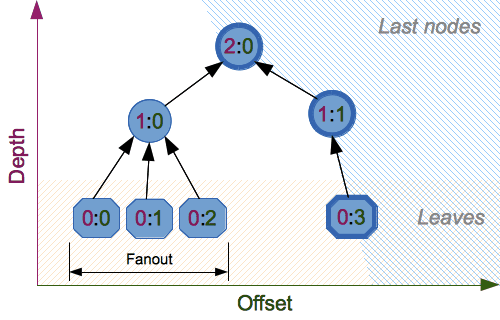
See section 2.10 in BLAKE2 specification for comprehensive review of tree hashing.
Constants
- blake2b.SALT_SIZE
- blake2s.SALT_SIZE
Salt length (maximum length accepted by constructors).
- blake2b.PERSON_SIZE
- blake2s.PERSON_SIZE
Personalization string length (maximum length accepted by constructors).
- blake2b.MAX_KEY_SIZE
- blake2s.MAX_KEY_SIZE
Maximum key size.
- blake2b.MAX_DIGEST_SIZE
- blake2s.MAX_DIGEST_SIZE
Maximum digest size that the hash function can output.
Examples
Simple hashing
To calculate hash of some data, you should first construct a hash object by
calling the appropriate constructor function (blake2b() or
blake2s()), then update it with the data by calling update() on the
object, and, finally, get the digest out of the object by calling
digest() (or hexdigest() for hex-encoded string).
>>> from hashlib import blake2b
>>> h = blake2b()
>>> h.update(b'Hello world')
>>> h.hexdigest()
'6ff843ba685842aa82031d3f53c48b66326df7639a63d128974c5c14f31a0f33343a8c65551134ed1ae0f2b0dd2bb495dc81039e3eeb0aa1bb0388bbeac29183'
As a shortcut, you can pass the first chunk of data to update directly to the constructor as the positional argument:
>>> from hashlib import blake2b
>>> blake2b(b'Hello world').hexdigest()
'6ff843ba685842aa82031d3f53c48b66326df7639a63d128974c5c14f31a0f33343a8c65551134ed1ae0f2b0dd2bb495dc81039e3eeb0aa1bb0388bbeac29183'
You can call hash.update() as many times as you need to iteratively
update the hash:
>>> from hashlib import blake2b
>>> items = [b'Hello', b' ', b'world']
>>> h = blake2b()
>>> for item in items:
...     h.update(item)
...
>>> h.hexdigest()
'6ff843ba685842aa82031d3f53c48b66326df7639a63d128974c5c14f31a0f33343a8c65551134ed1ae0f2b0dd2bb495dc81039e3eeb0aa1bb0388bbeac29183'
Using different digest sizes
BLAKE2 has configurable size of digests up to 64 bytes for BLAKE2b and up to 32 bytes for BLAKE2s. For example, to replace SHA-1 with BLAKE2b without changing the size of output, we can tell BLAKE2b to produce 20-byte digests:
>>> from hashlib import blake2b
>>> h = blake2b(digest_size=20)
>>> h.update(b'Replacing SHA1 with the more secure function')
>>> h.hexdigest()
'd24f26cf8de66472d58d4e1b1774b4c9158b1f4c'
>>> h.digest_size
20
>>> len(h.digest())
20
Hash objects with different digest sizes have completely different outputs (shorter hashes are not prefixes of longer hashes); BLAKE2b and BLAKE2s produce different outputs even if the output length is the same:
>>> from hashlib import blake2b, blake2s
>>> blake2b(digest_size=10).hexdigest()
'6fa1d8fcfd719046d762'
>>> blake2b(digest_size=11).hexdigest()
'eb6ec15daf9546254f0809'
>>> blake2s(digest_size=10).hexdigest()
'1bf21a98c78a1c376ae9'
>>> blake2s(digest_size=11).hexdigest()
'567004bf96e4a25773ebf4'
Keyed hashing
Keyed hashing can be used for authentication as a faster and simpler replacement for Hash-based message authentication code (HMAC). BLAKE2 can be securely used in prefix-MAC mode thanks to the indifferentiability property inherited from BLAKE.
This example shows how to get a (hex-encoded) 128-bit authentication code for
message b'message data' with key b'pseudorandom key':
>>> from hashlib import blake2b
>>> h = blake2b(key=b'pseudorandom key', digest_size=16)
>>> h.update(b'message data')
>>> h.hexdigest()
'3d363ff7401e02026f4a4687d4863ced'
As a practical example, a web application can symmetrically sign cookies sent to users and later verify them to make sure they weren’t tampered with:
>>> from hashlib import blake2b
>>> from hmac import compare_digest
>>>
>>> SECRET_KEY = b'pseudorandomly generated server secret key'
>>> AUTH_SIZE = 16
>>>
>>> def sign(cookie):
...     h = blake2b(digest_size=AUTH_SIZE, key=SECRET_KEY)
...     h.update(cookie)
...     return h.hexdigest().encode('utf-8')
>>>
>>> def verify(cookie, sig):
...     good_sig = sign(cookie)
...     return compare_digest(good_sig, sig)
>>>
>>> cookie = b'user-alice'
>>> sig = sign(cookie)
>>> print("{0},{1}".format(cookie.decode('utf-8'), sig))
user-alice,b'43b3c982cf697e0c5ab22172d1ca7421'
>>> verify(cookie, sig)
True
>>> verify(b'user-bob', sig)
False
>>> verify(cookie, b'0102030405060708090a0b0c0d0e0f00')
False
Even though there’s a native keyed hashing mode, BLAKE2 can, of course, be used
in HMAC construction with hmac module:
>>> import hmac, hashlib
>>> m = hmac.new(b'secret key', digestmod=hashlib.blake2s)
>>> m.update(b'message')
>>> m.hexdigest()
'e3c8102868d28b5ff85fc35dda07329970d1a01e273c37481326fe0c861c8142'
Randomized hashing
By setting salt parameter users can introduce randomization to the hash function. Randomized hashing is useful for protecting against collision attacks on the hash function used in digital signatures.
Randomized hashing is designed for situations where one party, the message preparer, generates all or part of a message to be signed by a second party, the message signer. If the message preparer is able to find cryptographic hash function collisions (i.e., two messages producing the same hash value), then they might prepare meaningful versions of the message that would produce the same hash value and digital signature, but with different results (e.g., transferring $1,000,000 to an account, rather than $10). Cryptographic hash functions have been designed with collision resistance as a major goal, but the current concentration on attacking cryptographic hash functions may result in a given cryptographic hash function providing less collision resistance than expected. Randomized hashing offers the signer additional protection by reducing the likelihood that a preparer can generate two or more messages that ultimately yield the same hash value during the digital signature generation process — even if it is practical to find collisions for the hash function. However, the use of randomized hashing may reduce the amount of security provided by a digital signature when all portions of the message are prepared by the signer.
(NIST SP-800-106 “Randomized Hashing for Digital Signatures”)
In BLAKE2 the salt is processed as a one-time input to the hash function during initialization, rather than as an input to each compression function.
Warning
Salted hashing (or just hashing) with BLAKE2 or any other general-purpose cryptographic hash function, such as SHA-256, is not suitable for hashing passwords. See BLAKE2 FAQ for more information.
>>> import os
>>> from hashlib import blake2b
>>> msg = b'some message'
>>> # Calculate the first hash with a random salt.
>>> salt1 = os.urandom(blake2b.SALT_SIZE)
>>> h1 = blake2b(salt=salt1)
>>> h1.update(msg)
>>> # Calculate the second hash with a different random salt.
>>> salt2 = os.urandom(blake2b.SALT_SIZE)
>>> h2 = blake2b(salt=salt2)
>>> h2.update(msg)
>>> # The digests are different.
>>> h1.digest() != h2.digest()
True
Personalization
Sometimes it is useful to force hash function to produce different digests for the same input for different purposes. Quoting the authors of the Skein hash function:
We recommend that all application designers seriously consider doing this; we have seen many protocols where a hash that is computed in one part of the protocol can be used in an entirely different part because two hash computations were done on similar or related data, and the attacker can force the application to make the hash inputs the same. Personalizing each hash function used in the protocol summarily stops this type of attack.
(The Skein Hash Function Family, p. 21)
BLAKE2 can be personalized by passing bytes to the person argument:
>>> from hashlib import blake2b
>>> FILES_HASH_PERSON = b'MyApp Files Hash'
>>> BLOCK_HASH_PERSON = b'MyApp Block Hash'
>>> h = blake2b(digest_size=32, person=FILES_HASH_PERSON)
>>> h.update(b'the same content')
>>> h.hexdigest()
'20d9cd024d4fb086aae819a1432dd2466de12947831b75c5a30cf2676095d3b4'
>>> h = blake2b(digest_size=32, person=BLOCK_HASH_PERSON)
>>> h.update(b'the same content')
>>> h.hexdigest()
'cf68fb5761b9c44e7878bfb2c4c9aea52264a80b75005e65619778de59f383a3'
Personalization together with the keyed mode can also be used to derive different keys from a single one.
>>> from hashlib import blake2s
>>> from base64 import b64decode, b64encode
>>> orig_key = b64decode(b'Rm5EPJai72qcK3RGBpW3vPNfZy5OZothY+kHY6h21KM=')
>>> enc_key = blake2s(key=orig_key, person=b'kEncrypt').digest()
>>> mac_key = blake2s(key=orig_key, person=b'kMAC').digest()
>>> print(b64encode(enc_key).decode('utf-8'))
rbPb15S/Z9t+agffno5wuhB77VbRi6F9Iv2qIxU7WHw=
>>> print(b64encode(mac_key).decode('utf-8'))
G9GtHFE1YluXY1zWPlYk1e/nWfu0WSEb0KRcjhDeP/o=
Tree mode
Here’s an example of hashing a minimal tree with two leaf nodes:
  10
 /  \
00  01
This example uses 64-byte internal digests, and returns the 32-byte final digest:
>>> from hashlib import blake2b
>>>
>>> FANOUT = 2
>>> DEPTH = 2
>>> LEAF_SIZE = 4096
>>> INNER_SIZE = 64
>>>
>>> buf = bytearray(6000)
>>>
>>> # Left leaf
... h00 = blake2b(buf[0:LEAF_SIZE], fanout=FANOUT, depth=DEPTH,
...               leaf_size=LEAF_SIZE, inner_size=INNER_SIZE,
...               node_offset=0, node_depth=0, last_node=False)
>>> # Right leaf
... h01 = blake2b(buf[LEAF_SIZE:], fanout=FANOUT, depth=DEPTH,
...               leaf_size=LEAF_SIZE, inner_size=INNER_SIZE,
...               node_offset=1, node_depth=0, last_node=True)
>>> # Root node
... h10 = blake2b(digest_size=32, fanout=FANOUT, depth=DEPTH,
...               leaf_size=LEAF_SIZE, inner_size=INNER_SIZE,
...               node_offset=0, node_depth=1, last_node=True)
>>> h10.update(h00.digest())
>>> h10.update(h01.digest())
>>> h10.hexdigest()
'3ad2a9b37c6070e374c7a8c508fe20ca86b6ed54e286e93a0318e95e881db5aa'
Credits
BLAKE2 was designed by Jean-Philippe Aumasson, Samuel Neves, Zooko Wilcox-O’Hearn, and Christian Winnerlein based on SHA-3 finalist BLAKE created by Jean-Philippe Aumasson, Luca Henzen, Willi Meier, and Raphael C.-W. Phan.
It uses core algorithm from ChaCha cipher designed by Daniel J. Bernstein.
The stdlib implementation is based on pyblake2 module. It was written by Dmitry Chestnykh based on C implementation written by Samuel Neves. The documentation was copied from pyblake2 and written by Dmitry Chestnykh.
The C code was partly rewritten for Python by Christian Heimes.
The following public domain dedication applies for both C hash function implementation, extension code, and this documentation:
To the extent possible under law, the author(s) have dedicated all copyright and related and neighboring rights to this software to the public domain worldwide. This software is distributed without any warranty.
You should have received a copy of the CC0 Public Domain Dedication along with this software. If not, see https://creativecommons.org/publicdomain/zero/1.0/.
The following people have helped with development or contributed their changes to the project and the public domain according to the Creative Commons Public Domain Dedication 1.0 Universal:
Alexandr Sokolovskiy
See also
- Module
hmac A module to generate message authentication codes using hashes.
- Module
base64 Another way to encode binary hashes for non-binary environments.
- https://nvlpubs.nist.gov/nistpubs/fips/nist.fips.180-4.pdf
The FIPS 180-4 publication on Secure Hash Algorithms.
- https://csrc.nist.gov/pubs/fips/202/final
The FIPS 202 publication on the SHA-3 Standard.
- https://www.blake2.net/
Official BLAKE2 website.
- https://en.wikipedia.org/wiki/Cryptographic_hash_function
Wikipedia article with information on which algorithms have known issues and what that means regarding their use.
- https://www.ietf.org/rfc/rfc8018.txt
PKCS #5: Password-Based Cryptography Specification Version 2.1
- https://nvlpubs.nist.gov/nistpubs/Legacy/SP/nistspecialpublication800-132.pdf
NIST Recommendation for Password-Based Key Derivation.
This page is licensed under the Python Software Foundation License Version 2.
Examples, recipes, and other code in the documentation are additionally licensed under the Zero Clause BSD License.
See History and License for more information.
The Python Software Foundation is a non-profit corporation. Please donate.
Last updated on Nov 12, 2026 (08:53 UTC). Found a bug?
Created using Sphinx 9.1.1.
Best viewed with Netscape Navigator 4.7 or Internet Explorer 6 at 800×600. No cookies required.