GeezerVisonThe World Wide Web, restored to 800 pixels of glory. |
| Home|About|Gaming cabinet|Archives|How it works|Starter sites |
GeezerVison is showing docs.voltdb.com — 5.5. Controlling How Memory is Allocated Documentation5.5. Controlling How Memory is AllocatedDespite the fact that you as a developer or database administrator cannot control when temporary
storage is allocated and freed, you can control how much memory is used. Java provides a way to specify
the size of the heap, the portion of memory the JVM uses to store runtime data such as class instances, arrays, etc. The
By setting both the Figure 5.3. Controlling the Java Heap Size 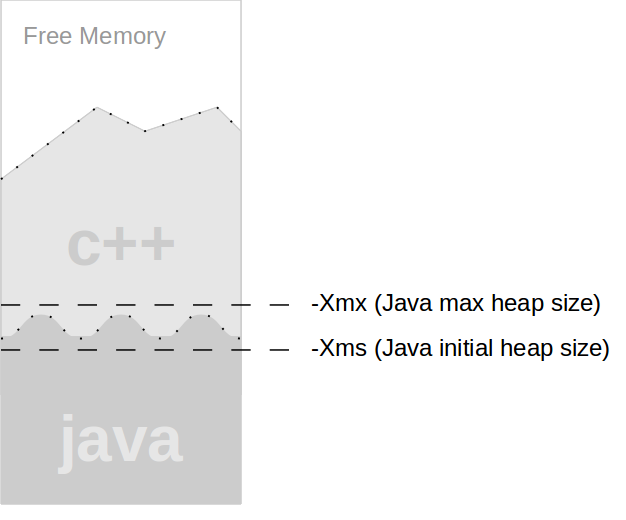 However, you must be careful when setting the values for the Java heap size, since the JVM will not exceed the value you set as a maximum. It is possible, under some conditions, to force a Java out-of-memory error if the maximum heap size is not large enough for the temporary storage VoltDB requires. See the VoltDB Planning Guide for recommendations on calculating the appropriate heap size for your specific application. Remember, temporary storage is used to queue the procedure requests and responses. If you are using synchronous procedures calls (and therefore little or no queuing on the server) a small heap size is acceptable. Also, if the size of the procedure invocations (in terms of the arguments passed into the procedures) and the return values are small, a lower heap size is acceptable. But if you are invoking procedures asynchronously with large argument lists or return values, be very careful when setting a low maximum heap size. |
| You are visitor 01402775 — GeezerVison does not store the pages you look up. Best viewed with Netscape Navigator 4.7 or Internet Explorer 6 at 800×600. No cookies required. |