GeezerVisonThe World Wide Web, restored to 800 pixels of glory. |
| Home|About|Gaming cabinet|Archives|How it works|Starter sites |
GeezerVison is showing docs.voltdb.com — Chapter 13. Exporting Live Data DocumentationChapter 13. Exporting Live DataVoltDB is an in-memory, transaction processing database. It excels at managing large volumes of transactions in real-time. However, transaction processing is often only one aspect of the larger business context and data needs to transition from system to system as part of the overall solution. The process of moving from one database to another as data moves through the system is often referred to as Extract, Transform, and Load (ETL). VoltDB supports ETL through the ability to selectively export data as it is committed to the database. Exporting differs from save and restore (as described in Chapter 9, Saving & Restoring a VoltDB Database) in several ways:
The target for exporting data from VoltDB may be another database, a repository (such as a sequential log file), or a process (such as a system monitor or accounting system). No matter what the target, VoltDB helps automate the process for you. This chapter explains how to plan for and implement the exporting of live data using VoltDB. 13.1. Understanding ExportVoltDB lets you automate the export process by specifying certain tables in the schema as sources for export. At runtime, any data written to the specified tables is sent to the selected export connector, which queues the data for export. Then, asynchronously, the connector sends the queued export data to the selected output target. Which export connector runs depends on the target you choose when configuring export in the deployment file. Currently, VoltDB provides connectors for exporting to files, for exporting to other business processes via a distributed message queue, and for exporting to other databases via JDBC. The connector processes are managed by the database servers themselves, helping to distribute the work and ensure maximum throughput. Figure 13.1, “Overview of the Export Process” illustrates the basic export procedure, where Tables B and D are specified as export tables. Figure 13.1. Overview of the Export Process 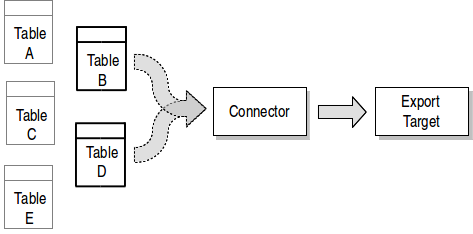 Note that you do not need to modify the schema or the client application to turn exporting of live data on and off. The application's stored procedures insert data into the export-only tables; but it is the deployment file that determines whether export actually occurs at runtime. When a stored procedure uses an SQL INSERT statement to write data into an export-only table, rather than storing that data in the database, it is handed off to the connector when the stored procedure successfully commits the transaction.[4] Export-only tables have several important characteristics:
Of course, there are restrictions to export-only tables. Since they have no storage associated with them, they are for INSERT only. Any attempt to SELECT, UPDATE, or DELETE export-only tables will result in an error when the project is compiled. [4] There is no guarantee on the latency of export between the connector and the export target. The export function is transactionally correct; no export occurs if the stored procedure rolls back and the export data is in the appropriate transaction order. But the flow of export data from the connector to the target is not synchronous with the completion of the transaction. There may be several seconds delay before the export data reaches the target. |
| You are visitor 01402775 — GeezerVison does not store the pages you look up. Best viewed with Netscape Navigator 4.7 or Internet Explorer 6 at 800×600. No cookies required. |