GeezerVisonThe World Wide Web, restored to 800 pixels of glory. | ||||||||
| Home|About|Gaming cabinet|Archives|How it works|Starter sites | ||||||||
GeezerVison is showing dorverbin.github.io — Ref-NeRF: Structured View-Dependent Appearance for Neural Radiance Fields
Ref-NeRF: Structured View-Dependent
|
|
Dor Verbin
Harvard University Google Research |
Peter Hedman
Google Research |
Ben Mildenhall
Google Research |
|
Todd Zickler
Harvard University |
Jonathan T. Barron
Google Research |
Pratul P. Srinivasan
Google Research |




Abstract
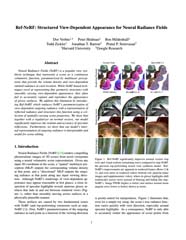
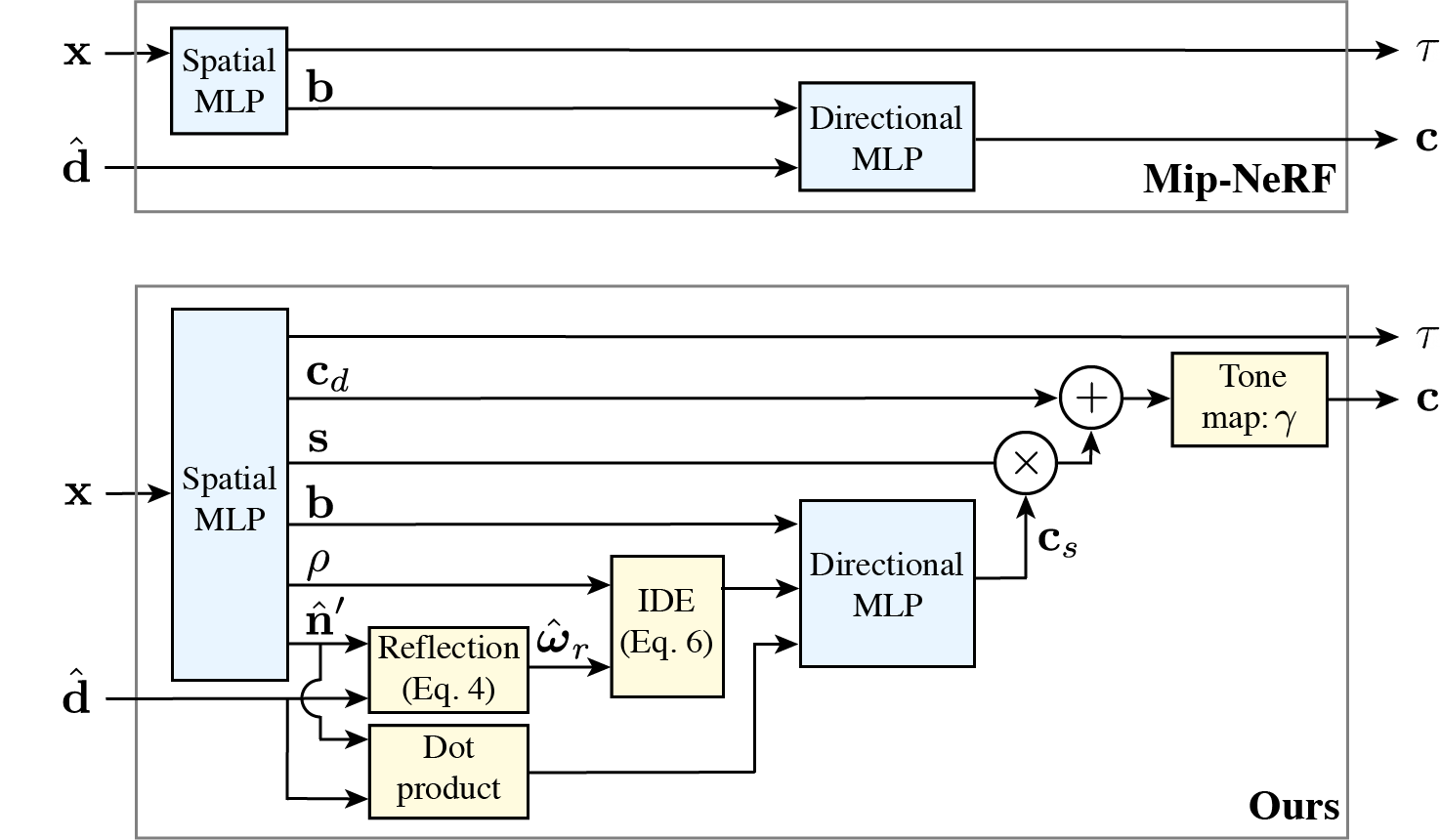
Neural Radiance Fields (NeRF) is a popular view synthesis technique that represents a scene as a continuous volumetric function, parameterized by multilayer perceptrons that provide the volume density and view-dependent emitted radiance at each location. While NeRF-based techniques excel at representing fine geometric structures with smoothly varying view-dependent appearance, they often fail to accurately capture and reproduce the appearance of glossy surfaces. We address this limitation by introducing Ref-NeRF, which replaces NeRF's parameterization of view-dependent outgoing radiance with a representation of reflected radiance and structures this function using a collection of spatially-varying scene properties. We show that together with a regularizer on normal vectors, our model significantly improves the realism and accuracy of specular reflections. Furthermore, we show that our model's internal representation of outgoing radiance is interpretable and useful for scene editing.
Video
Reflection Direction Parameterization
Integrated Directional Encoding

Additional Synthetic Results
Results on Captured Scenes
Our method also produces accurate renderings and surface normals from captured photographs:Scene Editing
We can increase and decrease material roughness:
Citation
Acknowledgements
We would like to thank Lior Yariv and Kai Zhang for helping us evaluate their methods, and Ricardo Martin-Brualla for helpful comments on our text. DV is supported by the National Science Foundation under Cooperative Agreement PHY-2019786 (an NSF AI Institute, http://iaifi.org)
The website template was borrowed from Michaël Gharbi.
Best viewed with Netscape Navigator 4.7 or Internet Explorer 6 at 800×600. No cookies required.