GeezerVisonThe World Wide Web, restored to 800 pixels of glory. | ||||||||||||||||||||||||||||||||||||||||||||||||||||||||||||||||||||||||||||||||||||||||||||||||||||||||||||||||||||||||||||||||||||||||||||||||||||||||||||||||||||||||||||||||||||||||||||||||||||||||||||||||||||||||||||||||||||||||||||||||||||||||||||||||||||||||||||||||||||||||||||||||||||||||||||||||||||||||||||||||||||||||||||||||||||||||||||||||||||||||||||||||||||||||||||||||||||||||||||||||||||||||||||||||||||||||||||||||||||||||||||||||||||||||||||||||||||||||||||||||||||||||||||||||||||||||||||||||||||||||||||||||||||||||||||||||||||||||||||||||||||||||||||||||||||||||||||||||||||||||||||||||||||||||||
| Home|About|Gaming cabinet|Archives|How it works|Starter sites | ||||||||||||||||||||||||||||||||||||||||||||||||||||||||||||||||||||||||||||||||||||||||||||||||||||||||||||||||||||||||||||||||||||||||||||||||||||||||||||||||||||||||||||||||||||||||||||||||||||||||||||||||||||||||||||||||||||||||||||||||||||||||||||||||||||||||||||||||||||||||||||||||||||||||||||||||||||||||||||||||||||||||||||||||||||||||||||||||||||||||||||||||||||||||||||||||||||||||||||||||||||||||||||||||||||||||||||||||||||||||||||||||||||||||||||||||||||||||||||||||||||||||||||||||||||||||||||||||||||||||||||||||||||||||||||||||||||||||||||||||||||||||||||||||||||||||||||||||||||||||||||||||||||||||||
GeezerVison is showing drafts.csswg.org (truncated) — CSS Fonts Module Level 4 1. IntroductionThis specification includes and expands on the basic font features described in the CSS3 Fonts specification ([CSS-FONTS-3]). 1.1. Value DefinitionsThis specification follows the CSS property definition conventions from [CSS2] using the value definition syntax from [CSS-VALUES-3]. Value types not defined in this specification are defined in CSS Values & Units [CSS-VALUES-3]. Combination with other CSS modules may expand the definitions of these value types. In addition to the property-specific values listed in their definitions, all properties defined in this specification also accept the CSS-wide keywords as their property value. For readability they have not been repeated explicitly. 1.2. Interaction With Font-Relative UnitsThe following properties defined in this specification are font-affecting properties:
Note: Some properties that can affect the size of text are not font-affecting properties, because they do so via font shaping, which the font-relative lengths explicitly do not take into account. 2. Basic Font PropertiesThe particular font face used to render a character is determined by the font family and other font properties that apply to a given element. This structure allows settings to be varied independently of each other. 2.1. Font family: the font-family property
Tests
This property specifies a prioritized list of font family names or generic family names. A font family defines a set of faces that vary in weight, width or slope. CSS uses the combination of a family name with other font properties to select an individual face. Using this selection mechanism, rather than selecting a face via the style name as is often done in design applications, allows some degree of regularity in textual display when fallback occurs. Component values are a comma-separated list indicating alternatives. A user agent iterates through the list of family names until it matches an available font that contains a glyph for the character to be rendered. (See § 5.3 Cluster matching.) This allows for differences in available fonts across platforms and for differences in the range of characters supported by individual fonts. body If Helvetica is available, it will be used when rendering. If neither Helvetica nor Verdana is present, then the generic font-family sans-serif font will be used. There are three types of font family names, two of which may be used with this property:
2.1.1. Syntax of <font-family-name><font-family-name> = <string> | <custom-ident>+ Font family names other than generic families or system font families must either be given quoted as <string>s, or unquoted as a sequence of one or more <custom-ident>. Note: This means most punctuation characters and digits at the start of each token must be escaped in unquoted font family names.
To illustrate this, the following declarations are invalid:
Any identifier which could be misinterpreted as a pre-defined keyword in the font-family value definition, or the CSS-wide keywords, is not allowed. Note: this means that if you really have a font whose name is the same as one of the <generic-font-family> names, or the system font names, or the CSS-wide keywords, it must be quoted.
To illustrate this,
the following unusual font family names are valid
because they are quoted:
If a sequence of identifiers is given as a <font-family-name>, the computed value is the name converted to a string by joining all the identifiers in the sequence by single spaces. To avoid mistakes in escaping, it is recommended to quote font family names that contain white space, digits, or punctuation characters other than hyphens:
Quoting font families prevents escaping mistakes.
body Font family names that happen to be the same as a font-family keyword value (e.g. CSS-wide keywords such as inherit, or <generic-font-family> keywords such as serif) must be quoted to prevent confusion with the keywords of the same names. UAs must not consider these keywords as matching the <font-family-name> type. 2.1.2. Syntax of <generic-font-family><generic-font-family> = <generic-font-script-specific>| <generic-font-complete> | <generic-font-incomplete> <generic-font-script-specific> = To make the syntax less succeptible to clashes, more recently defined generic font families are identified using a functional syntax. body The first choice in this example is a specific, named font, in Fang Song (仿宋) style. The family name is enclosed in quotes as it contains space characters. The second is a recently added script-specific generic font; it is unicode-range specific and so may not match to an actual installed font on some systems; but if it exists it will be an example of the requested style. The third is a universal generic font, which is guaranteed to match on all systems. 2.1.3. Syntax of <system-font-family-name><system-font-family-name> = caption | icon | menu | message-box | small-caption | status-bar 2.1.4. Relationship Between Faces and FamiliesA font family name only specifies a name given to a set of font faces; it does not specify an individual face.
For example, given the availability of the fonts below,
Futura would match but Futura Medium would not:

Note: The CSS definition of font attributes used for selection are explicitly not intended to define a font taxonomy. A type designer’s idea of a family can often extend to a set of faces that vary along axes other than just the standard axes of weight (font-weight), width (font-width), and slant (font-style). A family can vary along axes that are unique to that family. The CSS font selection mechanism merely provides a way to determine the “closest” match when substitution is necessary. Note: The precise way a set of fonts are grouped into font families varies depending upon the platform font management APIs. For example, the Windows GDI API only allows four faces to be grouped into a family, while the DirectWrite API, Core Text API, and other platforms support font families with a variety of weights, widths, and slopes (see Appendix A: Mapping platform font properties to CSS properties for more details). See § 5.1 Localized name matching below for information on how font-family names are matched. 2.1.5. Generic font familiesA generic font family is a font family which has a standard name (as defined by CSS), but which is an alias for an existing installed font family present on the system. However, a single generic font family may be a composite face combining different typefaces based on such things as the Unicode range of the character, the content language of the containing element, user preferences, system settings, etc. Different generic font families may map to the same used font. TestsNote: Generic font families are intended to be widely implemented on many platforms, unlike arbitrary <font-family-name>s which are usually platform-specific names. They are expected to map to different fonts on different platforms. Authors may specify these generic family names if they desire their text to follow a particular design on many platforms, and are not particular about which specific font is chosen on those platforms. User agents should provide reasonable default choices for the generic font families, that express the characteristics of each family as well as possible, within the limits allowed by the underlying technology. User agents are encouraged to allow users to select alternative faces for the generic font families.
2.2. Font weight: the font-weight property
Tests
The font-weight property specifies the weight of glyphs in the font, their degree of blackness, or stroke thickness. This property accepts values of the following: <font-weight-absolute> = Values have the following meanings:
Font formats that use a scale other than a nine-step scale should map their scale onto the CSS scale so that 400 roughly corresponds with a face that would be labeled as Regular, Book, Roman and 700 roughly matches a face that would be labeled as Bold. Alternately, weights may be inferred from style names that correspond roughly with the scale above. The scale is relative, so a face with a larger weight value must never appear lighter. If style names are used to infer weights, care should be taken to handle variations in style names across locales. 2.2.1. Relative WeightsSpecified values of bolder and lighter indicate weights relative to the weight of the parent element. The computed weight is calculated based on the inherited font-weight value using the chart below.
Note: The table above is equivalent to selecting the next relative bolder or lighter face, given a font family containing normal and bold faces along with a thin and a heavy face. Authors who desire finer control over the exact weight values used for a given element can use numerical values instead of relative weights. 2.2.2. Missing weightsQuite often there are only a few weights available for a particular font family. When a weight is specified for which no face exists, a face with a nearby weight is used. In general, bold weights map to faces with heavier weights and light weights map to faces with lighter weights. (See the § 5 Font Matching Algorithm for a precise definition.)
The examples here illustrate which face is used for different weights.
Grey indicates that a face for the desired weight does not exist, so a face with a nearby weight is used.


Most user agents model a font as having a particular weight
which often corresponds to one of the numbers in the nine-step scale
described above.
While this is true of most fonts, some fonts might be configurable so as to support a range of weights.
In this situation, the user agent uses a face with a weight as close as possible to the weight requested
(see § 5 Font Matching Algorithm for the precise algorithm).
In particular, a user agent using a font which supports a range of weights
should behave the same as if a font is present at each individual weight in the range.
For TrueType / OpenType fonts that use variations,
the Although the practice is not well-loved by typographers, bold faces are often synthesized by user agents for families that lack actual bold faces. For the purposes of font matching, these faces must be treated as if they exist within the family. Authors can explicitly avoid this behavior by using the font-synthesis property. 2.3. Font width: the font-width property
Tests
The font-width property selects a normal, condensed, or expanded face from a font family. Values are specified either as percentages or as keywords which map to a percentage as defined in the following table:
<percentage [0,∞]> values represent the fractional width of the glyphs, with 100% representing “normal” glyph widths (as defined by the font designer). Values less than 0% are invalid. When a face does not exist for a given width,
values less than 100% map to a narrower face if one exists, otherwise a wider face.
Conversely, values greater than or equal to 100% map to a wider face if one exists, otherwise a narrower face.
Some fonts might support a range of width values;
if the requested width value is not available in the font,
the closest supported value is used, using the same mapping rules
(see the § 5 Font Matching Algorithm for the precise algorithm).
For TrueType / OpenType fonts that support variations,
the
The figure below shows how nine font-width property settings
affect font matching for a font family containing a variety of discrete widths.
Grey indicates a width for which no face exists and a different width is substituted:

2.3.1. Font width: the font-stretch legacy name aliasFor historical reasons, a font-stretch property exists which is a legacy name alias and functions in the identical way to the font-width.
For example, here the legacy font-stretch is used
on level one headings.
h1 The specified value of the font-width on those headings becomes set to condensed'.
For example, here the font-width is used
on level one headings.
h1 The specified value of the font-stretch on those headings becomes set to condensed. Tests
User agents must not synthesize condensed or expanded faces for font families which lack such faces and which do not have a width variation axis. In particular, user agents must not geometrically stretch such faces. 2.4. Font style: the font-style property
Tests
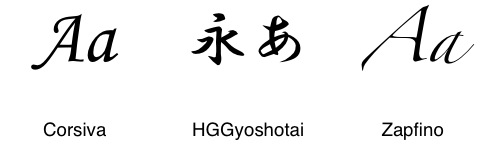
The font-style property allows italic or oblique faces to be selected. Italic forms are generally cursive in nature while oblique faces are typically sloped versions of the regular face.
Compare the artificially sloped renderings of Palatino "a" and Baskerville "N" in grey
with the actual italic versions:

Values have the following meanings:

A font family might contain no italic or oblique faces,
only an italic face and no oblique,
only an oblique face and no italic,
both an oblique and an italic,
multiple oblique faces at various angles,
or various combinations thereof.
The font matching routine will select a font to use
which is of the correct sign as the requested angle,
and (if there are multiple such faces) closest to the requested angle.
In general, for a requested angle greater or equal to 11deg,
larger angles are preferred;
otherwise, smaller angles are preferred.
(See § 5 Font Matching Algorithm.)
For TrueType / OpenType fonts that use variations,
the Note: the OpenType What direction should positive and negative obliques skew in vertical writing mode? How do we achieve skews in the opposite dimension (needed for vertical writing)? If no italic or oblique face is available, oblique faces may be synthesized by rendering non-obliqued faces with an artificial obliquing operation. The use of these artificially obliqued faces can be disabled using the font-synthesis property. Note: While oblique faces can be simulated by artificially sloping the glyphs of the regular face, this is not equivalent to a true oblique, in which optical stroke thicknesses are properly preserved despite the slant. It is always better to use an actual oblique font rather than rely on a synthetic version. For the purposes of font matching, User agents may treat italic as a synonym for oblique. For user agents that treat these values distinctly, synthesis must not be performed for italic. Note: Authors should also be aware that synthesized approaches might not be suitable for scripts like Cyrillic, where italic forms are very different in shape. It is always better to use an actual italic font rather than rely on a synthetic version. Note: Many scripts lack the tradition of mixing a cursive form within text rendered with a normal face. Chinese, Japanese and Korean fonts almost always lack italic or oblique faces. Fonts that support a mixture of scripts will sometimes omit specific scripts, such as Arabic, from the set of glyphs supported in the italic face. User agents should be careful about making character map assumptions across faces when implementing synthesis across fonts, as italic faces in a family can have different character maps than Roman faces. 2.5. Font size: the font-size property
Tests
This property indicates the desired height of glyphs from the font. For scalable fonts, the font-size is a scale factor applied to the EM unit of the font. For non-scalable fonts, the font-size is converted into absolute units and matched against the declared font-size of the font, using the same absolute coordinate space for both of the matched values. Note: There is no requirement on how closely a glyph should fit its EM box. Individual fonts can have a different apparent visual size when rendered at the same font-size. Additionally, glyphs might render arbitrarily far outside their EM box; and if they overflow their containing block can induce ink overflow. Values have the following meanings:
The following style sheet demonstrates
various ways of specifying the font size.
p Note: The used value of this property can differ from its computed value due to font-size-adjust. However, child elements inherit the computed font-size value, which is not affected by font-size-adjust (otherwise, the effect of font-size-adjust would compound). The actual value of this property can differ from the used value due to the unavailability of certain font sizes. 2.5.1. Absolute Size Keyword Mapping TableThe following table provides user agent guidelines for the absolute-size scaling factor and their mapping to HTML heading and absolute font-sizes. The medium value is used as the reference middle value. The user agent may fine-tune these values for different fonts or different types of display devices.
Note: In CSS1, the suggested scaling factor between adjacent indexes was 1.5, which user experience proved to be too large. In CSS2, the suggested scaling factor for computer screen between adjacent indexes was 1.2 which still created issues for the small sizes. The new scaling factor varies between each index to provide a better readability. To preserve readability, an UA applying these guidelines should nevertheless avoid creating font sizes of less than 9 device pixels per EM unit. 2.6. Relative sizing: the font-size-adjust property
Tests
For any given font size, the apparent size and effective legibility of text varies across fonts. For bicameral scripts such as Latin or Cyrillic that distinguish between upper and lowercase letters, the relative height of lowercase letters compared to their uppercase counterparts is a determining factor of legibility. This is commonly referred to as the aspect value and is equal to the x-height of a font divided by the font size. Note: For text which uses diacritics, too large an x-height will actually decrease legibility as the diacritics become cramped. In situations where font fallback occurs, fallback fonts might not share the same aspect value as the desired font family and will thus be less readable. The font-size-adjust property is a way to preserve the readability of text when font fallback occurs. It does this by adjusting the font-size so that the x-height is the same regardless of the font used.
The style defined below defines Verdana as the desired font family,
but if Verdana is not available Futura or Times will be used.
One paragraph also has font-size-adjust specified.
p Verdana has a relatively high aspect value of 0.545, meaning lowercase letters are relatively tall compared to uppercase letters, so at small sizes text appears legible. Times has a lower aspect value of 0.447, and so if fallback occurs, the text will be less legible at small sizes than Verdana unless font-size-adjust is also specified. How text rendered in each of these fonts compares is shown below, the columns show text rendered in Verdana, Futura and Times. The same font-size value is used across cells within each row and red lines are included to show the differences in x-height. In the upper half, each row is rendered in the same font-size value. The same is true for the lower half, but in this half the font-size-adjust property is also set to 0.545, so that the actual font size is adjusted to preserve the x-height of Verdana across each row. Note how small text remains relatively legible across each row in the lower half. 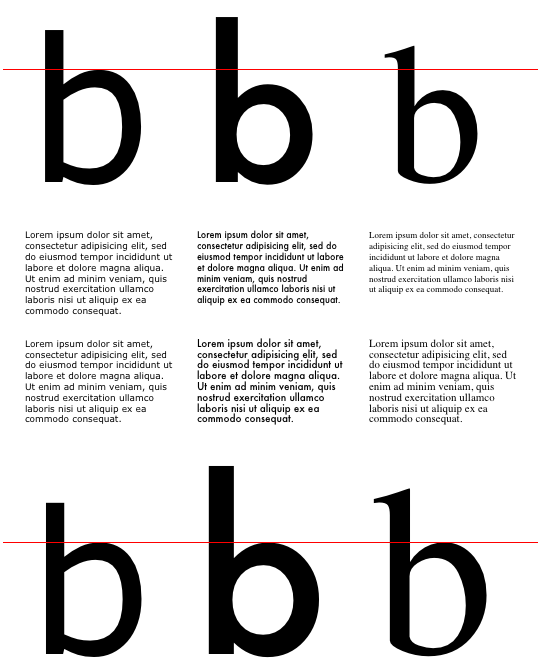
This property allows authors to specify an aspect value for an element that will effectively preserve the x-height of the first choice font, whether it is substituted or not. Values have the following meanings:
The value of font-size-adjust affects the used value of font-size
but does not affect the computed value.
It affects the size of relative units
that are based on font metrics
such as Note: In CSS, authors often specify line-height as a multiple of the font-size. Since the font-size-adjust property affects the used value of font-size, authors should take care setting the line height when font-size-adjust is used. Setting the line height too tightly can result in overlapping lines of text in this situation.
Authors can calculate the aspect value for a given font
by comparing spans with the same content
but different font-size-adjust properties.
If the same font-size is used, the spans will match
when the font-size-adjust value is accurate for the given font.
Two spans with borders are used to determine the aspect value of a font. The font-size is the same for both spans but the font-size-adjust property is specified only for the right span. Starting with a value of 0.5, the aspect value can be adjusted until the borders around the two letters line up. p 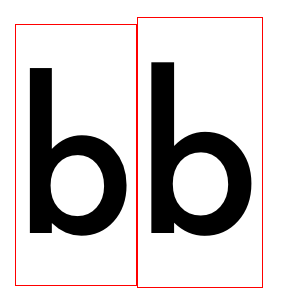
The box on the right is a bit bigger than the one on the left, so the aspect value of this font is something less than 0.5. Adjust the value until the boxes align. 2.7. Shorthand font property: the font property
Tests
The syntax of this property is based on a traditional typographical shorthand notation to set multiple properties related to fonts. For historical and backwards-compatibility reasons, it is almost a shorthand property. The font property is, except as described below, a shorthand property for setting font-style, font-variant, font-weight, font-width, font-size, line-height, font-family at the same place in the stylesheet. Values for the font-variant property can also be included but only those supported in CSS 2.1; none of the font-variant values added in CSS Fonts Levels 3 or 4 can be used in the font shorthand: <font-variant-css2> = normal | small-caps Values for the font-width property can also be included but only those supported in CSS Fonts level 3, none of the font-width values added in this specification can be used in the font shorthand: <font-width-css3> = normal | ultra-condensed | extra-condensed | condensed | semi-condensed | semi-expanded | expanded | extra-expanded | ultra-expanded Therefore we have the following classification of font-related properties and their interaction with the font property:
All subproperties of the font property in the Set Explicitly and Reset Implicitly groups are first reset to their initial values. Then, those properties the Set Explicitly group that are given explicit values in the font shorthand are set to those values. For a definition of allowed and initial values, see the individual longhand property definitions. p In the second rule, the font size percentage value ("80%") refers to the computed font-size of the parent element. In the third rule, the line height percentage ("110%") refers to the font size of the element itself. The first three rules do not specify the font-variant and font-weight explicitly, so these properties receive their initial values (normal). Notice that the font family name "new century schoolbook", which contains spaces, is enclosed in quotes. The fourth rule sets the font-weight to bold, the font-style to italic, and implicitly sets font-variant to normal. The fifth rule sets the font-variant (small-caps), the font-size (120% of the parent’s font size), the line-height (120% of the font size) and the font-family (fantasy). It follows that the keyword normal applies to the two remaining properties: font-style and font-weight. The sixth rule sets the font-style, font-width, font-size, and font-family, the other font properties being set to their initial values. The seventh rule sets font-style to oblique 25deg, font-weight to 753, and font-width to condensed. Note that the 25deg in this rule must be immediately following the "oblique" keyword. Since the font-width property was not defined in CSS 2.1, when using font-width values within font rules, authors should include a extra version compatible with older user agents: p System fonts can only be set as a whole; that is, the font family, size, weight, style, etc. are all set at the same time. These values can then be altered individually if desired. If no font with the indicated characteristics exists on a given platform, the user agent should either intelligently substitute (e.g., a smaller version of the caption font might be used for the small-caption font), or substitute a user agent default font. As for regular fonts, if, for a system font, any of the individual properties are not part of the operating system’s available user preferences, those properties should be set to their initial values. That is why this property is "almost" a shorthand property: system fonts can only be specified with this property, not with font-family itself, so font allows authors to do more than the sum of its subproperties. However, the individual properties such as font-weight are still given values taken from the system font, which can be independently varied. Note that the keywords used for the system fonts listed above are only treated as keywords when they occur in the initial position, in other positions the same string is treated as part of the font family name:
button If the font used for dropdown menus on a particular system happened to be, for example, 9-point Charcoal, with a weight of 600, then P elements that were descendants of BUTTON would be displayed as if this rule were in effect: button p Because the font shorthand resets to its initial value any property not explicitly given a value, this has the same effect as this declaration: button p 2.8. Controlling synthetic facesSynthetic font faces are a fallback strategy to provide an approximation to the requested font when a font family lacks a suitable face.
For example, a user agent might:
Synthesis is a fallback strategy because the end result, while perhaps better than nothing at all, does not meet the level of quality of a face designed for the purpose. Variable fonts, where the font designer has provided one or more axes of variation do not count as font synthesis and their use is not affected by the font-synthesis property. 2.8.1. Controlling synthesized bold: The font-synthesis-weight property
Tests
This property controls whether user agents are allowed to synthesize bold font faces when a font family lacks bold faces.
2.8.2. Controlling synthesized oblique: The font-synthesis-style property
Tests
This property controls whether user agents are allowed to synthesize oblique font faces when a font family lacks oblique faces.
In vertical text, for positive oblique angles, the glyph is skewed such that the line-over edge shifts towards the line-right side while the line-under edge shifts towards the line-left side. For negative oblique angles, the glyph is skewed such that the line-over edge shifts towards the line-left side while the line-under edge shifts towards the line-right side. Skewing is about the center of the glyph. 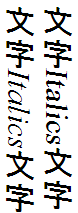
2.8.3. Controlling synthesized small caps: The font-synthesis-small-caps property
Tests
This property controls whether user agents are allowed to synthesize small caps font faces when a font family lacks small caps faces.
2.8.4. Controlling synthesized super- and subscripts: The font-synthesis-position property
TestsThis property controls whether user agents are required to synthesize superscript and subscript glyphs for font-variant-position when a font lacks them.
2.8.5. Controlling synthetic faces: the font-synthesis shorthand
Tests
This property is a shorthand for the font-synthesis-weight, font-synthesis-style, font-synthesis-small-caps, and font-synthesis-position properties. Values are mapped as following:
The style rule below disables the use of synthetically obliqued Arabic:
*:lang 3. Font Rendering Controls3.1. Introduction to Font Rendering ControlsWhen using downloadable Web Fonts via @font-face, the user agent needs to know what to do while the font is actively loading. Most web browsers have adopted some form of timeout:
While these default behaviors are reasonable, they’re unfortunately inconsistent across browsers. Worse, no single approach is sufficient to cover the range of use-cases required by modern user-experience– and performance–conscious applications. The Font Loading API [CSS-FONT-LOADING-3] allows a developer to override some of the above behaviors, but that requires scripting, a non-trivial amount of effort, and ultimately doesn’t provide sufficient hooks to cover all reasonable cases. Additionally, the developer needs to either inline the loading script into their page or load an external library, introducing additional network latency before the fonts can be loaded and delaying text rendering. Design/performance-conscious web developers have a good sense for the relative importance of a given Web Font for the intended user experience. This specification provides them the ability to control font timeout and rendering behavior. Specifically, it lets developers:
3.2. The Font Display TimelineAt the moment the user agent first attempts to use a given downloaded font face on a page, the font face’s font download timer is started. This timer advances through three periods of time associated with the font face—the block period, the swap period, and the failure period—which dictate the rendering behavior of any elements using the font face:
To render with a fallback font face for a given element, the user agent must find the first font face specified in the element’s font-family list which is already loaded, and use that for rendering text. Doing this must not trigger loads of any of the fallback fonts. To render with an invisible fallback font face for a given element, find a font face as per "render with a fallback font face". Create an anonymous font face with the same metrics as the selected font face but with all glyphs "invisible" (containing no "ink"), and use that for rendering text. Doing this must not trigger loads of any of the fallback fonts. fallback and optional can result in some faces in a family being used while others are required to fallback, giving a "ransom note" look. Perhaps require that all fonts in a family have the same behavior (all swapped in, or all fallback)? See also the @font-feature-values for controlling the behavior on a font family basis. 4. Font Resources4.1. The @font-face ruleThe @font-face rule allows for linking to fonts that are automatically fetched and activated when needed. This allows authors to select a font that closely matches the design goals for a given page rather than limiting the font choice to a set of fonts available on a given platform. A set of font descriptors define the location of a font resource, either locally or externally, along with the style characteristics of an individual face. Multiple @font-face rules can be used to construct font families with a variety of faces. Using CSS font matching rules, a user agent can selectively download only those faces that are needed for a given piece of text. Its syntax is:
TestsThe @font-face rule accepts the descriptors defined in this specification. Each @font-facerule specifies a value for every font descriptor, either implicitly or explicitly. Those not given explicit values in the rule take the initial value listed with each descriptor in this specification. These descriptors apply solely within the context of the @font-face rule in which they are defined, and do not apply to document language elements. There is no notion of which elements the descriptors apply to or whether the values are inherited by child elements. When a given descriptor occurs multiple times in a given @font-face rule, only the last descriptor declaration is used and all prior declarations for that descriptor are ignored.
To use a downloadable font called Gentium:
The user agent will download Gentium and use it when rendering text within paragraph elements. If for some reason the site serving the font is unavailable, the default serif font will be used. A given set of @font-face rules define a set of fonts available for use within the documents that contain these rules. When font matching is done, fonts defined using these rules are considered before other available fonts on a system. Downloaded fonts are only available to documents that reference them. The process of activating these fonts must not make them available to other applications or to documents that don’t directly link to the same font. User agent implementers might consider it convenient to use downloaded fonts when rendering characters in other documents for which no other available font exists as part of the installed font fallback procedure. However, this would cause a security leak since the contents of one page would be able to affect other pages, something an attacker could use as an attack vector. These restrictions do not affect caching behavior, fonts are cached the same way other web resources are cached. TestsThis at-rule follows the forward-compatible parsing rules of CSS. Like properties in a declaration block, declarations of any descriptors that are not supported by the user agent must be ignored. @font-face rules require a font-family and src descriptor; if either of these are missing, the @font-face rule must not be considered when performing the font matching algorithm. In cases where user agents have limited platform resources or implement the ability to disable downloadable font resources, @font-face rules must simply be ignored; the behavior of individual descriptors as defined in this specification should not be altered. 4.2. Font family: the font-family descriptor
This descriptor defines the font family name that will be used in all CSS font family name matching. It overrides the font family names contained in the underlying font data. If the font family name is the same as a font family available in a given user’s environment, it effectively hides the underlying font for documents that use the stylesheet. This permits a web author to freely choose font-family names without worrying about conflicts with font family names present in a given user’s environment. Likewise, platform substitutions for a given font family name must not be used. 4.3. Font reference: the src descriptor
This descriptor specifies the resource containing font data. Its value is a prioritized, comma-separated list of external references or locally-installed font face names. When a font is needed the user agent iterates over the set of references listed, using the first one it can successfully parse and activate. Parsing this descriptor is more complicated than parsing other descriptors; see § 4.3.1 Parsing the src descriptor for the parsing rules. Activation of a font involves downloading the file or reading it from disk, parsing it, and perhaps additional user-agent-dependent steps. Fonts containing invalid data or local font faces that are not found are ignored and the user agent loads the next font in the list. 4.3.1. Parsing the src descriptorTo parse a <font-src-list> production, parse a list of <font-src>s. <font-src> = <url> <font-format>
=
<font-tech>
=
<font-features-tech>
=
<color-font-tech>
=
TestsWhile keywords are preferred to identify font formats, for reasons of backwards compatibility the following strings are also accepted, and have the same effect as if the equivalent modern syntax had been used.
Note: The CSS WG does not anticipate extending this list of format strings in the future. If a component value is parsed correctly and is of a font format or font tech that the UA supports, add it to the list of supported sources. If parsing a component value results in a parsing error or its format or tech are unsupported, do not add it to the list of supported sources. If there are no supported entries at the end of this process, the value for the src descriptor is a parse error. These parsing rules allow for graceful fallback of fonts for user agents which don’t support a particular font tech or font format.
For example,
when incremental transfer is not supported,
a woff2 compressed version of the font
is supplied,
for optimal performance.
Then, for
incremental transfer,
the raw uncompressed OpenType font is provided,
portions of which will be loaded on demand.
4.3.2. Loading an individual item in the src descriptorAs with other URLs in CSS, the URL can be relative, in which case it is resolved relative to the location of the style sheet containing the @font-face rule. In the case of SVG fonts, the URL points to an element within a document containing SVG font definitions. If the element reference is omitted, a reference to the first defined font is implied. Similarly, font container formats that can contain more than one font must load one and only one of the fonts for a given @font-face rule. Fragment identifiers are used to indicate which font to load; these use the PostScript name of the font as defined in [RFC8081]. Conformant user agents must not use a face from the resource unless its PostScript name exactly matches the fragment identifier, and must skip downloading the resource if the given fragment identifier cannot be a valid PostScript name.
4.3.3. Selecting items in the srcExternal references consist of a URL, followed by an optional hint describing the format of the font resource referenced by that URL. Conformant user agents must skip downloading a font resource if the format hint indicates an unsupported or unknown font format, or if any of the font technologies are unsupported by the user agent. If no format hint is supplied, the user agent should download the font resource.
For example, the following shows how to load a WOFF 2 font if possible,
otherwise a WOFF 1,
otherwise use an OpenType font
In this example, if woff2 is not supported,
an unsupported and fictitious "zebra" format is skipped
and the opentype font is downloaded:
Here an individual instance in a collection is loaded,
or if collections are not supported, download an individual font instead.
4.3.3.1. Local font fallbackWhen authors would prefer to use
a locally available copy of a given font
and download it if it’s not,
For example, this use of
For OpenType and TrueType fonts, this string is used to match only the Postscript name or the full font name in the name table of locally available fonts. Which type of name is used varies by platform and font, so authors should include both of these names to assure proper matching across platforms. Platform substitutions for a given font name must not be used.
Just as an @font-face rule specifies
the characteristics of a single font
within a family,
the unique name used with For OpenType fonts with multiple localizations of the full font name, the US English version must be used (language ID = 0x409 for Windows and language ID = 0 for Macintosh) or the first localization when a US English full font name is not available (the OpenType specification recommends that all fonts minimally include US English names). User agents that also match other full font names, e.g. matching the Dutch name when the current system locale is set to Dutch, are considered non-conformant. Note: This is done, not to prefer English, but to avoid matching inconsistencies across font versions and OS localizations, since font style names (e.g. "Bold") are frequently localized into many languages and the set of localizations available varies widely across platform and font version. User agents that match a concatenation of family name (nameID = 1) with style name (nameID = 2) are considered non-conformant. Note: This also allows for referencing faces that belong to larger families that cannot otherwise be referenced.
Use a local font or reference an SVG font in another document:
Create an alias for local Japanese fonts on different platforms:
Reference a font face that cannot be matched within a larger family:
Since localized fullnames never match, a document with the header style rules below would always render using the default serif font, regardless whether a particular system locale parameter is set to Finnish or not:
A conformant user agent would never load the font 'gentium.eot' in the example below, since it is included in the first definition of the src descriptor which is overridden by the second definition in the same @font-face rule:
4.4. Font property descriptors: the font-style, font-weight, and font-width descriptors
Tests
These descriptors define the characteristics of a font face and are used in the process of matching styles to specific faces. For a font family defined with several @font-face rules, user agents can either download all faces in the family or use these descriptors to selectively download font faces that match actual styles used in document. The meaning of the values for these descriptors are the same as those for the corresponding font properties except that relative keywords are not allowed, bolder and lighter. If these descriptors are omitted, initial values are assumed. If specified values are out of range of the accepted values of the property of the same name, the descriptor is treated as a parse error. Ranges are accepted in these three descriptors in place of a single value. Where a single value is specified, it has the same meaning as a range with identical startpoint and endpoint. User agents must swap the computed value of the startpoint and endpoint of the range in order to forbid decreasing ranges. Both endpoints are inclusive. The ranges are used in the Font Matching Algorithm below. TestsThe auto values for these three descriptors have the following effects:
The value for these font face style attributes
is used in place of the style implied by the underlying font data.
This allows authors to combine faces in flexible combinations,
even in situations where the original font data was arranged differently.
User agents that implement synthetic bolding and obliquing
must only apply synthetic styling in cases
where the font descriptors imply this is needed,
rather than based on the style attributes implied by the font data.
However, variation values applied to fonts defined with '@font-face'
will be clamped to both the values specified in these descriptors,
or implied by the application of variation parameters
(such as manipulation of the
The font descriptors defined in this section
are used for selecting a font
from within the set of fonts defined by @font-face rules for a given family.
Consider a family containing a single, regular face:
Unstyled text would display using the regular face defined in the @font-face rule:  However, italic text would display in most user agents using synthetically obliqued glyphs from the regular face, since a separate italic face is not defined: 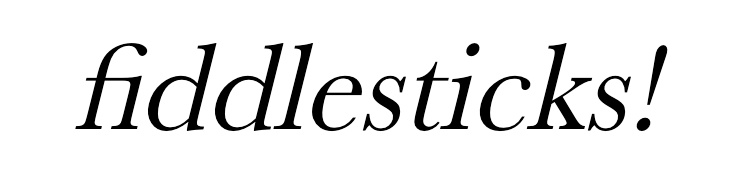 Now consider a family for which an actual italic face is defined:
The second @font-face rule
defines the font resource 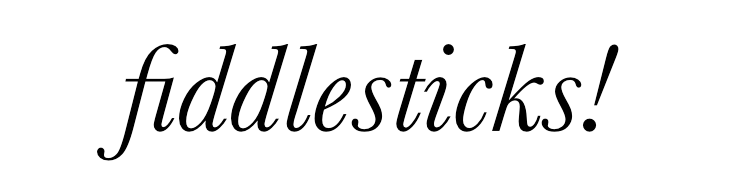 See the section on font matching for more complete details of the process used to select a particular face within a font family.
Fonts may advertise the range of font-weight, font-width, and font-style they are
compatible with.
The above @font-face rule indicates that As above, multiple @font-face rules may be joined together into a single family, spanning multiple ranges of font-weight, font-width, and/or font-style:
The above @font-face rules indicate that 4.4.1. Font width: the font-stretch legacy name aliasFor historical reasons, a font-stretch descriptor exists which is a legacy name alias and functions in the identical way to the font-width descriptor. Tests4.5. Character range: the unicode-range descriptor
TestsThis descriptor defines the set of Unicode codepoints that may be supported by the font face for which it is declared. The descriptor value is a comma-delimited list of Unicode range token (<unicode-range-token>) values. The union of these ranges defines the set of codepoints that serves as a hint for user agents when deciding whether or not to download a font resource for a given text run. Each <unicode-range-token> value is a token made up of a "U+" or "u+" prefix followed by a codepoint range in one of the three forms listed below. Ranges that do not fit one of these forms are invalid and cause the declaration to be ignored.
Individual codepoints are written using hexadecimal values that correspond to Unicode character codepoints. Unicode codepoint values must be between 0 and 10FFFF inclusive. Digit values of codepoints are ASCII case-insensitive. For interval ranges, the start and end codepoints must be within the range noted above and the end codepoint must be greater than or equal to the start codepoint. Wildcard ranges specified with ‘?’ that lack an
initial digit (e.g. "U+???") are valid and equivalent
to a wildcard range with an initial zero digit (e.g. "U+0???" = "U+0000-0FFF").
Wildcard ranges that extend beyond the range of
Unicode codepoints are invalid. Because of this, the maximum
number of trailing '?' wildcard characters is five, even though the
Within the comma-delimited list of Unicode ranges in a unicode-range descriptor declaration, ranges may overlap. The union of these ranges defines the set of codepoints for which the corresponding font may be used. User agents must not download or use the font for codepoints outside this set. User agents may normalize the list of ranges into a list that is different but represents the same set of codepoints. The associated font might not contain glyphs for the entire set of codepoints defined by the unicode-range descriptor. When the font is used, the effective character map is the intersection of the codepoints defined by unicode-range with the font’s character map. This allows authors to define supported ranges in terms of broad ranges without worrying about the precise codepoint ranges supported by the underlying font. 4.5.1. Using character ranges to define composite fontsMultiple @font-face rules with different unicode ranges for the same family and style descriptor values can be used to create composite fonts that mix the glyphs from different fonts for different scripts. This can be used to combine fonts that only contain glyphs for a single script (e.g. Latin, Greek, Cyrillic) or it can be used by authors as a way of segmenting a font into fonts for commonly used characters and less frequently used characters. Since the user agent will only pull down the fonts it needs this helps reduce page bandwidth. If the unicode ranges overlap for a set of @font-face rules with the same family and style descriptor values, the rules are ordered in the reverse order they were defined; the last rule defined is the first to be checked for a given character. Example ranges for specific languages or characters:
The BBC provides news services in a wide variety of languages, many
that are not well supported across all platforms. Using an @font-face
rule, the BBC could provide a font for any of these languages, as it
already does via a manual font download.
Technical documents often require a wide range of symbols. The STIX
Fonts project is one project aimed at providing fonts to support a wide
range of technical typesetting in a standardized way. The example below
shows the use of a font that provides glyphs for many of the
mathematical and technical symbol ranges within Unicode:
This example shows how an author can override the glyphs used for
Latin characters in a Japanese font with glyphs from a different font.
The first rule specifies no range so it defaults to the entire range.
The range specified in the second rule overlaps but takes precedence
because it is defined later.
Consider a family constructed to optimize bandwidth by separating out
Latin, Japanese and other characters into different font files:
For simple Latin text, only the font for Latin characters is downloaded: body In this case the user agent first checks the unicode-range for the font containing Latin characters (DroidSans.woff). Since all the characters above are in the range U+0-5FF, the user agent downloads the font and renders the text with that font. Next, consider text that makes use of an arrow character (⇨): <p>This ⇨ The user agent again first checks the unicode-range of the font containing Latin characters. Since U+2000-2300 includes the arrow code point (U+21E8), the user agent downloads the font. For this character however the Latin font does not have a matching glyph, so the effective unicode-range used for font matching excludes this code point. Next, the user agent evaluates the Japanese font. The unicode-range for the Japanese font, U+3000-9FFF and U+ff??, does not include U+21E8, so the user agent does not download the Japanese font. Next the fallback font is considered. The @font-face rule for the fallback font does not define unicode-range so its value defaults to the range of all Unicode code points. The fallback font is downloaded and used to render the arrow character. 4.6. Font features and variations: the font-feature-settings and font-variation-settings descriptors
Tests
Tests
These descriptors define initial settings that apply when the font defined by an @font-face rule is rendered. They do not affect font selection. Values are identical to those defined for the corresponding font-feature-settings and font-variation-settings properties defined below except that the CSS-wide keywords are omitted. When multiple font feature descriptors, properties, or variations are used, optionally along with a named instance, the cumulative effect on text rendering is detailed in the section § 7 Font Feature and Variation Resolution below. These descriptors set features and variation values on the font object which the @font-face rule represents, rather than on an entire element. Therefore, when using these descriptors, only some glyphs in an element may be rendered with that feature, due to § 5.3 Cluster matching. 4.7. Using named instances from variable fonts: the font-named-instance descriptor
If the font-named-instance descriptor is set to a value other than auto, then the appropriate stage in the § 7 Font Feature and Variation Resolution will inspect the font file to find the first named instance in the font which has a localized name equal to the given <string> according to the rules given in § 5.1 Localized name matching. If no such named instance exists, this descriptor is treated as if it has a value of 'font-named-instance/auto'. Otherwise, this named instance’s variation axis values are applied to this position in the § 7 Font Feature and Variation Resolution.
For example, the following @font-face block will
apply the instance named "Grotesque"
but will override the "XHGT" axis to have a value of 0.7.
Note: Because the variation axis values supplied in the font-weight, font-width, and font-style properties are applied before the value in the font-named-instance descriptor, there is no need to change the value of those properties when a named instance is desired. 4.8. Font request guidelines4.8.1. Font loading guidelinesThe @font-face rule is designed to allow lazy loading of font resources that are only downloaded when used within a document. A stylesheet can include @font-face rules for a library of fonts of which only a select set are used; user agents must only download those fonts that are referred to within the style rules applicable to a given page. User agents that download all fonts defined in @font-face rules without considering whether those fonts are in fact used within a page are considered non-conformant. In cases where a font might be downloaded in character fallback cases, user agents may download a font if it’s contained within the computed value of font-family for a given text run.
In cases where textual content is loaded before downloadable fonts are available, user agents must render text according to the font-display descriptor of that @font-face block. In cases where the font download fails, user agents must display the text visibly. Authors are advised to use fallback fonts in their font lists that closely match the metrics of the downloadable fonts to avoid large page reflows where possible. 4.8.2. Font fetching requirements
To fetch a font given a selected <url> url for @font-face rule,
fetch url,
with ruleOrDeclaration being rule,
destination "font",
CORS mode "cors",
and processResponse being the following steps given response res and null, failure or a
byte stream stream:
Note: The implications of this for authors are that fonts
will typically not be loaded cross-origin unless authors specifically
take steps to permit cross-origin loads. Sites can explicitly allow
cross-site loading of font data using the
For the examples given below, assume that a document is located at
Fonts defined with the src descriptor values below will be loaded:
Fonts defined with the src descriptor values below will fail to load:
4.9. Controlling Font Display Per Font-Face: the font-display descriptorThe font-display descriptor for @font-face determines how a font face is displayed, based on whether and when it is downloaded and ready to use.
TestsNote: For all of these values, user agents may use slightly different durations, or more sophisticated behaviors that can’t be directly expressed in the font-display syntax, in order to provide more useful behavior for their users. They may also provide the ability for users to override author-chosen behavior with something more desirable; for example, forcing all fonts to have a 0s block period.
4.9.1. Controlling Font Display Per Font-Family via @font-feature-valuesThe font-display descriptor for @font-feature-values determines how a font family is displayed, by setting the "default" font-display value for @font-face rules targeting the same font family. When font-display is omitted in an @font-face rule, the user agent uses the font-display value set via @font-feature-values for the relevant font-family if one is set, and otherwise defaults to auto. This mechanism can be used to set a default display policy for an entire font-family, and enables developers to set a display policy for @font-face rules that are not directly under their control. For example, when a font is served by a third-party font foundry, the developer does not control the @font-face rules but is still able to set a default font-display policy for the provided font-family. The ability to set a default policy for an entire font-family is also useful to avoid the ransom note effect (i.e. mismatched font faces) because the display policy is then applied to the entire font family.
4.10. Default font language overriding: the font-language-override descriptor
This descriptor defines initial settings that apply when the font defined by an @font-face rule is rendered. It does not affect font selection. Values are identical to those defined for the font-language-override property defined below except that the value inherit is omitted. When multiple font feature descriptors, properties, or variations are used, the cumulative effect on text rendering is detailed in the section § 7 Font Feature and Variation Resolution below. 4.11. Default font metrics overriding: the ascent-override, descent-override and line-gap-override descriptors
Tests
Tests
TestsThe ascent-override, descent-override and line-gap-override descriptors define the ascent metric, descent metric and line gap metric of the font, respectively. When the descriptor value is normal, the corresponding metric value is obtained from the font file directly. Note: User agents may draw data from different places from the font file as the metric values, which results in different text layouts. When the descriptor value is a percentage, the corresponding metric value is resolved as the given percentage multiplied by the used font size. Negative values are invalid at parse time.
The percentage is resolved against different font sizes for different elements.
The outer span uses an ascent value of 10px, whereas the inner span uses 15px.
We may override the metrics of a local fallback font to match the primary font, which
is a web font. This reduces layout shifting when switching from fallback to the
primary font.
The image will not be vertically shifted when the user agent finishes loading and switches to use the web font. 5. Font Matching AlgorithmThe algorithm below describes how fonts are associated with individual runs of text. For each character in the run a font family is chosen and a particular font face is selected containing a glyph for that character. The set of installed fonts available to the Font Matching Algorithm is explicitly undefined. The default set of installed fonts will vary by UA, platform, and locale; it is important that users be able to customise which installed fonts are available for rendering web pages and to which generic font families, if any, these fonts are mapped. UAs may choose to expose all installed fonts to the web, regardless of how that font was installed; doing so is likely to have good internationalization properties for users whose primary language is not supported by fonts shipping with their operating system. UAs may alternatively choose to not initially expose any user-installed fonts to aid privacy on the web; for the set of installed fonts a user has installed is often used as a tracking vector to track users across the web. Users should then be able to add to or remove fonts from that set, according to their needs. UAs may choose a hybrid approach, where some user-installed fonts are initially exposed for internationalization, but others aren’t. Again, users should be able to customise this starting set. UAs are expected to make informed decisions on which fonts they expose to the web by default, so as to balance between internationalization and privacy. UAs are expected to also provide a convenient means for users to add and subtract fonts to meet their particular needs. Tests5.1. Localized name matchingSome font file formats allow font faces to carry multiple localizations of a particular string (e.g. family name or named instance). User agents must recognize and correctly match all of these names independent of the underlying platform localization, system API used, or document encoding.
For example,
for each of the fonts listed below,
the author can use either the Latin name
or the localized name
in the font-family property,
and the results will be identical on all systems:

User agents must match these names case insensitively, using the "Default Caseless Matching" algorithm outlined in the Unicode specification [UNICODE]. This algorithm is detailed in section 3.13 entitled "Default Case Algorithms". Specifically, the algorithm must be applied without normalizing the strings involved and without applying any language-specific tailorings. The case folding method specified by this algorithm uses the case mappings with status field "C" or "F" in the CaseFolding.txt file of the Unicode Character Database. Note: For authors this means that font family names are matched case insensitively, whether those names exist in a platform font or in the @font-face rules contained in a stylesheet. Authors should take care to ensure that names use a character sequence consistent with the actual font family name, particularly when using combining characters such as diacritical marks. For example, a family name that contains a lowercase a (U+0061) followed by a combining ring (U+030A) will not match a name that looks identical but which uses the precomposed lowercase a-ring character (U+00E5) instead of the combining sequence. Note: Implementors should take care to verify that a given caseless string comparison implementation uses this precise algorithm and not assume that a given platform string matching routine follows it, as many of these have locale-specific behavior or use some level of string normalization. 5.2. Matching font stylesThe procedure for choosing a font for a given character in a run of text consists of iterating over the font families named by the font-family property, selecting a font face with the appropriate style based on other font properties and then determining whether a glyph exists for the given character. This is done using the character map of the font, data which maps characters to the default glyph for that character. A font is considered to support a given character if (1) the character is contained in the font’s character map and (2) if required by the containing script, shaping information is available for that character. Some legacy fonts might include a given character in the character map but lack the shaping information (e.g. OpenType layout tables or Graphite tables) necessary for correctly rendering text runs containing that character. Codepoint sequences consisting of a base character followed by a sequence of combining characters are treated slightly differently, see the section on cluster matching below. For this procedure, the default font face for a given font family is defined to be the face that would be selected if all font style properties were set to their initial value.
Optimizations of this process are allowed provided that an implementation behaves as if the algorithm had been followed exactly. Matching occurs in a well-defined order to ensure that the results are as consistent as possible across user agents, given an identical set of available fonts and rendering tech. The first available font, used for example in the definition of font-relative lengths such as ex or in the definition of the line-height property, is defined to be the first font for which the character U+0020 (space) is not excluded by a unicode-range, given the font families in the font-family list (or a user agent’s default font if none are available). Installed fonts referenced directly by family name, rather than via @font-face rules, are considered to have a unicode-range that covers the entire Unicode code space. Tests
Note: it does not matter whether that font actually has a glyph for the space character. 5.3. Cluster matchingWhen text contains characters such as combining marks, ideally the base character should be rendered using the same font as the mark, this assures proper placement of the mark. For this reason, the font matching algorithm for clusters is more specialized than the general case of matching a single character by itself. For sequences containing variation selectors, which indicate the precise glyph to be used for a given character, user agents always attempt installed font fallback to find the appropriate glyph before using the default glyph of the base character. A sequence of codepoints containing combining mark or other modifiers is termed a grapheme cluster (see [CSS3TEXT] and [UAX29] for a more complete description). For a given cluster containing a base character, b and a sequence of combining characters c1, c2…, the entire cluster is matched using these steps:
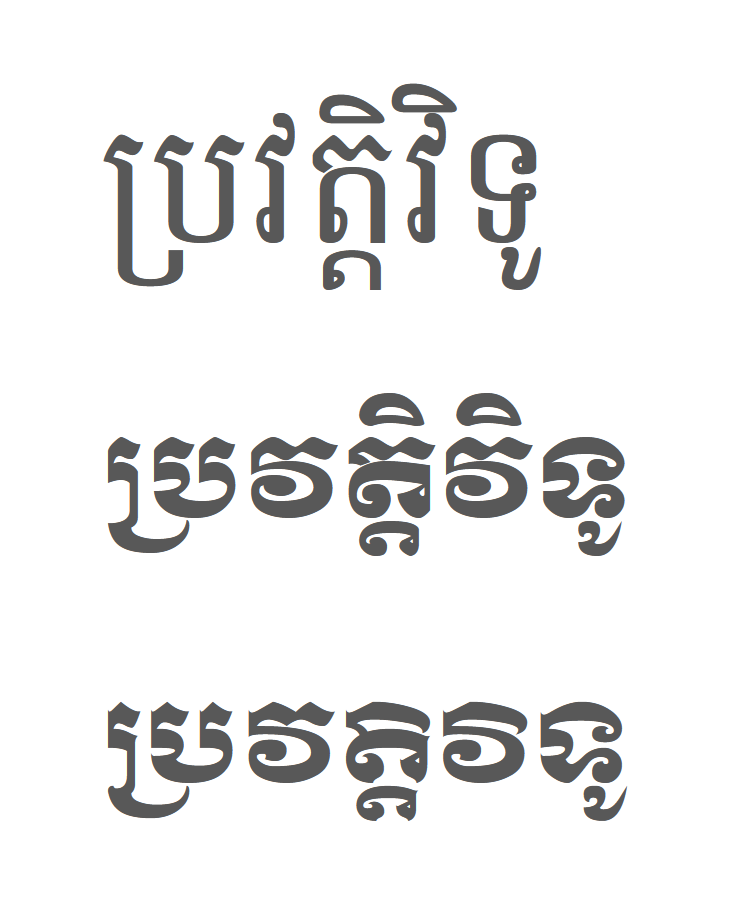
Tests5.4. Character handling issuesCSS font matching is always performed on text runs containing Unicode characters [UNICODE], so documents using legacy encodings are assumed to have been transcoded before matching fonts. For fonts containing character maps for both legacy encodings and Unicode, the contents of the legacy encoding character map must have no effect on the results of the font matching process. The font matching process does not assume that text runs are in either normalized or denormalized form (see [CHARMOD-NORM] for more details). Fonts may only support precomposed forms and not the decomposed sequence of base character plus combining marks. Authors should always tailor their choice of fonts to their content, including whether that content contains normalized or denormalized character streams. If a given character is a Private-Use Area Unicode codepoint, user agents must only match font families named in the font-family list that are not generic families. If none of the families named in the font-family list contain a glyph for that codepoint, user agents must display some form of missing glyph symbol for that character rather than attempting installed font fallback for that codepoint. When matching the replacement character U+FFFD, user agents may skip the font matching process and immediately display some form of missing glyph symbol, they are not required to display the glyph from the font that would be selected by the font matching process. In general, the fonts for a given family will all have the same or similar character maps. The process outlined here is designed to handle even font families containing faces with widely variant character maps. However, authors are cautioned that the use of such families can lead to unexpected results. Tests6. Font Feature PropertiesModern font technologies support a variety of advanced typographic and language-specific font features. Using these features, a single font can provide glyphs for a wide range of ligatures, contextual and stylistic alternates, tabular and old-style figures, small capitals, automatic fractions, swashes, and alternates specific to a given language. To allow authors control over these font capabilities, the font-variant property has been expanded. It now functions as a shorthand for a set of properties that provide control over stylistic font features. 6.1. Glyph selection and positioningThis section is non-normative Simple fonts used for displaying Latin text use a very basic processing model. Fonts contain a character map which maps each character to a glyph for that character. Glyphs for subsequent characters are simply placed one after the other along a run of text. Modern font formats such as OpenType and AAT (Apple Advanced Typography) use a richer processing model. The glyph for a given character can be chosen and positioned not just based on the codepoint of the character itself, but also on adjacent characters as well as the language, script, and features enabled for the text. Font features may be required for specific scripts, or recommended as enabled by default or they might be stylistic features meant to be used under author control. The point at which font selection and positioning happens in the overall order of text processing operations (such as text transformation, text orientation and text alignment) is described in CSS Text 3 § A Text Processing Order of Operations. For a detailed description of glyph processing for OpenType fonts, see [WINDOWS-GLYPH-PROC]. Stylistic font features can be classified into two broad categories: ones that affect the harmonization of glyph shapes with the surrounding context, such as kerning and ligature features, and ones such as the small-caps, subscript/superscript and alternate features that affect shape selection. The subproperties of font-variant listed below are used to control these stylistic font features. They do not control features that are required for displaying certain scripts, such as the OpenType features used when displaying Arabic or Indic language text. They affect glyph selection and positioning, but do not affect font selection as described in the font matching section (except in cases required for compatibility with CSS 2.1). To assure consistent behavior across user agents, the equivalent OpenType property settings are listed for individual properties and are normative. When using other font formats these should be used as a guideline to map CSS font feature property values to specific font features. 6.2. Language-specific displayOpenType also supports language-specific glyph selection and positioning, so that text can be displayed correctly in cases where the language dictates a specific display behavior. Many languages share a common script, but the shape of certain letters can vary across those languages. For example, certain Cyrillic letters have different shapes in Russian text than in Bulgarian. In Latin text, it’s common to render "fi" with an explicit fi-ligature that lacks a dot on the "i". However, in languages such as Turkish which uses both a dotted-i and a dotless-i, it’s important to not use this ligature or use a specialized version that contains a dot over the "i". Tests
The example below shows language-specific variations based on stylistic traditions found in Spanish, Italian and French orthography:    If the content language of the element is known according to the rules of the document language, user agents are required to infer the OpenType language system from the content language and use that when selecting and positioning glyphs using an OpenType font. If a writing system has been explicitly specified, it must take precedence over the customary one implied by the content language. For OpenType fonts, in some cases it may be necessary to explicitly declare the OpenType language to be used, for example when displaying text in a given language that uses the typographic conventions of another language or when the font does not explicitly support a given language but supports a language that shares common typographic conventions. The font-language-override property is used for this purpose. 6.3. Kerning: the font-kerning property
Tests
Kerning is the contextual adjustment of inter-glyph spacing of proportionally-spaced glyphs. It is not intended to apply to fixed-width glyphs, and to do so is an error. This property controls metric kerning, kerning that utilizes adjustment data contained in the font.
For fonts that do not include kerning data, this property will have no visible effect. Some CJK fonts have Proportional Alternate Widths; whereby glyphs designed to be set on full-em widths are re-spaced to be proportional. In OpenType, this is enabled with the palt feature, or, for vertical typesetting, the vpal feature. In that case, if requested, kerning can now be applied to these glyphs. (It is a valid choice to only apply palt or vpal, if requested, and not apply kerning). User agents must also support fonts that only support kerning via data contained in a kern font table, as detailed in the OpenType specification. If the letter-spacing property is defined, kerning adjustments are considered part of the default spacing and letter spacing adjustments are made after kerning has been applied. When set to auto, user agents can determine whether to apply kerning or not based on a number of factors: text size, script, or other factors that influence text processing speed. Authors who want proper kerning should use normal to explicitly enable kerning of proportionally-spaced glyphs. Likewise, some authors may prefer to disable kerning in situations where performance is more important than precise appearance. However, in well-designed modern implementations the use of kerning generally does not have a large impact on text rendering speed. When kerning is enabled, the relevant OpenType kerning features are applied as follows: 6.3.1. Horizontal kerningFor horizontal typographic modes and for sideways typesetting in vertical typographic modes:
To horizontally kern text using a font,
making Japanese characters proportional and applying kerning to proportional, non-joining characters:
6.3.2. Vertical kerningFor upright typesetting in vertical typographic modes:
To vertically kern text using a font,
making Japanese characters proportional and applying kerning to proportional, non-joining characters:
6.4. Ligatures: the font-variant-ligatures property
Tests
Ligatures and contextual forms are ways of combining glyphs to produce more harmonized forms. <common-lig-values> = <discretionary-lig-values> = <historical-lig-values> = <contextual-alt-values> = Individual values have the following meanings:
Required ligatures, needed for correctly rendering complex scripts, are not affected by the settings above, including none (OpenType feature: rlig). 6.5. Subscript and superscript forms: the font-variant-position property
Tests
This property is used to enable typographic subscript and superscript glyphs. These are alternate glyphs designed within the same em-box as default glyphs and are intended to be laid out on the same baseline as the default glyphs, with no resizing or repositioning of the baseline. They are explicitly designed to match the surrounding text and to be more readable without affecting the line height. 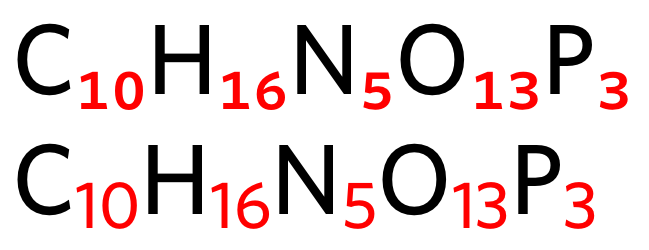
Subscript glyphs (top) vs. typical synthesized subscripts (bottom) Individual values have the following meanings:
Because of the semantic nature of subscripts and superscripts, when the value is either sub or super for a given contiguous run of text, if a variant glyph is not available for all the characters in the run, simulated glyphs should be synthesized for all characters using reduced forms of the glyphs that would be used without this feature applied. This is done per run to avoid a mixture of variant glyphs and synthesized ones that would not align correctly. In the case of OpenType fonts that lack subscript or superscript glyphs for a given character, user agents must synthesize appropriate subscript and superscript glyphs. 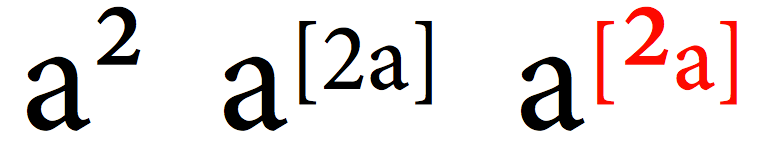
Superscript alternate glyph (left), synthesized superscript glyphs (middle), and incorrect mixture of the two (right) In situations where text decorations are only applied to runs of text containing superscript or subscript glyphs, the synthesized glyphs may be used, to avoid problems with the placement of decorations. In the past,
user agents have used font-size
and vertical-align
to simulate subscripts and superscripts
for the
Because The OpenType font format defines subscript and superscript metrics in the OS/2 table [OPENTYPE] but these are not always accurate in practice and so cannot be relied upon when synthesizing subscript and superscript glyphs. Authors should note that fonts typically only provide subscript and superscript glyphs for a subset of all characters supported by the font. For example, while subscript and superscript glyphs are often available for Latin numbers, glyphs for punctuation and letter characters are less frequently provided. The synthetic fallback rules defined for this property try to ensure that subscripts and superscripts will always appear but the appearance may not match author expectations if the font used does not provide the appropriate alternate glyph for all characters contained in a subscript or superscript. This property is not cumulative. Applying it to elements within a subscript or superscript won’t nest the placement of a subscript or superscript glyph. Images contained within text runs where the value of this property is sub or super will be drawn just as they would if the value was normal. Because of these limitations, font-variant-position is not recommended for use in user agent stylesheets. Authors should use it in cases where subscripts or superscripts will only contain the narrow range of characters supported by the fonts specified. The variant glyphs use the same baseline as the default glyphs would use. There is no shift in the placement along the baseline, so the use of variant glyphs doesn’t affect the height of the inline box or alter the height of the linebox. This makes superscript and subscript variants ideal for situations where it’s important that leading remain constant, such as in multi-column layout. A typical user agent default style for the sub element: sub Using font-variant-position to specify typographic subscripts in a way that will still show subscripts in older user agents:
User agents that support the font-variant-position property will select a subscript variant glyph and render this without adjusting the baseline or font-size. Older user agents will ignore the font-variant-position property definition and use the standard defaults for subscripts. 6.6. Capitalization: the font-variant-caps property
Tests
| ||||||||||||||||||||||||||||||||||||||||||||||||||||||||||||||||||||||||||||||||||||||||||||||||||||||||||||||||||||||||||||||||||||||||||||||||||||||||||||||||||||||||||||||||||||||||||||||||||||||||||||||||||||||||||||||||||||||||||||||||||||||||||||||||||||||||||||||||||||||||||||||||||||||||||||||||||||||||||||||||||||||||||||||||||||||||||||||||||||||||||||||||||||||||||||||||||||||||||||||||||||||||||||||||||||||||||||||||||||||||||||||||||||||||||||||||||||||||||||||||||||||||||||||||||||||||||||||||||||||||||||||||||||||||||||||||||||||||||||||||||||||||||||||||||||||||||||||||||||||||||||||||||||||||||
| You are visitor 01402503 — GeezerVison does not store the pages you look up. Best viewed with Netscape Navigator 4.7 or Internet Explorer 6 at 800×600. No cookies required. |