Problem: We aim to evaluate Large Language Models (LLMs) for embodied decision making. While a significant body of work has been leveraging LLMs for decision making in embodied environments, we still lack a systematic understanding of their performances, because they are usually applied in different domains for different purposes, and built based on different inputs and outputs. Furthermore, existing evaluations tend to rely solely on a final success rate, making it difficult to pinpoint what ability is missing in LLMs and where the problem lies, which in turn, blocks embodied agents from leveraging LLMs effectively and selectively.
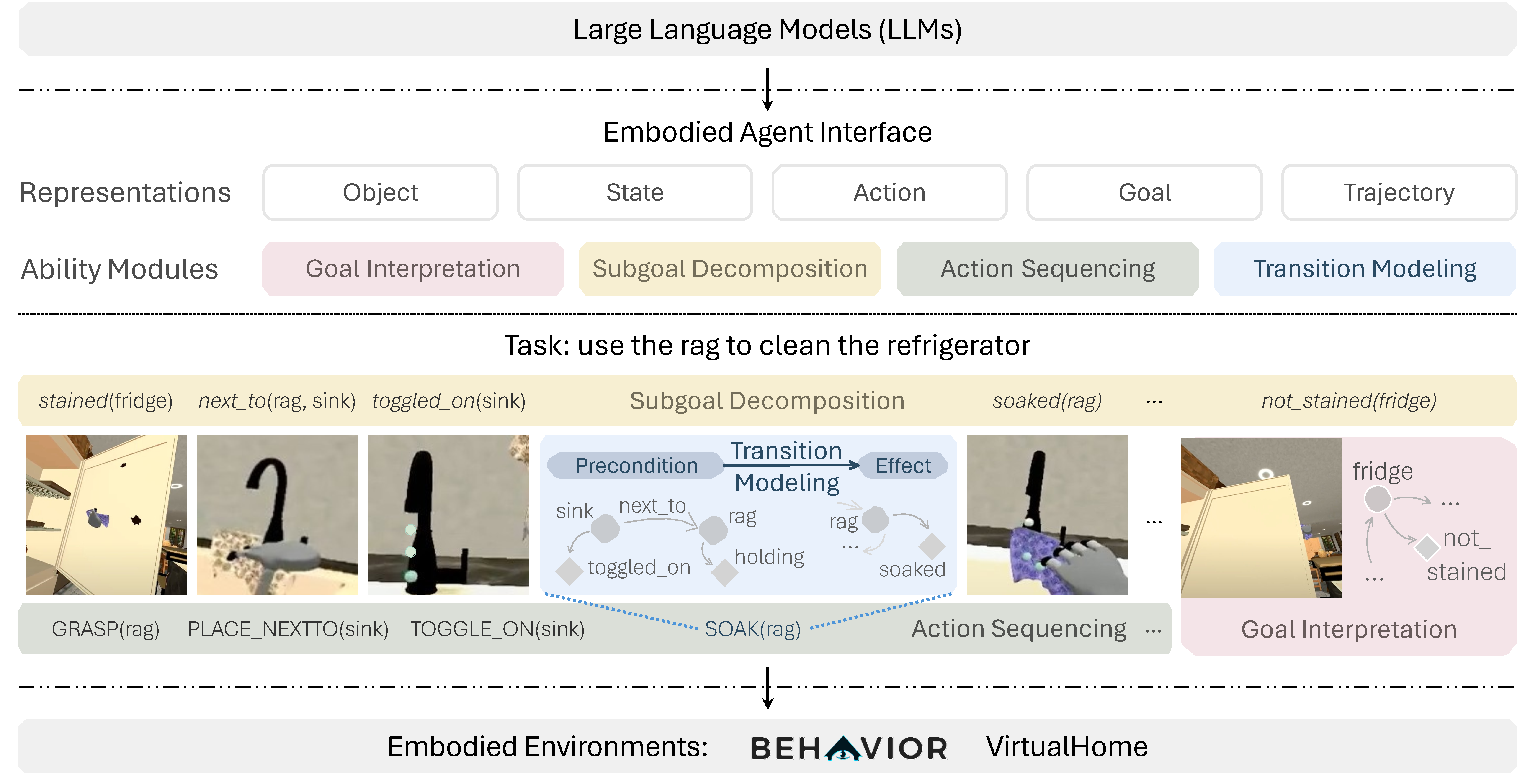
Method: To address these limitations, we propose a generalized interface (Embodied Agent Interface) that supports the formalization of various types of tasks and input-output specifications of LLM-based modules. Specifically, it allows us to unify 1) a broad set of embodied decision making tasks involving both state and temporally extended goals, 2) four commonly-used LLM-based modules for decision making: goal interpretation, subgoal decomposition, action sequencing, and transition modeling, and 3) a collection of fine-grained metrics which break down evaluation into various types of errors, such as hallucination errors, affordance errors, various types of planning errors, etc.
Conclusion: Overall, our benchmark offers a comprehensive and systematic assessment of LLMs' performance for different subtasks, pinpointing the strengths and weaknesses in LLM-powered embodied AI systems, and providing insights for effective and selective use of LLMs in embodied decision making.
Figure 1:Embodied Agent Interface unifies a broad set of tasks involving both state and temporally extended goals and four LLM-based modules for decision making.
Embodied Agent Interface
In our Embodied Agent Interface, we propose a set of ability modules to evaluate LLMs for embodied decision making. The four ability modules are: Goal Interpretation, Subgoal Decomposition, Action Sequencing, and Transition Modeling. We provide a detailed description of each module below.
Ability Module 1: Goal Interpretation
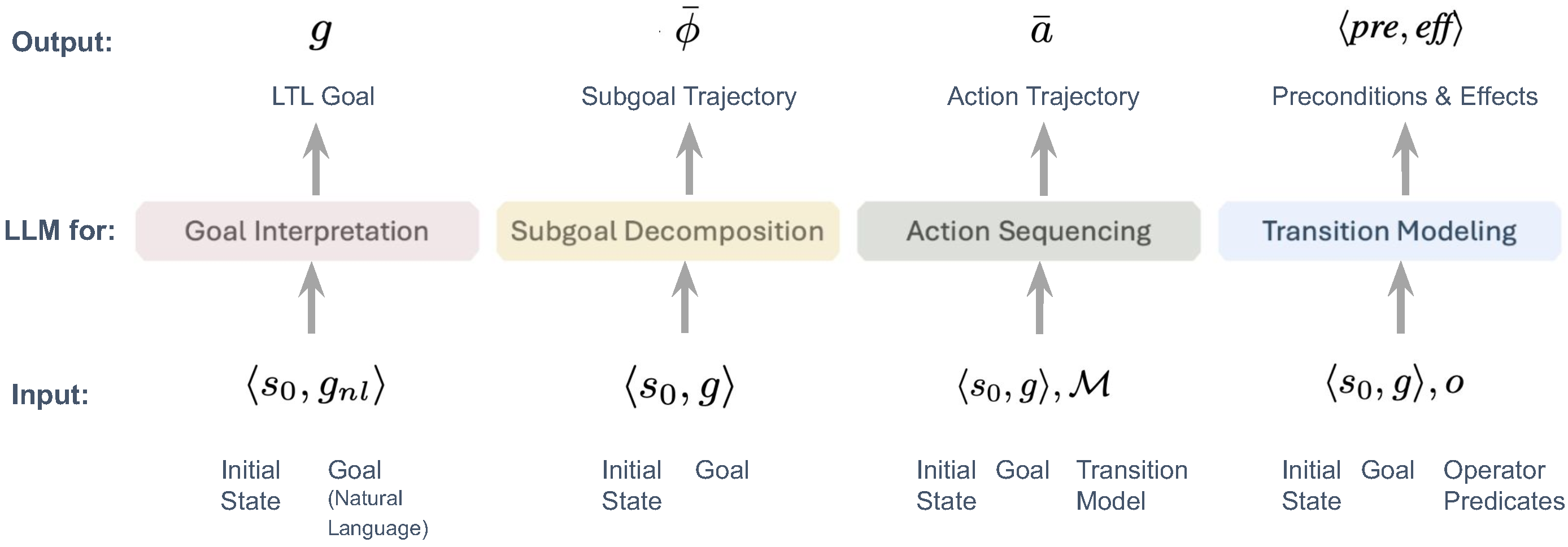
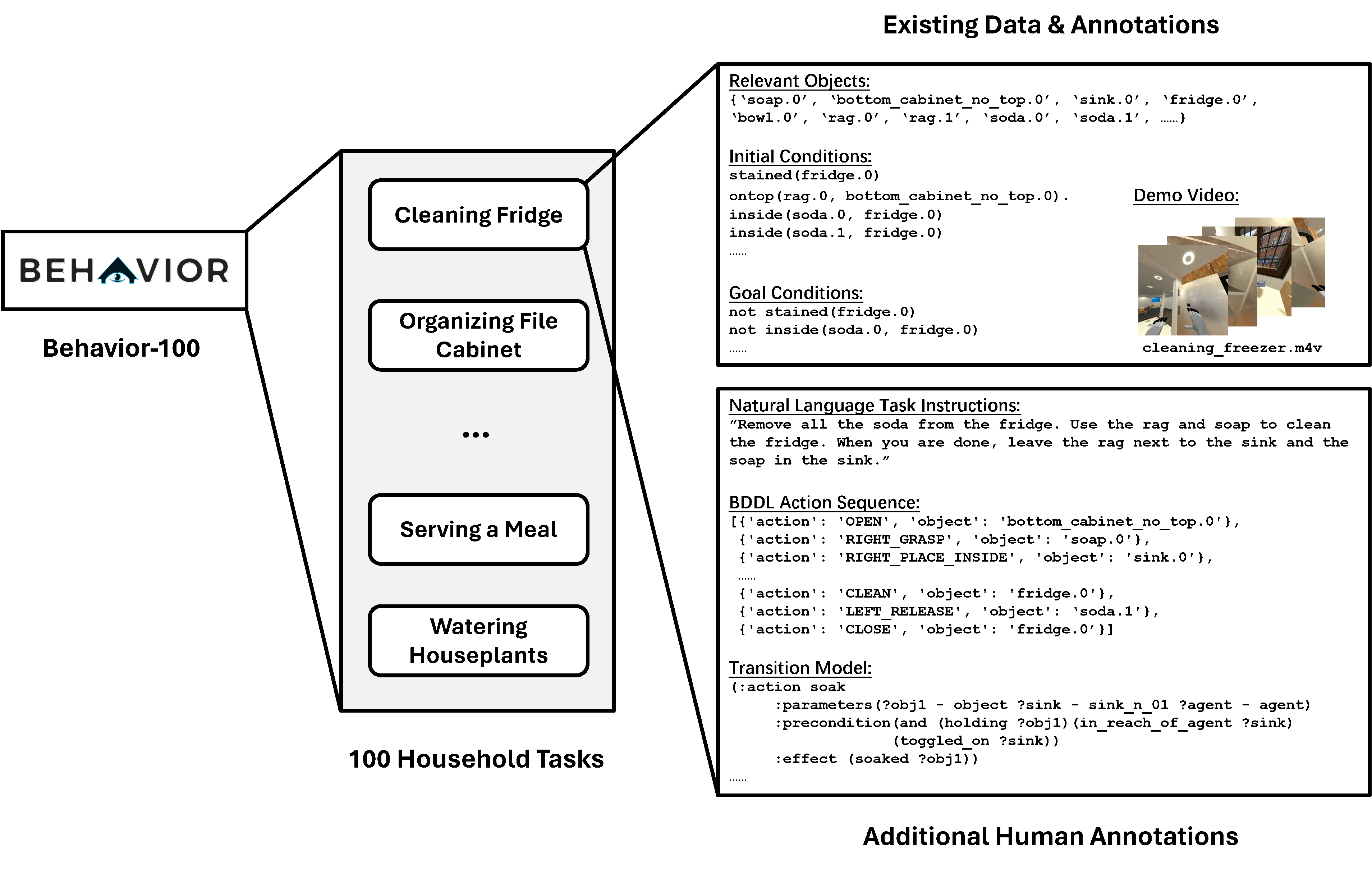
Goal Interpretation aims to ground the natural language instruction to the environment representations of objects, states, relations, and actions. For example, the task instruction "Use the rag to clean the trays, the bowl, and the refrigerator. When you are done, leave the rag next to the sink..." can be grounded to specific objects with IDs, such as fridge (ID: 97), tray (ID: 1), bowl (ID: 1), rag (ID: 0), and sink (ID: 82). Note that a simple natural language description can be grounded into a set of multiple goal conditions (object state and relation).
Ability Module 2: Subgoal Decomposition
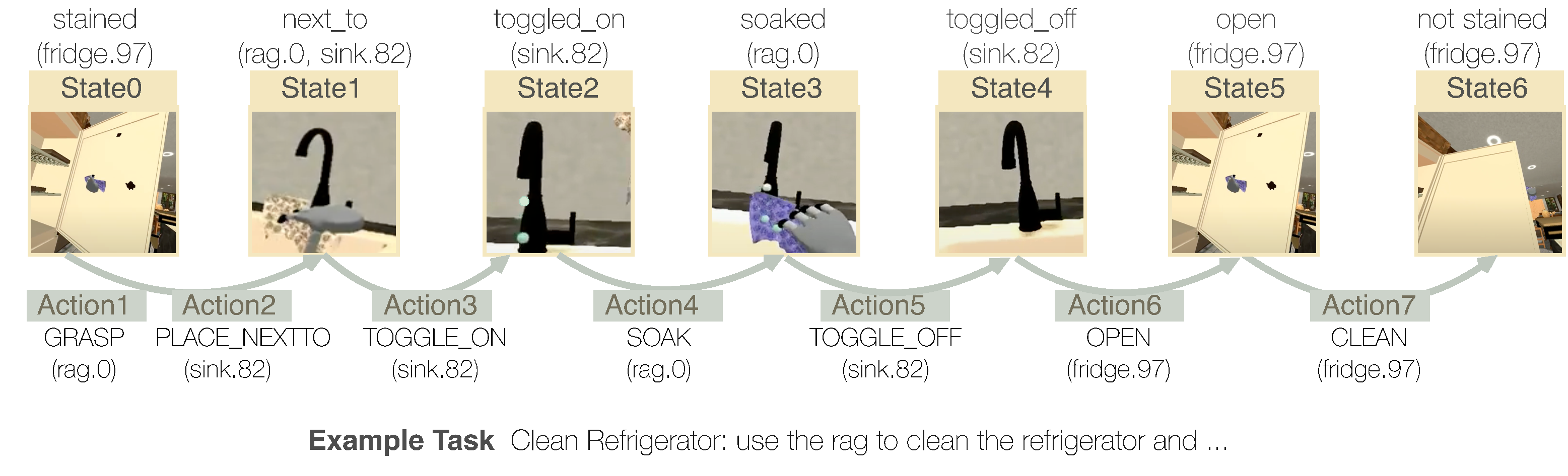
Subgoal Decomposition generates a sequence of states, where each state can be a set of objects and their states. Here, we highlight the important states, such as the transitions between a sequence of next_to(rag.0, sink.82), toggled_on(sink.82), soaked(rag.0), toggled_off(sink.82), open(fridge.97), not_stained(fridge.97). To achieve these state transitions, we can use a high-level planner such as BFS to search for the Action Sequences that achieve these state transitions. We obtain the following action sequence: RIGHT_GRASP(rag.0), RIGHT_PLACE_NEXTTO(sink.82), TOGGLE_ON(sink.82), SOAK(rag.0), TOGGLE_OFF(sink.82), OPEN(fridge.97), CLEAN(fridge.97). Note that multiple actions may be required to achieve a single one-step state transition. For example, to perform the state transition next_to(rag.0, sink.82) → toggled_on(sink.82), we need two actions RIGHT_GRASP(rag.0), RIGHT_PLACE_NEXTTO(sink.82). See Figure 2 for the input and output formulation.
Figure 2: The input and output formulation of four ability modules for Embodied Agent Interface.
Ability Module 3: Action Sequencing
Action Sequences are essential to achieve the state transitions identified in Subgoal Decomposition. For example, a successful execution of the action sequence RIGHT_GRASP(rag.0), RIGHT_PLACE_NEXTTO(sink.82), TOGGLE_ON(sink.82), SOAK(rag.0), TOGGLE_OFF(sink.82), OPEN(fridge.97), CLEAN(fridge.97) is shown in Figure 3.
Ability Module 4: Transition Modeling
Transition Modeling serves as the low-level controller to guide the simulator in performing state transitions from preconditions to post-effects. For example, in cleaning task, the input is the operator name soak, and the preconditions are three states: holding (?obj1), next_to (?sink ?agent), and toggled_on (?sink). The post effect after executing SOAK is soaked (?obj1).
Figure 3: An example of successful execution in Embodied Agent Interface.
Dataset Viewer
Leaderboard
Empirical Findings
Goal Interpretation:
LLMs struggle to translate natural language instructions into grounded states.
Common errors include generating intermediate goals and omitting spatial relationship goals.
Gemini 1.5 Pro has the highest goal interpretation performance, while Claude-3 Opus excels in goal retrieval rate.
Proprietary LLMs make fewer grammar errors compared to open-source LLMs.
Table: All goal evaluation results (%) for goal interpretation
Model Name
Goal Interpretation
State
Spatial
Action
Overall
Precision
Recall
F1
Precision
Recall
F1
Precision
Recall
F1
Precision
Recall
F1
V
B
V
B
V
B
V
B
V
B
V
B
V
B
V
B
V
B
V
B
V
B
V
B
Claude-3 Haiku
21.8
22.8
58.9
93.5
31.8
36.7
24.2
64.5
50.8
64.6
32.8
64.6
12.2
-
95.7
-
21.6
-
18.0
41.5
63.2
71.2
28.0
52.5
Claude-3 Sonnet
23.3
36.8
57.1
88.9
33.1
52.0
26.6
76.2
53.0
79.8
35.5
77.9
12.4
-
85.8
-
21.7
-
19.3
60.2
61.5
81.9
29.4
69.4
Claude-3 Opus
27.0
72.6
66.9
93.5
38.5
81.7
22.6
75.2
46.8
79.2
30.5
77.1
14.5
-
92.6
-
25.1
-
20.7
72.2
65.0
82.5
31.4
77.0
Claude-3.5 Sonnet
25.3
74.0
60.9
94.8
35.8
83.1
31.1
84.4
63.8
81.3
41.8
82.9
14.0
-
98.8
-
24.5
-
21.7
81.1
69.6
84.4
33.0
82.7
Cohere Command R
51.1
7.7
69.6
31.4
58.9
12.4
34.5
56.8
21.3
55.0
26.3
55.9
3.6
-
38.9
-
6.5
-
27.4
28.2
55.7
49.6
36.7
36.0
Cohere Command R+
20.9
23.3
52.0
79.1
29.8
36.0
17.9
66.7
15.2
61.5
16.4
64.0
10.4
-
82.6
-
18.5
-
14.9
42.0
44.5
65.5
22.4
51.2
Gemini 1.0 Pro
25.3
27.4
57.9
81.1
34.9
41.0
17.0
75.2
20.6
70.4
18.6
72.7
9.9
-
68.7
-
17.2
-
16.2
51.0
45.2
72.8
23.8
60.0
Gemini 1.5 Flash
23.6
55.8
57.9
94.1
33.5
70.1
19.8
76.6
21.1
76.7
20.5
76.7
13.5
-
90.1
-
23.5
-
18.2
69.7
50.8
80.7
26.8
74.8
Gemini 1.5 Pro
45.4
94.0
49.1
92.8
47.2
93.4
40.0
74.4
9.7
76.7
15.6
75.6
26.8
-
80.9
-
40.3
-
35.2
78.8
41.1
80.4
37.9
79.6
GPT-3.5-turbo
22.4
52.0
50.0
66.7
30.9
58.5
8.5
51.5
18.8
46.9
11.7
49.1
15.2
-
60.5
-
24.4
-
15.7
49.5
40.5
51.4
22.7
50.4
GPT-4-turbo
28.6
70.4
58.5
86.9
38.4
77.8
24.7
77.5
32.9
76.4
28.2
76.9
19.0
-
82.1
-
30.9
-
24.0
75.6
53.8
78.8
33.2
77.2
GPT-4o
29.0
67.1
60.0
94.8
39.1
78.6
31.5
81.1
43.6
78.5
36.6
79.8
20.5
-
85.8
-
33.1
-
26.4
76.5
59.1
82.2
36.5
79.2
Llama 3 8B Instruct
21.7
17.3
54.4
80.4
31.0
28.4
14.0
51.4
7.4
20.8
9.7
29.6
11.1
-
79.4
-
19.4
-
15.5
24.1
41.9
34.3
22.6
28.3
Llama 3 70B Instruct
23.9
69.5
61.2
95.4
34.3
80.4
22.6
70.0
37.5
73.3
28.2
71.6
11.2
-
88.8
-
19.8
-
17.5
64.7
58.0
78.3
26.9
70.9
Mistral Large
23.6
63.5
59.1
92.2
32.8
75.2
23.7
75.1
40.3
76.2
29.8
75.6
11.2
-
84.0
-
19.7
-
17.5
69.6
57.1
79.8
26.8
74.3
Mixtral 8x22B MoE
23.6
22.9
56.9
83.7
33.4
36.0
22.2
70.7
36.3
67.7
27.5
69.2
11.2
-
94.8
-
20.0
-
17.4
44.4
56.2
71.3
26.6
54.7
o1-mini
26.3
63.8
58.6
90.8
36.3
74.9
30.4
77.3
39.9
76.5
34.5
76.9
13.5
-
56.8
-
21.8
-
22.4
73.3
51.3
79.8
31.2
76.4
o1-preview
28.2
66.8
60.3
94.8
38.5
78.4
44.9
82.9
62.4
82.7
52.2
82.8
26.0
-
81.5
-
39.5
-
31.8
78.1
65.4
85.4
42.7
81.6
Action Sequencing:
Reasoning ability is crucial for LLMs; trajectory feasibility errors are common (41.2%).
o1-preview has the highest task (81.0%) and execution success rates (91.0%) in BEHAVIOR. Mistral Large (73.4%) and Gemini 1.5 Pro (73.1%) outperform it in VirtualHome.
SOTA LLMs make fewer grammar errors. For example, Claude-3 Opus makes no errors, while GPT-3.5-turbo has a 4.0% error rate in BEHAVIOR.
Common runtime errors include missing steps and wrong order. In BEHAVIOR, GPT-4o encounters 36.0% missing step errors and 9.0% wrong order errors.
LLMs perform better with state goals than relation goals, but struggle with complex action goals. GPT-4o achieves 82.0% success in state goals and 67.8% in relation goals in VirtualHome.
Task complexity, such as the number of goals and action sequence length, lowers success rates. In BEHAVIOR, tasks with more than 10 goals have a success rate below 40%.
Table: Trajectory evaluation results (%) for action sequencing.
Model Name
Goal Evaluation
Trajectory Evaluation
Goal SR
Execution SR
Grammar Error (↓)
Runtime Error (↓)
Parsing
Hallucination
Action-Arg Num
Wrong Order
Missing Step
Affordance
Additional Step
V
B
V
B
V
B
V
B
V
B
V
B
V
B
V
B
V
B
Claude-3 Haiku
43.3
26.0
48.5
32.0
0.0
0.0
4.9
6.0
0.3
0.0
1.6
7.0
43.3
54.0
1.3
1.0
3.3
1.0
Claude-3 Sonnet
62.9
44.0
67.2
57.0
0.0
0.0
5.6
1.0
0.7
7.9
2.3
11.0
22.9
19.0
1.3
11.0
3.6
2.0
Claude-3 Opus
66.2
51.0
70.8
59.0
0.0
0.0
14.1
0.0
0.0
0.0
0.7
3.0
14.1
35.0
0.3
3.0
6.2
2.0
Claude-3.5 Sonnet
72.8
60.0
75.4
69.0
0.0
0.0
2.3
0.0
0.0
0.0
1.0
5.0
19.7
25.0
1.6
1.0
5.2
2.0
Gemini 1.0 Pro
34.4
27.0
45.9
32.0
0.3
7.0
9.2
3.0
2.0
6.0
1.3
13.0
38.7
35.0
2.6
4.0
7.2
4.0
Gemini 1.5 Flash
61.9
40.0
67.2
52.0
0.0
0.0
2.0
0.0
0.3
0.0
0.3
5.0
29.8
42.0
0.3
1.0
4.3
2.0
Gemini 1.5 Pro
73.1
42.0
83.3
54.0
0.0
0.0
1.6
0.0
0.3
0.0
0.3
6.0
13.1
39.0
1.3
1.0
5.6
2.0
GPT-3.5-turbo
14.7
16.0
31.8
20.0
35.1
4.0
1.6
7.0
1.3
23.0
0.3
1.0
28.2
36.0
1.6
8.0
2.0
1.3
GPT-4-turbo
57.0
38.0
65.6
45.0
0.0
0.0
1.6
0.0
0.3
0.0
0.0
7.0
32.1
47.0
0.3
1.0
3.6
0.0
GPT-4o
61.6
47.0
71.1
53.0
0.3
0.0
1.3
1.0
0.3
0.0
0.3
9.0
25.2
36.0
1.3
1.0
4.9
0.0
Cohere Command R
24.6
16.0
37.7
19.0
0.7
5.0
29.8
13.0
2.0
0.0
3.0
8.0
25.2
43.0
2.0
12.0
4.3
4.0
Cohere Command R+
63.3
27.0
70.2
35.0
0.0
0.0
5.6
1.0
0.7
15.0
0.3
10.0
22.6
39.0
0.7
0.0
5.9
15.0
Mistral Large
73.4
33.0
83.6
50.0
0.0
0.0
2.6
0.0
0.3
0.0
0.3
8.0
12.8
35.0
0.3
6.0
4.9
7.0
Mixtral 8x22B MoE
46.2
30.0
49.5
40.0
0.0
3.0
13.1
6.0
0.7
0.0
0.7
10.0
34.7
32.0
1.3
9.0
3.0
2.0
Llama 3 8B
21.6
10.0
25.9
16.0
0.0
0.0
41.6
15.0
1.0
9.0
0.3
6.0
31.1
44.0
0.0
9.0
0.3
5.0
Llama 3 70B
55.7
34.0
63.0
42.0
0.0
0.0
23.3
2.0
1.0
0.0
2.0
15.0
7.9
38.0
3.0
3.0
7.9
6.0
o1-mini
65.9
56.0
68.9
65.0
0.3
0.0
5.2
3.0
3.3
0.0
0.3
7.0
21.6
17.0
0.3
6.0
5.9
5.0
o1-preview
71.1
81.0
78.4
91.0
2.0
0.0
8.2
0.0
0.0
0.0
0.3
0.0
34.1
6.0
0.3
2.0
8.9
3.0
Table: All goal success results (%) for action sequencing and subgoal decomposition.
Model Name
Action Sequencing
Subgoal Decomposition
State Goal
Relation Goal
Action Goal
Total
State Goal
Relation Goal
Action Goal
Total
V
B
V
B
V
B
V
B
V
B
V
B
V
B
V
B
Claude-3 Haiku
58.6
27.0
47.2
38.7
33.1
-
49.0
35.5
89.4
26.0
82.2
34.8
71.6
-
83.1
32.4
Claude-3 Sonnet
80.9
41.0
73.3
59.8
48.6
-
70.8
54.6
89.1
37.0
89.3
49.8
83.3
-
88.0
46.3
Claude-3 Opus
64.7
45.0
79.4
53.0
57.4
-
67.3
50.8
92.4
43.0
88.6
41.6
83.3
-
89.1
42.0
Claude-3.5 Sonnet
81.3
63.0
79.4
62.4
57.4
-
74.9
62.6
92.9
41.0
88.6
39.5
87.0
-
90.1
39.9
Gemini 1.0 Pro
52.2
28.0
36.1
32.0
42.6
-
45.0
30.9
84.4
26.0
61.5
31.1
72.8
-
73.5
29.7
Gemini 1.5 Flash
79.5
34.0
65.5
50.0
48.0
-
67.7
45.6
93.5
44.0
88.3
36.0
92.0
-
91.3
38.2
Gemini 1.5 Pro
81.7
41.0
77.2
43.2
68.2
-
77.1
42.6
91.2
31.0
72.5
37.1
89.5
-
83.9
35.4
GPT-3.5-turbo
29.5
20.0
18.3
22.6
23.6
-
24.8
21.9
84.7
28.0
54.4
28.5
64.8
-
69.4
28.3
GPT-4-turbo
74.1
39.0
73.3
39.5
47.3
-
67.3
39.3
93.5
45.0
84.2
46.1
90.7
-
89.5
45.8
GPT-4o
82.0
49.0
67.8
45.5
57.4
-
71.8
46.5
92.1
50.0
84.2
53.2
93.2
-
89.4
52.3
Cohere Command R
24.1
20.0
40.0
25.9
37.1
-
32.0
24.3
85.3
20.0
67.4
21.4
60.5
-
73.6
21.0
Cohere Command R+
71.2
28.0
63.9
32.0
60.2
-
66.3
30.9
89.4
34.0
66.8
29.6
75.9
-
78.3
30.8
Mistral Large
81.3
38.5
77.8
41.2
75.0
-
78.7
40.4
92.9
33.0
71.5
35.6
90.1
-
84.4
34.9
Mixtral 8x22B MoE
48.9
30.0
56.1
36.8
37.2
-
48.2
35.0
92.1
30.0
74.8
34.1
87.7
-
84.8
33.0
Llama 3 8B
26.3
16.0
26.1
23.7
10.1
-
22.2
21.6
68.8
21.0
54.7
23.6
50.0
-
59.8
22.9
Llama 3 70B
42.8
31.0
64.4
45.5
53.4
-
51.8
41.5
93.2
25.0
63.4
27.7
82.7
-
80.0
27.0
o1-mini
75.2
64.0
68.3
66.9
51.4
-
67.3
66.1
89.7
28.0
68.8
38.0
81.5
-
80.3
35.3
o1-preview
86.0
89.5
71.1
84.4
56.1
-
74.3
85.8
91.8
56.5
88.3
69.4
92.6
-
90.6
65.9
Subgoal Decomposition:
Subgoal decomposition is not easier than action sequencing in abstract action spaces.
o1-preview shows superior performance in VirtualHome (89.4%) and BEHAVIOR (57.0%). Gemini 1.5 Flash also performs well in VirtualHome (89.1%).
SOTA models avoid grammar errors but can hallucinate actions (e.g., GPT-4o adds "POUR" in VirtualHome).
Common runtime errors: extra steps in VirtualHome, missing steps in BEHAVIOR.
LLMs like o1-preview are more accurate in action goals in VirtualHome; state and relation goals in BEHAVIOR are more difficult due to stricter precondition checks.
Performance is lower in BEHAVIOR due to complex task representations with quantifiers like "forall" and "forpairs."
Table: All trajectory evaluation results (%) for subgoal decomposition.
Model Name
Goal Evaluation
Trajectory Evaluation
Goal SR
Execution SR
Grammar Error (↓)
Runtime Error (↓)
Parsing
Hallucination
Action-Arg Num
Wrong Order
Missing Step
Affordance
Additional Step
V
B
V
B
V
B
V
B
V
B
V
B
V
B
V
B
V
B
Claude-3 Haiku
78.4
30.0
82.8
35.0
0.3
0.0
2.4
1.0
1.8
0.0
1.8
3.0
2.7
58.0
8.3
3.0
20.4
3.0
Claude-3 Sonnet
83.1
39.0
86.4
43.0
0.0
0.0
1.8
2.0
0.0
2.0
0.6
3.0
2.7
51.0
8.6
1.0
33.7
3.0
Claude-3 Opus
87.0
41.0
90.0
47.0
0.3
0.0
3.6
3.0
0.0
0.0
1.2
5.0
3.0
45.0
2.4
0.0
16.0
6.0
Claude-3.5 Sonnet
89.1
39.0
92.0
44.0
0.0
0.0
1.8
1.0
0.0
0.0
1.5
11.0
2.7
44.0
2.1
0.0
24.6
4.0
Gemini 1.0 Pro
70.4
24.0
84.6
33.0
0.6
2.0
3.3
4.0
2.4
0.0
1.2
3.0
2.7
51.0
5.3
7.0
10.4
3.0
Gemini 1.5 Flash
89.1
34.0
94.1
42.0
0.0
2.0
1.5
1.0
0.0
0.0
0.6
2.0
3.9
53.0
0.0
0.0
13.3
3.0
Gemini 1.5 Pro
87.0
31.0
91.1
37.0
0.0
1.0
1.5
0.0
1.8
1.0
0.0
3.0
5.6
59.0
0.0
0.0
16.0
2.0
GPT-3.5-turbo
69.2
24.0
81.4
36.0
1.5
2.0
0.0
3.0
0.6
0.0
1.5
4.0
11.8
51.0
3.3
4.0
20.4
3.0
GPT-4-turbo
85.5
38.0
94.1
47.0
0.0
0.0
1.8
3.0
0.0
0.0
1.5
9.0
2.4
40.0
0.3
1.0
22.2
6.0
GPT-4o
88.8
49.0
90.2
55.0
0.0
0.0
6.2
3.0
0.0
0.0
1.2
6.0
2.4
36.0
0.0
0.0
15.7
5.0
Cohere Command R
71.3
15.0
79.6
25.0
2.1
23.0
3.9
10.0
0.9
0.0
1.5
0.0
6.2
37.0
5.9
5.0
14.5
4.0
Cohere Command R+
79.0
25.0
83.7
37.0
1.5
2.0
4.5
4.0
2.1
0.0
0.9
4.0
7.7
52.0
2.7
1.0
16.0
6.0
Mistral Large
84.3
31.0
92.0
38.0
0.3
1.0
1.8
3.0
0.3
0.0
2.1
4.0
3.3
52.0
0.3
2.0
11.0
1.0
Mixtral 8x22B MoE
80.5
28.0
90.2
33.0
0.3
0.0
2.4
4.0
0.0
0.0
3.0
2.0
3.9
59.0
0.3
2.0
11.2
0.0
Llama 3 8B
48.8
21.0
58.0
29.0
0.6
2.0
2.4
11.0
0.6
0.0
6.8
6.0
5.0
44.0
26.6
8.0
18.3
7.0
Llama 3 70B
78.4
20.0
87.3
30.0
0.0
1.0
2.4
5.0
0.9
1.0
2.4
8.0
5.3
51.0
1.8
4.0
20.4
4.0
o1-mini
79.3
31.0
84.6
39.0
0.0
0.0
1.5
3.0
0.6
3.0
0.3
7.0
8.9
46.0
4.1
2.0
21.9
1.0
o1-preview
89.4
57.0
93.2
62.0
0.0
2.0
1.5
3.0
0.0
0.0
0.3
5.0
2.7
25.0
2.4
3.0
12.1
7.0
Transition Modeling:
Models excel in specific categories like object states and orientation.
Non-spatial relations consistently pose a challenge.
Planning effectiveness relies on consistency in predicted action space.
Table: Full results of logic form accuracy for transition modeling in VHO
Model
Object States
Object Orientation
Object Affordance
Spatial Relations
Non-Spatial Relations
Precision
Recall
F1
Precision
Recall
F1
Precision
Recall
F1
Precision
Recall
F1
Precision
Recall
F1
Claude-3 Haiku
76.0
40.1
52.5
19.0
34.4
24.4
67.8
73.9
70.7
37.7
38.7
38.2
2.0
1.5
1.7
Claude-3 Opus
87.4
49.2
63.0
46.3
96.9
62.6
76.8
74.3
75.5
37.6
39.9
38.7
10.4
5.2
7.0
Claude-3 Sonnet
76.6
37.4
50.3
48.1
78.1
59.5
60.7
74.3
66.8
32.3
39.9
35.7
6.2
4.1
4.9
Claude-3.5 Sonnet
86.1
46.7
60.5
93.9
96.9
95.3
77.7
75.5
76.6
45.3
39.8
42.4
7.1
5.1
5.9
Cohere Command R
18.0
6.8
9.9
38.7
90.6
54.2
40.2
23.0
29.2
12.6
6.7
8.8
3.3
0.9
1.4
Cohere Command R+
44.9
19.0
26.3
34.6
68.8
45.9
51.0
62.1
56.0
30.1
34.8
32.4
7.6
3.1
4.4
Gemini 1.0 Pro
68.4
12.3
20.4
16.3
62.5
27.9
55.3
20.1
29.6
45.0
16.5
24.3
7.7
2.5
3.8
Gemini 1.5 Flash
82.3
37.6
51.6
2.0
3.1
2.5
54.4
74.7
62.9
47.4
42.9
45.0
16.3
5.2
7.9
Gemini 1.5 Pro
45.3
11.9
18.8
88.2
93.8
90.9
79.9
75.5
77.7
42.2
35.8
38.7
15.5
5.2
7.8
GPT-3.5-turbo
63.5
21.9
32.5
11.4
15.6
13.2
57.2
53.1
54.9
35.2
21.7
26.8
1.7
0.3
0.6
GPT-4-turbo
79.3
44.2
56.7
10.1
31.3
15.3
65.9
71.0
68.4
31.8
34.2
32.9
3.8
1.0
1.6
GPT-4o
80.2
41.5
54.6
48.0
59.4
52.8
76.2
73.7
74.9
40.8
40.7
40.8
14.8
5.1
7.5
Llama 3 8b
30.8
13.7
18.9
0.0
0.0
0.0
1.6
3.2
2.1
15.5
18.2
16.8
0.0
0.0
0.0
Llama 3 70b
63.5
21.9
32.5
49.0
66.3
56.6
65.0
50.0
57.0
27.0
27.0
27.0
5.0
2.0
3.0
Mistral Large
30.0
8.0
13.0
48.0
88.0
62.0
72.0
29.0
41.0
35.0
18.0
24.0
3.0
1.0
1.0
Mixtral 8x22B MoE
72.0
33.0
45.0
43.0
83.0
57.0
64.0
74.0
69.0
40.0
38.0
39.0
12.0
4.0
6.0
o1-mini
82.5
45.9
59.0
51.3
62.5
56.3
59.8
57.1
58.5
32.1
32.8
32.5
5.0
4.1
4.5
o1-preview
83.0
45.1
58.5
69.0
90.6
78.4
84.7
71.4
77.5
39.8
37.8
38.8
17.1
9.0
11.8
Table: Full results of logic form accuracy for transition modeling in BH
Model
Object States
Spatial Relations
Non-Spatial Relations
Precision
Recall
F1
Precision
Recall
F1
Precision
Recall
F1
Claude-3.5 Sonnet
83.3
74.8
78.8
73.3
48.8
58.6
82.9
66.2
73.6
Claude-3 Haiku
64.1
55.2
59.3
54.7
37.4
44.4
63.3
51.4
56.7
Claude-3 Opus
74.6
69.4
71.9
70.4
44.6
54.6
68.5
69.1
68.8
Claude-3 Sonnet
66.2
68.7
67.5
62.8
39.8
48.7
68.8
52.0
59.2
Cohere Command R
59.7
43.9
50.6
29.1
11.6
16.6
27.2
15.3
19.6
Cohere Command R+
58.0
58.4
58.2
54.2
33.6
41.5
53.0
56.6
54.7
Gemini 1.0 Pro
67.2
55.2
60.6
47.5
35.3
40.5
43.8
48.3
45.9
Gemini 1.5 Flash
73.9
57.2
64.5
54.5
40.7
46.6
60.7
53.8
57.0
Gemini 1.5 Pro
69.6
46.7
55.9
52.9
27.2
35.9
59.6
47.4
52.8
GPT-3.5-turbo
67.1
46.1
54.6
57.6
31.6
40.9
40.8
36.1
38.3
GPT-4-turbo
58.2
59.4
58.8
50.3
27.8
35.8
58.5
38.4
46.4
GPT-4o
73.1
69.6
71.3
63.9
35.8
45.9
84.7
64.2
73.0
Llama 3 70b
68.1
64.6
66.3
60.3
38.8
47.2
65.1
53.8
58.9
Llama 3 8b
40.3
32.4
35.9
29.6
22.7
25.7
48.9
43.9
46.2
Mistral Large
67.5
66.5
67.0
54.9
32.3
40.7
59.7
44.6
51.1
Mixtral 8x22B MoE
60.2
60.0
60.1
53.2
39.9
45.6
57.9
55.8
56.8
o1-mini
46.3
37.2
41.3
71.1
42.3
53.1
80.1
58.3
67.5
o1-preview
85.5
72.3
78.3
72.4
46.1
56.3
88.0
79.5
83.5
Table: Full results of planner success rate for transition modeling (%)
Model
Object States
Object Orientation
Object Affordance
Spatial Relations
Non-Spatial Relations
V
B
V
B
V
B
V
B
V
B
Claude-3 Haiku
13.5
68.9
3.6
-
19.8
-
46.9
62.8
73.0
62.3
Claude-3 Opus
63.5
84.4
71.4
-
58.7
-
64.8
80.9
55.4
82.0
Claude-3 Sonnet
11.2
80.0
3.6
-
10.8
-
20.0
79.8
13.5
80.3
Claude-3.5 Sonnet
67.4
86.7
96.4
-
67.8
-
96.6
80.8
91.9
80.3
Cohere Command R
44.6
48.9
82.1
-
40.1
-
62.6
38.3
58.3
39.3
Cohere Command R+
36.5
77.8
46.4
-
35.3
-
40.7
57.4
31.1
47.5
Gemini 1.0 Pro
10.7
22.2
0.0
-
10.2
-
14.5
13.8
2.7
14.8
Gemini 1.5 Flash
34.8
55.6
7.1
-
46.7
-
61.4
68.1
60.8
70.5
Gemini 1.5 Pro
94.4
35.6
89.3
-
95.8
-
89.0
40.4
83.8
39.3
GPT-3.5-turbo
1.1
26.7
25.0
-
1.2
-
0.0
39.4
0.0
54.1
GPT-4-turbo
51.7
40.0
50.0
-
47.9
-
67.6
44.7
64.9
52.5
GPT-4o
71.9
68.9
78.6
-
63.5
-
66.9
64.9
68.9
68.9
Llama 3 8b
27.0
35.6
0.0
-
26.4
-
37.9
27.7
31.1
26.2
Llama 3 70b
10.1
68.9
3.6
-
6.6
-
15.2
77.7
18.9
85.2
Mistral Large
15.7
73.3
7.1
-
14.4
-
17.9
76.6
8.1
80.3
Mixtral 8x22B MoE
36.5
57.8
50.0
-
28.1
-
44.1
52.1
43.2
57.4
o1-mini
63.5
77.8
82.1
-
59.3
-
75.9
77.7
71.6
75.4
o1-preview
69.1
86.7
100.0
-
67.1
-
76.6
89.4
78.4
90.2
Sensitivity Analysis:
Actions like "plug_in" and "walk_towards" show low success rates.
Complex interactions like "slice_carvingknife" and "place_inside" present challenges.
Training regimens may not fully capture real-world interaction diversity.
Pipeline-Based vs. Modularized:
Similar trajectory executable rates for both methods.
Pipeline-based methods suffer from error accumulation.
SOTA LLMs avoid grammar errors; less advanced models do not.
All LLMs are prone to runtime errors, missing necessary steps.
Table: Pipeline-based evaluation results for (1) \(\mathcal{G}+\mathcal{Q}\) and (2) \(\mathcal{G}+\Phi\)$ in BEHAVIOR. \(\mathcal{G}\): Goal Interpretation. \(\mathcal{Q}\): Action Sequencing. \(\Phi\): Subgoal Decomposition. In this table, M means 'modularized', whereas P means 'pipeline-based'.
Model Name
Goal Evaluation
Trajectory Evaluation
Goal SR
Execution SR
Grammar Error (↓)
Runtime Error (↓)
Parsing
Hallucination
Action-Arg Num
Wrong Order
Missing Step
Affordance
Additional Step
M
P
M
P
M
P
M
P
M
P
M
P
M
P
M
P
M
P
Goal Interpretation + Action Sequencing
Claude-3 Haiku
26.0
21.0
32.0
29.0
0.0
0.0
6.0
6.0
0.0
0.0
7.0
6.0
54.0
52.0
1.0
7.0
1.0
17.0
Claude-3 Sonnet
44.0
41.0
57.0
53.0
0.0
0.0
1.0
3.0
0.0
0.0
11.0
14.0
19.0
21.0
11.0
9.0
2.0
12.0
Claude-3 Opus
51.0
46.0
59.0
54.0
0.0
1.0
0.0
1.0
0.0
0.0
3.0
6.0
35.0
35.0
3.0
3.0
2.0
4.0
Gemini 1.0 Pro
27.0
26.0
32.0
35.0
7.0
5.0
3.0
3.0
6.0
6.0
13.0
14.0
35.0
38.0
4.0
2.0
4.0
11.0
Gemini 1.5 Flash
40.0
35.0
52.0
49.0
0.0
0.0
0.0
2.0
0.0
0.0
5.0
10.0
42.0
41.0
1.0
0.0
2.0
7.0
Gemini 1.5 Pro
42.0
37.0
54.0
55.0
0.0
1.0
0.0
1.0
0.0
0.0
6.0
7.0
39.0
35.0
1.0
1.0
2.0
0.0
GPT-3.5-turbo
16.0
14.0
20.0
32.0
4.0
1.0
7.0
3.0
23.0
15.0
1.0
5.0
36.0
39.0
8.0
6.0
1.0
3.0
GPT-4-turbo
38.0
32.0
45.0
47.0
0.0
1.0
0.0
1.0
0.0
0.0
7.0
9.0
47.0
41.0
1.0
1.0
0.0
0.0
GPT-4o
47.0
42.0
53.0
55.0
0.0
0.0
1.0
3.0
0.0
0.0
9.0
6.0
36.0
35.0
1.0
1.0
0.0
4.0
Cohere Command R
16.0
5.0
19.0
9.0
5.0
3.0
13.0
38.0
0.0
1.0
8.0
8.0
43.0
31.0
12.0
12.0
4.0
8.0
Cohere Command R+
27.0
15.0
35.0
29.0
0.0
0.0
1.0
8.0
15.0
14.0
10.0
30.0
39.0
31.0
0.0
2.0
15.0
22.0
Mistral Large
33.0
31.0
50.0
38.0
0.0
0.0
0.0
3.0
0.0
0.0
8.0
14.0
35.0
37.0
6.0
8.0
7.0
5.0
Mixtral 8x22B MoE
30.0
26.0
40.0
36.0
3.0
3.0
6.0
13.0
0.0
0.0
10.0
14.0
32.0
21.0
9.0
13.0
2.0
15.0
Llama3 8B
10.0
0.0
16.0
5.0
0.0
2.0
15.0
25.0
9.0
6.0
6.0
11.0
44.0
34.0
9.0
17.0
5.0
14.0
Llama3 70B
34.0
26.0
42.0
40.0
0.0
1.0
2.0
3.0
0.0
0.0
15.0
18.0
38.0
35.0
3.0
5.0
6.0
9.0
Goal Interpretation + Subgoal Decomposition
Claude-3 Haiku
29.0
21.0
35.0
40.0
0.0
0.0
1.0
5.0
0.0
0.0
2.0
2.0
59.0
46.0
3.0
7.0
3.0
16.0
Claude-3 Sonnet
38.0
31.0
43.0
45.0
0.0
0.0
2.0
3.0
0.0
0.0
3.0
2.0
51.0
47.0
1.0
3.0
3.0
18.0
Claude-3 Opus
39.0
35.0
47.0
45.0
0.0
0.0
3.0
8.0
0.0
0.0
5.0
4.0
45.0
42.0
0.0
1.0
5.0
7.0
Gemini 1.0 Pro
23.0
14.0
33.0
30.0
2.0
0.0
4.0
10.0
0.0
1.0
3.0
1.0
51.0
45.0
7.0
13.0
3.0
17.0
Gemini 1.5 Flash
34.0
32.0
42.0
44.0
2.0
1.0
1.0
3.0
0.0
0.0
2.0
2.0
53.0
48.0
0.0
2.0
3.0
7.0
Gemini 1.5 Pro
31.0
26.0
37.0
38.0
0.0
1.0
1.0
3.0
0.0
0.0
3.0
2.0
59.0
56.0
0.0
0.0
2.0
1.0
GPT-3.5-turbo
24.0
14.0
36.0
27.0
2.0
0.0
3.0
12.0
0.0
22.0
3.0
1.0
52.0
32.0
4.0
6.0
3.0
5.0
GPT-4-turbo
37.0
37.0
47.0
49.0
0.0
0.0
3.0
4.0
0.0
0.0
9.0
8.0
40.0
37.0
1.0
2.0
6.0
6.0
GPT-4o
48.0
38.0
55.0
52.0
0.0
0.0
3.0
4.0
0.0
0.0
5.0
6.0
37.0
35.0
0.0
3.0
5.0
9.0
Cohere Command R
15.0
8.0
25.0
15.0
21.0
13.0
11.0
32.0
0.0
1.0
0.0
1.0
38.0
32.0
4.0
6.0
4.0
12.0
Cohere Command R+
24.0
17.0
37.0
31.0
2.0
6.0
4.0
10.0
0.0
2.0
5.0
7.0
51.0
40.0
1.0
4.0
6.0
14.0
Mistral Large
30.0
22.0
38.0
29.0
1.0
1.0
3.0
12.0
0.0
1.0
4.0
5.0
52.0
50.0
2.0
2.0
1.0
5.0
Mixtral 8x22B MoE
27.0
22.0
33.0
29.0
0.0
0.0
4.0
9.0
0.0
2.0
2.0
2.0
59.0
45.0
2.0
13.0
0.0
17.0
Llama3 8B
21.0
3.0
29.0
14.0
2.0
7.0
11.0
29.0
0.0
2.0
6.0
3.0
44.0
30.0
8.0
15.0
7.0
7.0
Llama3 70B
20.0
19.0
30.0
31.0
1.0
1.0
5.0
22.0
1.0
1.0
8.0
7.0
51.0
35.0
4.0
3.0
4.0
7.0
Replanning and Feedback:
Replanning based on feedback significantly improves performance.
Replanning can result in over-generation of actions.
Table: Replanning evaluation results (%) for action sequencing.
Model Name
Goal Evaluation
Trajectory Evaluation
Goal SR
Execution SR
Grammar Error (↓)
Runtime Error (↓)
Parsing
Hallucination
Action-Arg Num
Wrong Order
Missing Step
Affordance
Additional Step
GPT-4o
65.2
71.8
0.0
1.3
0.7
0.0
25.3
1.0
0.3
GPT-4o w/ replanning
77.4
83.3
0.0
1.3
0.0
0.0
14.1
0.3
0.7
Evaluation Setup
We evaluate the performance of LLMs for embodied decision making using the Embodied Agent Interface. Below is a detailed description of the evaluation setup.
Dataset Description
Focusing on complex long-horizon tasks, we select VirtualHome (V) and BEHAVIOR (B) as our evaluation simulators based on their task length and scene complexity. Table 1 shows our annotations. Apart from the goal and trajectory annotations, we introduce the Goal Action annotation to reflect necessary actions that do not have post effects, such as the goal action touch in the task “pet the cat”. In the subset of VirtualHome tasks we work on, \(80.7\%\) task categories include instructions with action steps longer than \(10\), and \(33\%\) of the instructions have step lengths of more than \(10\).
We select BEHAVIOR as another simulator for our evaluation due to its task complexity. BEHAVIOR BDDL goals may contain quantifiers, such as (forpairs (?jar ?apple) (inside ?apple ?jar)), which need to be translated into grounded goals with only atomic propositions, e.g., and ((inside apple_1 jar_1) (inside apple_2 jar_2)). There can be different grounded goals that satisfy the same BDDL goal, such as ((inside apple_2 jar_1) (inside apple_1 jar_2)). We call them goal options. In general, one BDDL goal corresponds to a number of goal options. The average number of grounded goals for each task is \(6.7\), and there are \(4,164.4\) goal options for each task on average.
Table 1: Simulator dataset statistics. New annotations collected in this paper are highlighted in color.
VirtualHome
BEHAVIOR
#task name
26
100
#task instruction
338
100
#goal
801
673
- #state
340
153
- #relation
299
520
- #action
162
-
#trajectory
338
100
- #step
2960
1460
- avg. step
8.76
14.6
#transition model
33
30
- #precondition
99
84
- #effect
57
51
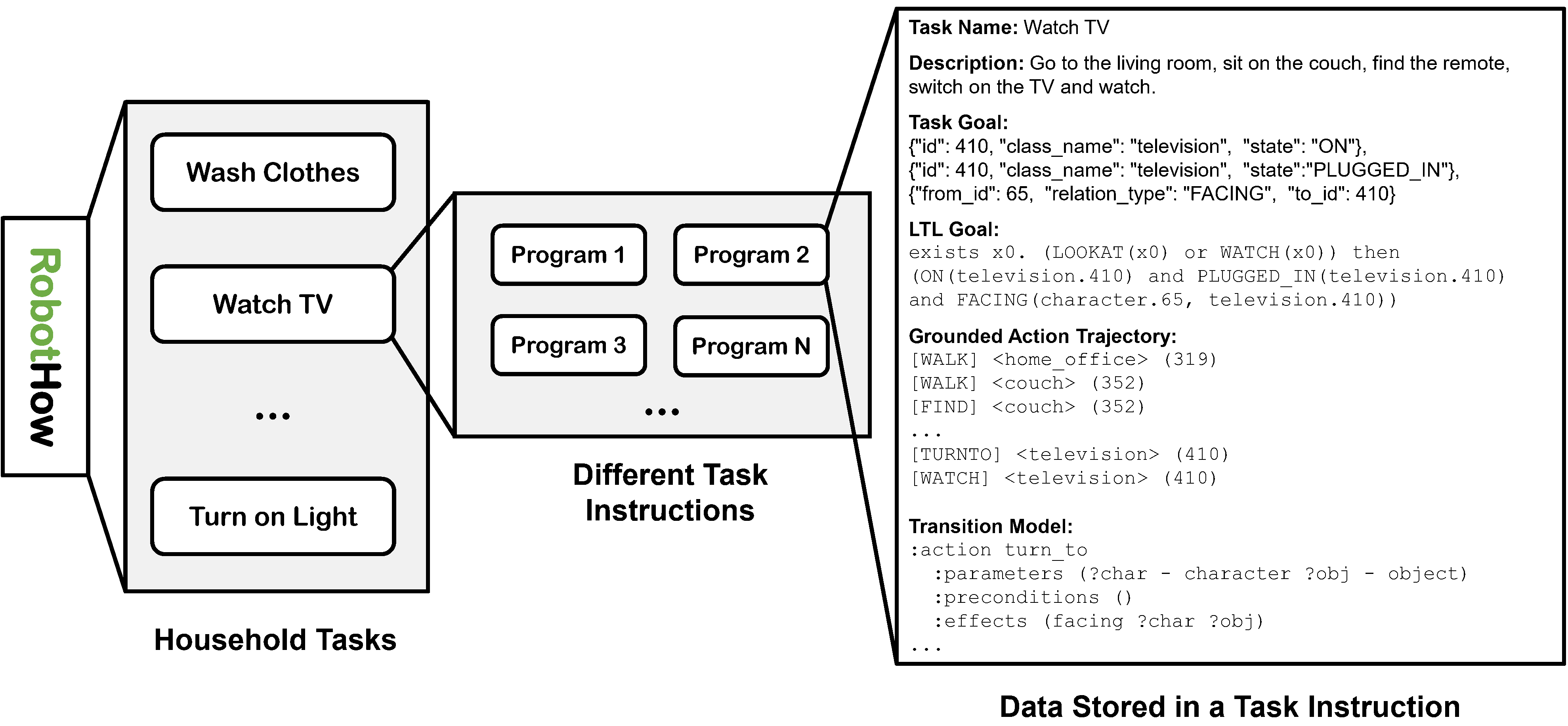
Each instance in the dataset represents a task goal. Specifically, each task contains the following data:
Natural language task name
Natural language task instruction
Symbolic goal definition (including its LTL form)
Symbolic action trajectory
The transition models involved in the task
For tasks in the BEHAVIOR environment, the dataset also includes accompanying VR human demonstration videos that showcase the execution of the ground truth action trajectories.
We integrated our evaluation pipeline into the HELM code base for easy and reproducible LLM inference. Users can set up their environment using here. We standardized decoding parameters across all models, using temperature zero for \(\operatorname*{arg\,max}\) sampling. Evaluating all models on our benchmark required \(180\) runs. Detailed model information is provided in the table below.
Table 2 : Model Cards for All Evaluated Large Language Models
Model Name
Creator
Complete Model ID
Release
Hosting
Claude-3 Haiku
Anthropic
claude-3-haiku-20240307
03/07/24
Anthropic
Claude-3 Sonnet
Anthropic
claude-3-sonnet-20240229
02/29/24
Anthropic
Claude-3 Opus
Anthropic
claude-3-opus-20240229
02/29/24
Anthropic
Claude-3.5 Sonnet
Anthropic
claude-3-5-sonnet-20240620
06/20/24
Anthropic
Cohere Command R
Cohere
command-r
03/11/24
Cohere
Cohere Command R+
Cohere
command-r-plus
04/04/24
Cohere
Gemini 1.0 Pro
Google
gemini-pro
12/13/23
GCP Vertex
Gemini 1.5 Flash
Google
gemini-1.5-flash-preview-0514
05/14/24
GCP Vertex
Gemini 1.5 Pro
Google
gemini-1.5-pro-preview-0409
04/09/24
GCP Vertex
GPT-3.5-turbo
OpenAI
gpt-3.5-turbo-0125
01/25/24
OpenAI
GPT-4-turbo
OpenAI
gpt-4-turbo-2024-04-09
04/09/24
OpenAI
GPT-4o
OpenAI
gpt-4o-2024-05-13
05/13/24
OpenAI
Llama3 8B Instruct
Meta
meta-llama-3-8b-instruct
04/18/24
TogetherAI
Llama3 70B Instruct
Meta
meta-llama-3-70b-instruct
04/18/24
TogetherAI
Mistral Large
MistralAI
mistral-large-2402
02/26/24
MistralAI
Mixtral 8x22B MoE
MistralAI
mixtral-8x22b-instruct-v0.1
04/17/24
TogetherAI
o1-mini
OpenAI
o1-mini-2024-09-12
09/12/24
OpenAI
o1-preview
OpenAI
o1-preview-2024-09-12
09/12/24
OpenAI
BibTeX
@inproceedings{li2024embodied,
    title={Embodied Agent Interface: Benchmarking LLMs for Embodied Decision Making},
    author={Li, Manling and Zhao, Shiyu and Wang, Qineng and Wang, Kangrui and Zhou, Yu and Srivastava, Sanjana and Gokmen, Cem and Lee, Tony and Li, Li Erran and Zhang, Ruohan and others},
    booktitle={NeurIPS 2024},
    year={2024}
}
You are visitor 01402503 — GeezerVison does not store the pages you look up. Best viewed with Netscape Navigator 4.7 or Internet Explorer 6 at 800×600. No cookies required.