GeezerVisonThe World Wide Web, restored to 800 pixels of glory. |
| Home|About|Gaming cabinet|Archives|How it works|Starter sites |
GeezerVison is showing github.com — RocksDB Bloom Filter RocksDB Bloom Filter
Merlin edited this page
For any arbitrary set of keys, an algorithm may be applied to create a bit array called a Bloom filter. Given an arbitrary key, this bit array may be used to determine if the key may exist or definitely does not exist in the key set. For a more detailed explanation of how Bloom filters work, see this Wikipedia article. In RocksDB, when the filter policy is set, every newly created SST file will contain a Bloom filter, which is used to determine if the file may contain the key we're looking for. The filter is essentially a bit array. Multiple hash functions are applied to the given key, each specifying a bit in the array that will be set to 1. At read time also the same hash functions are applied on the search key, the bits are checked, i.e., probe, and the key definitely does not exist if at least one of the probes return 0. The example of setting up a bloom filter: This generates filters using about 10 bits of space per key, which works well for many workloads, though the bits per key is continuously configurable from 1 to 20 or more. The benefit of a higher setting is reducing I/O, CPU, and block cache churn associated with DB::Get, or Seek with prefix Bloom. The benefit of a lower setting is reducing Bloom filter space, almost all of which will live in memory as well as on disk. An important thing to keep in mind when configuring Bloom filter space is diminishing returns (or non-linearity; more details in below sections):
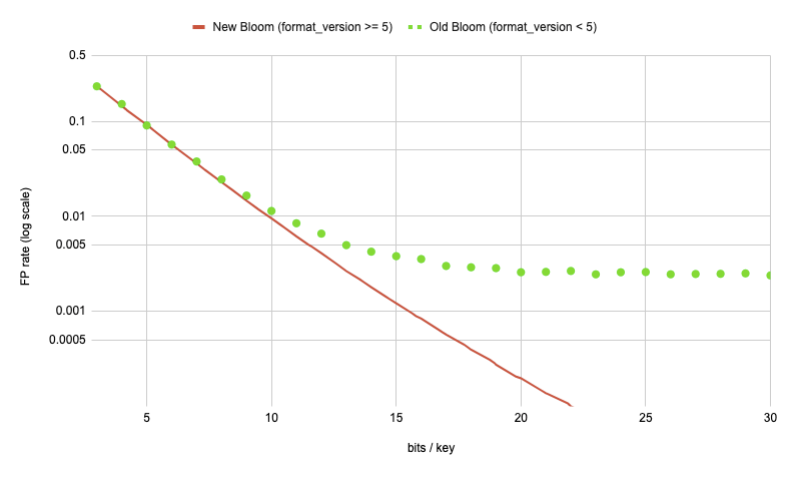
There is a small CPU overhead associated with using Bloom filters at all, largely independent of bits-per-key setting, but for most workloads, the savings far exceed the cost. If the question is whether to enable Bloom filters or not and memory pressure is a concern, it's better to compare NewBloomFilterPolicy(3) to no filter policy, than to compare NewBloomFilterPolicy(10) to no filter policy. (We should not assume outright that it's worth tripling Bloom space for 1/3rd more benefit.) A new Bloom filter alternative is available as a drop-in replacement (since version 6.15.0), saving about 30% of Bloom filter space (most importantly, memory) but using about 3-4x as much CPU on filters. Most of the additional CPU time is in the background jobs constructing the filters, and this is usually a good trade because it is common for SST filters to use ~10% of system RAM and well under 1% of CPU. At present, the new API assumes you want the same false positive rate as a Bloom filter but save memory. For example, There is higher temporary (untracked) memory use during construction of each Ribbon filter compared to Bloom filters (~231 bits per key vs. ~74 bits per key), but only ~50 filters (SST files or partitions) are needed to recoup this extra memory with savings from constructed filters. Ribbon filter construction could also slow peak write rates in some cases. (We are working to address these issues.) Ribbon filters are described in this paper. When configured in RocksDB, each SST file is created with a Bloom filter, embedded in the SST file itself. Bloom filters are generally constructed for files in all levels in the same way, except that the last level can be skipped by setting Because of different sizes and other Bloom filter limitations, SST Bloom filters are not generally compatible with each other for optimized AND/OR composition. Even when we combine two SST files, a new Bloom filter is created from scratch with the keys of the new file, in part to ensure predictable bits/key and, thus, false positive rate. When we open an SST file, the corresponding Bloom or Ribbon filter is also opened and loaded in memory using its original configuration parameters. (Any With this API, a Bloom filter could only be built if all keys fit in memory. On the other hand, sharding keys across bloom filters does not affect the overall false positive rate if each filter is sized for the number of keys added. Therefore, to alleviate the memory pressure when creating the SST file, in the old format a separate bloom filter is created per each 2KB block of key values. Details for the format can be found here. At the end an array of the offsets of individual bloom blocks is stored in SST file. At read time, the offset of the block that might contain the key/value is obtained from the SST index. Based on the offset the corresponding bloom filter is then loaded. If the filter suggests that the key might exist, then it searches the actual data block for the key. The individual filter blocks in the old format are not cache aligned and could result into a lot of cache misses during lookup. Moreover although negative responses (i.e., key does not exist) of the filter saves the search from the data block, the index is already loaded and looked into. The new format, full filter, addresses these issues by creating one filter for the entire SST file. The tradeoff is that more memory is required to cache a hash of every key in the file (versus only keys of a 2KB block in the old format). Full filter limits the probe bits for a key to be all within the same CPU cache line. This ensures fast lookups and maximizes CPU cache effectiveness by limiting the CPU cache misses to one per key (per filter). Note that this is essentially sharding the bloom space and has only a small effect on the false positive rate as long as there are many keys. Refer to "The Math" section below for more details. At read time, RocksDB uses the same format that was used when creating the SST file. Users can specify the format for the newly created SST files by setting The first underlying Bloom filter implementation used for full filters (and partitioned filters) had some flaws, and a new implementation is used with The following graph can be used to pick a bits_per_key setting to achieve a certain false positive rate in the Bloom filter, old or new implementation. You might also consult this for migrating to format_version=5 if you wish to save filter space and keep the same FP rate. (Note that FP rates are not percentages here. For example, 0.001 means 1 in 1000 queries of keys not in the SST file will falsely return true, leading to extra work by RocksDB to determine the key is not actually in the SST.)
By default a hash of every whole key is added to the bloom filter. This can be disabled by setting Here are the statistics that can be used to gain insight of how well your full bloom filter settings are performing in production: The following stats are updated after each
The following stats are updated after each point lookup. If
So the observed false positive rate of point lookups is computed by (positives - true positives) / (positives - true positives + true negatives), which is (number of queries returning positive on keys or prefixes not in the SST) / (number of queries on keys or prefixes not in the SST). Pay attention to these confusing scenarios:
FilterPolicy (include/rocksdb/filter_policy.h) can be extended to define custom filters. The two main functions to implement are: In this way, the new filter policy would function as a factory for FilterBitsBuilder and FilterBitsReader. FilterBitsBuilder provides interface for key storage and filter generation and FilterBitsReader provides interface to check if a key may exist in filter. A newer alternative to This variant allows custom filter configuration based on contextual information such as table level, compaction style, and column family. See Notice: This builder/reader interface only works for full and partitioned filters (new format). Partitioned filters use the same filter block format as full filters, but use many filter blocks per SST file partitioned by key range. This feature increases the average CPU cost of an SST Bloom query because of key range partitioning, but (with cache_index_and_filter_blocks=true) greatly reduces worst-case data loaded into the block cache for a single small-data op. This can mitigate and smooth a block cache thrashing "cliff" and improve tail latencies. Read here. A key cost of Bloom and Ribbon filters is the memory space they occupy, and that space can often be reduced by setting Refer e.g. to the wikipedia article for standard false positive rate of a Bloom filter. The CPU cache-friendly Bloom filter variant is presented and analyzed in this 2007 paper(page 4, formula 3). In short, the Bloom filter is sharded into For CPU-cache locality of probes, This can be understood using the Poisson distribution (as an approximation of a binomial distribution), using parameter
The standard deviation is the square root of that This modest increase in false positive rate, here a factor of 1.13 higher, is considered quite acceptable for the speed boost, especially in environments heavily utilizing many cores. (Ribbon filters generally offer a better space-for-time trade-off than standard Bloom filters with no locality.) Contents
Clone this wiki locally |
| You are visitor 01402503 — GeezerVison does not store the pages you look up. Best viewed with Netscape Navigator 4.7 or Internet Explorer 6 at 800×600. No cookies required. |