GV

GeezerVison

The World Wide Web, restored to 800 pixels of glory.

Home|About|Gaming cabinet|Archives|How it works|Starter sites

On this site

  • Sign in
  • ActionsCI/CD and automation
  • CodespacesCloud development environments
  • All Features
  • Documentation
  • Training
  • Certifications
  • Build with Copilot
  • Customize Copilot
  • Integrations
  • Trending repos
  • GitHub Sponsors
  • Developer articles
  • Enterprises

This view

  • Original page
  • New address

GeezerVison is showing github.com — GitHub - MagicStack/uvloop: Ultra fast asyncio event loop.

BranchesTags
Open more actions menu

Latest commit


History

985 Commits
985 Commits

Folders and files

NameName
Last commit message
Last commit date
.github
.github
 
 
docs
docs
 
 
examples/bench
examples/bench
 
 
tests
tests
 
 
uvloop
uvloop
 
 
vendor
vendor
 
 
.editorconfig
.editorconfig
 
 
.flake8
.flake8
 
 
.gitignore
.gitignore
 
 
.gitmodules
.gitmodules
 
 
LICENSE-APACHE
LICENSE-APACHE
 
 
LICENSE-MIT
LICENSE-MIT
 
 
MANIFEST.in
MANIFEST.in
 
 
Makefile
Makefile
 
 
README.rst
README.rst
 
 
mypy.ini
mypy.ini
 
 
performance.png
performance.png
 
 
pyproject.toml
pyproject.toml
 
 
setup.py
setup.py


Repository files navigation

https://img.shields.io/github/actions/workflow/status/MagicStack/uvloop/tests.yml?branch=master PyPI - Downloads

uvloop is a fast, drop-in replacement of the built-in asyncio event loop. uvloop is implemented in Cython and uses libuv under the hood.

The project documentation can be found here. Please also check out the wiki.

Performance

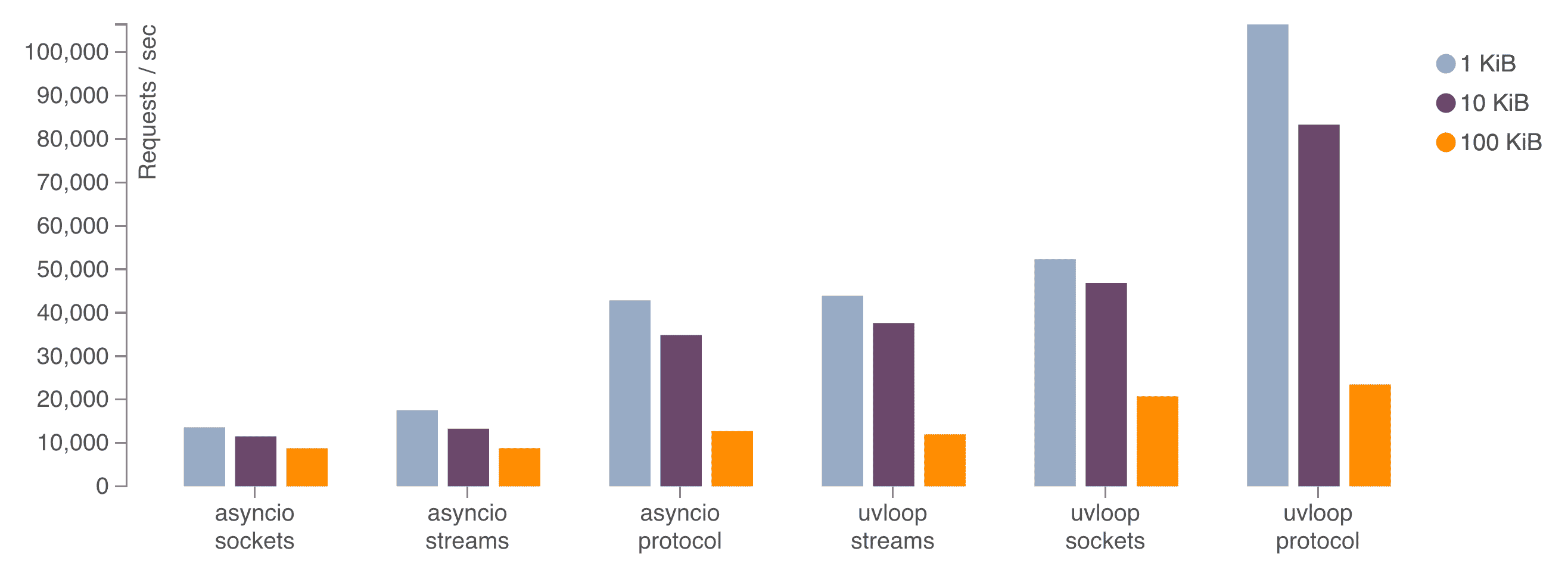
uvloop makes asyncio 2-4x faster.

https://raw.githubusercontent.com/MagicStack/uvloop/master/performance.png

The above chart shows the performance of an echo server with different message sizes. The sockets benchmark uses loop.sock_recv() and loop.sock_sendall() methods; the streams benchmark uses asyncio high-level streams, created by the asyncio.start_server() function; and the protocol benchmark uses loop.create_server() with a simple echo protocol. Read more about uvloop in a blog post about it.

Installation

uvloop requires Python 3.9 or greater and is available on PyPI. Use pip to install it:

$ pip install uvloop

Note that it is highly recommended to upgrade pip before installing uvloop with:

$ pip install -U pip

Using uvloop

As of uvloop 0.18, the preferred way of using it is via the uvloop.run() helper function:

import uvloop

async def main():
    # Main entry-point.
    ...

uvloop.run(main())

uvloop.run() works by simply configuring asyncio.run() to use uvloop, passing all of the arguments to it, such as debug, e.g. uvloop.run(main(), debug=True).

With Python 3.11 and earlier the following alternative snippet can be used:

import asyncio
import sys

import uvloop

async def main():
    # Main entry-point.
    ...

if sys.version_info >= (3, 11):
    with asyncio.Runner(loop_factory=uvloop.new_event_loop) as runner:
        runner.run(main())
else:
    uvloop.install()
    asyncio.run(main())

Building From Source

To build uvloop, you'll need Python 3.9 or greater:

  1. Clone the repository:

    $ git clone --recursive [email protected]:MagicStack/uvloop.git
    $ cd uvloop
    
  2. Create a virtual environment and activate it:

    $ python3 -m venv uvloop-dev
    $ source uvloop-dev/bin/activate
    
  3. Install development dependencies:

    $ pip install -e .[dev]
    
  4. Build and run tests:

    $ make
    $ make test
    

License

uvloop is dual-licensed under MIT and Apache 2.0 licenses.

About

Ultra fast asyncio event loop.

Topics

asyncasync-awaitasync-pythonasyncioevent-loophigh-performancelibuvnetworkingpythonpython-3

Resources

Readme
Activity
Custom properties

Stars

11.9k stars

Watchers

215 watching

Forks

620 forks
Report repository

Releases

Packages

Used by

Contributors

Languages

You are visitor 01402503 — GeezerVison does not store the pages you look up.
Best viewed with Netscape Navigator 4.7 or Internet Explorer 6 at 800×600. No cookies required.