
The official command-line interface for Aliyun Model Studio (DashScope) AI Platform
Aliyun Model Studio CLI Site · 中文文档 · API Documentation · Get API Key
Chat with Qwen, generate and edit images and videos, understand images, synthesize and recognize speech, call apps, manage memory, retrieve knowledge, search the web — every AI capability, one command away.
Built for AI Agents. Every command works as a structured tool call.
- Model generation — Full-modality generation across text, image, video, and speech, with editing and reference-based generation
- Asset understanding — Parse and ask questions about images, documents, audio, and long videos
- App orchestration — Call Managed Agents, agents, and workflows published on Aliyun Model Studio, wired to knowledge bases, memory, web search, and MCP tools; create, update, publish, copy, and delete agents/workflows, and edit workflow canvases from the CLI
- Native MCP setup — Register Bailian MCP servers in Codex, Claude Code, Cursor, Qoder, Qoder Work, QwenWork (千问办公), Qwen Code, Gemini CLI, or Pi
- Training & deployment — Prepare decision training data (local split, teacher-model generation, or fully async offline Batch), validate and upload datasets, fine-tune models (SFT/DPO/CPT), run reinforcement-learning jobs in an isolated sandbox (macOS/Linux), submit OPD distillation jobs via OpenAPI, deploy dedicated models as endpoints
- Batch inference — Prepare CSV/JSONL, create and follow asynchronous Chat/Embedding tasks, download original results/errors with optional CSV, or send one synchronous Batch Chat request
- Account operations — Login, UI-based configuration, model marketplace, usage and quota, rate-limit increases, team seat management
- Plan onboarding — Connect subscription plans such as Token Plan to the CLI and common coding agents in one step
Note: App orchestration, native MCP setup, training & deployment, account operations, and plan onboarding are currently available only to China site (aliyun.com) account holders and are not yet supported for international / global site accounts.

👆 Click the cover to play the full 2-minute demo
A complete 2-minute, 16:9 cinematic short film — produced end-to-end from a single natural-language sentence, with zero manual editing. This showcase demonstrates how an AI Agent can compose a multi-step creative pipeline by orchestrating three primitives:
- Qwen Code — the agentic coding model that interprets the user's intent and drives the workflow
- Aliyun Model Studio CLI — invokes HappyHorse 1.1, Aliyun Model Studio's text-/image-/reference-to-video generation model
- spark-video Skill — handles scene decomposition, storyboarding, shot continuity, and final stitching
"Generate a roughly 2-minute video in Japanese cinematic style — a sweet, innocent first-love story about a high-school girl. The plot should be heart-fluttering enough to make viewers want to fall in love. Aspect ratio: 16:9."
👆 Click the cover to play the full demo
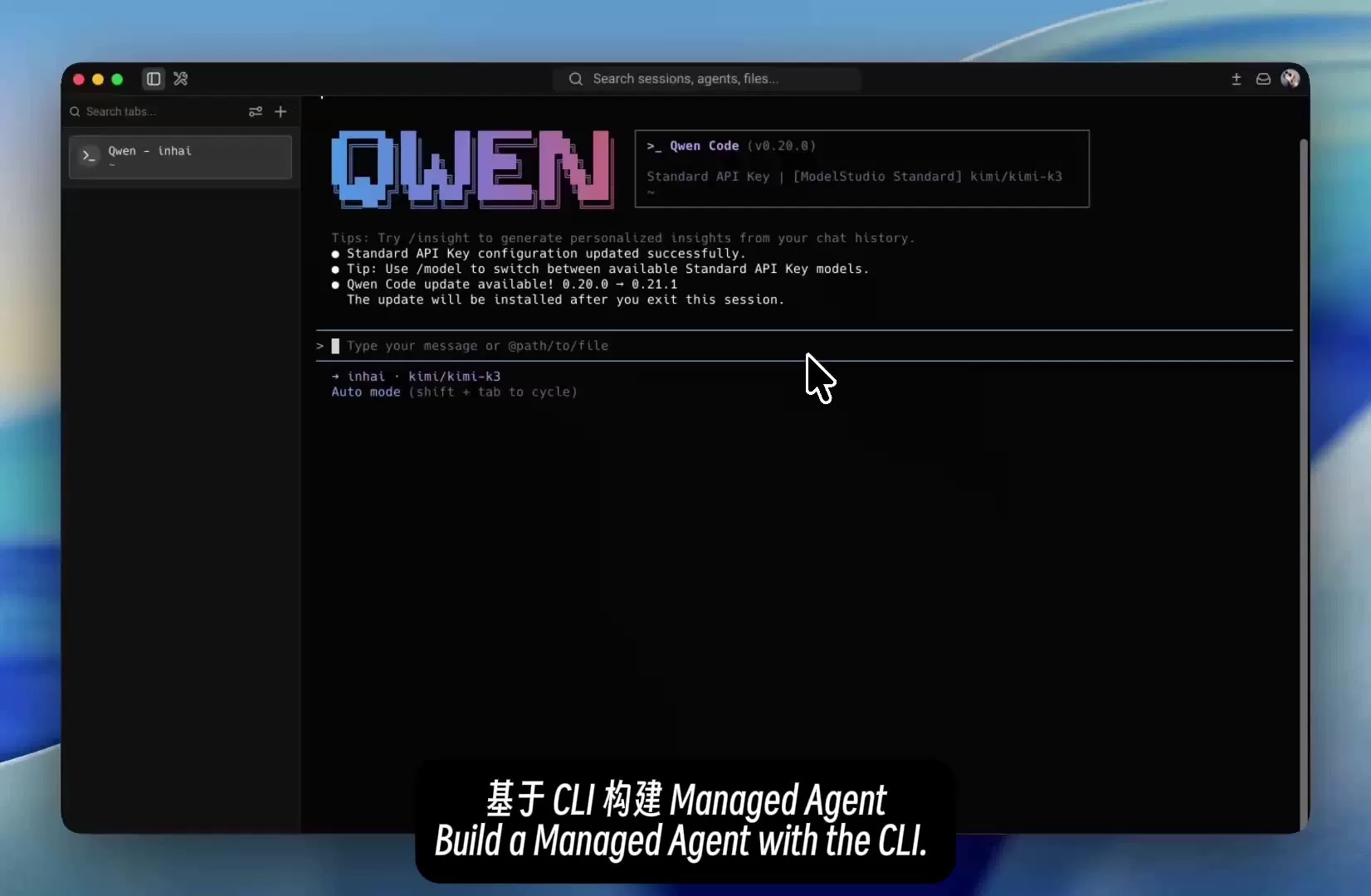
One sentence builds a reusable cloud-side short-film director for storyboarding, storyboard image generation, and video creation:
- Qwen Code — understands the requirement and generates the agent configuration
- Aliyun Model Studio CLI — validates the configuration, previews the changes, and completes the deployment
- Managed Agent — runs the director role along with its skills and tools in the cloud
"Build me a Managed Agent app that can produce short films — a director expert that generates videos and can also design the matching storyboards."
Agent install (recommended)
Send the following to your Agent — it will detect your environment, then install and verify the CLI for you:
Please read https://bailian.aliyun.com/cli/install.md and install the Aliyun Model Studio CLI for me
Install with NPM
npm install -g bailian-cli
bl skill init
Requires Node.js >= 18.17.
Install on macOS/Linux
curl -fsSL https://bailian.aliyun.com/cli/install.sh | bashNo Node.js required. The installer automatically installs Bailian Skills.
Install on Windows
irm https://bailian.aliyun.com/cli/install.ps1 | iex
No Node.js required. The installer automatically installs Bailian Skills.
Once installed, just describe your task to your AI Agent — no need to assemble commands by hand.
| Scenario | What to say to your Agent |
|---|---|
| Managed Agent | "Create a Managed Agent that can generate short-film storyboards and videos." |
| Image & video generation | "Generate an image of a cat in a spacesuit on Mars, then turn it into a video." |
| Speech recognition | "Transcribe this audio; if proper nouns are wrong, add hot words and try again." |
| Usage & quota | "Show my recent model usage, free-tier quota, and rate limits." |
| Monitoring & alerts | "Show my model call stats, failures and logs, and create an alert rule." |
| Throughput reservations | "List my throughput reservations and capacity instances, then scale, renew or release capacity and wait for the operation to finish." |
| Model selection | "Recommend a model for image understanding and customer support." |
| Decision model | "Use the Bailian decision model to route this ticket and assess whether it needs escalation." |
| About Bailian CLI | "Tell me what Bailian CLI can do for me, and suggest how to use it for my needs." |
More examples and scenarios: Aliyun Model Studio CLI Site
With a valid API key and workspace, preview initialization first:
bl knowledge init --workspace-id <workspace-id> --dry-run
Knowledge bases accrue running-time charges from creation, even without queries. The one-time Standard Edition 720-hour allowance is shared across knowledge bases and expires 30 days after activation for new users. Model calls cost extra; your remaining allowance is unknown. Review the plan and billing rules, then add --yes to the same command after confirming the operation, removing --dry-run to execute.
Keep the returned IDs and recovery record. Closing the CLI or a later failure does not stop billing; follow the reported cleanup actions to delete unused knowledge bases. See the Knowledge Studio quick start for retrieval and cleanup. The bailian-knowledge Skill is available through bl skill init.
bl dataset groups --page 1 --page-size 10 --output json
bl dataset version --dataset-group-id <group-id> --output json
bl dataset version --dataset-id <version-id> --include-status --output json
bl file url --file-key <console-file-key> --output json
bl deploy instances --page 1 --page-size 10 --output json
Use dataset groups (--name optionally filters on the server) to obtain records[].datasetGroupId, then dataset version --dataset-group-id <group-id> to get {result:[...]} with result[].datasetId and its optional fileId. Use dataset version --dataset-id <version-id> for details; --include-status is available only in detail mode. Exactly one of --dataset-group-id and --dataset-id is required; they cannot be combined. fileId is not datasetId and must not be passed as a version ID. Groups fetch one page with one embedded version preview per group; version --dataset-group-id does not promise exhaustive results or expose pagination. The API Key / file_id semantics of dataset list are unchanged.
These read-only commands use Console authentication. An optional --workspace-id resolves the workspace's Console identity before querying; resolution failure stops the request. dataset version --dataset-id keeps metadata and version/task state separate and does not infer validation success or training readiness. file url only resolves a download address. deploy instances returns one page of independent services (records is the list, items the total), not capacity instances. The API-key dataset get --file-id and deploy list commands are unchanged. Add --dry-run to preview without business requests; framework update checks/telemetry follow their settings.
bl knowledge doc import --index-id <id> --doc-id <fileId> imports an existing file into a knowledge base; doc list --details shows per-file processing settings. Media support includes parser options, streaming uploads, and media references in search/chunk output. Chat JSON separates the final answer from phases, tools, docs, usage, and raw events; quiet mode hides progress and informational messages while preserving the final result, including every JSON field. See the command guide.
Parse documents or audio/video and extract structured fields through the workspace-scoped ParseX API:
bl parsex parse submit --workspace-id <workspace-id> --file-url "https://example.com/document.pdf" --file-name document.pdf --output-file-format markdown --output json
bl parsex parse result --workspace-id <workspace-id> --biz-id <parse-biz-id> --follow --output json
bl parsex extract submit --workspace-id <workspace-id> --parsed-file-biz-id <parse-biz-id> --schema-file schema.json --output json
bl parsex extract result --workspace-id <workspace-id> --biz-id <extract-biz-id> --follow --output json
Use an ordinary API key and a workspace with ParseX access. Submission returns data.biz_id immediately; result --follow waits for completion. schema.json contains a JSON Schema object, for example {"type":"object","properties":{"title":{"type":"string"}}}. Inputs are accessible HTTP(S) URLs; extraction also accepts a retained document parsing task. See the ParseX command guide for processing options, result slices, OSS credentials, dry-run and polling behavior.
bl batch convert --help
bl batch convert --file input.csv --output-file input.jsonl --model qwen-plus
bl batch create --file input.jsonl --dry-run
bl batch create --file input.jsonl
bl batch get --batch-id <id> --follow
bl batch download --batch-id <id> --csv
bl text chat --batch --model qwen-plus --message "Hello" --timeout 3600
--help includes CSV, JSONL and result data examples. convert is local and needs no key; inference/task commands use a model API key. File inference uses asynchronous tasks via create → get → download: create uploads/submits and returns a task ID without waiting for completion. Query with get and download results after completion. Conversion/download files are atomically published per file and never silently overwritten. Use --force to recover partial downloads. JSONL is the authoritative result, while CSV is a lossy display; import IDs as text to preserve leading zeros. Ctrl-C stops local polling, not the remote task.
text chat --batch sends one synchronous request and waits for its response; it does not create an asynchronous task ID. Use --message or --messages-file, which contains one request's conversation context, not independent file requests. The total request timeout defaults to 300 seconds (--timeout: 60–3600 seconds). Timeout/Ctrl-C/disconnection do not guarantee server cancellation.
Synchronous Batch Chat is non-streaming; explicit realtime/international/Token Plan endpoints are rejected. An explicit realtime profile requires --base-url https://batch.dashscope.aliyuncs.com. Batch availability and limits depend on the service/model. Dry-run avoids business requests and output/directory writes; framework update checks/telemetry follow their settings.
Required for console capability commands (model list, flow-agent list, workspace, usage queries, rate-limit increases, direct console calls). It can create an ordinary API key when needed. Token Plan and other subscription plans cannot use --console; use the API Key login below.
bl auth login --console
Use --console-site international for the international console.
The CLI always prints the login URL. To choose a browser yourself, keep the command running and open the URL on the same machine:
bl auth login --console --no-browser --console-site international
If the browser blocks the local callback, check the console site's local-network permission or try Firefox. The PNA compatibility header does not bypass Chrome's local-network permission or Safari's mixed-content restrictions. No callback within 15 minutes is a failure (exit code 5), not a successful login.
If you already have a valid console access token, import it via stdin without a browser or local callback server. Specify the token's actual region and site; for example, in a POSIX shell:
bl auth login --console --token-stdin --console-site international --console-region ap-southeast-1 < /path/to/console-token.txtInput must be one raw token (up to 64 KiB), not JSON or Bearer ...; interactive terminal input is rejected to avoid echoing secrets. Use a protected file or trusted pipe, never put the token in command arguments or shell history, and remove temporary secret files after use. The CLI validates the token before saving; failure leaves existing credentials and the active Profile unchanged. Add --config <name> to save and activate a specific Profile on success. This imports only the console session, not a model API key.
MCP management and cloud Skill commands use the configured workspace ID to build the Beijing workspace endpoint. Set it once with bl config set workspace_id <id>, or use BAILIAN_WORKSPACE_ID or --workspace-id. An explicit model base URL (flag, environment or profile) takes precedence.
Search the cloud Skill catalog with a Bailian API key, for example bl skill search --keyword pdf --type official. Pass a returned skill_code to bl skill get --code <skill_code> to see the latest version and local installation paths. Omit --type to include private skills in your workspace. skill get also reads MCP server codes from the latest package’s mcp-config.json by default. Use --with-mcp false to skip the package download.
Install a search result with bl skill add --code <skill_code> --agent cursor --scope project. Add --skill-version 1.0 to pin a version. bl skill list --scope project shows installation paths and states. Preview updates with bl skill update --code <skill_code> --scope project --diff --dry-run and omit --dry-run to apply. bl skill remove --code <skill_code> --agent cursor --scope project removes that local installation offline.
When targeting a skill with get, add, update or remove, use either --code with its cloud OpenAPI code or --name with its public OSS registry name. For example, bl skill add --name spark-video installs one OSS skill. bl skill add --all installs the entire public OSS registry. Browse that registry with bl skill list --source oss.
Skill commands check unpinned installations from the selected source and report available updates on stderr. The check reuses catalog reads and caches revisions for 24 hours. Removal uses the cache offline. Run bl skill update to update installed cloud skills, or bl skill update --all to update installed OSS skills. bl skill update --name all remains an alias for bl skill update --all.
Installation activates inactive MCP dependencies by default, which may incur charges. Use --dry-run to preview the activation plan. To install only the Skill, pass --with-mcp false.
Use an ordinary Bailian API key to list activated MCP servers (bl mcp list), inspect server details and tools (bl mcp get --server <code>), and manage custom servers (bl mcp create, update, delete). Use --dry-run to preview changes. Deleting a custom server requires bl mcp delete --server <code> --yes.
Search for tools with a natural-language query, for example bl mcp tool search --query "look up an order" --limit 5. Recommendations can trigger OneKey activation. For a known server, use bl mcp tool list --server <code> to read its tools and input schemas through OpenAPI. Listing tools can also trigger OneKey activation. Both commands support a local --dry-run preview. To inspect tools through an MCP session, use bl mcp tools --server <code> with an optional --url <endpoint>.
To call a tool through OpenAPI, run bl mcp tool call --server <code> --tool getOrder --arg orderId=A123. Use --dry-run to preview the arguments. Calling a tool may activate a OneKey service. To call through an MCP session, use bl mcp call --target <code>.getOrder --arg orderId=A123. Both commands apply --json first, then repeated --arg values, and finally --query as text.
Use bl mcp activate --server <code,...> or bl mcp deactivate --server <code,...> for up to 30 distinct official or custom servers. Preview changes with --dry-run. OneKey activation may place an order. Stopping a custom server keeps its saved configuration.
Use bl mcp connect --server <code> --transport streamable-http --agent cursor to register the workspace endpoint. Connecting activates an inactive service by default. Use --and-activate=false to connect only to active services. Add --scope project from the project root for project-level registration. Agent config files and backups can contain your API key. bl mcp disconnect --server <code> --agent cursor removes the matching local registration offline. Use the same scope for both commands.
To use an existing ordinary API key or a Token Plan subscription key, run the same command:
bl auth login --api-key <API_KEY>
Get an ordinary key from the DashScope Console, or a Token Plan key from the subscription overview.
Token Plan seat/member management and console token refresh need an Alibaba Cloud AccessKey. Run the setup guide, or get keys from the RAM Console and paste them.
Recommended: create a RAM sub-account with minimum privileges instead of using the root account's AK/SK.
# Open the setup guide (when finished, paste your AccessKey back in the terminal)
bl auth login --open-api

# If you already have an AccessKey, configure it directly
bl auth login --open-api --access-key-id LTAI5t... --access-key-secret ...
# View current config
bl config show

# List all config profiles
bl config list

# Switch config profile
bl config use --name token-plan

# Switch the CLI interface to Chinese
bl config set --key language --value zh-CN
Config file location: ~/.bailian/config.json
bl update
Upgrades the CLI to the latest version and refreshes the installed Agent Skills. Release notes for every version live in CHANGELOG.md.
Bug reports, feature requests, and PRs are welcome. See CONTRIBUTING.md for developer setup, repo layout, and the workflow for adding or changing commands.
Scan the QR code to join the Aliyun Model Studio CLI DingTalk user group for usage help, troubleshooting, bug reports, and tips from other users.

Memory documentation (Chinese): capability matrix · command guide.
| Resource | URL |
|---|---|
| Aliyun Model Studio CLI Site | https://bailian.console.aliyun.com/cli?spm=a2ty07.github |
| DashScope API Docs | https://help.aliyun.com/zh/model-studio/ |
| Qwen Model List | https://help.aliyun.com/zh/model-studio/getting-started/models |
| Aliyun Model Studio Console | https://bailian.console.aliyun.com/?spm=a2ty07.github |
| Get API Key | https://bailian.console.aliyun.com/cn-beijing/?spm=a2ty07.github&tab=app#/api-key |
| Get Token Plan API Key | https://bailian.console.aliyun.com/cn-beijing?spm=a2ty07.github&tab=plan#/efm/subscription/overview |
| Get AccessKey | https://ram.console.aliyun.com/manage/ak |