2nd place in [AIM 2019 ICCV Workshop] - Video Temporal Super-Resolution Challenge
Project | Paper-AAAI (Download the paper [here] in case the AAAI link is broken) | Poster

project
│   README.md
|   run.sh - main script to train CAIN model
|   run_noca.sh - script to train CAIN_NoCA model
|   test_custom.sh - script to run interpolation on custom dataset
|   eval.sh - script to evaluate on SNU-FILM benchmark
|   main.py - main file to run train/val
|   config.py - check & change training/testing configurations here
|   loss.py - defines different loss functions
|   utils.py - misc.
└───model
│   │   common.py
│   │   cain.py - main model
|   |   cain_noca.py - model without channel attention
|   |   cain_encdec.py - model with additional encoder-decoder
└───data - implements dataloaders for each dataset
│   |   vimeo90k.py - main training / testing dataset
|   |   video.py - custom data for testing
│   └───symbolic links to each dataset
|       | ...
Current version is tested on:
- Ubuntu 18.04
- Python==3.7.5
- numpy==1.17
- PyTorch==1.3.1, torchvision==0.4.2, cudatoolkit==10.1
- tensorboard==2.0.0 (If you want training logs)
- opencv==3.4.2
- tqdm==4.39.0
# Easy installation (using Anaconda environment)
conda create -n cain
conda activate cain
conda install python=3.7
conda install pip numpy
conda install pytorch torchvision cudatoolkit=10.1 -c pytorch
conda install tqdm opencv tensorboard

- We use Vimeo90K Triplet dataset for training + testing.
- After downloading the full dataset, make symbolic links in
data/folder :ln -s /path/to/vimeo_triplet_data/ ./data/vimeo_triplet
- Then you're done!
- After downloading the full dataset, make symbolic links in
- For more thorough evaluation, we built SNU-FILM (SNU Frame Interpolation with Large Motion) benchmark.
- Download links can be found in the project page.
- Also make symbolic links after download :
ln -s /path/to/SNU-FILM_data/ ./data/SNU-FILM
- Done!
- First make symbolic links in
data/folder :ln -s /path/to/vimeo_triplet_data/ ./data/vimeo_triplet - For training:
CUDA_VISIBLE_DEVICES=0 python main.py --exp_name EXPNAME --batch_size 16 --test_batch_size 16 --dataset vimeo90k --model cain --loss 1*L1 --max_epoch 200 --lr 0.0002 - Or, just run
./run.sh - For testing performance on Vimeo90K dataset, just add
--mode testoption - For testing on SNU-FILM dataset, run
./eval.sh- Testing mode (choose from ['easy', 'medium', 'hard', 'extreme']) can be modified by changing
--test_modeoption ineval.sh.
- Testing mode (choose from ['easy', 'medium', 'hard', 'extreme']) can be modified by changing
- Download pretrained models from [Here]
- Prepare frame sequences in
data/frame_seq - run
test_custom.sh

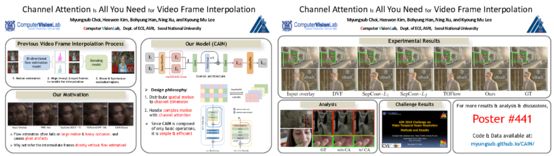
If you find this code useful for your research, please consider citing the following paper:
@inproceedings{choi2020cain,
    author = {Choi, Myungsub and Kim, Heewon and Han, Bohyung and Xu, Ning and Lee, Kyoung Mu},
    title = {Channel Attention Is All You Need for Video Frame Interpolation},
    booktitle = {AAAI},
    year = {2020}
}
Many parts of this code is adapted from:
We thank the authors for sharing codes for their great works.