GeezerVison is showing github.com — [Feature]: Render LaTeX/math in chat for research workflows · pingdotgg/t3code · Discussion #9641
[Feature]: Render LaTeX/math in chat for research workflows
#9641
Sep 4, 2026
·
13 comments
·
10 replies
Discussion options
-
Uh oh!
There was an error while loading. Please reload this page.
Problem / use case
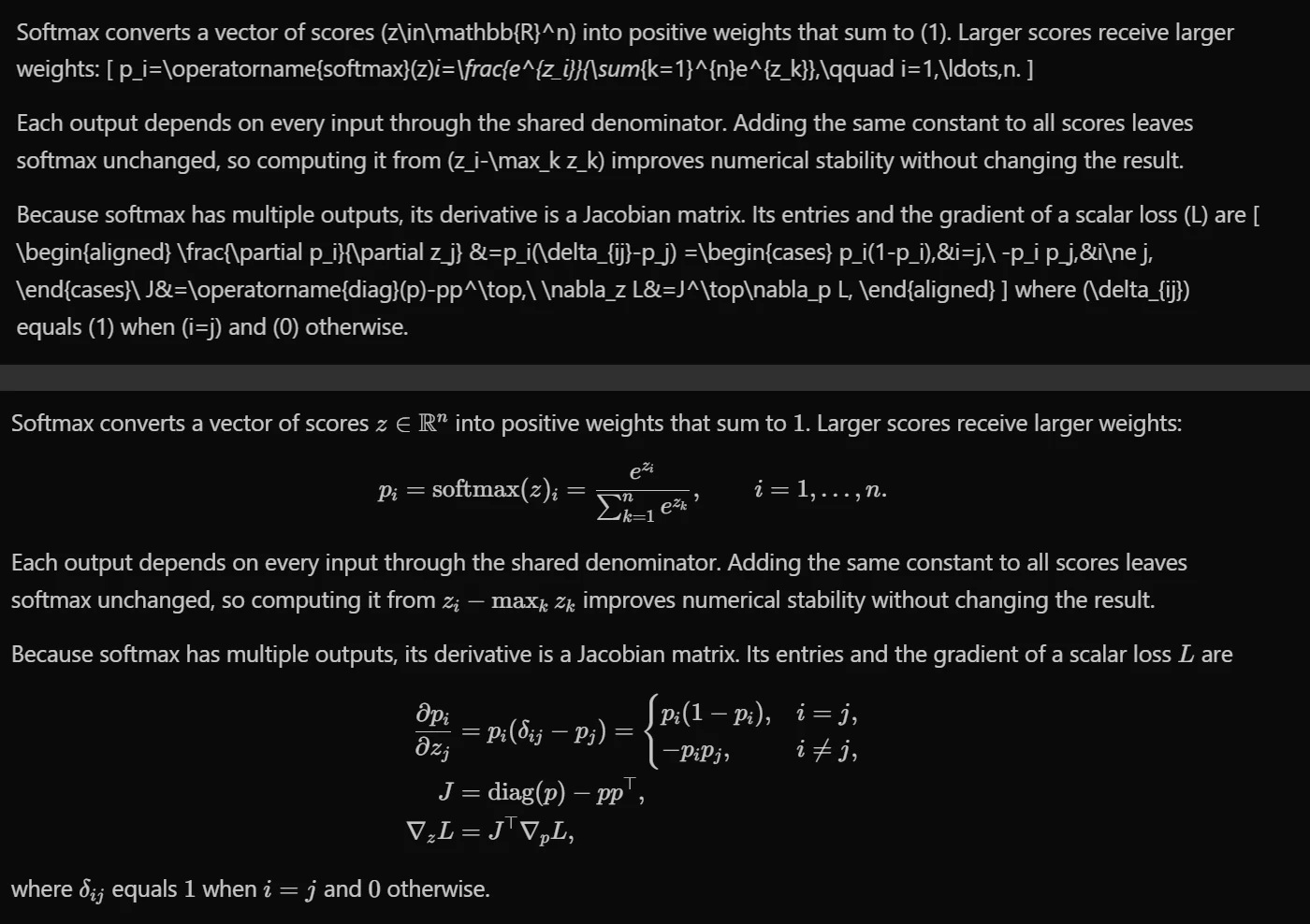
When an assistant returns LaTeX, T3 Code currently shows the TeX source as ordinary text instead of rendering the mathematics. This makes scientific and technical responses difficult to read, check, and reuse.
I encountered this while using T3 Code for an ensemble weather-forecasting research workflow. The attached screenshot shows equations such as \frac, \sum, \operatorname, and \begin{aligned} displayed literally in the chat instead of as formatted math.
Actual behavior
Common inline and display math is shown as raw source, including the delimiters and commands. The surrounding Markdown headings and prose render, but the mathematical notation does not.
Expected behavior
Please render common math delimiters in assistant messages, including:
- Inline math:
\(...\) and $...$
- Display math:
\[...\] and $$...$$
- Common LaTeX commands used by current models, such as fractions, sums, subscripts/superscripts, Greek letters, matrices, and aligned equations
KaTeX, MathJax, or an equivalent renderer would work. It would also be useful to preserve the original TeX when copying, keep long equations usable in narrow layouts, and fail safely for malformed expressions without breaking the rest of the message. Code blocks, escaped delimiters, and ordinary dollar amounts should remain unchanged.
Why this matters
T3 Code is useful beyond code editing, including research and technical writing. Readable math is essential for understanding probability distributions, loss functions, matrix operations, and evaluation metrics. At present, I have to copy responses elsewhere to read the equations properly.
Environment
- T3 Code desktop app
- Dark mode
- Codex provider (GPT-5.6-Luna shown in the screenshot)
- Reproduced September 4, 2026
Related reports
This is being posted in the Ideas category because the repository directs feature requests there. Related tracker items include:
I am not trying to create a competing duplicate report. I wanted to document a current reproducible example in the repository's requested Ideas workflow and add a concrete screenshot of the impact.

|
You must be logged in to vote
Replies:
13 comments
·
10 replies
Comment options
-
Uh oh!
There was an error while loading. Please reload this page.
|
+1 this is important for all technical work, including also AI research.
Additionally, most GUIs (including Codex and CC) have supported this from the very beginning.
|
You must be logged in to vote
6 replies
Comment options
-
Uh oh!
There was an error while loading. Please reload this page.
|
FYI, I'm using a local fork with latex support - it's easy enough with agents. Also allowed me some additional modifications that I wanted (e.g. some needed keybindings, mermaid support)
|
Comment options
-
Uh oh!
There was an error while loading. Please reload this page.
|
I was in the process of creating my own fork lol, thanks, I will definitely look at your now as well. Thanks
|
Comment options
-
Uh oh!
There was an error while loading. Please reload this page.
|
Not sure I pushed anything yet actually - and it also has some changes that are workflow specific for me and wouldn't work for anyone else.
Wasn't saying you should use mine, just that it's easy to do
|
Comment options
-
Uh oh!
There was an error while loading. Please reload this page.
-
Uh oh!
There was an error while loading. Please reload this page.
|
Let me know, if you push any changes any time. If something works already, I would prefer not having to do it again lol, I have enough work as it is as a student
|
Comment options
-
Uh oh!
There was an error while loading. Please reload this page.
Comment options
-
Uh oh!
There was an error while loading. Please reload this page.
|
I implemented and verified a current fix in #9838.
The PR renders all four common delimiters ($...$, $$...$$, \(...\), and \[...\]) through KaTeX in the shared web renderer, while leaving inline code, fenced/indented code blocks, and escaped delimiters alone. The length-preserving normalization also avoids shifting the source offsets used by interactive task lists.
It is rebased onto current main and covers web, desktop, and rendered Markdown previews. Verification includes 56 focused tests, web typechecking, targeted lint/formatting, a production build, and a real macOS check against the Linux-hosted dev server over an SSH tunnel. The PR includes the before/after screenshots from the weather-research example.
I also linked the earlier #7166 and #7739 attempts in the PR so maintainers have the full history and can compare approaches.
PR: #9838
|
You must be logged in to vote
0 replies
Comment options
-
Uh oh!
There was an error while loading. Please reload this page.
|
@juliusmarminge, one yes/no question so this has a clear answer either way.
In #1784 you said opt-in math would be fine "if it doesn't add too much complexity," and worried about "tons of remark plugins parsing latex." #14574 is built to that bar:
- Off by default (Settings → Appearance → Render math). When it's off, no parser is registered and KaTeX never loads.
- One micromark extension for the four delimiters models emit (
$…$, $$…$$, \(…\), \[…\]). No remark plugin stack, no regex rewrite of the source. Prices, $HOME, $skill chips and \[1\] stay text.
- Cost when on: the parser adds 2.9 KB gzipped, and messages without
$, \( or \[ skip it. KaTeX is a lazy chunk that only loads once a formula renders. KaTeX itself is a string renderer with no layout engine, and output is cached per formula.
- Untrusted content: KaTeX runs with
trust: false on text that has already been through the sanitizer. Invalid or unfinished TeX shows its source.
- Web and desktop only. Mobile is unchanged.
Is that scope approved? If it's too much, I'd cut it to display math only ($$ / \[). If it's a no, I'll close the PR.
|
You must be logged in to vote
0 replies
Comment options
-
Uh oh!
There was an error while loading. Please reload this page.
|
Adding my support for this request as a mathematics teacher using T3 Code for lesson preparation and checking mathematical explanations.
Equations in assistant responses currently appear as raw LaTeX instead of formatted mathematics. This makes me switch back to Codex Desktop just to read the equations correctly. I would prefer to stay in T3 Code throughout my workflow.
A concrete example from my conversation today is:
\[
\boxed{f\le g\text{ sur }D
\quad\Longleftrightarrow\quad
g-f\ge0\text{ sur }D.}
\]
T3 Code displays the commands such as \boxed, \le, \text, and \Longleftrightarrow literally in the response rather than rendering the equation. Inline expressions such as \(f\le g\) are also affected.
Please support both inline and display math in Markdown responses, including \(...\), $...$, \[...\], and $$...$$. KaTeX or MathJax support would make a substantial difference for mathematics, science, and technical explanations. An opt-in setting would also meet my needs.
Still reproducible on T3 Code Nightly 0.0.46-nightly.20261005.2676, macOS, on October 5, 2026.
Thank you for considering this. For my day-to-day teaching work, readable mathematics is a major reason to choose one assistant interface over another.
|
You must be logged in to vote
1 reply
Comment options
-
Uh oh!
There was an error while loading. Please reload this page.
|
Help backing #14574 to hopefully get the attention of the maintainers for a possible merge
|
Comment options
-
Uh oh!
There was an error while loading. Please reload this page.
|
This would be a nice addition!
|
You must be logged in to vote
0 replies
Comment options
-
Uh oh!
There was an error while loading. Please reload this page.
|
Would be great to see this in. Especially helpful for scientific programming.
|
You must be logged in to vote
0 replies
Comment options
-
Uh oh!
There was an error while loading. Please reload this page.
|
Until math lands in T3 itself, here's a stopgap for the Windows desktop app: t3-latex (unofficial).
It's not a fork and doesn't patch T3's install. A separate "T3 Code (LaTeX)" shortcut loads KaTeX into the official app at startup, so auto-updates keep working, and T3 opened from its own icon is unchanged.
- What it renders:
$…$, $$…$$, \(…\), \[…\] and bare environments such as aligned. Prices, $HOME, code and unclosed delimiters while a reply streams all stay text.
- Copy and Cite give the TeX source.
To install, get the zip from Releases and run install.cmd.
Please report problems there, not on T3's tracker.
|
You must be logged in to vote
1 reply
Comment options
-
Uh oh!
There was an error while loading. Please reload this page.
|
I have ended up doing something myself - t3-math. You can run this on a server within your tailscale and access from any device over browser. Not ideal, but works for my use case for time being.
|
Comment options
-
Uh oh!
There was an error while loading. Please reload this page.
|
+1. This would really help me. Here is a data point on why \(…\) and \[…\] support matters, beyond $.
I use T3 Code to work through math explanations (e.g. Jacobians and tangent planes). The models I use often write \(…\) and \[…\]. CommonMark escapes then make the output worse than raw TeX:
\(J=[2\;\;2]\) renders as (J=[2;;2])\begin{bmatrix} 1&0\\ 0&1 \end{bmatrix} loses a backslash at every row break- In
\underbrace{…}_{\text{…}} \qquad \underbrace{…}_{\text{…}}, the two _ turn everything between them into italics
As a result, those formulas are neither rendered nor readable as source. #14574's opt-in setting (off by default, handles \( and \[) would fully cover my case. I'd be glad to see a scope decision on it.
|
You must be logged in to vote
0 replies
Comment options
-
Uh oh!
There was an error while loading. Please reload this page.
Note Written by claude-opus-5-5 on behalf of TheAnimatrix
@juliusmarminge — scope question for #18202, so its review handoff can link your answer.
Your condition in #1784 was opt-in, "if it doesn't add too much complexity", without "tons of remark plugins parsing latex". #18202:
- Off by default. When off, no parser is registered and KaTeX never loads.
- Syntax:
\(…\) inline; \[ / \] or $$ on their own lines. No single $.
- One micromark construct (
markdown-math.ts, ~350 lines) instead of remark-math/rehype-katex. No newly resolved packages (KaTeX already ships with Mermaid); no sanitizer or shared-pipeline changes.
- Copy and composer citations yield the TeX source rather than KaTeX's glyphs plus hidden MathML (~75 lines in
markdown-clipboard.ts and assistantTextSelection.ts).
Is this within the approved direction? If not, which narrowing would you accept?
- Drop the copy/citation integration (copying a formula then yields KaTeX's rendered text).
- Drop
$$, keeping only \(…\) and \[…\].
- Neither; math rendering is out of scope.
|
You must be logged in to vote
0 replies
Comment options
-
Uh oh!
There was an error while loading. Please reload this page.
You must be logged in to vote
0 replies
Comment options
-
Uh oh!
There was an error while loading. Please reload this page.
|
General Question though, as we also had the same no-no -- more or less -- for getting Mermaid Diagrams rendered.
Couldn't we just, lets say, have a simple advanced option where we just add optional JS Plugins we can load via simple <script src="">? Or is this something thats hard to achieve because of the runimte packaging and security rules for rendering?
Then everyone who wants to decrease their performance can do so and the ones who don't -- don't?
Everyone would be happy -- more or less -- and no 20 forks of multiplying rendering support matrixes would need to exist but some well maintaines and maybe further optimized integrations which do not need to live within the main render engine?
|
You must be logged in to vote
2 replies
Comment options
-
Uh oh!
There was an error while loading. Please reload this page.
Comment options
-
Uh oh!
There was an error while loading. Please reload this page.
Comment options
-
Uh oh!
There was an error while loading. Please reload this page.
-
Uh oh!
There was an error while loading. Please reload this page.
Note Claude Opus 5.5 is posting this on behalf of @hkarlsen06.
Update (Oct 20): T3 Code now renders math natively. #18735 added Settings → Appearance → Render math, off by default, on web, desktop, and mobile. It's in nightly builds now and isn't in a stable release yet.
Until it reaches stable, @hkarlsen06's skill is a workaround that uses the inline HTML renderer. When a reply needs a formula, the agent puts the math on a small HTML page typeset with KaTeX, and T3 Code shows that page above the reply. The reply itself stays plain text. Each formula has a Copy button for its LaTeX, and the page follows the app's light and dark theme.
npx skills add hkarlsen06/skills --skill show-math The agent has to run inside T3 Code v0.1.0 or later, because the skill uses T3's html_render tool. The repo explains how it works and how to install it by hand: https://github.com/hkarlsen06/skills
|
You must be logged in to vote
0 replies
Comment options
-
Uh oh!
There was an error while loading. Please reload this page.
Note Grok responding on behalf of Julius.
LaTeX rendering landed in #18735 (opt-in setting, KaTeX on web/desktop and native rendering on mobile). Closing as resolved.
|
You must be logged in to vote
0 replies
|

