GeezerVison is showing graphcode.app — Graph Engineering, simplified — with GraphCode
macOS 15+ · Apple Silicon · FSL-1.1-MIT
Graph Engineering, simplified — with GraphCode.
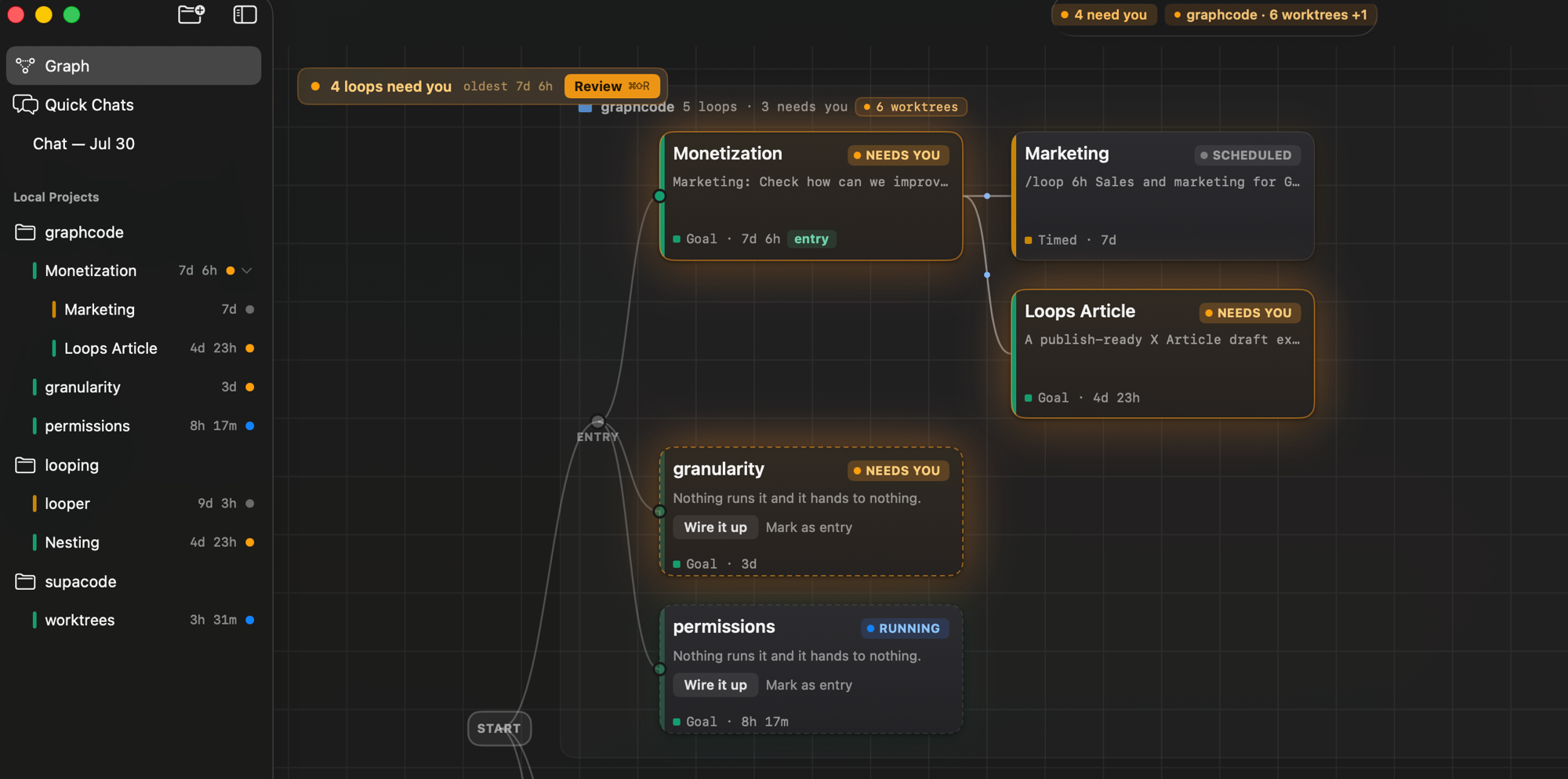
A loop is an agent session that runs on repeat. GraphCode connects loops on a canvas — they run unattended, bounded, and still live, so you can attach to any one of them mid-run and steer.
Check how we improve conversion on the pricing page…
Goal · 7d 6h entry
MarketingSCHEDULED
/loop 6h Sales and marketing…
Timed · 7d
permissionsRUNNING
editing GraphStore.swift
Goal · 8h 17m
granularityNothing runs it yet
GUARD
≤5×
pass 2 of 5
An Issue orchestration loop on a 15-minute cadence, fanning out a child loop per GitHub issue.
10+
parallel live sessions, one canvas
0
files written inside your project folder
5
backends: Claude Code, Copilot, Codex, OpenCode, Pi
∞
reboots survived — sessions outlive the app
01 — FOUR LOOP TYPES
Pick by what you're ready to let go of.
Put an agent on repeat and you hand off exactly one thing: the check, the stop condition, the trigger, or the prompt itself. That's the whole space.
Turn-based
hands off: the check
Pauses each turn until you say go. For a refactor you eyeball step by step.
make test
exit 0 → resolved
Goal-based
hands off: the stop condition
Runs until the goal is met — optionally proven by a shell command exiting 0.
Time-based
hands off: the trigger
A cadence in the prompt: /loop 1h triage new bug reports.
Composite
hands off: the prompt
A pipeline that plans its own steps and runs a sub-graph end to end.
A working graph mixes them — a time-based triage loop hands findings to a goal-based fixer, which hands the fix to a turn-based reviewer.
02 — LOOP-TO-LOOP MESSAGING
No IDs. No plumbing. You just say the name.
A loop finishes its fix, you tell it "merge and ask Release for the next beta" — and it messages the Release loop, running in a different repo's graph. Delivered live if the peer is awake, staged into its memory if it isn't.
LIVE
Loop messaging · across graphs, across repos
03 — WORKSPACES
One window per line of work.
A workspace is a whole second GraphCode — its own projects, loops and daemon, in its own window with its own Dock tile. ⌥⌘1…9 or ⌘` to switch, or put one on each screen. Nothing is shared between them — and a loop in one can still message a loop in the other, straight into its running session.
LIVE
Workspaces · two windows, one message across
04 — SESSIONS OUTLIVE EVERYTHING
The daemon starts it at 3 a.m. You're in that same session at 9.
Every loop is a zmx session — a PTY that survives quitting the app, restarting the daemon, or rebooting. Click a node and you attach to the terminal that did the work, live, with one scrollback.
→Drag between nodes for hand-off, message, or spawn edges.
→Each edge carries a condition: always, on success, on failure.
→A message to a sleeping loop is staged, not lost.
loop-a4f2 · attachedRUNNING
[graphcode] Cycle re-entry 2 of 5 — the stop condition
is not yet met. Continue toward your goal.
⏺ Reading wake digest… 40 lines
• approach A failed
• metric 41 → 38
• try B next
⏺ editing GraphStore.swift
05 — THE SELF-IMPROVING LOOP
Try → get judged → remember → try again smarter → stop honestly.
A maker, a reviewer, and a guarded back-edge closing the cycle. The feature that lets a loop repeat is the same feature that bounds it — so "loop forever, spending tokens" can't be said by accident.
FORGE
Make change
pass 2 · running
CRITIC
Verify change
idle · judges only
GUARD · ≤5 passes · stop after 2 idle
A loop may not change its own stop condition. The verifier stays outside the verified — the same reason maker and reviewer are separate sessions.
Measured by
lower is better
The orchestrator runs your metric command once per pass, so recorded numbers come from the measurement — never the loop's self-report.
41
38
27
27
STALLEDstopped after 2 passes without improvement
Every loop keeps a diary
The daemon records facts, the agent records lessons. A relaunched session opens by reading the digest — round two starts smarter, not from scratch.
14:24 tried A, failed
14:31 metric: 38
14:42 pass 3 started
↳ read wake digest
06 — THE GRAPH, LIVE
A canvas you design, not a pile of terminals you babysit.
graphcode · 6 worktrees
LIVE
Issue orchestration · fan-out per GitHub issue
Hand-off
Fires when the source resolves, unblocking the target.
Message
Injects text into a running peer. Staged if it's asleep.
Spawn
Instantiates a copy from a template. Children die with their parent.
07 — UNDER THE HOOD
Four pieces, one socket.
App and CLI are both clients speaking length-framed JSON over ~/.graphcode/graphcoded.sock. Validation lives in the daemon — a rule only one client enforces isn't a rule.
Reported, never estimated. Presence, current tool call and token usage come from the backend's own hooks. Without hooks the UI says "not reported" rather than a zero nobody measured.
graphcode.app
SwiftUI app — sidebar, canvas, per-loop terminal rendered with GhosttyKit.
graphcoded
The orchestrator daemon, kept alive by launchd — owns every graph and all automation.
graphcode
CLI on the same socket: status, node create, send, memo, update, delete.
GraphcodeKit
The shared framework, so app and daemon can never disagree about what a loop is.
~/.graphcode/
Graphs, memory logs, layouts, socket — plain JSON. Nothing is ever written inside a project folder you open.
Draw your first graph in a minute.
Add a folder, write a goal — GraphCode names the loop for you. Connect a second with an edge. Then close the app; the loops won't notice.
Developer ID signed & notarized · requires Claude Code on your PATH
You are visitor 01402503 — GeezerVison does not store the pages you look up. Best viewed with Netscape Navigator 4.7 or Internet Explorer 6 at 800×600. No cookies required.