GeezerVison is showing hermit-os.github.io — RustyHermit RustyHermitShort introduction into RustyHermit Institute for Automation of Complex Power Systems
RWTH Aachen University
Stefan Lankes
Introduction1. S. Lankes, S. Pickartz, and J. Breitbart, “HermitCore: A Unikernel for Extreme Scale Computing,” 2016, doi: 10.1145/2931088.2931093. HermitCore
Completly written in C ⇒ error-prone Combination of different tools to manage the build process (make, cmake) Difficult to maintain code, which is (more or less) equivalent between kernel- and user-space
Why Rust for Kernel Development?Safe memory handling through Ownership & Borrowing Runtime is split into a OS-independent (libcore) and OS-dependent (libstd) part By registration of a memory allocator, dynamic data structures are already supported The Rust community want to create fast and safe code Already used in many kernel-related projects Many projects share their code via Rust’s package manager For instance, x86 specific data structures are shared in https://crates.io/crates/x86
pub unsafe fn wrmsr(msr: u32, value: u64) {
    let low = value as u32;
    let high = (value >> 32) as u32;
    asm!("wrmsr", in("ecx") msr, in("eax") low, in("edx") high);
}
Do we have disadvantage?Kernel development requires Rust’s nightly compiler Rust code isn’t easy In general C code should be faster See Exploring Rust for Unikernel Development [1] for details
1. S. Lankes, J. Breitbart, and S. Pickartz, “Exploring Rust for Unikernel Development,” in Proceedings of the 10th Workshop on Programming Languages and Operating Systems, 2019, pp. 8–15, doi: 10.1145/3365137.3365395. Removing of POSIX-based system libraries
Requirements
$ curl --proto '=https' --tlsv1.2 -sSf https://sh.rustup.rs | sh
Required tools The tutorial is based on QEMU The kernel requires NASM for SMP Windows users should take a look at Chocolatey, macOS users at brew to install QEMU Here Ubuntu is used as host system
$ sudo apt-get install qemu-system-x86 nasm git
Build your first RustHermit Application$ git clone [email protected]:hermitcore/rusty-demo.git
$ cd rusty-demo
$ git submodule init
$ git submodule update
Cargo is the Rust package manager, already installed with your toolchain Cargo.toml is describing your dependencies
hermit-sys is a helper crate to build the libOS.
[package]
name = "hello_world"
version = "0.1.0"
authors = ["Stefan Lankes <[email protected]>"]
edition = "2021"
publish = false
license = "MIT/Apache-2.0"
readme = "README.md"
description = "Hello, RustyHermit!"

[target.'cfg(target_os = "hermit")'.dependencies]
hermit-sys = "0.2"
Key elements of HelloWorld
#[cfg(target_os = "hermit")]
use hermit_sys as _;

fn main() {
	println!("Hello World!");
}
[toolchain]
channel = "nightly-2022-05-15"
components = [
    "rust-src",
    "llvm-tools-preview",
    "rustfmt",
    "clippy",
]
targets = [ "x86_64-unknown-hermit" ]
Building the demo application
$ cargo build -Zbuild-std=core,alloc,std,panic_abort \
    -Zbuild-std-features=compiler-builtins-mem \
    --target x86_64-unknown-hermit
$ cd loader
$ cargo xtask build --arch x86_64
$ cd ..
Run HelloWorld
$ qemu-system-x86_64 -smp 1 -display none -m 1G -serial stdio \
    -cpu qemu64,apic,fsgsbase,rdtscp,xsave,xsaveopt,fxsr \
    -device isa-debug-exit,iobase=0xf4,iosize=0x04 \
    -kernel loader/target/x86_64/debug/rusty-loader \
    -initrd target/x86_64-unknown-hermit/debug/hello_world \
    -smp 1
[0][INFO] HermitCore is running on common system!
Hello World!
[0][INFO] Number of interrupts
[0][INFO] [0][7]: 1
[0][INFO] Shutting down system
Release Versions
$ cargo build -Zbuild-std=core,alloc,std,panic_abort \
    -Zbuild-std-features=compiler-builtins-mem \
    --target x86_64-unknown-hermit --release
$ cd loader
$ cargo xtask build --arch x86_64 --release
$ cd ..
$ qemu-system-x86_64 -smp 1 -display none -m 1G -serial stdio \
    -cpu qemu64,apic,fsgsbase,rdtscp,xsave,xsaveopt,fxsr \
    -device isa-debug-exit,iobase=0xf4,iosize=0x04 \
    -kernel loader/target/x86_64/release/rusty-loader \
    -initrd target/x86_64-unknown-hermit/release/hello_world \
    -smp 1
$ -rwxr-xr-x  87368 loader/target/x86_64/release/rusty-loader
$ -rwxr-xr-x  4747296 target/x86_64-unknown-hermit/release/hello_world
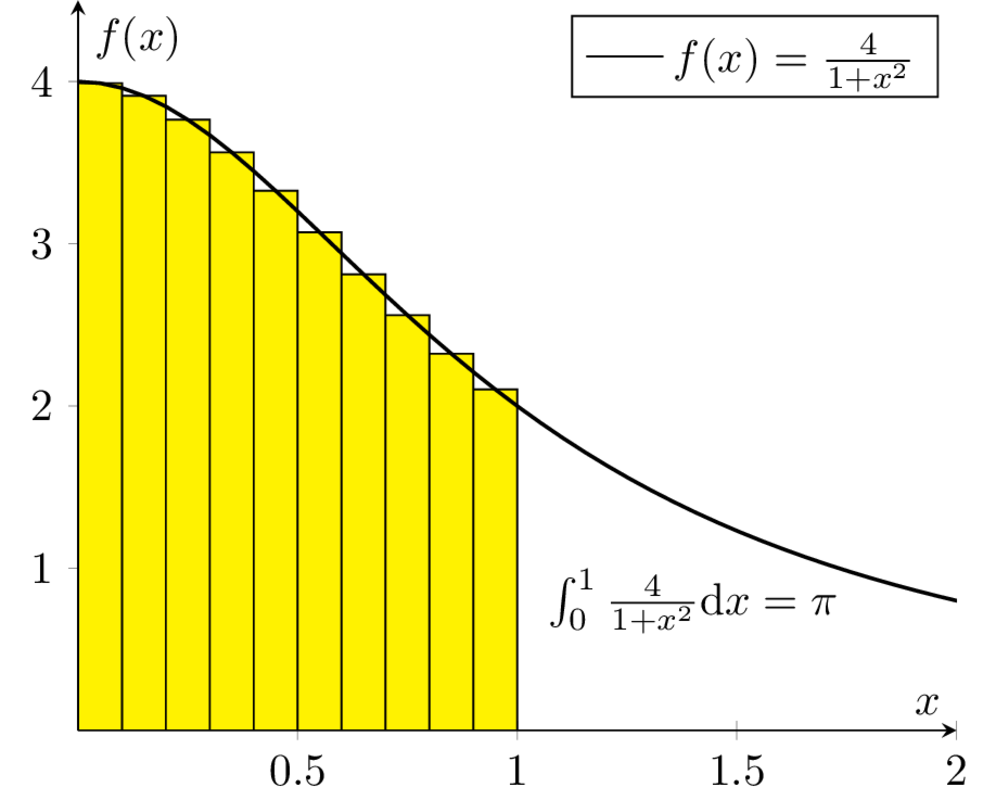
Concurrent applicationslet step = 1.0 / num_steps as f64;
let mut sum = 0 as f64;
for i in 0..num_steps {
let x = (i as f64 + 0.5) * step;
sum += 4.0 / (1.0 + x * x);
}
Naive solution
let step = 1.0 / NUM_STEPS as f64;
let mut sum = 0.0 as f64;

let threads: Vec<_> = (0..nthreads)
    .map(|tid| {
        thread::spawn(move || 	{
            let start = (NUM_STEPS / nthreads) * tid;
            let end = (NUM_STEPS / nthreads) * (tid+1);

            for i  in start..end {
                let x = (i as f64 + 0.5) * step;
                sum += 4.0 / (1.0 + x * x);
            }
        })
    }).collect();
Compiler error
error: cannot assign to immutable captured outer variable
   |
43 |   sum += 4.0 / (1.0 + x * x);
   |   ^^^^^^^^^^^^^^^^^^^^^^^^^^
Concurrent solution (I)
#[cfg(target_os = "hermit")]
use hermit_sys as _;

use std::thread;
use std::time::Instant;

const NUM_STEPS: u64 = 1000000;
const NTHREADS: u64 = 2;

fn main() {
	let step = 1.0 / NUM_STEPS as f64;
	let mut sum = 0.0 as f64;
	let now = Instant::now();

	let threads: Vec<_> = (0..NTHREADS)
		.map(|tid| {
			thread::spawn(move || {
				let mut partial_sum = 0 as f64;
				let start = (NUM_STEPS / NTHREADS) * tid;
				let end = (NUM_STEPS / NTHREADS) * (tid + 1);

				for i in start..end {
					let x = (i as f64 + 0.5) * step;
					partial_sum += 4.0 / (1.0 + x * x);
				}

				partial_sum
			})
		})
		.collect();

	for t in threads {
		sum += t.join().unwrap();
	}

	let duration = now.elapsed();

	println!(
		"Time to calculate (local sum): {}",
		duration.as_secs() as f64 + (duration.subsec_nanos() as f64 / 1000000000.0)
	);
	println!("Pi: {}", sum * (1.0 / NUM_STEPS as f64));
}
Concurrent solution (II)
$ cargo build -Zbuild-std=core,alloc,std,panic_abort -Zbuild-std-features=compiler-builtins-mem --target x86_64-unknown-hermit --release
$ qemu-system-x86_64 -smp 1 -display none -m 1G -serial stdio \
    -cpu qemu64,apic,fsgsbase,rdtscp,xsave,xsaveopt,fxsr \
    -device isa-debug-exit,iobase=0xf4,iosize=0x04 \
    -kernel loader/target/x86_64/release/rusty-loader \
    -initrd target/x86_64-unknown-hermit/release/hello_world \
    -smp 2

Time to calculate (local sum): 4.154339
Pi: 3.14159265358991
[0][INFO] Number of interrupts
[0][INFO] [0][7]: 3
[0][INFO] [0][Wakeup]: 1
[0][INFO] [1][7]: 1
[0][INFO] [1][Wakeup]: 1
[0][INFO] Shutting down system
HTTPD[package]
...
[dependencies]
tiny_http = "0.11"
[target.'cfg(target_os = "hermit")'.dependencies.hermit-sys]
default-features = false
[features]
default = ["pci", "pci-ids", "acpi", "tcp", "dhcpv4"]
dhcpv4 = ["hermit-sys/dhcpv4"]
pci = ["hermit-sys/pci"]
pci-ids = ["hermit-sys/pci-ids"]
tcp = ["hermit-sys/tcp"]
acpi = ["hermit-sys/acpi"]
fsgsbase = ["hermit-sys/fsgsbase"]
trace = ["hermit-sys/trace"]
Server itself is already explained in the README
#[cfg(target_os = "hermit")]
use hermit_sys as _;
use tiny_http::{Response, Server};

fn main() {
	let server = Server::http("0.0.0.0:8000").unwrap();

	for request in server.incoming_requests() {
		println!(
			"received request! method: {:?}, url: {:?}, headers: {:?}",
			request.method(),
			request.url(),
			request.headers()
		);

		let response = Response::from_string("hello world");
		request.respond(response);
	}
}
Running HTTPD
$ cargo build -Zbuild-std=core,alloc,std,panic_abort \
    -Zbuild-std-features=compiler-builtins-mem \
    --target x86_64-unknown-hermit
qemu-system-x86_64 -cpu qemu64,apic,fsgsbase,rdtscp,xsave,xsaveopt,fxsr \
   -device isa-debug-exit,iobase=0xf4,iosize=0x04 -display none \
   -serial stdio -kernel loader/target/x86_64/debug/rusty-loader \
   -initrd target/x86_64-unknown-hermit/debug/hello_world \
   -netdev user,id=u1,hostfwd=tcp::8000-:8000 \
   -device rtl8139,netdev=u1 -smp 1 -m 1G
$ curl http://127.0.0.1:8000/hello
hello world
Using VirtioTo increase the performance, virtio can be used A TAP device is used to forward ethernet frames from the guest to the host system In addition, a bridge allows VMs to have their own IP addresses while using the same physical link
        |
        | physical link
        |
        o br0
       / \
      /   \
eth0 o     o tap0
           |
- - - - - - - - - - - - - - - Host / VM boundary
           |
           o device inside VM
Create bridge
# Create bridge
sudo ip link add bridge0 type bridge
sudo ip link set bridge0 up

# According to Arch wiki eth0 needs to be up
sudo ip link set eth0 up
sudo ip link set eth0 master bridge0

# Drop existing IP from eth0
sudo ip addr flush dev eth0

# Assign IP to bridge0
sudo ip addr add 192.168.122.10/24 brd + dev bridge0
sudo ip route add default via 192.168.122.1 dev bridge0
Create TAP device and boot HTTPD
sudo ip tuntap add tap0 mode tap
sudo ip link set dev tap0 up
sudo ip link set tap0 master bridge0
sudo qemu-system-x86_64 --enable-kvm -cpu qemu64,apic,fsgsbase,rdtscp,xsave,xsaveopt,fxsr \
   -display none -smp 1 -m 1G -serial stdio \
   -kernel loader/target/x86_64/debug/rusty-loader \
   -initrd target/x86_64-unknown-hermit/debug/httpd \
   -netdev tap,id=net0,ifname=tap0,script=no,downscript=no,vhost=on \
   -device virtio-net-pci,netdev=net0,disable-legacy=on
Test HTTPD
Now listening on port 8000
[INFO] DHCP config acquired!
[INFO] IP address:      192.168.122.76/24
[INFO] Default gateway: 192.168.122.1
[INFO] DNS server 0:    192.168.122.1
$ curl http://192.168.122.76:8000/hello
Hello from RustyHermit 🦀
ImprintDr. rer. nat. Stefan Lankes RWTH Aachen University, E.ON Energy Research Center, Mathieustraße 10, 52074 Aachen, Germany |