GeezerVisonThe World Wide Web, restored to 800 pixels of glory. |
| Home|About|Gaming cabinet|Archives|How it works|Starter sites |
GeezerVison is showing indieweb.org — reader A reader in the context of the indieweb is either a feature integrated into an indieweb site or a separate site or piece of software that provides a way to read content from indieweb sites and sometimes respond (like, comment, repost, etc). Two-way readers that have features to respond (like, comment, repost, etc.) are typically known as: If you’re looking for pre-indieweb one-way read-only sidefile readers (e.g. like the defunct Google Reader) see: Social ReadersMain article: social reader
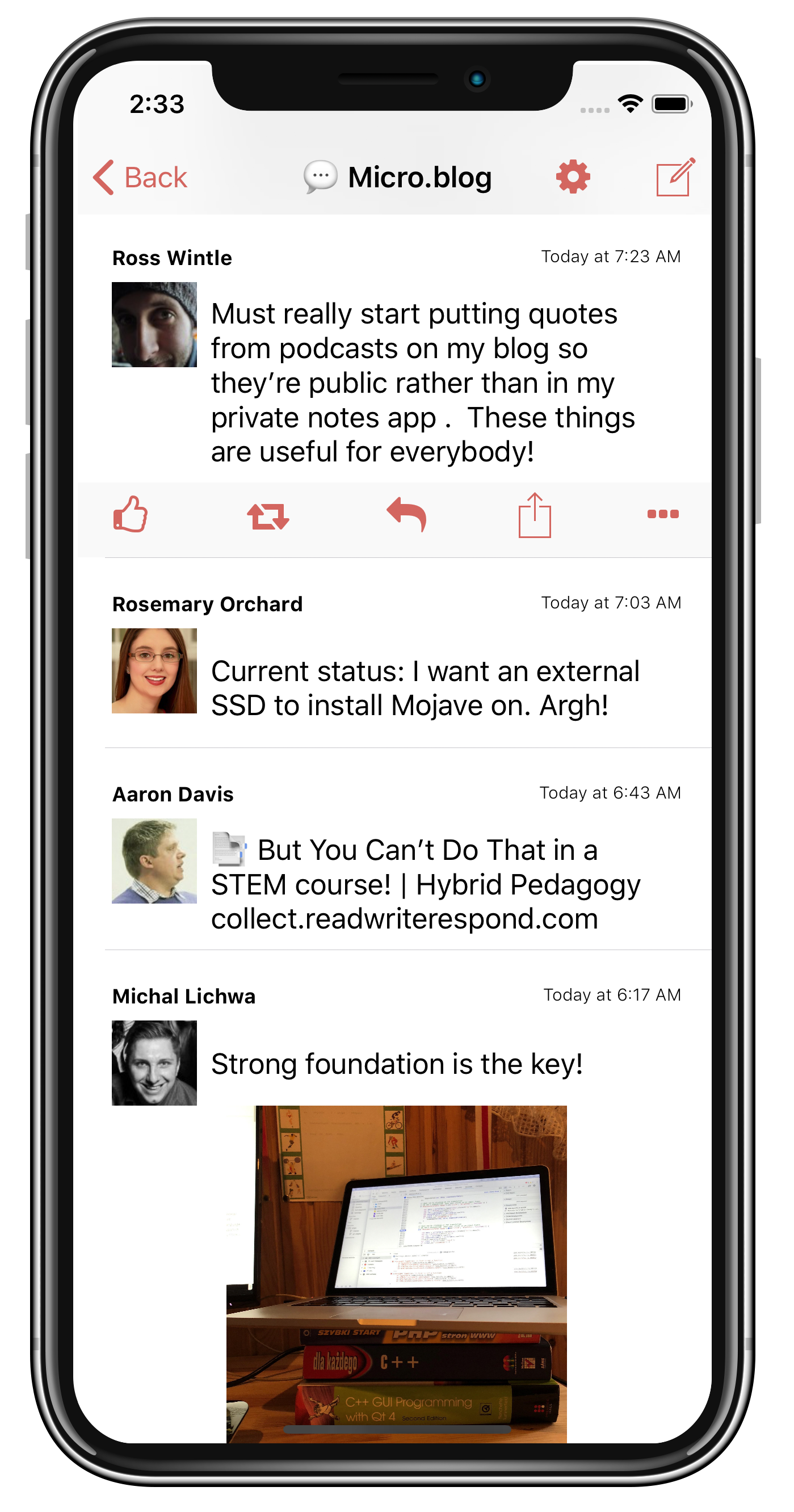
The latest exciting development in readers is easy to set-up interactive Social Readers built on top of the emerging Microsub standard that builds on the openness of yesterday’s feed readers, modernized with interactivity everyone now expects from social media.
IndiePass
Monocle
Monocle is a web-based reader (desktop and mobile, see above) that is a generic Microsub client and can be used with any Microsub server, written by
WhyWhy integrated personal readerReasons to have a personal reader (a reader integrated into your site for you to use)
That's just the beginnings of what an indieweb reader can enable. IndieWeb ExamplesIn datetime order of implementation (earliest first). Note: 2018-11-19 some of these may be out of date, need to review them to see which are still active and move others to a former examples subsection. Ashton McAllan
Barnaby WaltersBarnaby Walters developed Intertubes, an experimental indieweb-oriented flow-based programming + feed reader UI parsing microformats and shimmed twitter.com microformats.
Barnaby is using and developing Shrewdness, a multi-column feed reader as of at least 2014-08-04 Amber CaseAmber Case also uses selfoss with the Microformats2 plugin on caseorganic.com since 2014-02-13. See: http://caseorganic.com/articles/2014/02/13/1/indiereader-subscribe-to-people-from-your-own-site Andy SylvesterAndy Sylvester also uses selfoss with the Microformats2 plugin on http://andysylvester.com/selfoss/ since 2014-03-01. See http://andysylvester.com/2014/03/01/howto-setting-up-the-selfoss-feed-reader-with-microformats-support/ for instructions on how to set up the Selfoss reader. IndieReaderAt IndieWebCamp 2014, Ben, Aaron, and Emma built an IndieReader demo/prototype in PHP reusing components from their personal site implementations. Features:
 Emma KuoEmma Kuo used an experimental reader in neonblog since 2014-7-26.
thready, a thread reader created for Indieweb Summit 2016 hack day.
Kyle MahanKara Mahan is developing Woodwind, a simple reader in Python/Flask, with an instance running at [1] since 2015-02-01. It includes:
Aaron Parecki
Malcolm Blaney
Chris Aldrich
Additional details can be found here. Yarns Indie ReaderYarns is a reader that is built for use with WordPress as a plugin. It supports microformats and micropub. Built by Jack Jamieson and announced on his site on 2018-02-08. It's based in part on Kicks CondorMain article: fraidycat
fraidycat created in late 2019 is a browser extension for Firefox or Chrome that lets you follow people, see a summary of who has recently posted instead of a news feed, and expand the summaries to see recent titles/excerpts. It was created by Kicks Condor. Use it to follow people (hundreds) on whatever platform they choose — Twitter, a blog, YouTube, even on a public TiddlyWiki. Previous ExamplesAaron Parecki selfossAaron Parecki developed a Microformats2 plugin for selfoss, and ran it on a subdomain of aaronparecki.com around 2014-02-13. The reader polls the subscriptions at a predefined interval looking for new h-entry posts on each person's home page. Here's a screenshot of a following list:
Here's a screenshot of a reading window:
For more on this see: https://aaronparecki.com/2014/02/13/13/microformats-selfoss-indieweb Artemis by capjamesgArtemis is a calm web reader developed by capjamesg that updates once a day, has a minimal UI, and is free to use at https://artemis.jamesg.blog.
Software ExamplesSee also: Microsub WoodwindWoodwind is an open source social reader that supports subscribing to h-feed and XML feeds, as well as IndieAuth and Micropub. BrainstormingIntegrated Activity ReadingFrom analyzing the screenshots in this article: of Facebook's News Feed experiment:
A single integrated news feed of friends' activities, including posts and likes. Comparing the experiment and the reversion, shows the experiment provided:
All of these differences provided for a better-for-the-user user experience (faster, more focused, more relaxed) which could (should) be used in the design of indieweb reader user interfaces, as it provides opportunities to outdo silo UX. Tantek 16:36, 27 March 2014 (PDT) Jeena Notes ReaderThoughts on challenges and how to develop an indie notes reader: Dark Matter ReaderI ( The plan is for Dark Matter Reader and Dark Matter Publisher to be sister projects.
Subscribe webactions (while browsing around the web) will get caught by Dark Matter Reader.
Repost/Reply/Bookmark webactions will go from my Dark Matter Reader app to my Dark Matter Publisher powered site.
But both will be optional connections to the other. Either Dark Matter Reader or Dark Matter Publisher could be run stand-alone without the other one. At least, that's the Big Plan™. (Not enough time/money/people.) - Partial FeedsSee: h-feed#partial_feeds Discovery of posts on a pageGiven a URL, a reader needs to be able to reliably find the list of entries on the page. Discovery of alternate feedsSee also: h-feed#canonical_feed_autodiscovery Given someone's home page, they may link to one or more additional feeds of posts other than what's visible on the home page. List and hashtagIn 2015, at the XOXO festival,
In-stream comments and likesAs discussed on IRC [2] I enjoy the integrated experience of an indie reader, but am missing comments and likes from others. This is especially noticeable when I want to comment on something and then realize someone may have made the same comment, a better comment, or a comment that makes my comment seem silly. A "(n) comments" indicator would be a nice alternative/addition. Technical challenges:
Ideas:
Post PresentationHow should a reader display a post -- should it try to include the whole thing, or just an excerpt or summary? Woodwind includes an optional title ("name") followed by the "content" or "summary" if content is not provided.
Inclusion of non-Indieweb sourcesConsidering that a user's interest is likely not limited to content published on Indieweb-enabled sites, an important feature of a reader app could also be the ability to subscribe other sources, such as RSS feeds or even silo feeds (by means of an API, if available). As of December 2017 Incremental development path
My sense is that there are useful steps along the way, each of which is both not too hard to implement, and provides actual user benefit when built. I'm not saying there shouldn't be separate / standalone reader UIs like Woodwind and Monocle, rather that that represents existing (pre-social-media) models / apps, and that a compelling UX (as compared to social media) for generations 2-4 will require integrated /reader UX. I'm working on this in two ways:
I'm assuming for now that I'm missing key pieces of or underestimating the scope of this challenge, and in particular missing some key difficult building blocks required by an integrated reader. I hope that documenting my thinking and coding as I go will both reveal some of these, and perhaps more importantly, help the community as a whole figure out what some of these missing building blocks may be. Miscellaneous ArticlesCommunity member articles with ideas about what they'd want in reader:
ChallengesoverloadAs Twitter, Tumblr, and other aggregators have demonstrated, keeping up with everything you've subscribed to is both challenging, and eventually unrewarding. Thus some amount of smart filtering/pruning/batching is likely to be an essential part of making indie readers scale beyond following only a handful of people. See also: one of the reasons I'm not building algorithmic filtering into whisperfollow at the moment is to avoid the filter bubble effect: [3] - acegiak (2013-08-10) distractionWhoever is working on the indie reader problem, please consider the problem of social media distraction (which seems to come more from the reading side than the writing side). See related: silo-quits. missing good stuffLikely as an attempt to compensate for #overload as noted above, users tend to limit the number of sources they follow, thus resulting in another challenge - the loss of signal, AKA "missing good stuff". It is possible that there are some approaches for mitigating overload (e.g. perhaps categorizing notes with non-self-source links as comments on those links, and aggregating them by link destination) that could help bubble up "good stuff" from a larger set of people you follow. outdo search
Subscription MaintenanceIt becomes more and more time consuming to maintain a large list of subscriptions in traditional feed readers. It isn't uncommon to see feed URLs go dark, change location or just stop working for whatever reason. It would be advantageous for the next crop of readers to provide tools to help automate this sort of maintenance. It would also be great to find ways for feeds to state "This will never be updated again" and "This feed will be moving to this new location". Open source examples
Silo examplesMany social content hosting silos have integrated reader like features, but only for "feeds" of accounts on the particular silo.
Next StepsAfter implementing an indie reader, you may find that you want to search all the things you read. See:
ArticlesBlog posts and articles about readers:
Sessions
See Also
Retrieved from "https://indieweb.org/wiki/index.php?title=reader&oldid=102842" |
| You are visitor 01402503 — GeezerVison does not store the pages you look up. Best viewed with Netscape Navigator 4.7 or Internet Explorer 6 at 800×600. No cookies required. |