Alvaro Lopez 0000-0002-0013-4602
· alvaro.lopez
Spanish National Research Council (CSIC); Institute of Physics of Cantabria (IFCA)
Giacinto Donvito 0000-0002-0628-1080
National Institute of Nuclear Physics (INFN)
Abstract
The purpose of this document is to define a set of quality standards, procedures and best practices
to conform a Software Quality Assurance plan to serve as a reference within the European research
ecosystem related projects for the adequate development and timely delivery of software products.
The INDIGO-DataCloud, DEEP-Hybrid-DataCloud, eXtreme-DataCloud and EOSC-Synergy projects have
received funding from the European Union’s Horizon 2020 research and innovation programme under
grant agreement number 653549, 777435, 777367 and 857647 respectively.
This document has been tailored upon the recommendations and requirements found in the Initial Plan
for Software Management and Pilot Services deliverable
[1], produced by the
INDIGO-DataCloud project.
These guidelines evolved throughout the project’s lifetime and are being extended in the
EOSC-Synergy [2], as well as the past DEEP-Hybrid-DataCloud and
eXtreme DataCloud subsequent projects.
The result is a consolidated Software Quality Assurance (SQA) baseline criteria emanated from the
European Open Science Cloud (EOSC), which aims to outline the SQA principles to be considered in the
upcoming software development efforts within the European research community, and continuously
evolve in order to be aligned with future software engineering practices and security
recommendations.
2. Goals
Set the base of minimum SQA criteria that a software developed within EOSC development project
MUST fulfill.
Enhance the visibility, accessibility and distribution of the produced source code through the
alignment to the Open Source Definition [3].
Promote code style standards to deliver good quality source code emphasizing its readability and
reusability.
Improve the quality and reliability of software by covering different testing methods at
development and pre-production stages.
Propose a change-based driven scenario where all new updates in the source code are continuously
validated by the automated execution of the relevant tests.
Adopt an agile approach to effectively produce timely and audience-specific documentation.
Lower the barriers of software adoption by delivering quality documentation and the utilization
of automated deployment solutions.
Encourage secure coding practices and security static analysis at the development phase while
providing recommendations on external security assessment.
3. Notational Conventions
The keywords “MUST”, “MUST NOT”, “REQUIRED”, “SHALL”, “SHALL NOT”, “SHOULD”, “SHOULD NOT”,
“RECOMMENDED”, “MAY”, and “OPTIONAL” in this document are to be interpreted as described in RFC 2119
[4].
4. Quality Criteria
The following sections describe the quality conventions and best practices that apply to the
development phase of a software component within the EOSC ecosystem. These guidelines ruled the
software development process of the former European Commission-funded project INDIGO-DataCloud,
where they have proved valuable for improving the reliability of software produced in the scientific
European arena.
The next sections describe the development process driven by a change-based strategy, followed by a
continuous integration approach. Changes in the source code, trigger automated builds to analyze the
new contributions in order to validate them before being added to the software component code base.
Consequently, software components are more eligible for deployment in production infrastructures,
reducing the likelihood of service disruption.
4.1. Code handling
4.1.1. Code Accessibility [QC.Acc]
[QC.Acc01] Following the open-source model, the source code being produced MUST be open
and publicly available to promote the adoption and augment the visibility of the software
developments.
[QC.Acc02] Source code MUST use a Version Control System (VCS).
[QC.Acc02.1] It is RECOMMENDED that all software components delivered by the same
project agree on a common VCS.
[QC.Acc03] Source code produced within the scope of a broader development project SHOULD
reside in a common organization of a version control repository hosting service.
4.1.2. Code Workflow [QC.Wor]
A change-based approach is accomplished with a branching model.
[QC.Wor01] The main branch in the source code repository MUST maintain a working state
version of the software component.
[QC.Wor01.1] Main branch SHOULD be protected to disallow force pushing, thus preventing
untested and un-reviewed source code from entering the production-ready version.
[QC.Wor01.2] New features SHOULD only be merged in the main branch whenever the SQA
criteria is fulfilled.
[QC.Wor02] New changes in the source code MUST be placed in individual branches.
[QC.Wor02.1] It is RECOMMENDED to agree on a branch nomenclature, usually by prefixing,
to differentiate change types (e.g. feature, release, fix).
[QC.Wor03] The existence of a secondary long-term branch that contains the changes for the
next release is RECOMMENDED.
[QC.Wor03.1] Next release changes SHOULD come from the individual branches.
[QC.Wor03.2] Once ready for release, changes in the secondary long-term branch are merged
into the main branch and versioned. At that point in time, main and secondary branches are
aligned. This step SHOULD mark a production release.
4.1.3. Code Management [QC.Man]
[QC.Man01] An issue tracking system facilitates structured software development. Leveraging
issues to track down both new enhancements and defects (bugs, documentation typos) is
RECOMMENDED.
[QC.Man01.1] In addition to monitoring the internal development, issues are the best means
for supporting users. External users SHOULD be able to create issues based on the
operational performance of the software.
[QC.Man01.2] The description of an issue SHOULD be concise and state clearly the
problem. It is RECOMMENDED to add any reference to the actual problem. In the case of bugs,
the issue SHOULD be accompanied by the relevant debug information.
* The usage of templates for the issue description is RECOMMENDED.
[QC.Man02] In social coding environments, pull or merge requests represent the cornerstone of
collaboration. A pull or merge request provides a place for review and discussion of the changes
proposed to be part of an existing version of the code.
[QC.Man02.1] Pull/Merge requests SHOULD be used for every change in the codebase.
[QC.Man02.2] A software project SHOULD be open to external collaboration through
pull/merge requests.
[QC.Man02.3] A pull/merge request description SHOULD be concise and state clearly its
purpose (e.g. if it is fixing an observed bug or adding a new feature).
[QC.Man02.4] The usage of templates for the pull/merge request’s description is
RECOMMENDED.
[QC.Man02.5] It is RECOMMENDED to use pull/merge requests to address open issues.
[QC.Man02.6] The pull/merge request description SHOULD make reference to the identifiers
of the issues it is fixing (to eventually close them, either manually or automatically).
4.1.4. Code Review [QC.Rev]
Code review implies the informal, non-automated, peer review of any change in the source code
[5]. It appears as the last step in
the change management pipeline, once the candidate change has successfully passed over the required
set of change-based tests.
[QC.Rev01] Code reviews MUST be done in the agreed peer review tool within the project,
with the following RECOMMENDED functionality:
[QC.Rev01.1] Allows general and specific comments on the line or lines that need to be
reviewed.
[QC.Rev01.2] Shows the results of the required change-based test executions.
[QC.Rev01.3] Allows to prevent merges of the candidate change whenever not all the required
tests are successful. Exceptions to this rule cover the third-party or upstream contributions
which MAY use the existing mechanisms or tools for code review provided by the target software
project. This exception MUST only be allowed whenever the external revision lifecycle does
not interfere with the project deadlines.
[QC.Rev02] Code reviews MUST be open and collaborative, allowing external experts
revisions.
[QC.Rev03] Code reviews SHOULD be concise and use neutral language. The areas where the
reviewers MAY focus are:
[QC.Rev03.1] Message description: commit message is clear, self-explanatory and describes
precisely the objectives being addressed.
[QC.Rev03.2] Goal or scope: change is needed and/or addresses/fixes the whole set of
objectives.
[QC.Rev03.3] Code analysis: useless statements in the code, library or modules imported but
never used or code style suggestions.
[QC.Rev03.4] Review of required tests: check if they include tests of the changes, such as
tests of new features, or tests of bug fixing (regression tests), ensuring proper validation of
the changes.
[QC.Rev03.5] Review of documentation: whether the change SHOULD bring along a
corresponding update in the documentation.
[QC.Rev04] Code reviews MUST be checked on change basis.
[QC.Rev05] Code reviews SHOULD assess the inherent security risk of the changes, ensuring
that the security model has not been downgraded or compromised by the changes.
4.1.5. Semantic Versioning [QC.Ver]
[QC.Ver01] Semantic Versioning [6] specification is RECOMMENDED for
tagging the production releases.
4.2. Files and documents
4.2.1. Licensing [QC.Lic]
[QC.Lic01] As open-source software, source code MUST adhere to an open-source license to
be freely used, modified and distributed by others. Non-licensed software is exclusive copyright
by default.
[QC.Lic01.1] Licenses MUST be physically present (e.g. as a LICENSE file) in the root
of all the source code repositories related to the software component.
[QC.Lic02] License MUST be compliant with the Open Source Definition
[3].
[QC.Lic02.1]RECOMMENDED licenses are listed in the Open Source Initiative portal under
the Popular Licenses category [7], c.f. the complete list of
Software Package Data Exchange (SPDX) [8].
4.2.2. Code metadata [QC.Met]
Metadata for the software component provides a way to achieve its full identification, thus making
software citation viable [9]. It allows the assignment of a Digital Object
Identifier (DOI) and is key towards preservation, discovery, reuse, and attribution of the software
component.
[QC.Met01] A metadata file SHOULD exist along side the code, under its VCS. The metadata
file SHOULD be updated when needed, as is the case of a new version.
4.2.3. Documentation [QC.Doc]
[QC.Doc01] Documentation MUST be treated as code.
[QC.Doc01.1] Version controlled, it MAY reside in the same repository where the source
code lies.
[QC.Doc02] Documentation MUST use plain text format using a markup language, such as
Markdown or reStructuredText.
[QC.Doc02.1] It is RECOMMENDED that all software components delivered by the same
project agree on a common markup language.
[QC.Doc2.2] Each individual documentation file SHOULD comply with community-driven or
de-facto style standards for the markup languages being used.
[QC.Doc03] Documentation MUST be online and available in a documentation repository.
[QC.Doc03.1] Documentation SHOULD be rendered automatically.
[QC.Doc04] Documentation MUST be updated on new software versions involving any
substantial or minimal change in the behavior of the application.
[QC.Doc05] Documentation MUST be updated whenever reported as inaccurate or unclear.
[QC.Doc06] Documentation MUST be produced according to the target audience, varying
according to the software component specification. The identified types of documentation and their
RECOMMENDED content are:
[QC.Doc06.1] README file MUST be present:
One-paragraph description of the application.
A “Getting Started” step-by-step description on how to get a development environment running
(prerequisites, installation).
Automated test execution how-to.
Links to the external documentation below (production deployment, user guides).
Versioning specification.
Author list and contacts.
Acknowledgments.
[QC.Doc06.2] CONTRIBUTING file MUST be present in order to communicate how external
parties can contribute to the code.
[QC.Doc06.3] A code of conduct (usually defined in a CODE_OF_CONDUCT file) MUST be
present in order to establish the positive social attitudes expected within the community of
code contributors.
[QC.Doc06.4] LICENSE file MUST be present, License information with detailed description.
[QC.Doc06.5] Developer
Private API documentation.
Structure and interfaces.
Build documentation.
[QC.Doc06.6] Deployment and Administration
Installation and configuration guides.
Service Reference Card, with the following RECOMMENDED content:
Brief functional description.
List of processes or daemons.
Init scripts and options.
List of configuration files, location and example or template.
Log files location and other useful audit information.
List of ports.
Service state information.
List of cron jobs.
Security information.
FAQs and troubleshooting.
[QC.Doc06.7] User
Public API documentation.
Command Line Interface (CLI) reference.
4.3. Static testing - White box testing
4.3.1. Code Style [QC.Sty]
Code style requirements pursue the correct maintenance of the source code by the common agreement of
a series of style conventions. These vary based on the programming language being used.
[QC.Sty01] Each individual software product MUST comply with community-driven or de-facto
code style standards for the programming languages being used.
[QC.Sty01.1] Compliance with multiple complementary standards MAY exist.
[QC.Sty02] Custom code style guidelines SHOULD be avoided, only considered in the
hypothetical event of programming languages without existing community style standards.
[QC.Sty02.1] Custom styles MUST be documented by defining each convention and its
expected output.
[QC.Sty02.2] Custom styles SHOULD evolve over time towards a more consistent definition.
[QC.Sty03] Exceptions of individual conventions from the main definition are allowed but
SHOULD be avoided
[QC.Sty03.1] Absence of standard conventions SHOULD be justified and tracked.
[QC.Sty04] Code style compliance testing MUST be automated and MUST be triggered for
each candidate change in the source code.
4.3.2. Unit Testing [QC.Uni]
Unit testing evaluates all the possible flows in the internal design of the code, so that its
behavior becomes apparent. It is a key type of testing for early detection of failures in the
development cycle.
[QC.Uni01] Minimum acceptable code coverage threshold SHOULD be 70%.
[QC.Uni01.1] Unit testing coverage SHOULD be higher for those sections of the code
identified as critical by the developers, such as units part of a security module.
[QC.Uni01.2] Unit testing coverage MAY be lower for external libraries or pieces of code
not maintained within the product’s code base.
[QC.Uni02] Units SHOULD reside in the repository code but separated from the main code.
[QC.Uni03] Unit testing coverage MUST be checked on change basis.
[QC.Uni04] Unit testing coverage MUST be automated.
4.3.3. Test Harness [QC.Har]
In software development, a test harness
[10], is a collection of software
and test data used by developers to unit test software models during development. A test harness
will specifically refer to test doubles, which are programs that interact with the software being
tested. Once a test harness is used to execute a test, they can also utilize a test library to
generate reports.
It is also a simple form of Integration Testing, where interaction and integration with external
components are substituted by a Double.
Test Double is a generic term for any case where you replace a production object for testing
purposes. There are various kinds of double [11]:
Dummy objects are passed around but never actually used. Usually they are just used to fill
parameter lists.
Fake objects actually have working implementations, but usually take some shortcut which makes
them not suitable for production (such as an InMemoryTestDatabase).
Stubs provide canned answers to calls made during the test, usually not responding at all to
anything outside what’s programmed in for the test.
Spies are stubs that also record some information based on how they were called. One form of
this might be an email service that records how many messages where sent.
Mocks are pre-programmed with expectations which form a specification of the calls they are
expected to receive. They can throw an exception if they receive a call they don’t expect and are
checked during verification to ensure they got all the calls they were expecting.
As such the following criteria is defined for Test Harness:
[QC.Har01] When working on automated testing, the use of Test Doubles is RECOMMENDED to
mimic a simplistic behavior of objects and procedures.
[QC.Har02] Test Doubles SHOULD reside in the software component repository code base but
separated from the main code.
[QC.Har03] Regression testing, that checks the conformance with previous tests, SHOULD be
covered at this stage by executing the complete set of Test Doubles available.
[QC.Har04] Test Doubles and regression, MUST be checked on change basis.
4.3.4. Test-Driven Development [QC.Tdd]
Test-Driven Development [12], is a software development process relying on software
requirements being converted to test cases before software is fully developed, and tracking all
software development by repeatedly testing the software against all test cases. This is opposed to
software being developed first and test cases created later.
[QC.Tdd01] Software requirements SHOULD be converted to test cases, and these test cases
SHOULD be checked automatically.
4.3.5. Security [QC.Sec]
Security assessment is essential for any production Software. An effective implementation of the
security requirements applies to every stage in the Software Development Life Cycle (SDLC),
especially effective at the source code level.
[QC.Sec01] Secure coding practices MUST be applied into all the stages of a software
component development lifecycle.
[QC.Sec01.1] Compliance with Open Web Application Security Project (OWASP) secure coding
guidelines
[13]
is RECOMMENDED, even for non-web applications.
[QC.Sec02] Source code MUST use automated linter tools to perform static application
security testing (SAST) [14] that flag
common suspicious constructs that may cause a bug or lead to a security risk (e.g. inconsistent
data structure sizes or unused resources).
[QC.Sec03] Security code reviews
[5]
for certain vulnerabilities SHOULD be done as part of the identification of potential security
flaws in the code. Inputs SHOULD come from automated linters.
[QC.Sec04] World-writable files or directories MUST NOT be present in the product’s
configuration or logging locations.
4.4. Delivery
4.4.1. Automated Delivery [QC.Del]
Automated delivery comprises the build of Software into an artifact, its upload/registration into a
public repository of such artifacts and notification of the success of the process.
[QC.Del01] Production-ready code MUST be built as an artifact that can be efficiently
executed on a system.
[QC.Del01.1] The built artifact SHOULD be as minimal as possible, including no more than
the precise runtime environment and dependencies required for the execution of the software.
[QC.Del02] The built artifact MUST be uploaded and registered into a public repository
of such artifacts.
[QC.Del03] Upon success of the previous (QC.Del02) process, a notification MUST be
sent to pre-defined parties such as the main developer or team.
4.5. Deployment
4.5.1. Automated Deployment [QC.Dep]
[QC.Dep01] Production-ready code MUST be deployed as a workable system with the minimal
user or system administrator interaction leveraging software configuration management (SCM) tools.
[QC.Dep02] A SCM module is treated as code.
[QC.Dep02.1] Version controlled, it SHOULD reside in a different repository than the
source code to facilitate the distribution.
[QC.Dep03] It is RECOMMENDED that all software components delivered by the same project
agree on a common SCM tool.
[QC.Dep03.1] However, software products MAY not be restricted to provide a unique
solution for the automated deployment.
[QC.Dep04] Any change affecting the application’s deployment or operation MUST be
subsequently reflected in the relevant SCM modules.
[QC.Dep05] Official repositories provided by the main developer SHOULD be used to host the
SCM modules, thus augmenting the visibility and promote external collaboration.
5. Glossary
API
Application Programming Interface
CLI
Command Line Interface
EOSC
European Open Science Cloud
OWASP
Open Web Application Security Project
SAST
Static Application Security Testing
SCM
Software Configuration Management
SQA
Software Quality Assurance
TDD
Test-Driven Development
VCS
Version Control System
A1. Annex
The Quality Criteria described in this document follows a technology-agnostic approach, as such the
choice of tools and services to implement the code workflow, followed by the verification &
validation processes, is up to the team or community developing and/or using a given software.
This annex describes an implementation approach to help software developers cover the Quality
Criteria detailed in this document.
A1.1. Code workflow
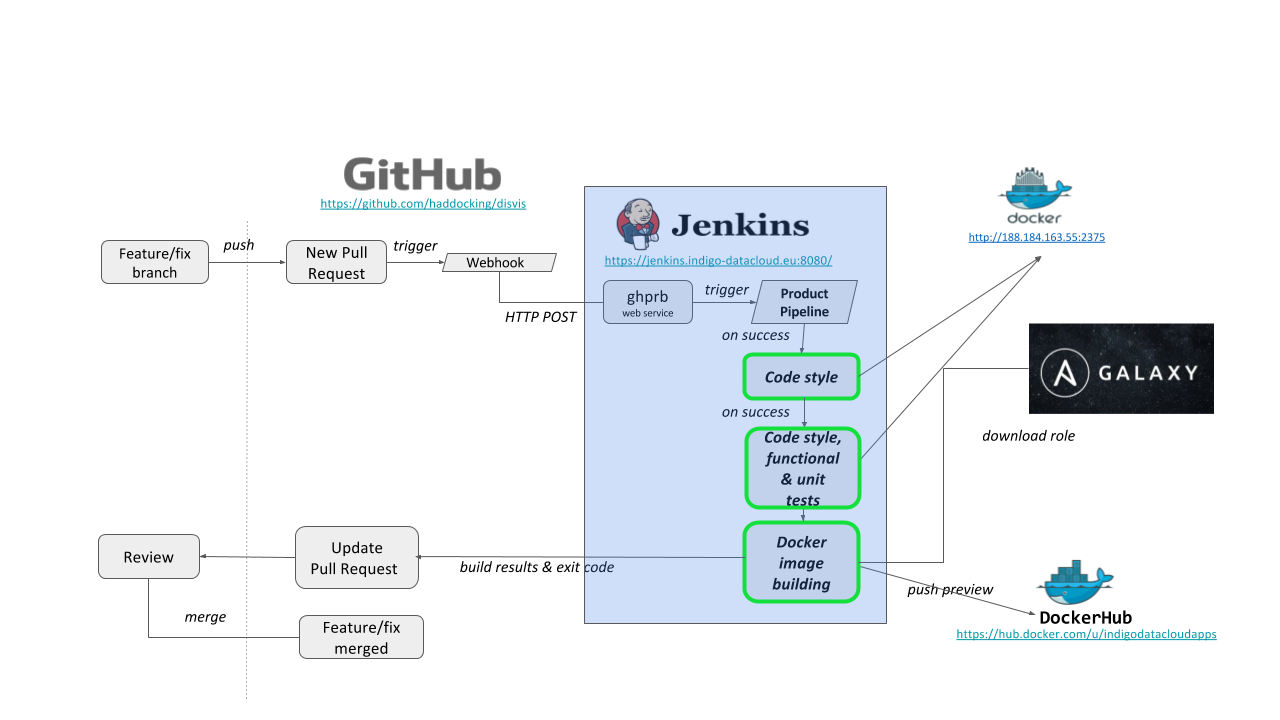
The code workflow is shown in Figure 1. It depicts a real case example, Github is used
for several purposes that will be described below. The workflow starts when the developer branches
the code to implement a given new feature or fix, after the implementation the Pull Request triggers
a CI pipeline in the Jenkins service.
In the Jenkins service, several checks are performed, both on the code (static), such as code style
linting, as well as dynamic tests such as unit and harness tests. To perform functional tests that
may include API tests in case of a service, the packages will need to be built (delivery), and
automatically deployed into a running state. In the case shown, the configuration is done with
ansible roles and playbooks.
The Pull Request is updated with the results of the tests, thus notifying the developer team that
they can proceed with the review and, if approved, with the release process where the branch is
merge into the main production branch.
Figure 1: Code workflow
A1.2. Verification & Validation (V&V)
Once having the code workflow, the next step is to shape the V&V processes in order to ensure that
the software does “the right things right”. One way to address them is to rely on CI/CD pipelines
that encompass the series of checks that will be executed automatically for each change done in
the code, driven by the agreed code workflow (see A1.1).
There are multiple technological solutions to compose CI/CD pipelines. The SQA as a Service
(SQAaaS) platform1 aids developers in such task, with the additional benefit of being 100%
aligned with the criteria being described in this document. The SQAaaS solution relies on Jenkins
code pipelines [16/] and allows developers to use either
a graphical (web-based) or code-based approach to define the work to be performed in each stage of
the CI/CD pipeline.
A1.3. Services
As it can be seen in Figure 1, multiple services take part in the execution of the
CI/CD pipelines. Table 1 shows the list of services used for the source code management
as well as to implement the V&V of the Quality Criteria detailed in this document.
One of the most popular services for Software source code management is Github. It is uses Git
as the Version Control System, branching and tag management. Additionally has an issue tracker for
bugs, requests and enhancements and the mechanism of Pull Requests for code review and discussion
of changes.
Ansible and Ansible-Galaxy are used in many software frameworks as deployment and configuration
tools.
The software is packed/built into executable artifacts that can be RPMs (case of RedHat and
derivative OS), DEBs (case of Debian/Ubuntu and derivatives) and in many cases containers such as
Docker images.
The artifacts are provided, in general, by public repositories and most notably Docker Hub
[17/] in the case of Docker images. Other common repositories are PyPI
[18/] for python SW and Maven [19/] for Java.
Regarding the CI/CD automation, Jenkins pipelines can be easily composed through the SQAaaS platform
and put into the git repositories to be used by the Jenkins CI service to perform the tests. The
tools used in the CI automation are shown in section A1.2.
The SQAaaS platform is being developed in the framework of the EOSC-Synergy project described
in Deliverable 3.2 [15]). It details the architecture and set of
components of the platform.↩︎
You are visitor 01402503 — GeezerVison does not store the pages you look up. Best viewed with Netscape Navigator 4.7 or Internet Explorer 6 at 800×600. No cookies required.