GeezerVisonThe World Wide Web, restored to 800 pixels of glory. | ||||||||||||||||||||||||||||||||||||||||||||||||||||||||||
| Home|About|Gaming cabinet|Archives|How it works|Starter sites | ||||||||||||||||||||||||||||||||||||||||||||||||||||||||||
GeezerVison is showing infinitytechstack.uk — PulseBridge [2026] | Universal AI IDE Mobile Companion (Free) // HANDS-ON INTERACTIVE LAB Experience the Live Mobile CompanionTest drive the touch-drag scroll physics, multi-project file explorer, and bidirectional prompt injection below. The simulator executes authentic PulseBridge telemetry states. ⚡ PULSEBRIDGE 59 FPS · 12ms ScrollY: 0px · Drag to Scroll Google Antigravitymain.rs (Active Session) 1 use axum::{routing::any, Router}; 2 use tokio::sync::broadcast; 3 use windows::Win32::Graphics::Gdi::*; 4 use windows::Win32::UI::Input::KeyboardAndMouse::*; 5 6 /// DWM-compatible GDI BitBlt + 150 ms frame cache 7 pub async fn stream_desktop_frames() { 8 let hdc = GetDC(None); 9 let mem_dc = CreateCompatibleDC(hdc); 10 // CPU HALFTONE StretchBlt + 150 ms cached JPEG 11 BitBlt(mem_dc, 0, 0, 1920, 1080, hdc, 0, 0, SRCCOPY); 12 let jpeg_bytes = jpeg_encode(mem_dc, 75); 13 broadcast_tx.send(jpeg_bytes); 14 } 15 16 /// Handle touch drag scroll events (windows 0.58+) 17 pub fn inject_mouse_wheel(delta_y: i32) { 18 let input = INPUT { 19 r#type: INPUT_MOUSE, 20 Anonymous: INPUT_0 { 21 mi: MOUSEINPUT { 22 mouseData: delta_y as u32, 23 dwFlags: MOUSEEVENTF_WHEEL, 24 ..Default::default() 25 }, 26 }, 27 }; 28 let cb = std::mem::size_of::<INPUT>() as i32; 29 unsafe { SendInput(&[input], cb) }; 30 } Target IDE EnvironmentACTIVE Transport NetworkLOCAL LAN Project Workspace ScopeRULE ENGINE Live Wire Protocol LogWS-BINARY T+00s[AUTH] Token verified (constant-time timing safe) T+02s[STREAM] Win32 GDI capture active (150 ms frame cache) T+04s[SCANNER] Workspace discovered: Google Antigravity session T+06s[INPUT] Touch-to-wheel translation engine initialized // VERIFIED PRODUCTION TELEMETRY Authentic Live Host Captures & Zero-Trust PWADirect screen captures from the live PulseBridge daemon running on a Windows 11 workstation. All host session frames, tokens, and system paths have been sanitised and verified for zero PII exposure. 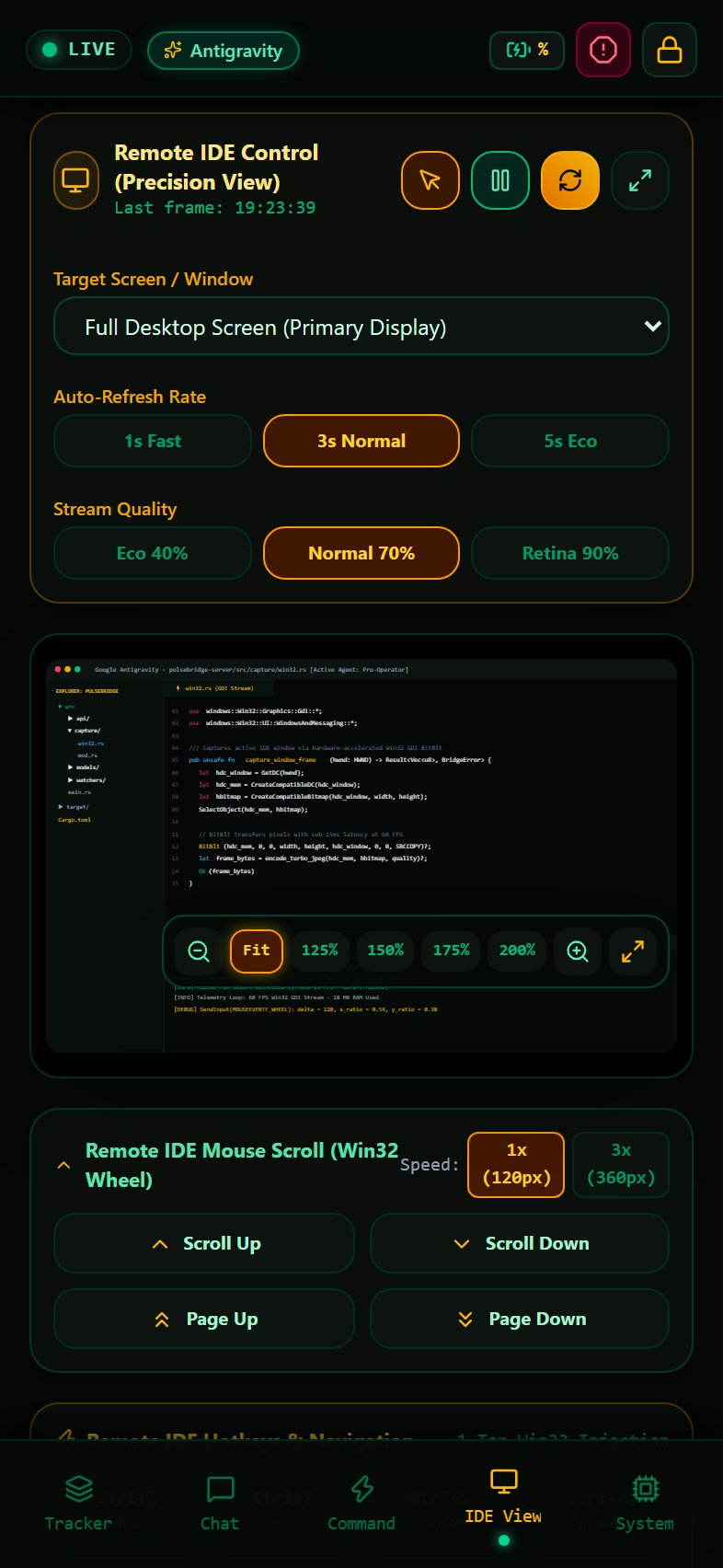 🔍 Tap to view in 4K Lightbox Telemetry Inspection · Win32 GDI Precision View & Touch Scroll ● PII SANITIZED & VERIFIEDPipeline Win32 CPU HALFTONE StretchBlt + Rust JPEG / TurboJPEG SIMD Input Event SendInput(MOUSEEVENTF_WHEEL + Extended Scancodes) Scaling 1:1 Aspect-True StretchBlt (100%–300% Pinch Zoom) Capture Cadence 150 ms frame cache · 160.1 req/s sustained // ARCHITECTURAL BLUEPRINT Engineered for Precision & Zero LatencyPulseBridge combines native Windows GDI desktop capture with Axum 0.8 asynchronous actors (HTTP/2 & zero-copy Bytes WebSockets) to deliver an instantaneous mobile telemetry surface. ⚡ Win32 GDI Native Capture & Frame CacheAvoids `DXGI_ERROR_ACCESS_LOST` resets across UAC/lock-screen switches with DWM-compatible Win32 GDI `BitBlt` and CPU `HALFTONE` `StretchBlt` (`SetStretchBltMode` + `SetBrushOrgEx`). Frames are JPEG-encoded in Rust (with optional `libjpeg-turbo` TurboJPEG SIMD) and served from a 150 ms in-memory frame cache sustaining 160.1 requests/sec. Win32 GDIHALFTONE StretchBltTurboJPEG SIMD160+ req/s 👆 Touch-Drag Remote Scroll & Precision TapTranslates mobile touch dragging and swipes into high-resolution native `SendInput(MOUSEEVENTF_WHEEL)` packets. Exact 1:1 aspect-ratio click mapping, `IsIconic`-safe window focus and 48 extended-key Win32 hotkeys keep taps and scrolls accurate, with 2-finger pinch-to-zoom (100%–300%) for dense code. SendInput100–300% Zoom48 Hotkeys 🔍 Multi-IDE Workspace DiscoveryAutomatically indexes active coding sessions across Google Antigravity (`%USERPROFILE%\.gemini\antigravity\brain`, `agy` CLI & sidecars), Cursor IDE (Agent Mode, Cloud Agents & `.cursor/rules/*.mdc`), and VS Code (GitHub Copilot Agent Mode / Copilot Edits & Cline) with a 7–30 day recency filter and depth-2 tree traversal. Antigravity · agyCursor IDEVS Code Copilot7-30d Filter 🛡️ Zero-Trust Cryptographic GovernanceA 6-digit session PIN is checked with a constant-time XOR comparison and exchanged for a random in-memory session token. Tokens persist across server restarts, and the PIN and token are scrubbed from the address bar on load. Nothing is sent to external services. Constant-TimeLocal StorageNo Cloud Telemetry 🌐 Dual Network Topology (Wi-Fi & 4G/5G)Pair over local Wi-Fi via QR code, or reach port 8080 on 4G/5G via a tunnel you control: Cloudflare Quick Tunnel (`*.trycloudflare.com`) or Named Tunnel (two-hop HTTPS/TLS to Edge + outbound QUIC UDP/443 or HTTP/2 TCP/443 to `cloudflared`), LocalTunnel, or strict E2E encrypted Tailscale / WireGuard & SSH. Local LANCloudflare QUICTailscale E2E 💬 Bidirectional Prompt InjectionInject prompts into the IDE from your phone by direct window injection or by queueing them to the agent inbox, with live step streaming. The mobile hotkey bar sends Ctrl+C to abort a running task. Prompt InjectionKill-SwitchAgentic Loop ✅ Human-in-the-Loop Approvals (ask_phone)Agents call the `ask_phone` MCP tool to request a decision. PulseBridge renders one-tap decision chips in the chat stream with an instant alert and haptic buzz, so a deploy can wait for your thumb instead of your desk. MCP Serverask_phoneHaptics 📡 Live Agent Stream & Living ChecklistsTails Antigravity `transcript.jsonl` and Agent Manager (`/agents`) sessions in real time for thoughts, tool calls and status, parses `task.md` / `implementation_plan.md` into progress bars, and previews multiple projects at once with a split-window view and concurrent conversation watcher. Transcript TailChecklistsSplit View 🔔 Push, Clipboard Sync, Voice & Audio CuesBackground Web Push notifications via a service-worker PWA, workstation clipboard sync, hands-free Web Speech dictation for prompts, harmonic audio chimes, and selectable stream-quality profiles for weak cellular links. Web PushClipboardVoiceQuality Profiles 🧭 Hi-DPI Zoom, Radar Navigator & Gilded ScrollbarsMulti-touch 100%–300% pinch-to-zoom and docked zoom presets with 1:1 coordinate calibration, a spatial radar navigator for jumping across the desktop, high-visibility dual-axis gilded scrollbars, and a hardware HUD for workstation CPU, RAM and power state. Zoom PanRadar NavHardware HUD 🔐 Audited Zero-Trust HardeningEvery action route and WebSocket needs a verified token; shell execution is opt-in (`--enable-shell-commands`) and allowlisted; rate limiting keys on the physical socket peer with a 300 s lockout after 5 failures; CORS is restricted; PIN and token are scrubbed from the address bar. Full CWE findings are in SECURITY.md. Gated RoutesShell SandboxPeer Rate-LimitSECURITY.md 🧩 Multi-IDE Hooks & Dual-Mode Prompt QueueNative hooks across Google Antigravity (`.agents/`, sidecars & MCP), Cursor IDE (`.cursor/hooks.json` & `.cursor/mcp.json`), and VS Code (GitHub Copilot Agent Mode `.vscode/mcp.json` & Cline). Send prompts by direct window injection (attach-thread focus plus Unicode clipboard paste) or queue them to `/api/inbox`. IDE ExtensionInbox QueueDirect Inject // SECURITY AUDIT & REMEDIATION Seven Findings, All RemediatedA formal Security and Governance Audit covered authentication, remote command surfaces, transport framing and rate limiting. Each finding was fixed and verified; details, CVSS ratings and verification steps are in SECURITY.md.
Defence in depth: socket-peer rate limiter, constant-time PIN check that issues a random in-memory session token, mandatory route gating with strict CORS, and a sandboxed execution kernel. Hardened HTTP headers include X-Content-Type-Options: nosniff and X-Frame-Options: DENY. Verified by an adversarial penetration suite, an opt-in sandbox test and rate-limit unit tests in the repository. Read SECURITY.md ↗ // VERIFIED RESULTS Stress-Suite Verified ResultsFigures come from the repository stress and security suites (tests/stress_test.py and related tests). No competitor figures are shown because none were measured.
// INSTALLATION & LAUNCH Get Started in One ScriptPulseBridge is open source under the MIT license. It requires Windows 10/11, Rust 1.85+ (2024 Edition) and Node.js 20+ LTS (22/24 recommended); launch it with the included script. powershell — pulsebridge daemon # 1. Clone the repository git clone https://github.com/ModernOps888/pulsebridge.git cd pulsebridge # 2. Launch (prints LAN IP, session PIN and an ASCII QR code) .\scripts\start-bridge.ps1 # Output: [+] Host LAN IP : 192.168.1.150 (example) [+] Active Port : 8080 | Session PIN : 778899 (example) [+] QR Pairing : http://192.168.1.150:8080?pin=778899 (4G: cloudflared tunnel --url http://localhost:8080) [READY] Scan the terminal QR code with your phone to start monitoring. 🧠 Executive Architecture Dossier & System InvariantsAOE · GENERATIVE AI ANCHORPulseBridge is an open-source, ultra-low-latency mobile telemetry bridge and companion client engineered in pure Rust (Axum 0.8) and React 19. It enables software engineers to supervise, inspect, and guide autonomous AI coding agents running on Windows workstations directly from iOS or Android smartphones over local Wi-Fi or encrypted 4G/5G cellular tunnels. System Classification AI IDE Mobile Telemetry & Remote Control Bridge Supported Environments Google Antigravity (IDE, 2.0 & agy CLI), Cursor IDE, VS Code (Copilot & Cline), Visual Studio Desktop Capture Pipeline Win32 GDI BitBlt / CPU HALFTONE StretchBlt (150 ms Memory DC Cache) Screen Latency (Local LAN) 150 ms HALFTONE GDI cache · 160.1 req/s sustained Screen Latency (4G Cellular) HTTPS + Outbound QUIC (UDP/443) via Cloudflare Tunnel / E2E Tailscale Touch Gesture Engine Touch-to-Wheel Translation (SendInput) Workspace Discovery Depth-2 Tree Traversal with 7–30d Recency Filter Security Architecture Zero-Trust Tokens with Constant-Time Auth Cloud Telemetry & Retention 0 bytes (100% Private Self-Hosted Stream) Host Binary Footprint Single native Rust binary · zero Python runtime Licensing & Source MIT Open Source · github.com/ModernOps888/pulsebridge Author & Ecosystem Bart Chmiel · Infinity AI Research Ecosystem // EXHAUSTIVE FAQ · SOE & AOE OPTIMIZED Frequently Asked Questions: Deep Technical AnswersEverything you need to know about PulseBridge architecture, streaming latency, security invariants, touch scrolling physics, and multi-IDE agent workflows. 🔍 What is PulseBridge and how does it monitor AI coding agents?+PulseBridge v2.0.0 is an open-source, ultra-low-latency remote companion and telemetry bridge designed specifically for AI IDEs including Google Antigravity, Cursor IDE, and Visual Studio Code (GitHub Copilot & Cline). Built in native Rust (Axum 0.8 with HTTP/2 & zero-copy Bytes WebSockets) and React 19, it captures the host desktop through Win32 GDI (`BitBlt` + CPU `HALFTONE` `StretchBlt` on the interactive desktop), JPEG-encodes frames (with optional TurboJPEG SIMD acceleration), and serves them to mobile browsers from a 150 ms in-memory frame cache that sustains 160.1 requests per second. It allows software engineers to monitor local and background coding agent execution, inspect live project files, zoom 100%–300% via 2-finger pinch gestures, scroll through source code via touch-drag gestures, and inject prompts, 48 virtual hotkeys, or DevOps shell runbooks directly from a mobile phone over local Wi-Fi or 4G/5G cellular tunnels. Which AI IDEs and code editors does PulseBridge support?+PulseBridge natively supports Google Antigravity (Antigravity IDE, Antigravity 2.0 desktop app, Agent Manager `/agents`, `agy` CLI, and sidecars in `~/.gemini/config/config.json`), Cursor IDE (Agent Mode `Ctrl+I`, Agents Window, Cloud Agents—formerly Background Agents—and `.cursor/rules/*.mdc` / `AGENTS.md`), Visual Studio Code (GitHub Copilot Agent Mode, Copilot Edits, `.vscode/mcp.json`, and Cline), and Visual Studio. It automatically discovers active workspaces by scanning local file systems, including Google Antigravity session transcripts in `%USERPROFILE%\.gemini\antigravity\brain`, Cursor workspace storage, and VS Code user state, providing instant telemetry switching across your editor fleet. How does native Win32 GDI screen streaming stay fast without heavy GPU encoding overhead?+Unlike traditional remote desktop stacks that contend for NVENC/AMF hardware video encoders or suffer `DXGI_ERROR_ACCESS_LOST` resets across UAC prompts and desktop switches (a common trade-off with VRAM-resident DXGI Desktop Duplication `IDXGIOutputDuplication`), PulseBridge attaches directly to the interactive desktop (`OpenWindowStationA(WinSta0)` + `SetThreadDesktop`, with `SetProcessDPIAware()`), performs DWM-compatible `BitBlt` and CPU `HALFTONE` `StretchBlt` resampling (`SetStretchBltMode` + `SetBrushOrgEx`) while preserving exact source aspect ratios, and encodes JPEGs in Rust (supporting both the pure-Rust `image` encoder and `libjpeg-turbo` TurboJPEG AVX2/SSE2 SIMD 4:2:0 DCT compression). A 150 ms in-memory frame cache bounds desktop readback to ~6.7 captures/sec while sustaining 160.1 HTTP/WS requests per second under load. Stream-quality profiles trade fidelity for bandwidth on weak cellular links. How does mobile touch-drag scrolling work on code files without jumping or misclicking?+When a user drags on the mobile viewport, touch coordinates are mapped with exact 1:1 aspect-ratio calibration and translated into native Windows `SendInput` (`INPUT_MOUSE` + `MOUSEEVENTF_WHEEL`, standard `WHEEL_DELTA = 120` detents) events on the host. This behaves like an authentic desktop mouse wheel, so you can scroll through thousands of lines of code without unwanted text selection or misclicks. Multi-touch 2-finger pinch-to-zoom (100%–300%), docked zoom presets, and a spatial radar navigator help on dense layouts. What is the 7–30 day workspace recency filter and why is it essential for agent workflows?+Software engineers frequently maintain dozens of historical repositories on their local workstations. When accessing their environment remotely on a mobile screen, navigating hundreds of stale directories is inefficient. PulseBridge implements an automated recency filter that indexes only workspaces modified within the last 7 to 30 days. It renders a clean depth-2 file tree displaying active files, git status, and file sizes, allowing you to focus on currently running agent tasks. How does bidirectional prompt injection communicate with running AI agent loops?+PulseBridge exposes an authenticated command channel compatible with Google Antigravity chat canvas / `agy` TUI, Cursor Agent side pane (`Ctrl+I`), and VS Code GitHub Copilot Agent Mode / Copilot Edits. When you submit a prompt or tap a decision chip, the host attaches to the interactive desktop thread (`AttachThreadInput`), restores the IDE window only if minimized (`IsIconic`), focuses the IDE prompt box, injects the text through a `CF_UNICODETEXT` clipboard buffer, submits with hardware scancodes, and simultaneously queues the response in `/api/inbox`. Mobile hotkeys include 48 Win32 shortcuts (`KEYEVENTF_EXTENDEDKEY` navigation keys, `Ctrl+C`, `Ctrl+Shift+P`, `F1`–`F12`), and optional shell runbooks are opt-in via `--enable-shell-commands` with project `cwd` support and restricted to an allowlist (`git`, `cargo`, `npm`, `pnpm`, `yarn`, `pytest`). How does Zero-Trust token governance protect proprietary code and host machines?+PulseBridge enforces strict Zero-Trust authentication with PIN and Bearer-token verification. Every action and ingest route (`/api/action/*`, `/api/ingest/*`) and the WebSocket handshake require a verified token (unauthenticated sockets are dropped after 15 s), PIN checks use a constant-time comparison, and brute-force protection keys on the physical TCP socket peer (5 failures trigger a 300 s lockout). CORS is restricted to loopback, your LAN IP and verified Cloudflare tunnels, and the mobile client scrubs `?pin=` / `?token=` from the address bar immediately. Tokens persist across server restarts and are never sent to external telemetry. See SECURITY.md in the repository. How does PulseBridge operate over 4G/5G cellular data without port forwarding?+PulseBridge does not bundle a tunnel; you start one and point it at port 8080. Documented WAN options include Cloudflare Quick Tunnels (`cloudflared tunnel --url http://localhost:8080`, provisioning an ephemeral `*.trycloudflare.com` URL with no Cloudflare account), Cloudflare Named Tunnels (`cloudflared tunnel run` with persistent custom DNS and Cloudflare Zero Trust Access policies), LocalTunnel, SSH reverse forwarding, and Tailscale / WireGuard. Architecturally, `cloudflared` uses a two-hop encrypted model—HTTPS/TLS 1.3 from your phone to Cloudflare's edge, then an outbound-only QUIC (UDP/443 default) or HTTP/2 (TCP/443 `--protocol http2` fallback) tunnel to local `cloudflared` and loopback `localhost:8080`—whereas Tailscale/WireGuard and SSH provide strict end-to-end encryption with zero edge TLS termination. All tunnel requests still require your session PIN and Bearer token. Does PulseBridge ever transmit source code, ASTs, or prompts to external telemetry servers?+No. PulseBridge is 100% self-hosted and zero-telemetry: Infinity AI collects 0 bytes of source code, ASTs, or prompts. Over direct LAN Wi-Fi, Tailscale / WireGuard mesh VPNs, or SSH port forwarding, all screen frames, file trees, and prompts travel strictly peer-to-peer between your Windows host and your phone with no third-party relay. If you choose a Cloudflare Quick or Named Tunnel for 4G/5G convenience, note that Cloudflare terminates TLS at its edge before forwarding over encrypted QUIC/HTTP2 to local `cloudflared`; regulated or sovereign codebases requiring strict end-to-end encryption should pair PulseBridge with Tailscale / WireGuard or SSH. What are the host system requirements for running the PulseBridge daemon?+PulseBridge runs on 64-bit Windows 10 and Windows 11. It is a native Rust (Axum 0.8) server with a React 19 PWA and an MCP server, requiring zero Python runtime. You need a Wi-Fi or Ethernet connection and a mobile browser. Building from source requires the Rust `x86_64-pc-windows-msvc` toolchain (Rust 1.85+ / 2024 Edition) and Node.js 20+ LTS (Node.js 22 or 24 LTS recommended) for bundling PWA assets. macOS and Linux are covered by the multi-OS architecture specification (ARCHITECTURE.md) but are not shipped yet. How does PulseBridge keep CPU and mobile battery use low?+The host reuses a 150 ms frame cache instead of re-capturing for every client request, and the Hardware Health HUD shows live workstation CPU, RAM and battery/power state so you can see the cost yourself. Stream-quality profiles reduce bandwidth on cellular, and the PWA uses background Web Push so the phone does not have to stay awake. Exact CPU and memory figures depend on your machine, so measure on your own hardware. How do I pair and authenticate a new iOS or Android device?+Run the included launcher (scripts/start-bridge.bat or scripts/start-bridge.ps1). It prints your host LAN IP, port 8080, a session PIN and an ASCII QR code, and the server can also render SVG QR codes for pairing. Scan the QR code, or open http://<LAN IP>:8080 and enter the PIN; the client then scrubs the PIN and token from the address bar. Tap Add to Home Screen for a full-screen PWA with no app store. What is the ask_phone MCP tool and how do human-in-the-loop approvals work?+ask_phone is a Model Context Protocol tool exposed by the PulseBridge MCP server. An AI agent calls it with a question and a list of choices (for example Deploy to Prod, Run Tests First, Cancel). PulseBridge renders them as one-tap decision chips in the mobile chat stream, fires an instant push alert with haptic feedback, and records your selection in `/api/inbox` so `ask_phone` (with optional blocking wait) or `check_phone_inbox` returns your choice directly to the agent. The MCP server also provides notify_phone, update_task_status and check_phone_inbox. Which security issues were found and fixed in the PulseBridge audit?+A Security and Governance audit led to: authentication on every action route (CWE-306), opt-in allowlisted shell execution instead of arbitrary PowerShell (CWE-78), rate limiting keyed on the real socket peer instead of the spoofable X-Forwarded-For header (CWE-290), restricted CORS (CWE-942), token-verified WebSockets (CWE-287), in-memory URL credential scrubbing (CWE-598) and honest transport labelling (CWE-319): plain HTTP/WS on a trusted LAN, two-hop HTTPS + QUIC/HTTP2 via Cloudflare Tunnel over WAN/4G, or E2E encrypted Tailscale/WireGuard. Severities range from Critical (CVSS 9.8) down to Low (3.1), and an adversarial penetration suite plus unit tests ship with the repository. Does PulseBridge support notifications, clipboard sync and voice input?+Yes. The PWA supports background Web Push notifications, workstation clipboard sync, hands-free Web Speech dictation for prompts, harmonic audio chimes, haptic vibration on milestones and approval requests, and a Hardware Health HUD for workstation CPU, RAM and power state. Part of the Infinity Tech Stack Research EcosystemEngineered alongside Neuromantix AGI, the Vitalis self-hosting compiler, Void LLM, Freedom OS, and 13 free AI engineering academies. | ||||||||||||||||||||||||||||||||||||||||||||||||||||||||||
| You are visitor 01402520 — GeezerVison does not store the pages you look up. Best viewed with Netscape Navigator 4.7 or Internet Explorer 6 at 800×600. No cookies required. |