GeezerVisonThe World Wide Web, restored to 800 pixels of glory. | |||||||
| Home|About|Gaming cabinet|Archives|How it works|Starter sites | |||||||
GeezerVison is showing javaee.github.io — Web Applications
Web ApplicationsA web application is a dynamic extension of a web or application server. Web applications are of the following types:
In the Java EE platform, web components provide the dynamic extension
capabilities for a web server. Web components can be Java servlets, web
pages implemented with JavaServer Faces technology, web service
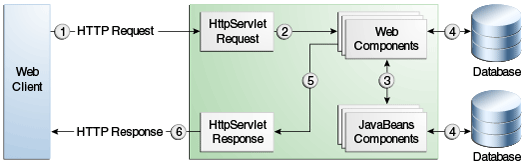
endpoints, or JSP pages. Figure 6-1 illustrates the
interaction between a web client and a web application that uses a
servlet. The client sends an HTTP request to the web server. A web
server that implements Java Servlet and JavaServer Pages technology
converts the request into an Figure 6-1 Java Web Application Request Handling
Servlets are Java programming language classes that dynamically process requests and construct responses. Java technologies, such as JavaServer Faces and Facelets, are used for building interactive web applications. (Frameworks can also be used for this purpose.) Although servlets and JavaServer Faces and Facelets pages can be used to accomplish similar things, each has its own strengths. Servlets are best suited for service-oriented applications (web service endpoints can be implemented as servlets) and the control functions of a presentation-oriented application, such as dispatching requests and handling nontextual data. JavaServer Faces and Facelets pages are more appropriate for generating text-based markup, such as XHTML, and are generally used for presentation-oriented applications. Web components are supported by the services of a runtime platform called a web container. A web container provides such services as request dispatching, security, concurrency, and lifecycle management. A web container also gives web components access to such APIs as naming, transactions, and email. Certain aspects of web application behavior can be configured when the application is installed, or deployed, to the web container. The configuration information can be specified using Java EE annotations or can be maintained in a text file in XML format called a web application deployment descriptor (DD). A web application DD must conform to the schema described in the Java Servlet specification. This chapter gives a brief overview of the activities involved in developing web applications. First, it summarizes the web application lifecycle and explains how to package and deploy very simple web applications on GlassFish Server. The chapter then moves on to configuring web applications and discusses how to specify the most commonly used configuration parameters.
 Copyright © 2017, Oracle and/or its affiliates. All rights reserved. | |||||||
| You are visitor 01402503 — GeezerVison does not store the pages you look up. Best viewed with Netscape Navigator 4.7 or Internet Explorer 6 at 800×600. No cookies required. |