GeezerVison is showing learning-python.com — Learning Python, 5th Edition
About Learning Python, 5th Edition
|
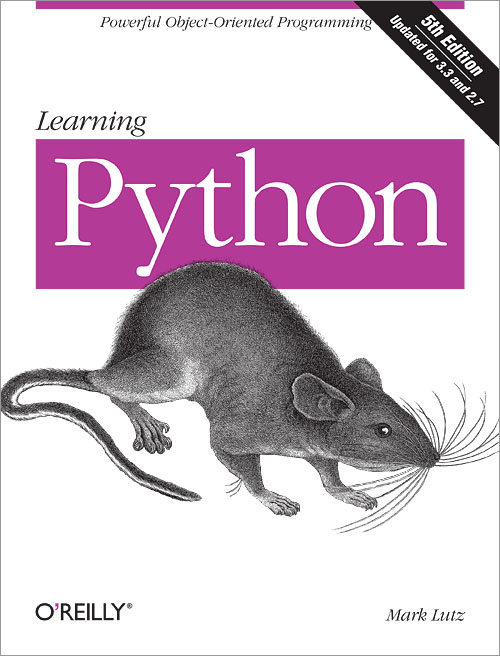
book,
ebook,
online,
6E
[June 2013] I'm pleased to announce the release of the 5th Edition
of the book Learning Python—the
most comprehensive version of this classic and foundational Python
language tutorial.
This new edition, designed for all Python learners in all Python
domains, has been brought thoroughly up-to-date with
Python 3.3 and 2.7 and expanded substantially to reflect
current practice in the Python world. Like its previous
editions, this book also applies to all other Python releases
in common use today. Whether you're using 3.X, 2.X, or both,
you'll find this new edition tailored to your current and
future needs.
Among other language extensions, this edition incorporates Python
3.3's namespace packages and Windows launcher, as well as 2.7's
adoption of 3.X features such as set and dictionary comprehensions.
In addition, this version has grown more 2.X compatible and has
been augmented with enhanced coverage of tools such as super(),
descriptors, the MRO, and metaclasses, which have grown more
pervasive in today's Python code.
As always, this book is designed to be an in-depth introduction
to the core Python language and work much like a self-paced class
on Python fundamentals. With quizzes, exercises, and solutions,
its material embodies nearly two decades of live Python training
experience and feedback from real Python learners like you.
There's more on this book's content and scope in the
Previews below and its main
title page.
Learning Python, 5th Edition is available in print,
ebook, and online forms from all the usual places, including
Amazon and O'Reilly. For purchase options and links, please see the
Purchase Pointers page.
FAQ: there were no plans for a new edition
until 2024.
|
Resources
More Resources
Previews
Contents
In brief, this edition's main parts reflect major language topics:
| Getting Started | An introduction to Python and ways to launch code
|
|---|
| Types and Operations | In-depth coverage of Python's built-in objects
|
|---|
| Statements and Syntax | Python's procedural statements' syntax and roles
|
|---|
| Functions and Generators | Functions and functional-programming tools
|
|---|
| Modules and Packages | Modules, module packages, and related concepts
|
|---|
| Classes and OOP | Comprehensive OOP coverage—from basic to advanced
|
|---|
| Exceptions and Tools | Raising and catching exceptions, context managers, tools survey
|
|---|
| Advanced Topics | Unicode, descriptors, properties, decorators, metaclasses, and more
|
|---|
| Appendixes | Usage tips, Windows launcher, Python changes, exercise solutions
|
|---|
For more details, check out the Preface excerpt or the
full Table of Contents in the
O'Reilly sampler.
Example Programs
There are hundreds of examples in this text. Some are short code segments typed and run at
the Python interactive prompt and others are larger scripts or modules coded and run in
files. Although typing code manually is an important part of the learning process,
the book's larger examples can also be fetched both
here and
here.
Related Books
The following two books are designed to complement and augment Learning Python,
forming a 3-book documentation set:
-
For a reference companion to this book, see also the book
Python Pocket Reference
This book provides supplemental reference-only material
and is intended to serve as an extension to Learning Python.
It's current 5th Edition has been updated to match the language
coverage in the latest Learning Python.
-
In addition, the applications-focused book
Programming Python is designed
to be a follow-up to Learning Python. It covers what you can do with
Python after you've mastered its language fundamentals. As a tutorial that moves
on to explore common libraries and tools and present more complete example programs,
Programming Python serves as the second of a two-book set.
These two related books are not required reading and some readers may opt to
instead focus on specific application domains after finishing Learning Python's
fundamentals coverage. For those looking for extra resources, though, they are
suggested texts.
Recent Notes
- (Sep-2024) About a new edition
-
Please see this page for breaking news.
- (Mar-2019) Want to run the book's code on your phone?
-
This book mentions using Python on the Android and iOS mobile platforms
in passing, but it is now entirely feasible to work though the book's
examples and exercises on your smartphone. On Android, for example, the
Termux app provides a
full-featured Linux environment for running code in a console; the
Pydroid 3 and
QPython
apps allow you to run Python code in GUI IDEs;
and programmer-friendly
keyboards
may help.
iOS also has multiple Python options, including
Pythonista.
For more on using Python on Android, check out this site's related documents
here and
here; they focus on running
Python tkinter GUIs on Android (also possible today) but cover general Android
topics along the way.
Of course, phones are not everyone's idea of coding-friendly tools,
but these devices are becoming powerful enough to double as general-purpose
computers, especially when paired with keyboards, mice, and styli.
|