GeezerVisonThe World Wide Web, restored to 800 pixels of glory. |
| Home|About|Gaming cabinet|Archives|How it works|Starter sites |
GeezerVison is showing learning-python.com — Python Slides, 1997 Python Talk Material (1997)[Note from the future: this page was restyled in 2018 for mobile, but its original content was left intact (even the silly bits). Early days to be sure, but most of it is still surprisingly relevant two decades later. The talk announcement is still online here, while it lasts.] This page contains HTML renditions of slides from an introductory talk on Python I've given in the past. Some of it has been updated, but not since its last change date: 5/23/97. Much of this material comes from the book "Programming Python". Since the pages here lack the narrative you'd get in a talk (or the book), I'm not sure how useful this is as an intro to Python; on the other hand, it's free :-). Please send comments about this page to [email protected]. Contents
Also see the appendix page for supplemental material. Some of it is specific to a company I've worked for, but it also includes some general Python information not listed above: Update: also see the new integration examples page for more Python/C integration examples. "And now, for something completely different..." Mark Lutz March 1997 Talk outline
But first: the book plug...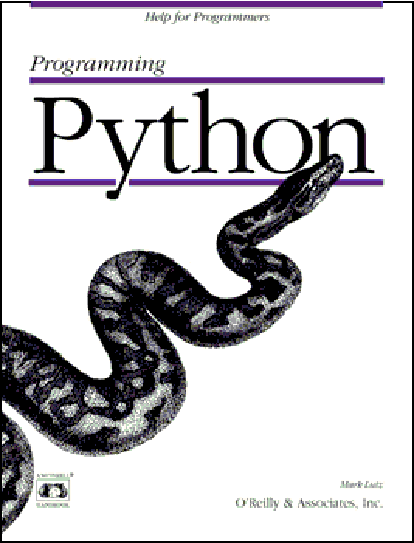
I. General Overview
So what's Python?
Major features
Some quotable quotes
A more formal definitionSeen on comp.lang.python... "python, (Gr. Myth. An enormous serpent that lurked in the cave of Mount Parnassus and was slain by Apollo) 1. any of a genus of large, non-poisonous snakes of Asia, Africa and Australia that crush their prey to death. 2. popularly, any large snake that crushes its prey. 3. totally awesome, bitchin' language invented by that rad computer geek Guido van Rossum that will someday crush the $'s out of certain *other* so-called VHLLs ;-)" The Life Of Python
What's Python good for?
What's Pythonnot good for?
The Compulsory Features List
Python Portability
General portability
Platform Extensions
The PythonWin IDE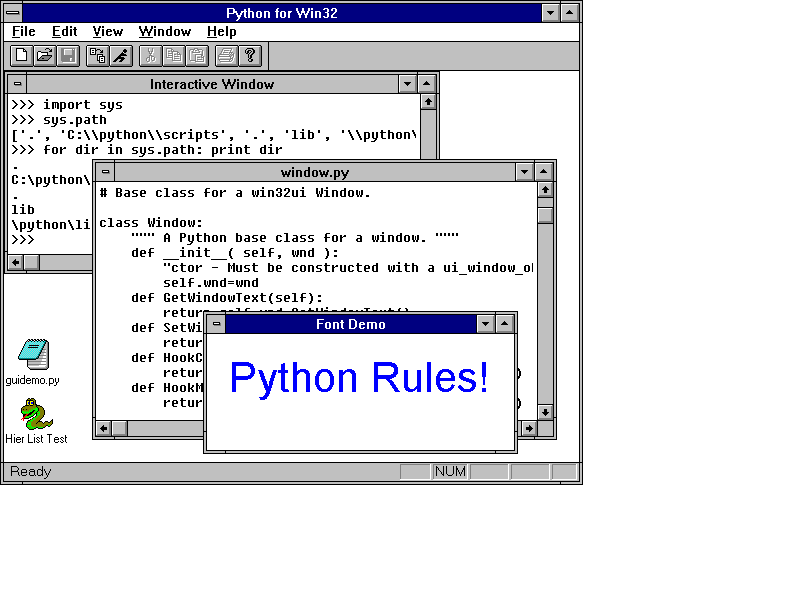
Major Python Packages
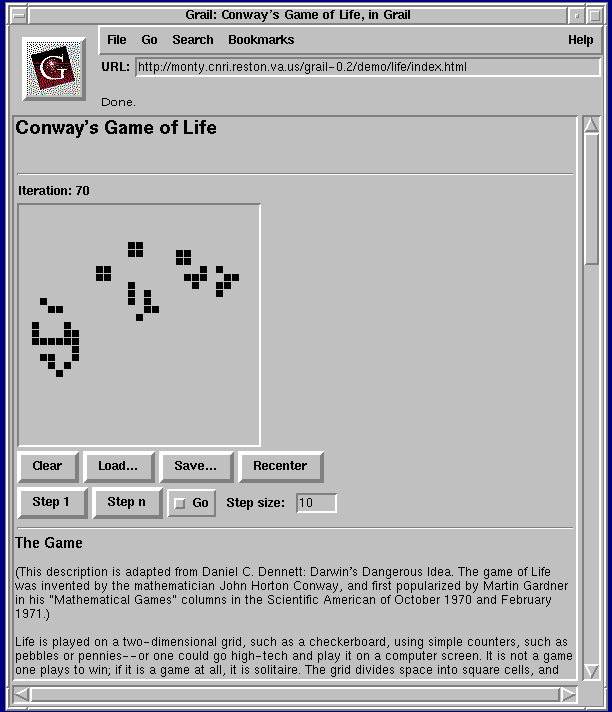
A first look: the Grail web browser in action
HTML file

<HEAD>
<TITLE>Grail Applet Test Page</TITLE>
</HEAD>

<BODY>
<H1>Test an Applet Here!</H1>
Click this button!
<APP CLASS=Question>
</BODY>


file: Question.py

# Python applet file: Question.py
# in the same location (URL) as the html file
# that references it; adds widgets to browser;

from Tkinter import *

class Question:                          # run by grail?
    def __init__(self, master):          # master=browser
        self.button = Button(master,
                             bitmap='question',
                             command=self.action)
        self.button.pack()

    def action(self):
        if self.button['bitmap'] == 'question':
            self.button.config(bitmap='questhead')
        else:
            self.button.config(bitmap='question')

if __name__ == '__main__':
    root = Tk()                    # run stand-alone?
    button = Question(root)        # master=Tk: top-level
    root.mainloop()
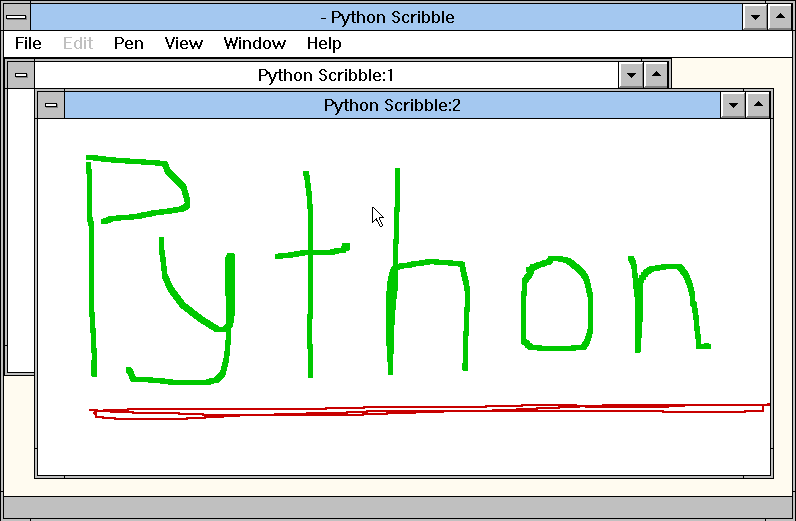
WPY at work
Python in the "Real World"
On Bananas and CoconutsPython versus...
But YMMV!
II. Python Resources
Internet Resources
Python Books
Also useful
Recent Python Articles
PSA-sponsored Python Conferences
Python Training
III. A first look at the language
How to Run Python ProgramsUNIX scriptsfile: brian.py #!/usr/local/bin/python print 'The Bright Side of Life...' % brian.py Module Files% python spam.py -i eggs -o bacon Interactive command line% python >>> print 'Hello world!' Hello world! >>> lumberjack = "okay" Embedded Code/ObjectsPy_Initialize();
PyRun_SimpleString("x = brave + sir + robin");
Notes: on UNIX, the environment variable PYTHONPATH should list all source directories you want to import modules from. Program start techniques and configuration details differ on Windows and Macintosh platforms; see package documentation. Builtin object typesNumbers: 3.1415
Strings: 'spam'
Lists: [1, [2, 'three']]
Dictionaries: {'food':'spam', 'taste':'yum'}
Tuples: (1,'spam', 4, 'U')
Files: open('temp', 'r').read()
NumbersCommon operations1234 normal integers (C long's) 99999999L long integers (unlimited size) 1.23, 3.14e-10 floating-point (C double's) 0177, 0x9ff octal and hex constants Interactive examples% python >>> a = 3 >>> b = 4 >>> b / 2 + a 5 >>> b / (2.0 + a) 0.8 >>> 9999999999999999999999999999 + 1 OverflowError: integer literal too large >>> 9999999999999999999999999999L + 1 10000000000000000000000000000L StringsCommon operationss1 = '' empty strings s2 = "spam's" double quotes s2[i], s2[i:j] indexing, slicing s1 + s2, s2 * 3 concatenate, repeat "a %s parrot" % 'dead' string formatting block = """...""" triple-quoted blocks Interactive examples% python
>>> 'abc' + 'def'
'abcdef'
>>> 'Ni!' * 4 # like "Ni!" + "Ni!" + ...
'Ni!Ni!Ni!Ni!'
>>> S = 'spam'
>>> S[0], S[-2] # same as: S[len(S)-2]
('s', 'a')
>>> S[:-1], S[1:]
('spa', 'pam')
>>> 'That is %d %s bird!' % (1, 'dead')
That is 1 dead bird!
ListsCommon operationsL1 = [] an empty list L2 = [0, 1, 2, 3] 4-items: indexes 0..3 ['abc', ['def', 'ghi']] nested sublists L2[i], L2[i:j] indexing, slicing L1 + L2, L2 * 3 concatenate, repeat L2.append(newvalue) growing: methods del L2[k], L2[i:j] = [] shrinking L2[i:j] = [1,2,3] slice assignment range(4), xrange(0, 4) make integer lists Interactive examples% python >>> [1, 2, 3] + [4, 5, 6] [1, 2, 3, 4, 5, 6] >>> ['Ni!'] * 4 ['Ni!', 'Ni!', 'Ni!', 'Ni!'] >>> L = ['spam', 'Spam', 'SPAM!'] >>> L[2] 'SPAM!' >>> L[1] = 'eggs' >>> for x in L: print x, ... spam eggs SPAM! DictionariesCommon operationsd1 = {} empty
d2 = {'spam': 2, 'ham': 1, 'eggs': 3} 3-items
d3 = {'pork': {'ham': 1, 'brats': 2}} nesting
d2['eggs'], d3['pork']['ham'] indexing
d2.has_key('eggs'), d2.keys() methods
Interactive examples% python
>>> table ={'Perl': 'Larry Wall',
... 'Tcl': 'John Ousterhout',
... 'Python': 'Guido van Rossum' }
...
>>> language = 'Python'
>>> creator = table[language]
'Guido van Rossum'
TuplesCommon operations() an empty tuple
t1 = (0,) a one-item tuple
t2 = (0, 1, 2, 3) 4-item tuple
t3 = ('abc', ('def', 'ghi')) nested tuples
t1[i], t1[i:j] index, slice
t1 + t2, t2 * 3 concatenate, repeat
FilesCommon operationso = open("/tmp/spam", 'w') output file
i = open('data', 'r') input file
i.read(), i.readline(), i.read(1) file,line,char
o.write(s), o.writelines(l) string,lines
o.close() or when free'd
And everything else...In Python, everything is an object type.
General properties
Nesting exampleL = ['abc', [(1,2), ([3], 4)], 5] 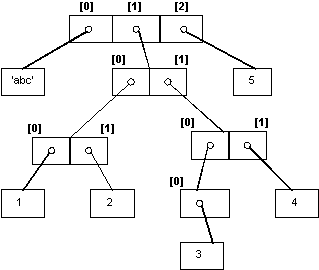
Basic statementsPython syntax...
Python assignment...
Python programming...
Simple statementsAssignmentspam = 'SPAM' basic form spam, ham = 'yum', 'YUM' tuple assignment [spam, ham] = ['yum', 'YUM'] list assignment spam = ham = 'lunch' multi-target Expressionsspam(egs, ham) function calls spam.ham(eggs) method calls spam print interactive spam < ham and ham != eggs compound expr's spam < ham < eggs range tests print spam, ham print objects to sys.stdout print spam, ham, don't add linefeed Compound statementsIf selections>>> x = 'killer rabbit' >>> if x == 'bunny': ... print 'hello little bunny' ... elif x == 'bugs': ... print "what's up doc?" ... else: ... print 'Run away! Run away!...' ... Run away! Run away!... While loopswhile 1:
print 'Type Ctrl-C to stop me!'
The loop "else"...
x = y / 2
while x > 1:
if y % x == 0: # remainder
print y, 'has factor', x
break # skip else
x = x-1
else: # normal exit
print y, 'is prime'
For loops>>> for x in ["spam", "eggs", "spam"]: ... print x, ... spam eggs spam Counter loops... >>> range(5) [0, 1, 2, 3, 4] >>> for i in xrange(len(X)): print X[i] >>> for i in range(5): print 'A shrubbery!' ... A shrubbery! A shrubbery! A shrubbery! A shrubbery! A shrubbery! Program unit statementsModules: code/data packages Classes: new objects Functions: procedural units C modules: optimization, integration Exceptions: errors and special cases Modules contain Statements that process Objects 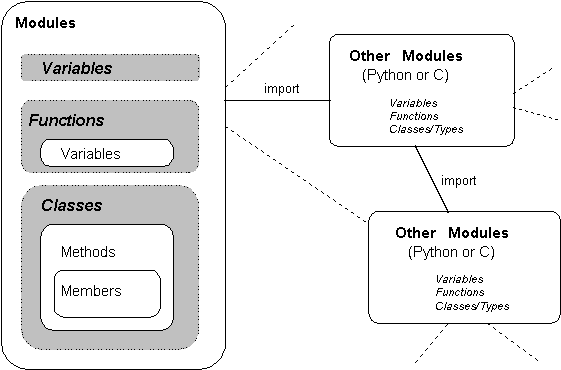
Functions
def intersect(seq1, seq2):
    res = []                     # start empty
    for x in seq1:               # scan seq1
        if x in seq2:            # common item?
            res.append(x)        # add to end
    return res


>>> s1 = "SPAM"
>>> s2 = "SCAM"

>>> intersect(s1, s2)               # strings
['S', 'A', 'M']

>>> intersect([1, 2, 3], (1, 4))    # mixed types
[1]
Modules
file: hello.py

def printer(x):
    print x


% python
>>> import hello
>>> hello.printer('Hello world!')
Hello world!

>>> from hello import printer
>>> printer('Hello world!')

>>> from hello import *
>>> printer('Hello world!')
Classes
class FirstClass:                   # class
    def printer(self, text):        # method
        print text

x = FirstClass()
x.printer('Hello world!')


class SecondClass(FirstClass):      # subclass
    def __init__(self, value):      # constructor
        self.name = value
    def printname(self):
        self.printer(self.name)   	  # inherited

x = SecondClass('Hello world!')
x.printname()
More on Python's OOP model
class Counter:
    def __init__(self, start):          # on Counter()
        self.data = start
    def __call__(self):                 # on x()
        self.data = self.data + 1
        return self.data
    def __add__(self, y):               # on x + y
        return Counter(self.data + y)
    def __repr__(self):                 # on print
        return `self.data`


if __name__ == "__main__":
    x = Counter(2)                # self-test
    x = x + 4
    print x                       # 6

    c1 = Counter(10)
    c2 = Counter(24)
    print c1(), c2(), c1(), c2()  # 11, 25, 12, 26
Exceptions
Builtin exceptions...

def kaboom(list, n):
    print list[n]            # trigger IndexError

try:
    kaboom([0, 1, 2], 3)
except IndexError:
    print 'Hello world!'     # catch exception here


User-defined exceptions...

MyError = "my error"
def stuff(file):
    raise MyError

file = open('data', 'r')     # open a file
try:
    stuff(file)              # raises exception
finally:
    file.close()             # always close file
A pragmatic interlude: system interfacesPython tools: sys>>> import sys >>> sys.path ['.', '/usr/local/lib/python', ... ] >>> sys.platform 'sunos4' System tools: os>>> import os
>>> os.environ['USER']
'mlutz'
>>> listing = os.popen("ls *.py").readlines()
>>> for name in listing: print name,
...
cheader1.py
finder1.py
summer.py
>>> for name in listing: os.system("vi " + name)
...
>>> os.listdir(".")
['summer.out', 'summer.py', 'table1.txt', ... ]
File globbing: glob, string>>> import glob, string, os
>>> glob.glob("*.py")
['cheader1.py', 'finder1.py', 'summer.py']
>>> for name in glob.glob("*.py"):
... os.rename(name, string.upper(name))
...
>>> glob.glob("*.PY")
['FINDER1.PY', 'SUMMER.PY', 'CHEADER1.PY']
Arguments and streams: sys% cat play.py
#!/usr/local/bin/python
import sys
print sys.argv
sys.stdout.write("ta da!\n")
% play.py -x -i spammify
['play.py', '-x', '-i', 'spammify']
ta da!
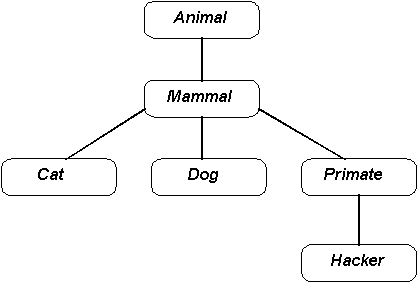
OOP and inheritanceA zoo-animal hiearchy in Python file: zoo.py
class Animal:
def reply(self): self.speak()
def speak(self): print 'spam'
class Mammal(Animal):
def speak(self): print 'huh?'
class Cat(Mammal):
def speak(self): print 'meow'
class Dog(Mammal):
def speak(self): print 'bark'
class Primate(Mammal):
def speak(self): print 'Hello world!'
class Hacker(Primate): pass
% python
>>> from zoo import Cat, Hacker
>>> spot = Cat()
>>> spot.reply()
meow
>>> data = Hacker()
>>> data.reply()
Hello world!
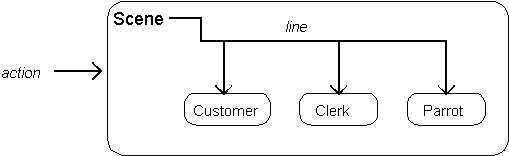
OOP and compositionThe dead-parrot skit in Python file: parrot.py
class Actor:
def line(self): print self.name + ':', `self.says()`
class Customer(Actor):
name = 'customer'
def says(self): return "that's one ex-bird!"
class Clerk(Actor):
name = 'clerk'
def says(self): return "no it isn't..."
class Parrot(Actor):
name = 'parrot'
def says(self): return None
class Scene:
def __init__(self):
self.clerk = Clerk() # embed some instances
self.customer = Customer() # Scene is a composite
self.subject = Parrot()
def action(self):
self.customer.line() # delegate to embedded
self.clerk.line()
self.subject.line()
% python
>>> import parrot
>>> parrot.Scene().action()
customer: "that's one ex-bird!"
clerk: "no it isn't..."
parrot: None
Functions are objects: indirect callsdef echo(message): print message
x = echo
x('Hello world!')
def indirect(func, arg):
func(arg)
indirect(echo, 'Hello world!')
schedule = [ (echo, 'Hello!'), (echo, 'Ni!') ]
for (func, arg) in schedule:
apply(func, (arg,))
File scannersfile: scanfile.py
def scanner(name, function):
file = open(name, 'r') # create file
for line in file.readlines():
function(line) # call function
file.close()
file: commands.py
import string
from scanfile import scanner
def processLine(line):
print string.upper(line)
scanner("data.txt", processLine) # start scanner
Classes are objects: factoriesdef factory(aClass, *args): # varargs tuple
return apply(aClass, args) # call aClass
class Spam:
def doit(self, message):
print message
class Person:
def __init__(self, name, job):
self.name = name
self.job = job
object1 = factory(Spam)
object2 = factory(Person, "Guido", "guru")
Methods are objects: bound or unboundx = object1.doit # bound method object
x('hello world') # instance is implied
t = Spam.doit # unbound method object
t(object1, 'howdy') # pass in instance
Modules are objects: metaprogramsfile: fixer.py
editor = 'vi' # your editor's name
def python(cmd):
import __main__
namespace = __main__.__dict__
exec cmd in namespace, namespace
def edit(filename):
import os
os.system(editor + ' ' + filename)
def fix(modname):
import sys # edit,(re)load
edit(modname + '.py')
if modname in sys.modules.keys():
python('reload(' + modname + ')')
else:
python('import ' + modname)
% python
>>> from fixer import fix
>>> fix("spam") # browse/edit and import by string name
>>> spam.function() # spam was imported in __main__
>>> fix("spam") # edit and reload() by string name
>>> spam.function() # test new version of function
Python/C integration[See the appendix for examples] Extending Python in C
Embedding Python in C
Going both ways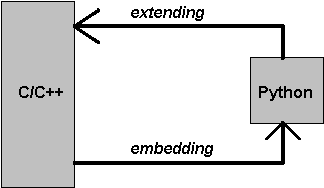
Python and rapid development
Summary: Python tool-set layers
IV. Real Python Programs
Simple shell toolsPacking files with simple scripts
% cat packer.py

#!/usr/local/bin/python
import sys                    # load the system module
marker = '::::::'

for name in sys.argv[1:]:     # for all command-line args
    input = open(name, 'r')   # open the next input file
    print marker + name       # write a separator line
    print input.read(),       # write the file's contents


% packer.py spam.txt eggs.txt toast.txt  >  packed.txt
Packing files with a class framework
% cat packapp.py

#!/usr/local/bin/python
from apptools import StreamApp       # get the superclass
from textpack import marker          # get marker constant

class PackApp(StreamApp):            # define a subclass
    def start(self):                 # define some methods
        if not self.args:
            self.exit('packapp.py [-o file]? src src...')

    def help(self):
        StreamApp.help(self)         # superclass args
        print '<file> <file>...'     # then show my args

    def run(self):
        for name in self.restargs():
            try:
                self.message('packing: ' + name)
                self.pack_file(name)
            except:
                self.exit('error processing: ' + name)

    def pack_file(self, name):
        self.setInput(name)
        self.write(marker + name + '\n')
        while 1:
            line = self.readline()       # read next line
            if not line: break           # until eof
            self.write(line)             # copy to output

if __name__ == '__main__':  PackApp().main()    # script?


% packapp.py -o packed.txt spam.txt eggs.txt toast.txt
GUI programming
file: hello
#!/usr/local/bin/python
from Tkinter import *                   # get widget classes

class Hello(Frame):                     # container subclass
    def __init__(self, parent=None):
        Frame.__init__(self, parent)    # do superclass init
        self.pack()
        self.make_widgets()

    def make_widgets(self):
        widget = Button(self,
                        text='Hello world',
                        command = self.onPress)
        widget.pack(side=LEFT)

    def onPress(self):
        print "Hi."

if __name__ == '__main__':  Hello().mainloop()


% hello

Persistent Python objects
file: person.py

# a person object: fields + behavior
# class defined at outer level of file

class Person:
    def __init__(self, name = '', job = '', pay = 0):
        self.name = name
        self.job  = job
        self.pay  = pay               # real instance data
    def tax(self):
        return self.pay * 0.25        # computed on demand
    def info(self):
        return self.name, self.job, self.pay, self.tax()


% python
>>>jerry = Person('jerry', 'dentist')
>>>bob   = Person('bob', 'psychologist', 70000)
>>>emily = Person('emily', 'teacher', 40000)
...
>>>import shelve
>>>dbase = shelve.open('cast')          # open a new dbm file
>>>for obj in (bob, emily, jerry):      # put objs in a shelve
>>>    dbase[obj.name] = obj
...
>>>import shelve
>>>dbase = shelve.open('cast')           # reopen shelve file
>>>print dbase['bob'].info()             # fetch 'bob' object
Fun with Sets
Set functionsfile: inter.py
def intersect(list1, list2):
res = [] # start with an empty list
for x in list1: # scan the first list
if x in list2:
res.append(x) # add common items to end
return res
def union(list1, list2):
res = map(None, list1) # make a copy of list1
for x in list2: # add new items in list2
if not x in res:
res.append(x)
return res
% python
>>> from inter import *
>>> s1 = "SPAM"
>>> s2 = "SCAM"
>>> intersect(s1, s2), union(s1, s2) # strings
(['S', 'A', 'M'], ['S', 'P', 'A', 'M', 'C'])
>>> intersect([1,2,3], (1,4)) # mixed types
[1]
>>> union([1,2,3], (1,4))
[1, 2, 3, 4]
Set classesfile: set.py
class Set:
def __init__(self, value = []): # constructor
self.data = [] # manages a list
self.concat(value)
def intersect(self, other): # other is a sequence
res = [] # self is the subject
for x in self.data:
if x in other:
res.append(x)
return Set(res) # return a new Set
def union(self, other):
res = self.data[:] # copy of my list
for x in other:
if not x in res:
res.append(x)
return Set(res)
def concat(self, value): # value: list, Set...
for x in value: # removes duplicates
if not x in self.data:
self.data.append(x)
def __len__(self): return len(self.data)
def __getitem__(self, key): return self.data[key]
def __and__(self, other): return self.intersect(other)
def __or__(self, other): return self.union(other)
def __repr__(self): return 'Set:' + `self.data`
% python
>>> from set import Set
>>> x = Set([1,2,3,4]) # __init__
>>> y = Set([3,4,5])
>>> x & y, x | y # __and__,__or__,__repr__
(Set:[3, 4], Set:[1, 2, 3, 4, 5])
>>> z = Set("hello") # set of strings
>>> z[0] # __getitem__
'h'
>>> z & "mello", z | "mello"
(Set:['e', 'l', 'o'], Set:['h', 'e', 'l', 'o', 'm'])
Multiple operands: *varargsfile: inter2.py
def intersect(*args):
res = []
for x in args[0]: # scan first list
for other in args[1:]: # for all other args
if x not in other: break # this in each one?
else:
res.append(x) # add items to end
return res
def union(*args):
res = []
for seq in args: # for all args
for x in seq: # for all nodes
if not x in res:
res.append(x) # add items to result
return res
% python
>>> from inter2 import *
>>> s1, s2, s3 = "SPAM", "SCAM", "SLAM"
>>> intersect(s1, s2), union(s1, s2) # 2 operands
(['S', 'A', 'M'], ['S', 'P', 'A', 'M', 'C'])
>>> intersect([1,2,3], (1,4))
[1]
>>> intersect(s1, s2, s3) # 3 operands
['S', 'A', 'M']
>>> union(s1, s2, s3)
['S', 'P', 'A', 'M', 'C', 'L']
The Python FTP module#!/usr/local/bin/python
###############################################
# Usage: % sousa.py
# Fetch and play the Monty Python theme song.
###############################################
import os, sys
from ftplib import FTP # socket-based ftp tools
from posixpath import exists # file existence test
sample = 'sousa.au'
filter = {'sunos5': '/usr/bin/audioplay',
'linux1': '
Sockets in Python
file: sockserver.py

# Echo server program
from socket import *
HOST = ''                     # the local host
PORT = 50007                  # non-privileged server

s = socket(AF_INET, SOCK_STREAM)
s.bind(HOST, PORT)
s.listen(1)
conn, addr = s.accept()
print 'Connected by', addr

while 1:
    data = conn.recv(1024)
    if not data: break
    conn.send(data)
conn.close()


file: sockclient.py

# Echo client program
from socket import *
HOST = 'daring.cwi.nl'          # the remote host
PORT = 50007                    # the port used by server

s = socket(AF_INET, SOCK_STREAM)
s.connect(HOST, PORT)
s.send('Hello, world')

data = s.recv(1024)
s.close()
print 'Received', `data`
Text processing: regular expressionsfile: cheader1.py
#! /usr/local/bin/python
import sys, regex
from string import strip
pattDefine = regex.compile(
'^#[\t ]*define[\t ]+\([a-zA-Z0-9_]+\)[\t ]*')
pattInclude = regex.compile(
'^#[\t ]*include[\t ]+[<"]\([a-zA-Z0-9_/\.]+\)')
def scan(file):
count = 0
while 1: # scan line-by-line
line = file.readline()
if not line: break
count = count + 1
n = pattDefine.match(line) # save match length
if n >= 0:
name = pattDefine.group(1) # matched substring
body = line[n:]
print count, name, '=', strip(body)
elif pattInclude.match(line) >= 0:
regs = pattInclude.regs # start,stop
a, b = regs[1] # of group 1
filename = line[a:b] # slice out
print count, 'include', filename
if len(sys.argv) == 1:
scan(sys.stdin) # no args: read stdin
else:
scan(open(sys.argv[1], 'r')) # arg: input file name
% cheader1.py test.h
1 include stdio.h
2 include usr/local/include/Py/Python.h
4 SPAM =
5 SHOE_SIZE = 7.5
7 include local_constants.h
8 PARROT = dead + bird
Text processing: splitting files by columns
file: summer.py

import string, sys

def summer(numCols, fileName):
    sums = [0] * numCols
    for line in open(fileName, 'r').readlines():
        cols = string.split(line)
        for i in range(numCols):
            sums[i] = sums[i] + eval(cols[i])
    return sums

if __name__ == '__main__':
    print summer(eval(sys.argv[1]), sys.argv[2])


% summer.py cols file
System interfaces: regression tests#!/usr/local/bin/python
import os, sys # get unix, python services
from stat import ST_SIZE # file stat record
from glob import glob # file-name expansion
from posixpath import exists # file exists test
from time import time, ctime # time functions
print 'RegTest start.'
print 'user:', os.environ['USER'] # environment variables
print 'path:', os.getcwd() # current directory
print 'time:', ctime(time()), '\n'
program = sys.argv[1] # two command-line args
testdir = sys.argv[2]
for test in glob(testdir + '/*.in'): # for all *.in files
if not exists(test + '.out'):
# no prior results
command = '%s < %s > %s.out 2>&1'
os.system(command % (program, test, test))
print 'GENERATED:', test
else:
# backup, run, compare
os.rename(test + '.out', test + '.out.bkp')
command = '%s < %s > %s.out 2>&1'
os.system(command % (program, test, test))
command = 'diff %s.out %s.out.bkp > %s.diffs'
os.system(command % ((test,)*3) )
if os.stat(test + '.diffs')[ST_SIZE] == 0:
print 'PASSED:', test
os.unlink(test + '.diffs')
else:
print 'FAILED:', test, '(see %s.diffs)' % test
print 'RegTest done:', ctime(time())
% regtest.py shrubbery test1
RegTest start.
user: mark
path: /home/mark/stuff/python/testing
time: Mon Feb 26 21:13:20 1996
FAILED: test1/t1.in (see test1/t1.in.diffs)
PASSED: test1/t2.in
RegTest done: Mon Feb 26 21:13:27 1996
Other things that weren't covered
And finally... "Nobody expects the Spanish Inquisition..." Questions? Copyright 1997, Mark Lutz |
| You are visitor 01402503 — GeezerVison does not store the pages you look up. Best viewed with Netscape Navigator 4.7 or Internet Explorer 6 at 800×600. No cookies required. |