GeezerVisonThe World Wide Web, restored to 800 pixels of glory. |
| Home|About|Gaming cabinet|Archives|How it works|Starter sites |
GeezerVison is showing longvideohaystack.github.io — T*: Re-thinking Temporal Search for Long-Form Video Understanding AbstractWe introduce the "Long Video Haystack" task: finding a minimal set of relevant frames (one to five) from tens of thousands of frames for given queries. We provide LV-HAYSTACK, a new benchmark of 3,874 human-annotated instances with fine-grained metrics for keyframe search quality and efficiency. Current methods only achieve a 2.1% temporal F1 score on its LVBENCH subset, highlighting a large gap. To address this, we propose T*, a lightweight keyframe search framework that reframes expensive temporal search as a spatial search. T* leverages image-based visual localization capabilities and introduces adaptive zooming-in across temporal and spatial dimensions. Under a 32-frame inference budget, T* boosts GPT-4o's performance from 50.5% to 53.1%, and LLaVA-OneVision-OV-72B's from 55.5% to 62.4% on the LongVideoBench XL subset. Method OverviewT* is an advanced temporal search framework designed to efficiently identify key frames relevant to specific queries. By transforming temporal search into spatial search, T* leverages lightweight object detectors and Visual Language Model (VLM) visual grounding techniques to streamline the process. T* demonstrates exceptional performance, both with and without additional training, making it a versatile and powerful tool for various applications. 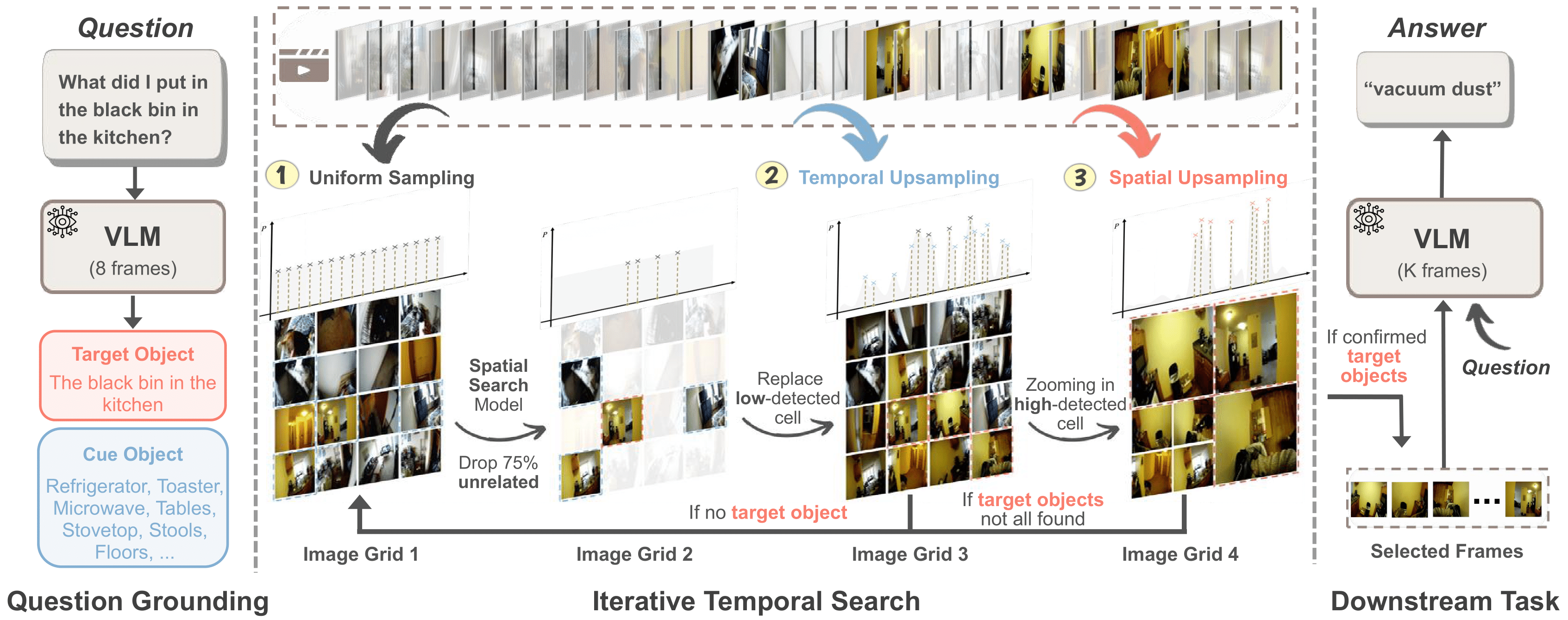
Figure 1. T* employs an iterative temporal search approach to search keyframes essential to answer questions.
Left: Question Grounding, where a visual language model identifies visual cues (target and cue object) from the textual question.
Center: Iterative Temporal Search, formulated as Spatial Search where a spatial search model iteratively detects visual cues and upsamples relevant temporal/visual regions.
Right: Downstream Task, where the visual language model answers questions using K keyframes sampled from the final temporal search distribution as visual input.
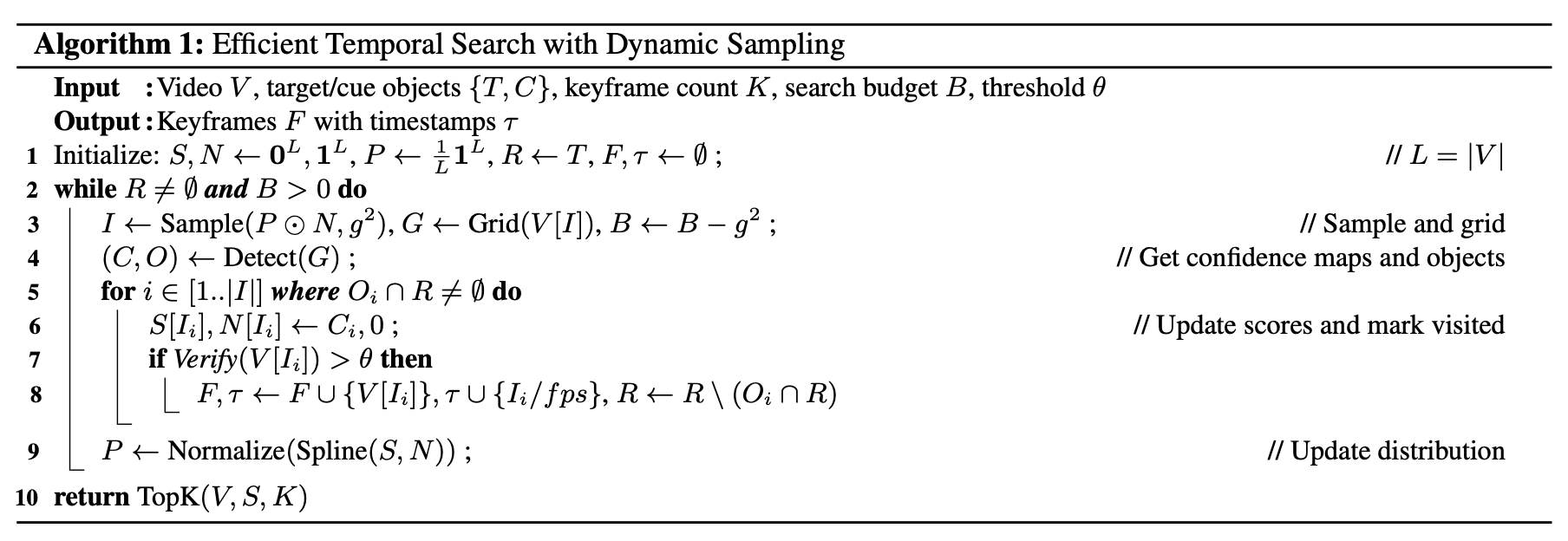
Figure 2. The algorithmic workflow of T* showing the iterative refinement process for keyframe selection.
ExperimentsEvaluations on Downstream Tasks: Video QA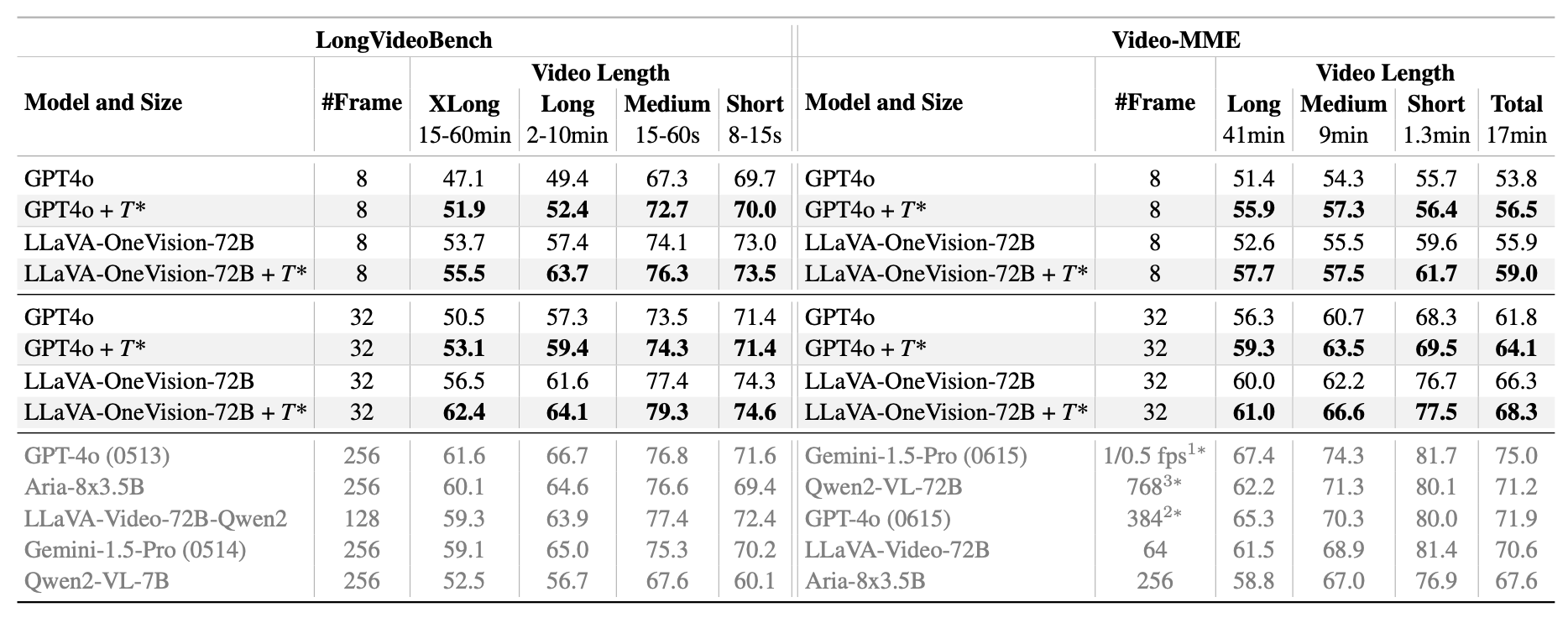
Table 1. Downstream task evaluation results show T* effectiveness as a temporal search module for VLMs on LongVideoBench and Video-MME (without subtitles for fair comparison). Using QA accuracy (%) as the metric, we compare with top leaderboard models (shown in gray), noting these typically use substantially more frames, making direct comparisons challenging. Models are ranked by XLong video performance on LongVideoBench and total score on Video-MME, with frame counts indicated. All baseline figures are directly cited from their original publications.
Evaluations on Search Utility and EfficiencyWe explore disentangled evaluation of temporal search & video understanding with 6 fine-grained search metrics. 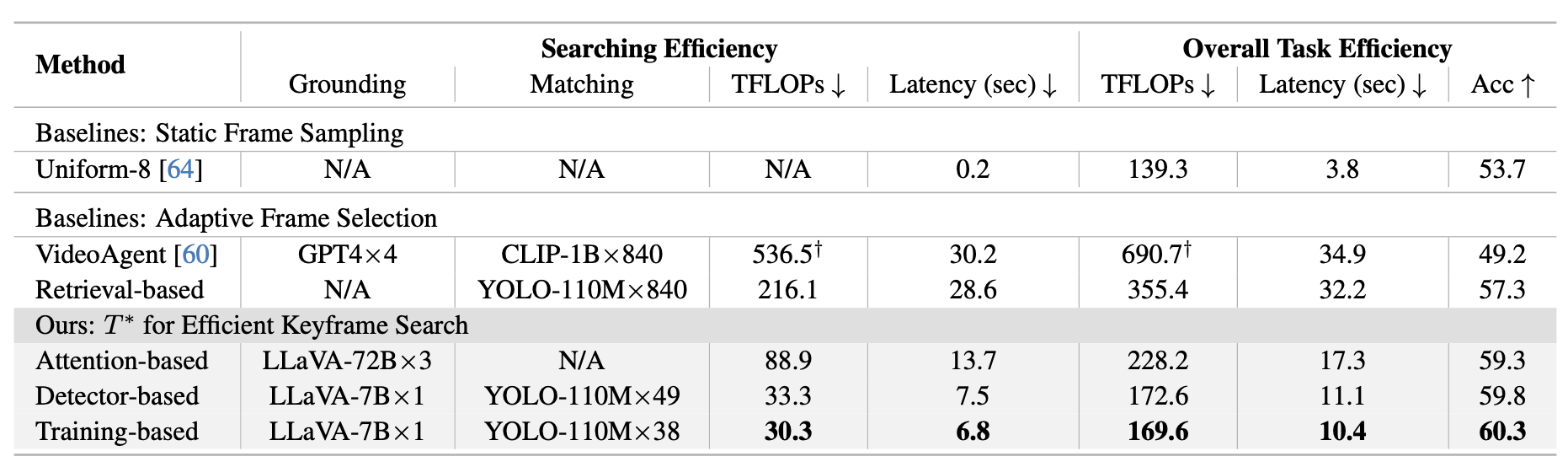
Table 2. Efficiency results on the full LV-HAYSTACK, including search efficiency and overall (search+downstream) efficiency. We report the search models used and their avg. call frequency (e.g., VideoAgent calls GPT-4 four times for grounding).
T* achieves high performance with significantly less computation and lower latency. VideoAgent's FLOPs (†) exclude GPT-4 costs due to its closed-source nature.
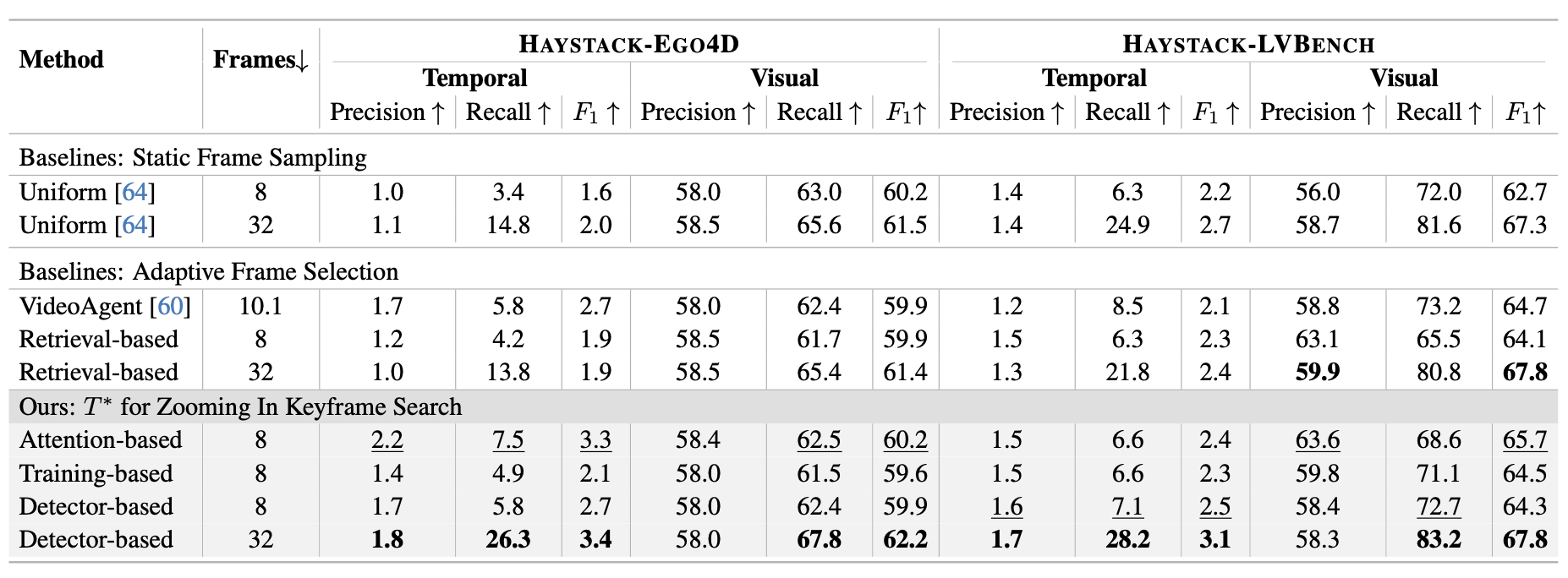
Table 3. Search utility results on LV-HAYSTACK. 8-frame setting bests are underlined, 32-frame setting bests are in bold. We show that more searched frames consistently improves recall but reduces precision in retrieval methods. Detector-based T* achieves best performance in 32-frame setting across metrics, demonstrating the effectiveness of visual grounding and iterative temporal search. Attention-based T* performs well in 8-frame setting but requires larger foundation models, thereby reducing efficiency.
LV-HAYSTACK Data
HAYSTACK-EGO4DEgocentric
video: 988 length: 423 h (~25.7 min/video) frame: 45,700,000 (~46,300/video) QA pair: 15,092 (~15.3/video) keyframe: 28,300 (~1.9/question) 
HAYSTACK-LVBENCHAllocentric
video: 114 length: 26.7 h (~14.1 min/video) frame: 2,200,000 (~19,100/video) QA pair: 342 (~3.0/video) keyframe: 496 (~1.5/question) Dataset ExamplesExplore examples from our LV-Haystack dataset. (Note: The video shown in the current interface is not the original dataset video length; it has been clipped to a segment close to the target frame.) HAYSTACK-EGO4D
Example 1 of 11
Video plays at 4x speed by default
Question:
Measuring from the closest point of each object, which of these objects (table, stool, sofa, stove) is the closest to the TV?
A. Table
B. Stool
C. Sofa
D. Stove
E. Shelf
Keyframes (Needle in Haystack):


Keyframe(s)
Ground Truth:
The sofa is the closest object to the TV, as seen in the keyframe.
ConclusionAcknowledgementThis work is in part supported by ONR N00014-23-1-2355 and ONR MURI N00014-22-1-2740. We thank Anabella Isaro for their valuable contributions in helping organizing open-source code. BibTeX @misc{tstar,
title={T*: Re-thinking Temporal Search for Long-Form Video Understanding},
author={Jinhui Ye and Zihan Wang and Haosen Sun and Keshigeyan Chandrasegaran and Zane Durante and Cristobal Eyzaguirre and Yonatan Bisk and Juan Carlos Niebles and Ehsan Adeli and Li Fei-Fei and Jiajun Wu and Manling Li},
year={2025},
eprint={2504.02259},
archivePrefix={arXiv},
primaryClass={cs.CV},
url={https://arxiv.org/abs/2504.02259},
}
|
| You are visitor 01402503 — GeezerVison does not store the pages you look up. Best viewed with Netscape Navigator 4.7 or Internet Explorer 6 at 800×600. No cookies required. |