GeezerVison is showing majewski.studio — Jakub Majewski · Software engineer
Software engineer Munich
JakubMajewski
I'm a software engineer in Munich with a background in Management & Technology. I build software end to end: XR apps, real-time 3D from engineering CAD, machine learning, and knowledge tools for teams that use AI agents. At TUM I research Gaussian Splatting for real-time 3D on standalone headsets, together with Qing Cheng and supervised at Prof. Daniel Cremers' Chair of Computer Vision and Artificial Intelligence.
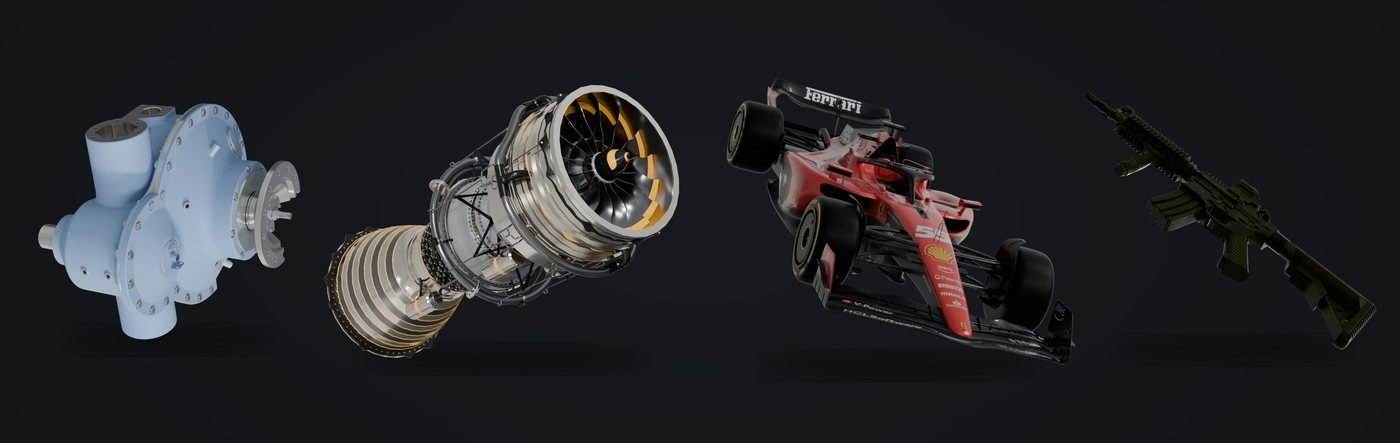
Test bench that turns CAD models into Gaussian splats and measures them on a standalone headset: how close each trained model stays to the CAD original and what it costs to render.
Each CAD model is rendered in Blender Cycles from 150 viewpoints spread evenly over a Fibonacci sphere, and the splats are trained from those images. I wrote my own splat renderer in NumPy for the scoring and a visionOS measurement app on the open-sourceMetalSplatter renderer, which I extended to draw several models in one frame and to time every render pass on the GPU. The analysis plan was fixed before the results came in and every number can be rebuilt from the raw records.
150 viewpoints on a Fibonacci sphere, each taking one picture of the CAD model
470
Gaussian splat models of five CAD models, trained with OpenSplat in CUDA on cloud GPUs
203,520
view-by-view comparisons of trained models with the CAD original
545,903
frames measured on the headset, each with its GPU time
55%
largest change in GPU time per frame when only the headset's display mode switched between 90 and 100 Hz, so results from the two modes are never mixed
3D Gaussian SplattingCADBlendervisionOSMetalCUDAPythonExperimental design
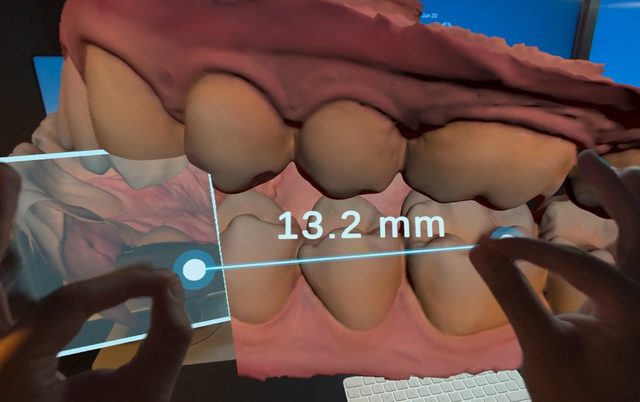
XR app for dental clinics that puts a patient's face scan, jaw scans and CBCT into one 3D scene at true scale, to explore by hand on the headset.
I built it for receptionOS. They had the scans and the headset but no way to use them together, so I took the app from an early proof of concept to the release on my own. Version 2.1.5 was accepted on the headset.
Up to 10 scans, each with up to 3 million triangles, load into one aligned scene that keeps the patient's real proportions. Any part can be grabbed, moved and turned by hand, layers can be made see-through or cut open with a clipping plane, the face texture is mapped to look photorealistic, without the scanner's colour casts, and a ruler measures right on the scan surface.
Patient sessions are kept in a database on the headset and everything runs on the device, with no need for the internet. Native SwiftUI windows and a Unity space rendered with URP and Metal run as one app.
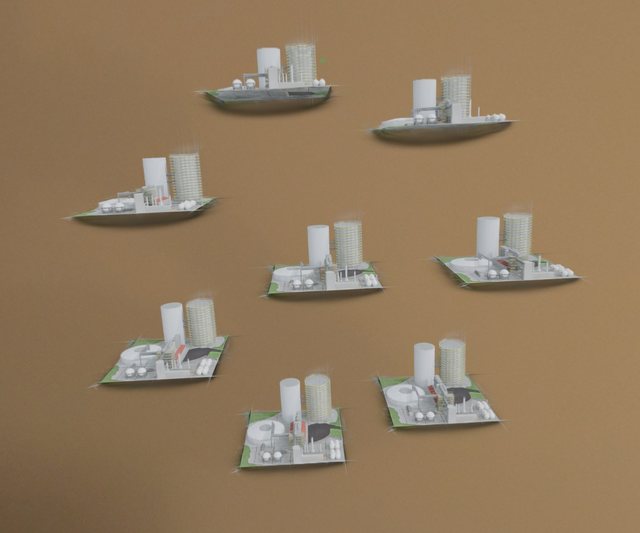
Large Gaussian splat scenes on a standalone headset. The goal is an app that takes any finished splat scene, analyses it on the device and builds the level of detail it needs, so even a whole town stays smooth to move through.
I test it on three large outdoor scenes I captured with TUM-XR: the Bismarck Tower near Lake Starnberg, from the air and on the ground, the Alpine town of Leukerbad and the Technical University of Munich. The scans were processed into Gaussian splats in LCC Studio, and the full scenes have 44.5, 23.3 and 24.1 million splats.
In the first results they run on a standalone headset with a dynamic level of detail computed on the device, so not every splat is drawn in every frame. The flyover comes from the TUM-XR video about the Leukerbad trip, which I edited end to end. I also work on large scenes for standalone headsets at SplatFactory3D.
3D Gaussian SplattingDrone captureLCC StudioLevel of detailvisionOS
App for full-scale vehicle design reviews on a headset, used by designers, engineers and management to judge an interior before a physical prototype exists.
The focus is the interior, from concept studies to production cars. Reviewers sit in a physical seating buck while the car is lined up on it in mixed reality, or see it in 360° environments that hide the room. The virtual steering assembly follows the real one, and seats, steering wheels, materials and display concepts can be swapped from the driver's seat.
Since October 2025 I have developed the app with a colleague, on requirements from my team lead, who owns the product. As technical lead I proposed a new architecture, worked out from a decision tree. It was accepted and an external development partner is building it now: I oversee their work, answer their technical questions and prepared all of their onboarding material.
I also keep the build pipeline and Unity Version Control in order and moved the project from Unity 6.0 to 6.3 LTS, Asset Transformer (Pixyz) included, which isn't fully made for visionOS. Early on, the project's size caused merge conflicts on a scale nobody in the company had seen before, and we solved them with Unity's support team.
UnityPolySpatialRealityKitC#
Public: the case study. The app and its code are in-house.
Workflow and tools that take car interiors from engineering CAD to a build that runs in the headset app.
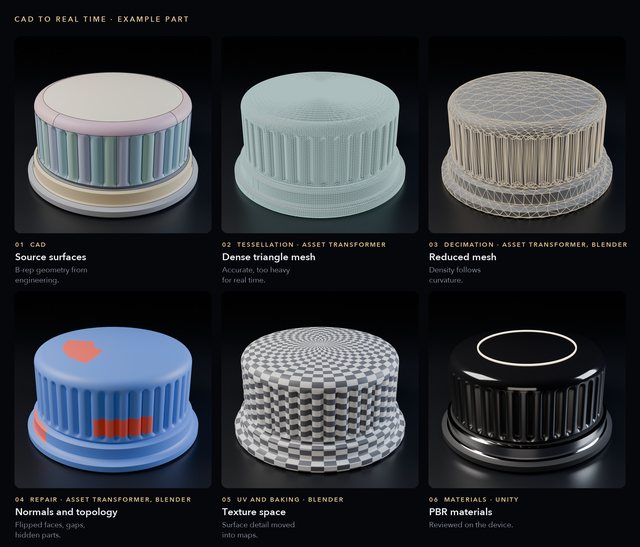
The core is the team's Blender add-on, which I took over and have released eight versions of. It sets the hierarchy and naming the app expects, decimates, fixes normals and unwraps UVs in a few clicks, so the designer who delivers a car hands over a build that works in the visionOS app straight away. For the trim, an AI agent I set up lays out the UVs from a reference photo, so the materials sit where they do on the real car.
The latest step is the seats: everything is in millimetres, so quilting and stitching keep their real size while the seats lose about 70% of their triangles. A measurement pipeline renders the same views before and after every reduction, with charts and tables of triangles and textures.
PythonBlenderUnity Asset Transformer (Pixyz)Unity
Public: the case study. The tools and the vehicle models are in-house.
Local search for coding agents that knows which decision is still current. Claude Code, GitHub Copilot or Codex ask over MCP and get cited passages from notes, PDFs, .docx files and code, with the index and the models on your own machine.
It finds them by words and by meaning and reads the status lines that decision logs keep, so a replaced decision ranks below its successor and points to it. After an edit it lists the notes to bring in line.
I chose its models in a tournament of 30 local model stacks under fixed gates for latency and memory, then put eight finalists on 158 held-out questions. The shipped pair puts the right note in the top five for 85.4% of them, against 61.4% for version 2.0 on the same questions. On 120 fresh questions written after release it reaches 83.3% against 46.7%, and it answers from PDF pages and in German and Polish.
With an agent at work over three scripted working days, 89% of answers were right with LEKS against 75% without it, and the three days came out 15% cheaper. I measured all of it on my own research knowledge base, a real record I have worked in every day since February 2026, with 7,294 documents searched in full and 172,775 files by name.
Next to other local search tools, on 695 held-out questions about the Python PEPs that none of them was tuned on, LEKS with its models puts the right PEP in the top five for 93.4%, against 86.5% for qmd, 83.3% for knowledge-rag and 81.2% for MemPalace, each in its best tested setting and each gap with Holm p 1.2e-6 or lower.
Heating and cooling load prediction for building designs, with a checked uncertainty range for each prediction.
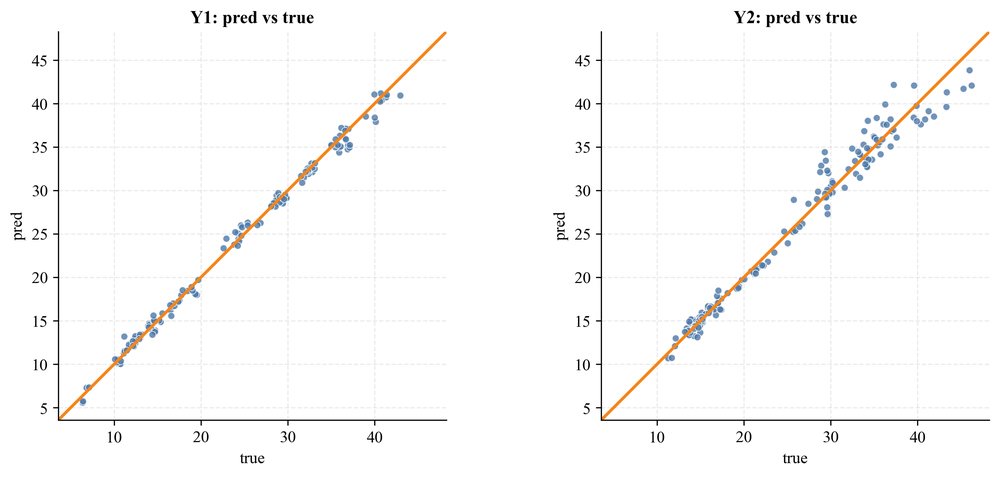
On 768 simulated building designs I compared ridge regression, a random forest and a Gaussian process on the same held-out splits. No single model won: the random forest was best on heating load, with 99.7% of the variance explained, the Gaussian process on cooling load, with 97.6%.
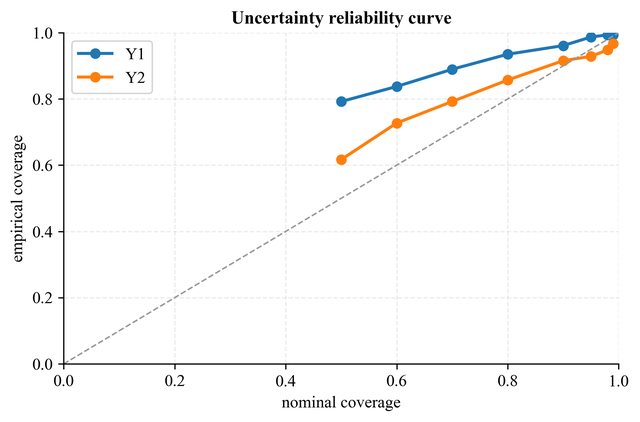
The Gaussian process also gives an uncertainty range for every prediction, and I checked whether those ranges hold, with split-conformal prediction as a second check that does not depend on the model. Its 90% ranges caught 91.6% of the true cooling loads, close to target, and were too cautious on heating, at 96.1%. The repository has 11 automated tests that run in CI.
Pythonscikit-learnUncertainty quantification
Public: the code, data, tests and CI, so every result can be rerun.
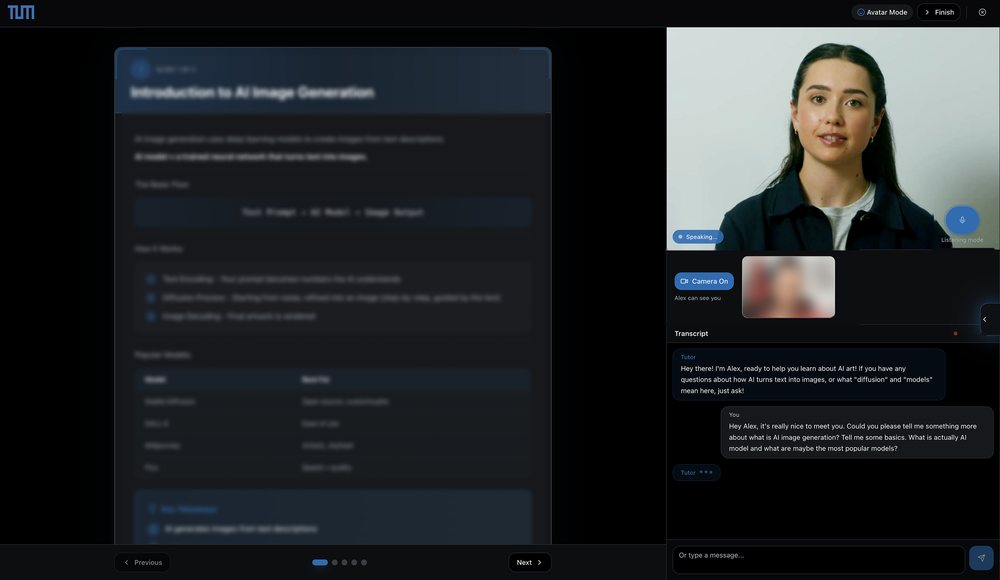
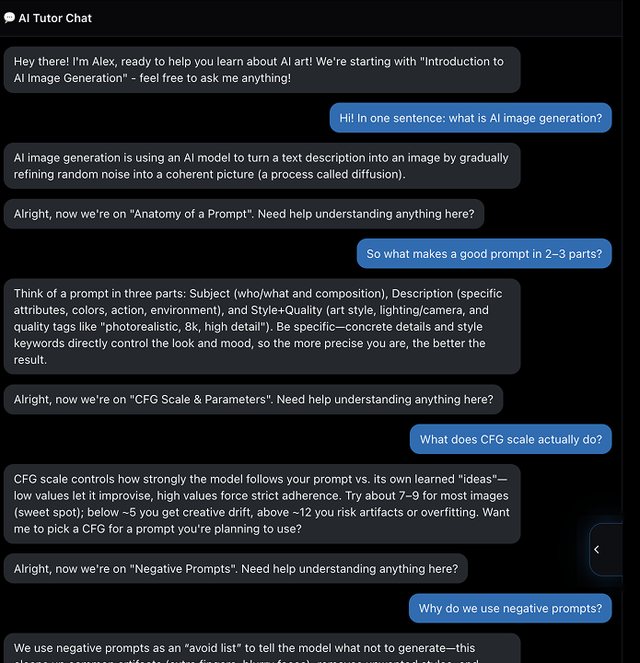
Platform for a user study that compares an AI text tutor with a speaking avatar tutor.
I was technical and product lead in a five-person student team and built the platform end to end. It covers consent, a baseline test, a learning session with one of the two tutors and a post-test, plus logging and data export for analysis. Timing rules flag sessions that move through the study implausibly fast, completeness checks catch missing parts, and a researcher accepts or rejects every flagged session before it goes into the analysis.
Across the whole group, correct answers to one key question went from 23% before the session to 95% after it.
Human-AI interactionTypeScriptReactSupabase
Public: the case study and the platform's code, whose 54 tests run in CI. The study data stays private.
VR safety training and design reviews for industrial plants, and a framework for designing such training.
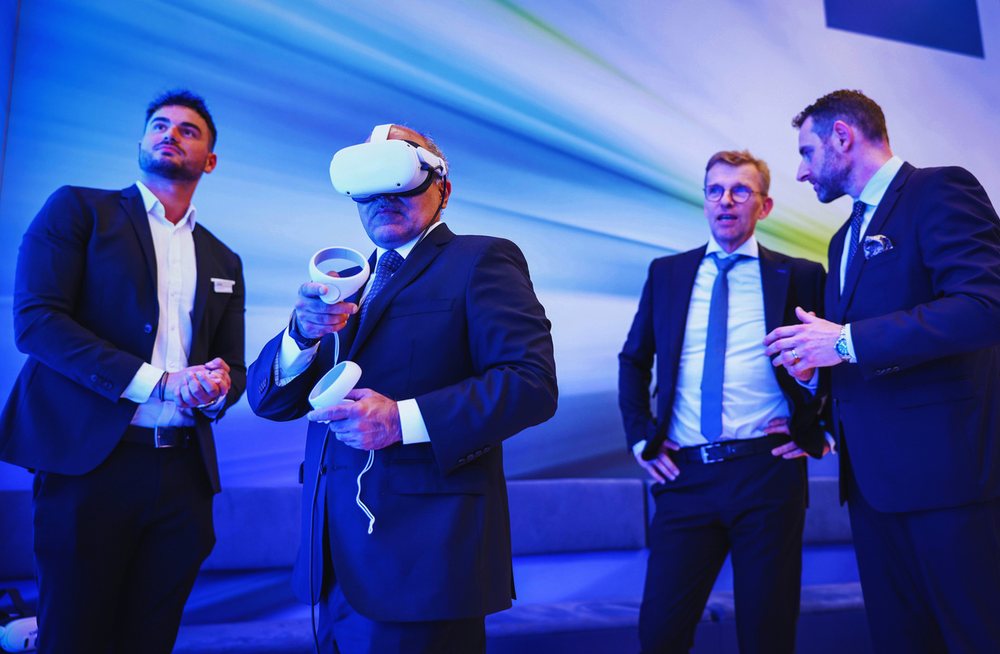
At Linde Engineering I worked on the Linde Virtual Academy, VR training and design reviews for industrial plants. I produced content from the storyboards to the CAD models prepared for VR and tested every training on the headset. Eleven trainings I worked on are published in the Meta Quest store, along with a free demo of the academy.
My research at Gdańsk University of Technology then turned this into a framework for designing such training: I reviewed 93 sources, compared published case studies, surveyed 44 industry professionals in Germany, the Netherlands and Poland and interviewed people from the academy's team. In the survey, 81.8% viewed VR training favourably, and cost was the main barrier.
At ACHEMA 2024 in Frankfurt I presented one of the trainings one-to-one to Saudi Arabia's Deputy Minister of Industry and Mineral Resources and the whole concept to the company's CEO. The work won the faculty's award for the best master's thesis of 2024.
I study Management & Technology at TUM with Computer Engineering as my technology specialization. Before that I did an M.Sc. in Management, specialising in Quality and Innovation Projects Management, at Gdańsk University of Technology, graduating with distinction. I'm also Head of Strategic Development at TUM-XR, the university's student XR initiative, and a Senior Associate at XR Association Munich e.V.
Experience
Software developer and technical lead for automotive XR
In preparationTwo papers with Qing Cheng at TUM, one on Gaussian splats trained from CAD models and measured on a standalone headset, one on large scenes with a dynamic level of detail
You are visitor 01402775 — GeezerVison does not store the pages you look up. Best viewed with Netscape Navigator 4.7 or Internet Explorer 6 at 800×600. No cookies required.