GeezerVison is showing omerbt.github.io — Omer Bar-Tal's Homepage
Selected Publications
Lumiere: A Space-Time Diffusion Model for Video Generation
SIGGRAPH Asia 2024
Abstract
We introduce Lumiere -- a text-to-video diffusion model designed for synthesizing videos that portray realistic, diverse and coherent motion -- a pivotal challenge in video synthesis. To this end, we introduce a model architecture that generates the entire duration of the video in one pass, followed by a spatial-only super-resolution model. Our model is based on a space-time U-Net architecture that incorporates both spatial and (importantly) temporal down- and up-sampling, and leverages a pre-trained text-to-image diffusion model. As opposed to existing methods which synthesize distant keyframes followed by temporal super-resolution, our model learns to directly generate a full-frame-rate, low resolution video by processing it in multiple space-time scales. We demonstrate state-of-the-art text-to-video generation results, as well as a range of creative applications that are easily facilitated by our design, including image-to-video, video inpainting, and stylized generation.
Space-Time Diffusion Features for Zero-Shot Text-Driven Motion Transfer
Conference on Computer Vision and Pattern Recognition (CVPR) 2024
Abstract
We present a new method for text-driven motion transfer - synthesizing a video that complies with an input text prompt describing the target objects and scene while maintaining an input video's motion and scene layout. Prior methods are confined to transferring motion across two subjects within the same or closely related object categories and are applicable for limited domains (e.g., humans). In this work, we consider a significantly more challenging setting in which the target and source objects differ drastically in shape and fine-grained motion characteristics (e.g., translating a jumping dog into a dolphin). To this end, we leverage a pre-trained and fixed text-to-video diffusion model, which provides us with generative and motion priors. The pillar of our method is a new space-time feature loss derived directly from the model. This loss guides the generation process to preserve the overall motion of the input video while complying with the target object in terms of shape and fine-grained motion traits.
TokenFlow: Consistent Diffusion Features for Consistent Video Editing
International Conference on Learning Representations (ICLR) 2024
Abstract
The generative AI revolution has been recently expanded to videos. Nevertheless, current state-of-the-art video mod- els are still lagging behind image models in terms of visual quality and user control over the generated content. In this work, we present a framework that harnesses the power of a text-to-image diffusion model for the task of text-driven video editing. Specifically, given a source video and a target text-prompt, our method generates a high-quality video that adheres to the target text, while preserving the spatial lay- out and dynamics of the input video. Our method is based on our key observation that consistency in the edited video can be obtained by enforcing consistency in the diffusion feature space. We achieve this by explicitly propagating diffusion features based on inter-frame correspondences, readily available in the model. Thus, our framework does not require any training or fine-tuning, and can work in con- junction with any off-the-shelf text-to-image editing method. We demonstrate state-of-the-art editing results on a variety of real-world videos.
MultiDiffusion: Fusing Diffusion Paths for Controlled Image Generation
International Conference on Machine Learning (ICML) 2023
Abstract
Recent advances in text-to-image generation with diffusion models present transformative capabilities in image quality. However, user controllability of the generated image, and fast adaptation to new tasks still remains an open challenge, currently mostly addressed by costly and long re-training and fine-tuning or ad-hoc adaptations to specific image generation tasks. In this work, we present MultiDiffusion, a unified framework that enables versatile and controllable image generation, using a pre-trained text-to-image diffusion model, without any further training or finetuning. At the center of our approach is a new generation process, based on an optimization task that binds together multiple diffusion generation processes with a shared set of parameters or constraints. We show that MultiDiffusion can be readily applied to generate high quality and diverse images that adhere to user-provided controls, such as desired aspect ratio (e.g., panorama), and spatial guiding signals, ranging from tight segmentation masks to bounding boxes.
Text2LIVE: Text-Driven Layered Image and Video Editing
European Conference on Computer Vision (ECCV) 2022, Oral
Abstract
We present a method for zero-shot, text-driven appearance manipulation in natural images and videos. Specifically, given an input image or video and a target text prompt, our goal is to edit the appearance of existing objects (e.g., object's texture) or augment the scene with new visual effects (e.g., smoke, fire) in a semantically meaningful manner. Our framework trains a generator using an internal dataset of training examples, extracted from a single input (image or video and target text prompt), while leveraging an external pre-trained CLIP model to establish our losses. Rather than directly generating the edited output, our key idea is to generate an edit layer (color+opacity) that is composited over the original input. This allows us to constrain the generation process and maintain high fidelity to the original input via novel text-driven losses that are applied directly to the edit layer. Our method neither relies on a pre-trained generator nor requires user-provided edit masks. Thus, it can perform localized, semantic edits on high-resolution natural images and videos across a variety of objects and scenes.
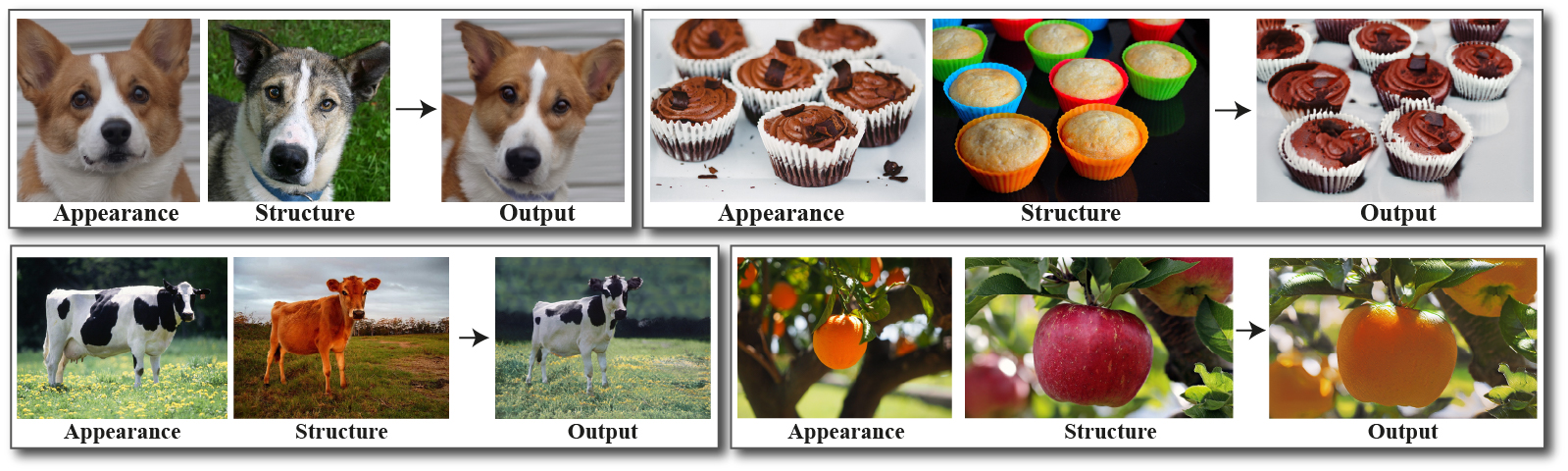
Splicing ViT Features for Semantic Appearance Transfer
Conference on Computer Vision and Pattern Recognition (CVPR) 2022, Oral
Abstract
We present a method for semantically transferring the visual appearance of one natural image to another. Specifically, our goal is to generate an image in which objects in a source structure image are "painted" with the visual appearance of their semantically related objects in a target appearance image. Our method works by training a generator given only a single structure/appearance image pair as input. To integrate semantic information into our framework - a pivotal component in tackling this task - our key idea is to leverage a pre-trained and fixed Vision Transformer (ViT) model which serves as an external semantic prior. Specifically, we derive novel representations of structure and appearance extracted from deep ViT features, untwisting them from the learned self-attention modules. We then establish an objective function that splices the desired structure and appearance representations, interweaving them together in the space of ViT features. Our framework, which we term "Splice", does not involve adversarial training, nor does it require any additional input information such as semantic segmentation or correspondences, and can generate high resolution results, e.g., work in HD. We demonstrate high quality results on a variety of in-the-wild image pairs, under significant variations in the number of objects, their pose and appearance.
Israel Computer Vision day