GeezerVisonThe World Wide Web, restored to 800 pixels of glory. |
| Home|About|Gaming cabinet|Archives|How it works|Starter sites |
GeezerVison is showing openpgp.dev — 9. Signature verification 9. Signature verification¶Signature verification in the OpenPGP protocol is a complex process. Many factors influence the validity of a signature. Firstly, its expiration time: A signature can be valid at one point in time and expired a second later. Signatures can be invalid due to the absence or presence of other signatures (e.g., revocations). Some signatures can be verified standalone, while others require the verification of a chain-like structure of signatures, mostly within the issuer’s certificate. 9.1. When are signatures valid?¶As a necessary condition, a valid signature must be cryptographically correct. This means that both the signature and its signed input data must be intact. However, there is a difference between signature correctness and validity: A signature may be cryptographically correct, but still not qualify as a valid signature. Put mathematically, the set of valid signatures is a subset of the set of correct signatures. The validity of a correct signature is additionally constrained by a number of conditions:
9.2. Well-formedness of signatures¶There are a number of criteria that a signature must fulfill to be considered well-formed:
9.3. Temporal validity¶A signature is valid only for a constrained period of time:
When checking a signature for validity, a reference time is used. The validity of the signature is evaluated at that reference time. The reference time can be:
For the signature to qualify as valid, it needs to be in effect. In other words, the reference time must fall into the period between signature creation and signature expiration. The same reference time must be used when verifying required qualifying signatures, if any. 9.4. Self-qualifying and non-self-qualifying signatures¶Some signatures can be verified on their own, while others require the verification of additional signatures on the issuer certificate. We will call the former category self-qualifying signatures. Typically, self-qualifying signatures are self-signatures, meaning signatures issued by an OpenPGP primary key for the components in its certificate. Examples for self-qualifying signatures are:
Examples for signatures which are not self-qualifying are:
9.5. Signature qualification¶To verify non-self-qualifying signatures, it is necessary to look at more than just the signature itself. This is required because the issuing component key needs to be qualified to create such a signature (e.g., because a specific capability key flag is required). The qualification typically emerges via a self-signature on the key itself. In short, a chain of valid signatures from the signature itself to the primary key of the issuer certificate needs to be established. For example, a subkey may issue a data signature over an email body only if that subkey is validly bound to the issuer’s certificate via a subkey binding signature. That binding signature needs to contain a key flags subpacket that marks the subkey as signing capable. Similarly, certification signatures over third-party certificates require the issuer key to carry a valid self-signature with the certification key flag. Self-qualifying signatures have no such limitations. For example, a certificate consisting only of a primary key and a single key-revocation self-signature contains everything needed to verify the revocation, as key-revocation self-signatures are self-qualifying. This construct is referred to as a revocation certificate. On the other hand, to verify a data signature over a text document, an implementation needs to verify not only the data signature itself, but also the binding signature (and back-signature) of the signing subkey which qualifies the signing subkey. 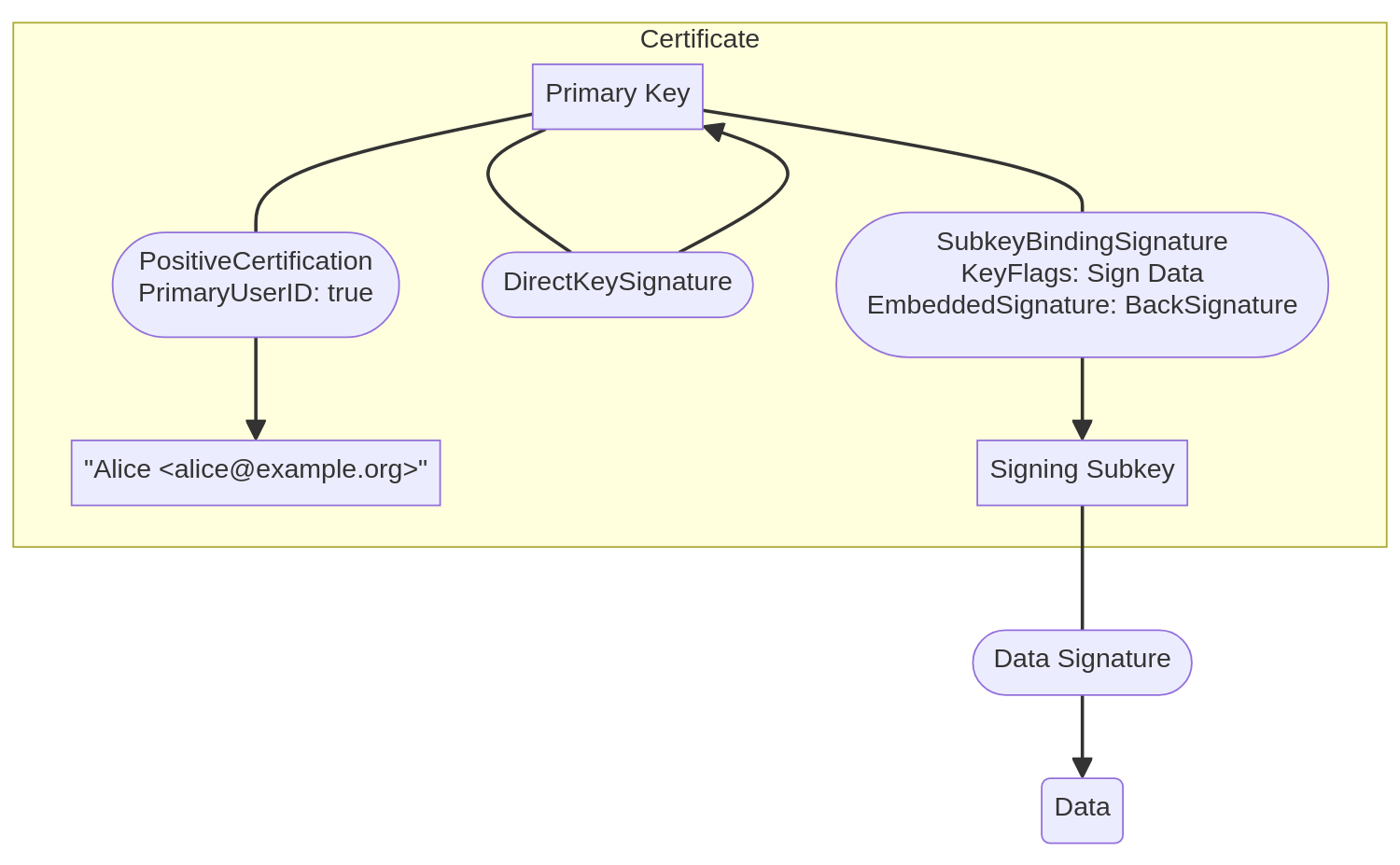
Fig. 23 Tree of signatures that qualify a data signature¶ 9.6. Revocations¶A signature can be disqualified by the presence of a revocation signature. Revocations can be limited in scope, e.g., a subkey-revocation signature only revokes a single subkey. Moreover, revocations can also be constrained to a certain validity period by including a soft revocation reason and expiration time in the revocation signature. |
| You are visitor 01402775 — GeezerVison does not store the pages you look up. Best viewed with Netscape Navigator 4.7 or Internet Explorer 6 at 800×600. No cookies required. |