GeezerVisonThe World Wide Web, restored to 800 pixels of glory. | ||||||||||||||||||||||||||||||||||||||||||||||||||||||||||||||||||||||||||||||||||||
| Home|About|Gaming cabinet|Archives|How it works|Starter sites | ||||||||||||||||||||||||||||||||||||||||||||||||||||||||||||||||||||||||||||||||||||
GeezerVison is showing python-course.eu — 28. Natural Language Processing with Python | Machine Learning 28. Natural Language Processing with PythonBy Bernd Klein. Last modified: 19 Feb 2025. On this page ➤ IntroductionWe mentioned in the introductory chapter of our tutorial that a spam filter for emails is a typical example of machine learning. Emails are based on text, which is why a classifier to classify emails must be able to process text as input. If we look at the previous examples with neural networks, they always run directly with numerical values and have a fixed input length. In the end, the characters of a text also consist of numerical values, but it is obvious that we cannot simply use a text as it is as input for a neural network. This means that the text have to be converted into a numerical representation, e.g. vectors or arrays of numbers. We will learn in this tutorial how to encode text in a way which is suitable for machine processing. Live Python training 
Enjoying this page? We offer live Python training courses covering the content of this site. See our Python training courses Bag-of-Words ModelIf we want to use texts in machine learning, we need a representation of the text which is usable for Machine Learning purposes. This means we need a numerical representation. We cannot use texts directly.
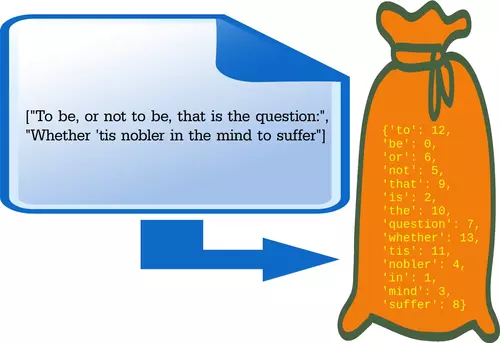
In natural language processing and information retrievel the bag-of-words model is of crucial importance. The bag-of-words model can be used to represent text data in a way which is suitable for machine learning algorithms. Furthermore, this model is easy and efficient to implement. In the bag-of-words model, a text (such as a sentence or a document) is represented as the so-called bag (a set or multiset) of its words. Grammar and word order are ignored. We will use in the following a list of three strings to demonstrate the bag-of-words approach. In linguistics, the collection of texts used for the experiments or tests is usually called a corpus: corpus = ["To be, or not to be, that is the question:", "Whether 'tis nobler in the mind to suffer", "The slings and arrows of outrageous fortune,"] We will use the submodule from sklearn.feature_extraction import text
First we need an instance of this class. When we instantiate a CountVectorizer, we can pass some optional parameters, but it is possible to call it with no arguments, as we will do in the following. Printing the vectorizer = text.CountVectorizer() print(vectorizer) OUTPUT:CountVectorizer() We have now an instance of CountVectorizer, but it has not seen any texts so far. We will use the method vectorizer.fit(corpus) OUTPUT:CountVectorizer()CountVectorizer()
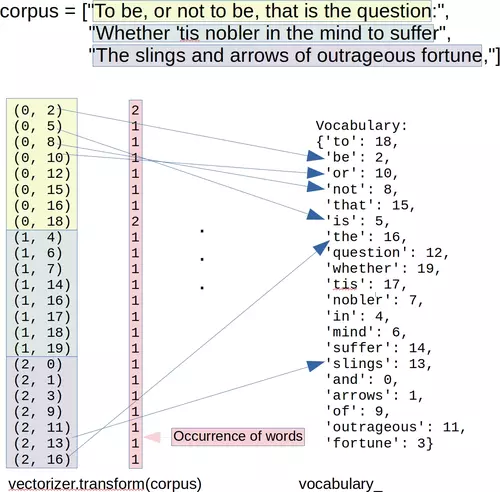
print("Vocabulary: ", vectorizer.vocabulary_) OUTPUT:Vocabulary: {'to': 18, 'be': 2, 'or': 10, 'not': 8, 'that': 15, 'is': 5, 'the': 16, 'question': 12, 'whether': 19, 'tis': 17, 'nobler': 7, 'in': 4, 'mind': 6, 'suffer': 14, 'slings': 13, 'and': 0, 'arrows': 1, 'of': 9, 'outrageous': 11, 'fortune': 3}
If you only want to see the words without the indices, you can use the method print(vectorizer.get_feature_names_out()) OUTPUT:['and' 'arrows' 'be' 'fortune' 'in' 'is' 'mind' 'nobler' 'not' 'of' 'or' 'outrageous' 'question' 'slings' 'suffer' 'that' 'the' 'tis' 'to' 'whether'] Alternatively, you can apply print(list(vectorizer.vocabulary_.keys())) OUTPUT:['to', 'be', 'or', 'not', 'that', 'is', 'the', 'question', 'whether', 'tis', 'nobler', 'in', 'mind', 'suffer', 'slings', 'and', 'arrows', 'of', 'outrageous', 'fortune'] With the aid of token_count_matrix = vectorizer.transform(corpus) print(token_count_matrix) OUTPUT:(0, 2) 2 (0, 5) 1 (0, 8) 1 (0, 10) 1 (0, 12) 1 (0, 15) 1 (0, 16) 1 (0, 18) 2 (1, 4) 1 (1, 6) 1 (1, 7) 1 (1, 14) 1 (1, 16) 1 (1, 17) 1 (1, 18) 1 (1, 19) 1 (2, 0) 1 (2, 1) 1 (2, 3) 1 (2, 9) 1 (2, 11) 1 (2, 13) 1 (2, 16) 1 The connection between the corpus, the Vocabulary
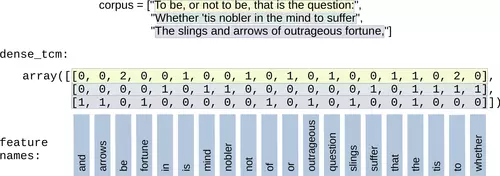
We will apply the method Just in case: You might see that people use sometimes Do not use todense!1 dense_tcm = token_count_matrix.toarray() dense_tcm OUTPUT:array([[0, 0, 2, 0, 0, 1, 0, 0, 1, 0, 1, 0, 1, 0, 0, 1, 1, 0, 2, 0],
[0, 0, 0, 0, 1, 0, 1, 1, 0, 0, 0, 0, 0, 0, 1, 0, 1, 1, 1, 1],
[1, 1, 0, 1, 0, 0, 0, 0, 0, 1, 0, 1, 0, 1, 0, 0, 1, 0, 0, 0]])
The rows of this array correspond to the strings of our corpus. The length of a row corresponds to the length of the vocabulary. The i'th value in a row corresponds to the i'th entry of the list returned by CountVectorizer method get_feature_names. If the value of This is visualized in the following diagram:
feature_names = vectorizer.get_feature_names_out() for el in vectorizer.vocabulary_: print(el, end=(", ")) OUTPUT:to, be, or, not, that, is, the, question, whether, tis, nobler, in, mind, suffer, slings, and, arrows, of, outrageous, fortune, import pandas as pd pd.DataFrame(data=dense_tcm, index=['corpus_0', 'corpus_1', 'corpus_2'], columns=vectorizer.get_feature_names_out())
word = "be" i = 1 j = vectorizer.vocabulary_[word] print("number of times '" + word + "' occurs in:") for i in range(len(corpus)): print(" '" + corpus[i] + "': " + str(dense_tcm[i][j])) OUTPUT:number of times 'be' occurs in:
'To be, or not to be, that is the question:': 2
'Whether 'tis nobler in the mind to suffer': 0
'The slings and arrows of outrageous fortune,': 0
We will extract the token counts out of new text documents. Let's use a literally doubtful variation of Hamlet's famous monologue and check what txt = "That is the question and it is nobler in the mind." vectorizer.transform([txt]).toarray() OUTPUT:array([[1, 0, 0, 0, 1, 2, 1, 1, 0, 0, 0, 0, 1, 0, 0, 1, 2, 0, 0, 0]]) print(vectorizer.get_feature_names_out()) OUTPUT:['and' 'arrows' 'be' 'fortune' 'in' 'is' 'mind' 'nobler' 'not' 'of' 'or' 'outrageous' 'question' 'slings' 'suffer' 'that' 'the' 'tis' 'to' 'whether'] print(vectorizer.vocabulary_) OUTPUT:{'to': 18, 'be': 2, 'or': 10, 'not': 8, 'that': 15, 'is': 5, 'the': 16, 'question': 12, 'whether': 19, 'tis': 17, 'nobler': 7, 'in': 4, 'mind': 6, 'suffer': 14, 'slings': 13, 'and': 0, 'arrows': 1, 'of': 9, 'outrageous': 11, 'fortune': 3}
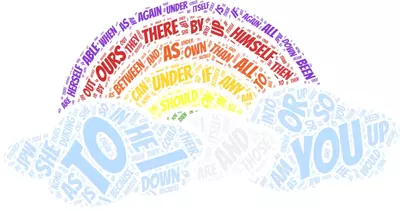
Word ImportanceIf you look at words like "the", "and" or "of", you will see see that they will occur in nearly all English texts. If you keep in mind that our ultimate goal will be to differentiate between texts and attribute them to classes, words like the previously mentioned ones will bear hardly any meaning. If you look at the following corpus, you can see words like "you", "I" or important words like "Python", "lottery" or "Programmer": from sklearn.feature_extraction import text corpus = ["It does not matter what you are doing, just do it!", "Would you work if you won the lottery?", "You like Python, he likes Python, we like Python, everybody loves Python!" "You said: 'I wish I were a Python programmer'", "You can stay here, if you want to. I would, if I were you." ] vectorizer = text.CountVectorizer() vectorizer.fit(corpus) token_count_matrix = vectorizer.transform(corpus) print(token_count_matrix) OUTPUT:(0, 0) 1 (0, 2) 1 (0, 3) 1 (0, 4) 1 (0, 9) 2 (0, 10) 1 (0, 15) 1 (0, 16) 1 (0, 26) 1 (0, 31) 1 (1, 8) 1 (1, 13) 1 (1, 21) 1 (1, 28) 1 (1, 29) 1 (1, 30) 1 (1, 31) 2 (2, 5) 1 (2, 6) 1 (2, 11) 2 (2, 12) 1 (2, 14) 1 (2, 17) 1 (2, 18) 5 (2, 19) 1 (2, 24) 1 (2, 25) 1 (2, 27) 1 (2, 31) 2 (3, 1) 1 (3, 7) 1 (3, 8) 2 (3, 20) 1 (3, 22) 1 (3, 23) 1 (3, 25) 1 (3, 30) 1 (3, 31) 3 tf_idf = text.TfidfTransformer() tf_idf.fit(token_count_matrix) tf_idf.idf_ OUTPUT:array([1.91629073, 1.91629073, 1.91629073, 1.91629073, 1.91629073,
1.91629073, 1.91629073, 1.91629073, 1.51082562, 1.91629073,
1.91629073, 1.91629073, 1.91629073, 1.91629073, 1.91629073,
1.91629073, 1.91629073, 1.91629073, 1.91629073, 1.91629073,
1.91629073, 1.91629073, 1.91629073, 1.91629073, 1.91629073,
1.51082562, 1.91629073, 1.91629073, 1.91629073, 1.91629073,
1.51082562, 1. ])
tf_idf.idf_[vectorizer.vocabulary_['python']] OUTPUT:1.916290731874155 da = vectorizer.transform(corpus).toarray() i = 0 # check how often the word 'would' occurs in the the i'th sentence: #vectorizer.vocabulary_['would'] word_ind = vectorizer.vocabulary_['would'] da[i][word_ind] da[:,word_ind] OUTPUT:array([0, 1, 0, 1]) word_weight_list = list(zip(vectorizer.get_feature_names_out(), tf_idf.idf_)) word_weight_list.sort(key=lambda x:x[1]) # sort list by the weights (2nd component) for word, idf_weight in word_weight_list: print(f"{word:15s}: {idf_weight:4.3f}") OUTPUT:you : 1.000 if : 1.511 were : 1.511 would : 1.511 are : 1.916 can : 1.916 do : 1.916 does : 1.916 doing : 1.916 everybody : 1.916 he : 1.916 here : 1.916 it : 1.916 just : 1.916 like : 1.916 likes : 1.916 lottery : 1.916 loves : 1.916 matter : 1.916 not : 1.916 programmer : 1.916 python : 1.916 said : 1.916 stay : 1.916 the : 1.916 to : 1.916 want : 1.916 we : 1.916 what : 1.916 wish : 1.916 won : 1.916 work : 1.916 from numpy import log from sklearn.feature_extraction import text corpus = ["It does not matter what you are doing, just do it!", "Would you work if you won the lottery?", "You like Python, he likes Python, we like Python, everybody loves Python!" "You said: 'I wish I were a Python programmer'", "You can stay here, if you want to. I would, if I were you." ] n = len(corpus) # the following variables are used globally (as free variables) in the functions :-( vectorizer = text.CountVectorizer() vectorizer.fit(corpus) da = vectorizer.transform(corpus).toarray() Term FrequencyWe will first define a function for the term frequency. Some notations:
The simplest choice to define tf(t,d) is to use the raw count of a term in a document, i.e., the number of times that term t occurs in document d, which we can denote as $f_{t, d}$ We can define tf(t, d) in different ways:
def tf(t, d, mode="raw"): """ The Term Frequency 'tf' calculates how often a term 't' occurs in a document 'd'. ('d': document index) If t_in_d = Number of times a term t appears in a document d and no_terms_d = Total number of terms in the document, tf(t, d) = t_in_d / no_terms_d """ if t in vectorizer.vocabulary_: word_ind = vectorizer.vocabulary_[t] t_occurences = da[d, word_ind] # 'd' is the document index else: t_occurences = 0 if mode == "raw": result = t_occurences elif mode == "length": all_terms = (da[d] > 0).sum() # calculate number of different terms in d result = t_occurences / all_terms elif mode == "log": result = log(1 + t_occurences) elif mode == "augfreq": result = 0.5 + 0.5 * t_occurences / da[d].max() return result We will check the word frequencies for some words: print(" raw length log augmented freq") for term in ['matter', 'python', 'would']: for docu_index in range(len(corpus)): d = corpus[docu_index] print(f"\n'{term}' in '{d}''") for mode in ['raw', 'length', 'log', 'augfreq']: x = tf(term, docu_index, mode=mode) print(f"{x:7.2f}", end="") OUTPUT:raw length log augmented freq 'matter' in 'It does not matter what you are doing, just do it!'' 1.00 0.10 0.69 0.75 'matter' in 'Would you work if you won the lottery?'' 0.00 0.00 0.00 0.50 'matter' in 'You like Python, he likes Python, we like Python, everybody loves Python!You said: 'I wish I were a Python programmer''' 0.00 0.00 0.00 0.50 'matter' in 'You can stay here, if you want to. I would, if I were you.'' 0.00 0.00 0.00 0.50 'python' in 'It does not matter what you are doing, just do it!'' 0.00 0.00 0.00 0.50 'python' in 'Would you work if you won the lottery?'' 0.00 0.00 0.00 0.50 'python' in 'You like Python, he likes Python, we like Python, everybody loves Python!You said: 'I wish I were a Python programmer''' 5.00 0.42 1.79 1.00 'python' in 'You can stay here, if you want to. I would, if I were you.'' 0.00 0.00 0.00 0.50 'would' in 'It does not matter what you are doing, just do it!'' 0.00 0.00 0.00 0.50 'would' in 'Would you work if you won the lottery?'' 1.00 0.14 0.69 0.75 'would' in 'You like Python, he likes Python, we like Python, everybody loves Python!You said: 'I wish I were a Python programmer''' 0.00 0.00 0.00 0.50 'would' in 'You can stay here, if you want to. I would, if I were you.'' 1.00 0.11 0.69 0.67 Document FrequencyThe document frequency df of a term t is defined as the number of documents in the document set that contain the term t. $df(t) = |{\{d \in D: t \in d\}}|$ Inverse Document FrequencyThe inverse document frequency is a measure of how much information the word provides, i.e., if it's common or rare across all documents. It is the logarithmically scaled inverse fraction of the document frequency. The effect of adding $idf(t) = log( \frac{n}{df(t)} ) + 1$ n is the number of documents in the corpus $n = |D|$ (Note that the idf formula above differs from the standard textbook notation that defines the idf as $idf(t) = log( \frac{n}{df(t) + 1})$.) The formula above is used, when TfidfTransformer() is called with $idf(t) = log( \frac{n + 1}{df(t) + 1} ) + 1$ Term frequency–Inverse document frequency$tf_idf$ is calculated as the product of $tf(t, d)$ and $idf(t)$: $tf_idf(t, d) = tf(t, d) \cdot idf(t)$ A high value of tf–idf means that the term has a high "term frequency" in the given document and a low "document frequency" in the other documents of the corpus. This means that this wieght can be used to filter out common terms. We will program the tf_idf function now: The helpfile of We will manually program these functions in the following: def df(t): """ df(t) is the document frequency of t; the document frequency is the number of documents in the document set that contain the term t. """ word_ind = vectorizer.vocabulary_[t] tf_in_docus = da[:, word_ind] # vector with the freqencies of word_ind in all docus existence_in_docus = tf_in_docus > 0 # binary vector, existence of word in docus return existence_in_docus.sum() #df("would", vectorizer) def idf(t, smooth_idf=True): """ idf """ if smooth_idf: return log((1 + n) / (1 + df(t)) ) + 1 else: return log(n / df(t) ) + 1 def tf_idf(t, d): return idf(t) * tf(t, d) res_idf = [] for word in vectorizer.get_feature_names_out(): tf_docus = [] res_idf.append([word, idf(word)]) res_idf.sort(key=lambda x:x[1]) for item in res_idf: print(item) OUTPUT:['you', 1.0] ['if', 1.5108256237659907] ['were', 1.5108256237659907] ['would', 1.5108256237659907] ['are', 1.916290731874155] ['can', 1.916290731874155] ['do', 1.916290731874155] ['does', 1.916290731874155] ['doing', 1.916290731874155] ['everybody', 1.916290731874155] ['he', 1.916290731874155] ['here', 1.916290731874155] ['it', 1.916290731874155] ['just', 1.916290731874155] ['like', 1.916290731874155] ['likes', 1.916290731874155] ['lottery', 1.916290731874155] ['loves', 1.916290731874155] ['matter', 1.916290731874155] ['not', 1.916290731874155] ['programmer', 1.916290731874155] ['python', 1.916290731874155] ['said', 1.916290731874155] ['stay', 1.916290731874155] ['the', 1.916290731874155] ['to', 1.916290731874155] ['want', 1.916290731874155] ['we', 1.916290731874155] ['what', 1.916290731874155] ['wish', 1.916290731874155] ['won', 1.916290731874155] ['work', 1.916290731874155] corpus
OUTPUT:['It does not matter what you are doing, just do it!', 'Would you work if you won the lottery?', "You like Python, he likes Python, we like Python, everybody loves Python!You said: 'I wish I were a Python programmer'", 'You can stay here, if you want to. I would, if I were you.'] for word, word_index in vectorizer.vocabulary_.items(): print(f"\n{word:12s}: ", end="") for d_index in range(len(corpus)): print(f"{d_index:1d} {tf_idf(word, d_index):3.2f}, ", end="" ) OUTPUT:it : 0 3.83, 1 0.00, 2 0.00, 3 0.00, does : 0 1.92, 1 0.00, 2 0.00, 3 0.00, not : 0 1.92, 1 0.00, 2 0.00, 3 0.00, matter : 0 1.92, 1 0.00, 2 0.00, 3 0.00, what : 0 1.92, 1 0.00, 2 0.00, 3 0.00, you : 0 1.00, 1 2.00, 2 2.00, 3 3.00, are : 0 1.92, 1 0.00, 2 0.00, 3 0.00, doing : 0 1.92, 1 0.00, 2 0.00, 3 0.00, just : 0 1.92, 1 0.00, 2 0.00, 3 0.00, do : 0 1.92, 1 0.00, 2 0.00, 3 0.00, would : 0 0.00, 1 1.51, 2 0.00, 3 1.51, work : 0 0.00, 1 1.92, 2 0.00, 3 0.00, if : 0 0.00, 1 1.51, 2 0.00, 3 3.02, won : 0 0.00, 1 1.92, 2 0.00, 3 0.00, the : 0 0.00, 1 1.92, 2 0.00, 3 0.00, lottery : 0 0.00, 1 1.92, 2 0.00, 3 0.00, like : 0 0.00, 1 0.00, 2 3.83, 3 0.00, python : 0 0.00, 1 0.00, 2 9.58, 3 0.00, he : 0 0.00, 1 0.00, 2 1.92, 3 0.00, likes : 0 0.00, 1 0.00, 2 1.92, 3 0.00, we : 0 0.00, 1 0.00, 2 1.92, 3 0.00, everybody : 0 0.00, 1 0.00, 2 1.92, 3 0.00, loves : 0 0.00, 1 0.00, 2 1.92, 3 0.00, said : 0 0.00, 1 0.00, 2 1.92, 3 0.00, wish : 0 0.00, 1 0.00, 2 1.92, 3 0.00, were : 0 0.00, 1 0.00, 2 1.51, 3 1.51, programmer : 0 0.00, 1 0.00, 2 1.92, 3 0.00, can : 0 0.00, 1 0.00, 2 0.00, 3 1.92, stay : 0 0.00, 1 0.00, 2 0.00, 3 1.92, here : 0 0.00, 1 0.00, 2 0.00, 3 1.92, want : 0 0.00, 1 0.00, 2 0.00, 3 1.92, to : 0 0.00, 1 0.00, 2 0.00, 3 1.92, Another Simple ExampleWe will use another simple example to illustrate the previously introduced concepts. We use a sentence which contains solely different words. The corpus consists of this sentence and reduced versions of it, i.e. cutting of words from the end of the sentence. from sklearn.feature_extraction import text words = "Cold wind blows over the cornfields".split() corpus = [] for i in range(1, len(words)+1): corpus.append(" ".join(words[:i])) print(corpus) OUTPUT:['Cold', 'Cold wind', 'Cold wind blows', 'Cold wind blows over', 'Cold wind blows over the', 'Cold wind blows over the cornfields'] vectorizer = text.CountVectorizer() vectorizer = vectorizer.fit(corpus) vectorized_text = vectorizer.transform(corpus) tf_idf = text.TfidfTransformer() tf_idf.fit(vectorized_text) tf_idf.idf_ OUTPUT:array([1.33647224, 1. , 2.25276297, 1.55961579, 1.84729786,
1.15415068])
word_weight_list = list(zip(vectorizer.get_feature_names_out(), tf_idf.idf_)) word_weight_list.sort(key=lambda x:x[1]) # sort list by the weights (2nd component) for word, idf_weight in word_weight_list: print(f"{word:15s}: {idf_weight:4.3f}") OUTPUT:cold : 1.000 wind : 1.154 blows : 1.336 over : 1.560 the : 1.847 cornfields : 2.253 TfidF = text.TfidfTransformer(smooth_idf=True, use_idf=True) tfidf = TfidF.fit_transform(vectorized_text) word_weight_list = list(zip(vectorizer.get_feature_names_out(), tf_idf.idf_)) word_weight_list.sort(key=lambda x:x[1]) # sort list by the weights (2nd component) for word, idf_weight in word_weight_list: print(f"{word:15s}: {idf_weight:4.3f}") OUTPUT:cold : 1.000 wind : 1.154 blows : 1.336 over : 1.560 the : 1.847 cornfields : 2.253 Live Python training
Enjoying this page? We offer live Python training courses covering the content of this site. Upcoming online Courses See our Python training courses Working With Real Datascikit-learn contains a dataset from real newsgroups, which can be used for our purposes: from sklearn.datasets import fetch_20newsgroups from sklearn.feature_extraction.text import CountVectorizer import numpy as np # Create our vectorizer vectorizer = CountVectorizer() # Let's fetch all the possible text data newsgroups_data = fetch_20newsgroups() Let us have a closer look at this data. As with all the other data sets in print(newsgroups_data.data[0]) OUTPUT:From: [email protected] (where's my thing) Subject: WHAT car is this!? Nntp-Posting-Host: rac3.wam.umd.edu Organization: University of Maryland, College Park Lines: 15 I was wondering if anyone out there could enlighten me on this car I saw the other day. It was a 2-door sports car, looked to be from the late 60s/ early 70s. It was called a Bricklin. The doors were really small. In addition, the front bumper was separate from the rest of the body. This is all I know. If anyone can tellme a model name, engine specs, years of production, where this car is made, history, or whatever info you have on this funky looking car, please e-mail. Thanks, - IL ---- brought to you by your neighborhood Lerxst ---- print(newsgroups_data.data[200]) OUTPUT:Subject: Re: "Proper gun control?" What is proper gun cont From: [email protected] (John Kim) Organization: Harvard University Science Center Nntp-Posting-Host: scws8.harvard.edu Lines: 17 In article <[email protected]> [email protected] (Kirk Hays) writes: >I'd like to point out that I was in error - "Terminator" began posting only >six months before he purchased his first firearm, according to private email >from him. >I can't produce an archived posting of his earlier than January 1992, >and he purchased his first firearm in March 1992. >I guess it only seemed like years. >Kirk Hays - NRA Life, seventh generation. I first read and consulted rec.guns in the summer of 1991. I just purchased my first firearm in early March of this year. NOt for lack of desire for a firearm, you understand. I could have purchased a rifle or shotgun but didn't want one. -Case Kim We create the vectorizer.fit(newsgroups_data.data) OUTPUT:CountVectorizer()CountVectorizer() Let's have a look at the first counter = 0 n = 10 for word, index in vectorizer.vocabulary_.items(): print(word, index) counter += 1 if counter > n: break OUTPUT:from 56979 lerxst 75358 wam 123162 umd 118280 edu 50527 where 124031 my 85354 thing 114688 subject 111322 what 123984 car 37780 We can turn the newsgroup postings into arrays. We do it with the first one: a = vectorizer.transform([newsgroups_data.data[0]]).toarray()[0] print(a) OUTPUT:[0 0 0 ... 0 0 0] The vocabulary is huge This is why we see mostly zeros. len(vectorizer.vocabulary_) OUTPUT:130107 There are a lot of 'rubbish' words in this vocabulary. newsgroups_data_cleaned = fetch_20newsgroups(remove=('headers', 'footers', 'quotes')) print(newsgroups_data_cleaned.data[0]) OUTPUT:I was wondering if anyone out there could enlighten me on this car I saw the other day. It was a 2-door sports car, looked to be from the late 60s/ early 70s. It was called a Bricklin. The doors were really small. In addition, the front bumper was separate from the rest of the body. This is all I know. If anyone can tellme a model name, engine specs, years of production, where this car is made, history, or whatever info you have on this funky looking car, please e-mail. Let's have a look at the complete posting: print(newsgroups_data.data[0]) OUTPUT:From: [email protected] (where's my thing) Subject: WHAT car is this!? Nntp-Posting-Host: rac3.wam.umd.edu Organization: University of Maryland, College Park Lines: 15 I was wondering if anyone out there could enlighten me on this car I saw the other day. It was a 2-door sports car, looked to be from the late 60s/ early 70s. It was called a Bricklin. The doors were really small. In addition, the front bumper was separate from the rest of the body. This is all I know. If anyone can tellme a model name, engine specs, years of production, where this car is made, history, or whatever info you have on this funky looking car, please e-mail. Thanks, - IL ---- brought to you by your neighborhood Lerxst ---- vectorizer_cleaned = vectorizer.fit(newsgroups_data_cleaned.data) len(vectorizer_cleaned.vocabulary_) OUTPUT:101631 So, we got rid of more than 30000 words, but with more than a 100000 words is it still very large. We can also directly separate the newsgroup feeds into a train and test set: newsgroups_train = fetch_20newsgroups(subset='train', remove=('headers', 'footers', 'quotes')) newsgroups_test = fetch_20newsgroups(subset='test', remove=('headers', 'footers', 'quotes')) from sklearn.datasets import fetch_20newsgroups from sklearn.feature_extraction.text import CountVectorizer from sklearn.naive_bayes import MultinomialNB from sklearn import metrics vectorizer = CountVectorizer() train_data = vectorizer.fit_transform(newsgroups_train.data) # creating a classifier classifier = MultinomialNB(alpha=.01) classifier.fit(train_data, newsgroups_train.target) test_data = vectorizer.transform(newsgroups_test.data) predictions = classifier.predict(test_data) accuracy_score = metrics.accuracy_score(newsgroups_test.target, predictions) f1_score = metrics.f1_score(newsgroups_test.target, predictions, average='macro') print("Accuracy score: ", accuracy_score) print("F1 score: ", f1_score) OUTPUT:Accuracy score: 0.6460435475305364 F1 score: 0.6203806145034193 Stop Words
So far we added all the words to the vocabulary. However, it is questionable whether words like "the", "am", "were" or similar words should be included at all, since they usually do not provide any significant semantic contribution for a text. In other words: They have limited predictive power. It would therefore make sense to exclude such words from editing, i.e. inclusion in the dictionary. This means we have to provide a list of words which should be neglected, i.e. being filtered out before or after processing text. In natural text recognition such words are usually called "stop words". There is no single universal list of stop words defined, which could be used by all natural language processing tools. Usually, stop words consist of the most frequently used words in a language. "Stop words" can be individually chosen for a given task. By the way, stop words are an idea which is quite old. It goes back to 1959 and Hans Peter Luhn, one of the pioneers in information retrieval. There are different ways to provide stop words in
We will start with individual stop words: Indivudual Stop Wordsfrom sklearn.feature_extraction.text import CountVectorizer corpus = ["A horse, a horse, my kingdom for a horse!", "Horse sense is the thing a horse has which keeps it from betting on people." "I’ve often said there is nothing better for the inside of the man, than the outside of the horse.", "A man on a horse is spiritually, as well as physically, bigger then a man on foot.", "No heaven can heaven be, if my horse isn’t there to welcome me."] cv = CountVectorizer(stop_words=["my", "for","the", "has", "than", "if", "from", "on", "of", "it", "there", "ve", "as", "no", "be", "which", "isn", "to", "me", "is", "can", "then"]) count_vector = cv.fit_transform(corpus) count_vector.shape cv.vocabulary_ OUTPUT:{'horse': 5,
'kingdom': 8,
'sense': 16,
'thing': 18,
'keeps': 7,
'betting': 1,
'people': 13,
'often': 11,
'said': 15,
'nothing': 10,
'better': 0,
'inside': 6,
'man': 9,
'outside': 12,
'spiritually': 17,
'well': 20,
'physically': 14,
'bigger': 2,
'foot': 3,
'heaven': 4,
'welcome': 19}
from sklearn.feature_extraction import text n = 25 print(str(n) + " arbitrary words from ENGLISH_STOP_WORDS:") counter = 0 for word in text.ENGLISH_STOP_WORDS: if counter == n - 1: print(word) break print(word, end=", ") counter += 1 OUTPUT:25 arbitrary words from ENGLISH_STOP_WORDS: afterwards, elsewhere, also, rather, mostly, bill, alone, any, every, myself, keep, none, five, upon, very, de, forty, something, thereafter, anyway, nobody, besides, not, could, much We can use stop words in our 20newsgroups classification problem: from sklearn.datasets import fetch_20newsgroups from sklearn.feature_extraction.text import CountVectorizer from sklearn.naive_bayes import MultinomialNB from sklearn import metrics vectorizer = CountVectorizer(stop_words=list(text.ENGLISH_STOP_WORDS)) vectors = vectorizer.fit_transform(newsgroups_train.data) # creating a classifier classifier = MultinomialNB(alpha=.01) classifier.fit(vectors, newsgroups_train.target) vectors_test = vectorizer.transform(newsgroups_test.data) predictions = classifier.predict(vectors_test) accuracy_score = metrics.accuracy_score(newsgroups_test.target, predictions) f1_score = metrics.f1_score(newsgroups_test.target, predictions, average='macro') print("accuracy score: ", accuracy_score) print("F1-score: ", f1_score) OUTPUT:accuracy score: 0.6526818906001062 F1-score: 0.6268816896587931 Automatically Created Stop WordsAs in many other cases, it is a good idea to look for ways to automatically define a list of stop words. A list that is or should be ideally adapted to the problem. To automatically create a stop word list, we will start with the parameter corpus = ["""People say you cannot live without love, but I think oxygen is more important""", "Sometimes, when you close your eyes, you cannot see." "A horse, a horse, my kingdom for a horse!", """Horse sense is the thing a horse has which keeps it from betting on people.""" """I’ve often said there is nothing better for the inside of the man, than the outside of the horse.""", """A man on a horse is spiritually, as well as physically, bigger then a man on foot.""", """No heaven can heaven be, if my horse isn’t there to welcome me."""] cv = CountVectorizer(min_df=2) count_vector = cv.fit_transform(corpus) cv.vocabulary_ OUTPUT:{'people': 7,
'you': 9,
'cannot': 0,
'is': 3,
'horse': 2,
'my': 5,
'for': 1,
'on': 6,
'there': 8,
'man': 4}
Hardly any words from our corpus text are left. Because we have only few documents (strings) in our corpus and also because these texts are very short, the number of words which occur in less then two documents is very high. We eliminated all the words which occur in less two documents. We can also see the words which have been chosen as stopwords by looking at cv.stop_words_ OUTPUT:{'as',
'be',
'better',
'betting',
'bigger',
'but',
'can',
'close',
'eyes',
'foot',
'from',
'has',
'heaven',
'if',
'important',
'inside',
'isn',
'it',
'keeps',
'kingdom',
'live',
'love',
'me',
'more',
'no',
'nothing',
'of',
'often',
'outside',
'oxygen',
'physically',
'said',
'say',
'see',
'sense',
'sometimes',
'spiritually',
'than',
'the',
'then',
'thing',
'think',
'to',
've',
'welcome',
'well',
'when',
'which',
'without',
'your'}
print("number of docus, size of vocabulary, stop_words list size") for i in range(1, len(corpus)): cv = CountVectorizer(min_df=i) count_vector = cv.fit_transform(corpus) len_voc = len(cv.vocabulary_) len_stop_words = len(cv.stop_words_) print(f"{i:10d} {len_voc:15d} {len_stop_words:19d}") OUTPUT:number of docus, size of vocabulary, stop_words list size
1 60 0
2 10 50
3 2 58
4 1 59
Another parameter of Let us use again our previous corpus for an example. cv = CountVectorizer(max_df=0.20) count_vector = cv.fit_transform(corpus) cv.stop_words_ OUTPUT:{'cannot', 'for', 'horse', 'is', 'man', 'my', 'on', 'people', 'there', 'you'}
Live Python training
Enjoying this page? We offer live Python training courses covering the content of this site. See our Python training courses ExercisesExercise 1In the subdirectory 'books' you will find some books:
Use these novels as the corpus and create a word count vector. Exercise 2Turn the previously calculated 'word count vector' into a dense ndarray representation. Exercise 3Let us have another example with a different corpus. The five strings are famous quotes from
Compute the IDF values! quotes = ["A horse, a horse, my kingdom for a horse!", "Horse sense is the thing a horse has which keeps it from betting on people." "I’ve often said there is nothing better for the inside of the man, than the outside of the horse.", "A man on a horse is spiritually, as well as physically, bigger then a man on foot.", "No heaven can heaven be, if my horse isn’t there to welcome me."] SolutionsSolution to Exercise 1corpus = [] books = ["night_and_day_virginia_woolf.txt", "the_way_of_all_flash_butler.txt", "moby_dick_melville.txt", "sons_and_lovers_lawrence.txt", "robinson_crusoe_defoe.txt", "james_joyce_ulysses.txt"] path = "books" corpus = [] for book in books: txt = open(path + "/" + book).read() corpus.append(txt) [book[:30] for book in corpus] OUTPUT:['The Project Gutenberg EBook of', 'The Project Gutenberg eBook, T', '\nThe Project Gutenberg EBook o', 'The Project Gutenberg EBook of', 'The Project Gutenberg eBook, T', '\nThe Project Gutenberg EBook o'] We have to get rid of the Gutenberg header and footer, because it doesn't belong to the novels. We can see by looking at the texts that the authors works begins after lines of the following kind
The footer of the texts start with this line:
There may or may not be a space after the first three stars or instead of "the" there may be "this". We can use regular expressions to find the starting point of the novels: from sklearn.feature_extraction import text import re corpus = [] books = ["night_and_day_virginia_woolf.txt", "the_way_of_all_flash_butler.txt", "moby_dick_melville.txt", "sons_and_lovers_lawrence.txt", "robinson_crusoe_defoe.txt", "james_joyce_ulysses.txt"] path = "books" corpus = [] for book in books: txt = open(path + "/" + book).read() text_begin = re.search(r"\*\*\* ?START OF (THE|THIS) PROJECT.*?\*\*\*", txt, re.DOTALL) text_end = re.search(r"\*\*\* ?END OF (THE|THIS) PROJECT.*?\*\*\*", txt, re.DOTALL) corpus.append(txt[text_begin.end():text_end.start()]) vectorizer = text.CountVectorizer() vectorizer.fit(corpus) token_count_matrix = vectorizer.transform(corpus) print(token_count_matrix) OUTPUT:(0, 4) 2 (0, 35) 1 (0, 60) 1 (0, 79) 1 (0, 131) 1 (0, 221) 1 (0, 724) 6 (0, 731) 5 (0, 734) 1 (0, 743) 5 (0, 761) 1 (0, 773) 1 (0, 779) 1 (0, 780) 1 (0, 781) 23 (0, 790) 1 (0, 804) 1 (0, 809) 412 (0, 810) 36 (0, 817) 2 (0, 823) 4 (0, 824) 19 (0, 825) 3 (0, 828) 11 (0, 829) 1 : : (5, 42156) 5 (5, 42157) 1 (5, 42158) 1 (5, 42159) 2 (5, 42160) 2 (5, 42161) 106 (5, 42165) 1 (5, 42166) 2 (5, 42167) 1 (5, 42172) 2 (5, 42173) 4 (5, 42174) 1 (5, 42175) 1 (5, 42176) 1 (5, 42177) 1 (5, 42178) 3 (5, 42181) 1 (5, 42182) 1 (5, 42183) 3 (5, 42184) 1 (5, 42185) 2 (5, 42186) 1 (5, 42187) 1 (5, 42188) 2 (5, 42189) 1 print("Number of words in vocabulary: ", len(vectorizer.vocabulary_)) OUTPUT:Number of words in vocabulary: 42192 Solution to Exercise 2All you have to do is applying the method token_count_matrix.toarray() OUTPUT:array([[ 0, 0, 0, ..., 0, 0, 0],
[19, 0, 0, ..., 0, 0, 0],
[20, 0, 0, ..., 0, 1, 1],
[ 0, 0, 1, ..., 0, 0, 0],
[ 0, 0, 0, ..., 0, 0, 0],
[11, 1, 0, ..., 1, 0, 0]])
Solution to Exercise 3from sklearn.feature_extraction import text # our corpus: quotes = ["A horse, a horse, my kingdom for a horse!", "Horse sense is the thing a horse has which keeps it from betting on people." "I’ve often said there is nothing better for the inside of the man, than the outside of the horse.", "A man on a horse is spiritually, as well as physically, bigger then a man on foot.", "No heaven can heaven be, if my horse isn’t there to welcome me."] vectorizer = text.CountVectorizer() vectorizer.fit(quotes) vectorized_text = vectorizer.fit_transform(quotes) tfidf_transformer = text.TfidfTransformer(smooth_idf=True,use_idf=True) tfidf_transformer.fit(vectorized_text) """ alternative way to output the data: import pandas as pd df_idf = pd.DataFrame(tfidf_transformer.idf_, index=vectorizer.get_feature_names(), columns=["idf_weight"]) df_idf.sort_values(by=['idf_weights']) # sorting data print(df_idf) """ print(f"{'word':15s}: idf_weight") word_weight_list = list(zip(vectorizer.get_feature_names_out(), tfidf_transformer.idf_)) word_weight_list.sort(key=lambda x:x[1]) # sort list by the weights (2nd component) for word, idf_weight in word_weight_list: print(f"{word:15s}: {idf_weight:4.3f}") OUTPUT:word : idf_weight horse : 1.000 for : 1.511 is : 1.511 man : 1.511 my : 1.511 on : 1.511 there : 1.511 as : 1.916 be : 1.916 better : 1.916 betting : 1.916 bigger : 1.916 can : 1.916 foot : 1.916 from : 1.916 has : 1.916 heaven : 1.916 if : 1.916 inside : 1.916 isn : 1.916 it : 1.916 keeps : 1.916 kingdom : 1.916 me : 1.916 no : 1.916 nothing : 1.916 of : 1.916 often : 1.916 outside : 1.916 people : 1.916 physically : 1.916 said : 1.916 sense : 1.916 spiritually : 1.916 than : 1.916 the : 1.916 then : 1.916 thing : 1.916 to : 1.916 ve : 1.916 welcome : 1.916 well : 1.916 which : 1.916 Live Python training
Enjoying this page? We offer live Python training courses covering the content of this site. See our Python training courses ExercisesExercise 1Perform sentiment analysis on IMDb movie reviews using TF-IDF features and a machine learning classifier to predict whether a review expresses positive or negative sentiment. SolutionsExercise 1import pandas as pd from sklearn.feature_extraction.text import TfidfVectorizer from sklearn.ensemble import RandomForestClassifier from sklearn.pipeline import Pipeline from sklearn.metrics import classification_report from sklearn.model_selection import train_test_split # Load the training and testing data from CSV files train_data = pd.read_csv("../data/IMDB/Train.csv") test_data = pd.read_csv("../data/IMDB/Test.csv") # Split the data into features (reviews) and labels (sentiments) X_train, y_train = train_data['text'], train_data['label'] X_test, y_test = test_data['text'], test_data['label'] # Initialize TfidfVectorizer vectorizer = TfidfVectorizer(max_features=5000, stop_words='english') # Initialize Random Forest classifier classifier = RandomForestClassifier(n_estimators=100, random_state=42) # Create a pipeline with TfidfVectorizer and Random Forest pipeline = Pipeline([ ('vectorizer', vectorizer), ('classifier', classifier) ]) # Train the pipeline pipeline.fit(X_train, y_train) # Predict on test data predicted = pipeline.predict(X_test) # Print classification report print(classification_report(y_test, predicted)) OUTPUT: precision recall f1-score support
0 0.85 0.85 0.85 2495
1 0.85 0.85 0.85 2505
accuracy 0.85 5000
macro avg 0.85 0.85 0.85 5000
weighted avg 0.85 0.85 0.85 5000
Live Python training
Enjoying this page? We offer live Python training courses covering the content of this site. See our Python training courses Footnotes1Logically Live Python training
Enjoying this page? We offer live Python training courses covering the content of this site. Upcoming online Courses See our Python training courses | ||||||||||||||||||||||||||||||||||||||||||||||||||||||||||||||||||||||||||||||||||||
| You are visitor 01402503 — GeezerVison does not store the pages you look up. Best viewed with Netscape Navigator 4.7 or Internet Explorer 6 at 800×600. No cookies required. |