GeezerVisonThe World Wide Web, restored to 800 pixels of glory. | ||||||||||||||||||||||||||||||||||||||||||||||||||||||||||||||||||||||||||||||||||||||||||||||||||||||||||||||||||||||||||||||||||||||||||||
| Home|About|Gaming cabinet|Archives|How it works|Starter sites | ||||||||||||||||||||||||||||||||||||||||||||||||||||||||||||||||||||||||||||||||||||||||||||||||||||||||||||||||||||||||||||||||||||||||||||
GeezerVison is showing runr.sh — RunR — Open Source Serverless Platform on Kubernetes
OPEN SOURCE · MIT
KNATIVE
SCALE-TO-ZERO
WEBASSEMBLY
SANDBOX API
GVISOR + KATA
DURABLE WORKFLOWS
GIT PUSH DEPLOY
EVENT TRIGGERS
BLUE-GREEN · CANARY
GPU + HUGGING FACE
MCP
ZERO LOCK-IN
GLOBAL PROJECTS
MULTI-REGION
OPEN SOURCE · MIT
KNATIVE
SCALE-TO-ZERO
WEBASSEMBLY
SANDBOX API
GVISOR + KATA
DURABLE WORKFLOWS
GIT PUSH DEPLOY
EVENT TRIGGERS
BLUE-GREEN · CANARY
GPU + HUGGING FACE
MCP
ZERO LOCK-IN
GLOBAL PROJECTS
MULTI-REGION
THREE PROJECT TYPES
From a single file to a full container.
One platform, three deployment models — all scaling to zero on Knative. Deploy from the web editor, with X
XaaSOne file, one function. Write or paste code in the web editor and hit deploy.
Python
Node.js
Go
PHP
Java
.NET (C#)
Ruby
TypeScript (Bun)
Wasm
+ plugins
F
FaaSMulti-file projects — in the web IDE or from your own git repository. Every save and every push is a version in the project's git repository; dependencies are built in-cluster.
Python
Node.js
Go
PHP
Java
.NET (C#)
Ruby
TypeScript (Bun)
PyTorch
TensorFlow
Wasm
C
CaaS
Any container image: from a registry, from an uploaded
OCI
Docker
Any Lang
GPU
Cron
Queue
runr.example.com/projects/orders-webhook/code
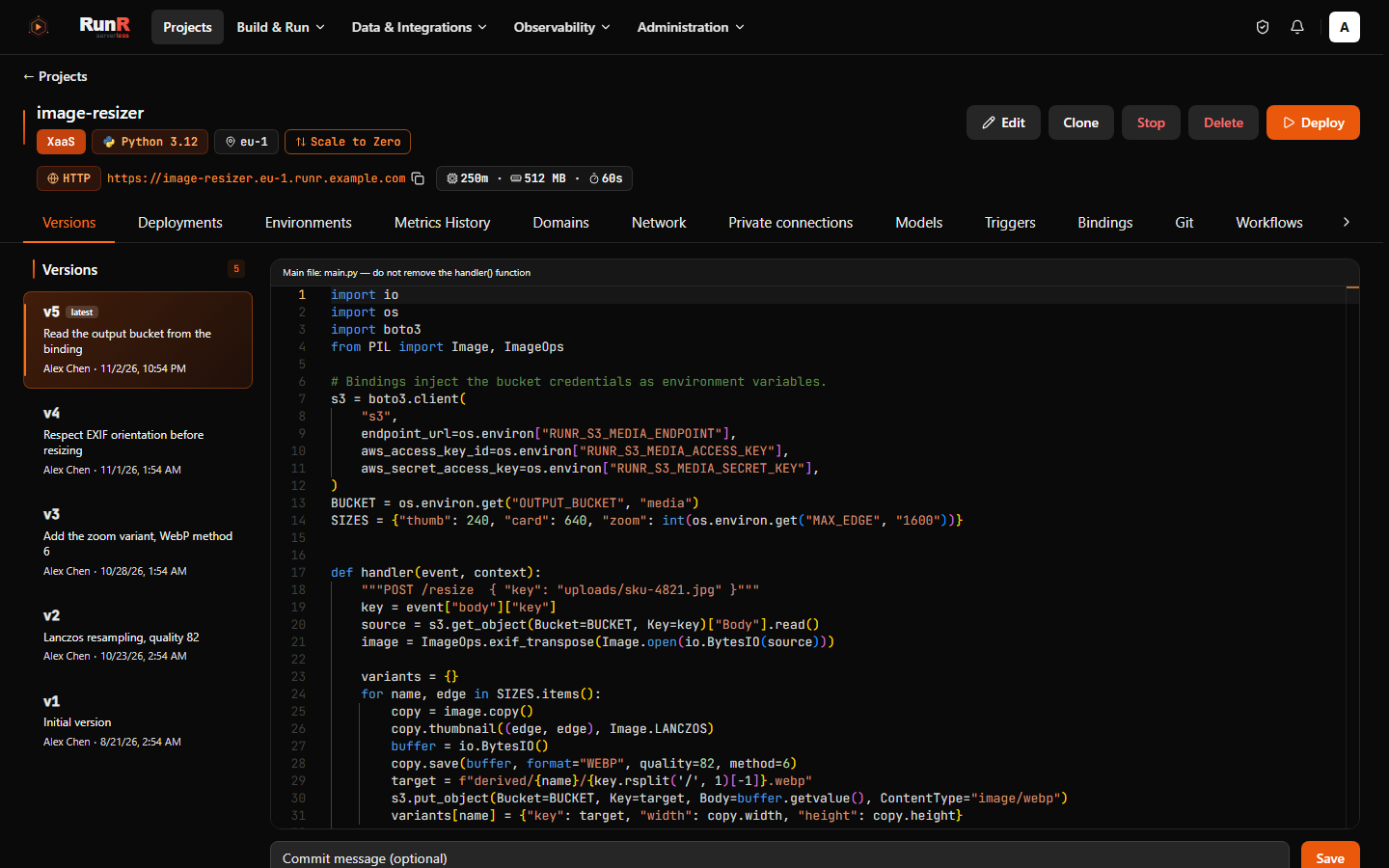
The web editorWrite a single-file function in the browser. Deploy ships that version to Knative; the history keeps every one, ready to roll back. runr.example.com/projects/checkout-api
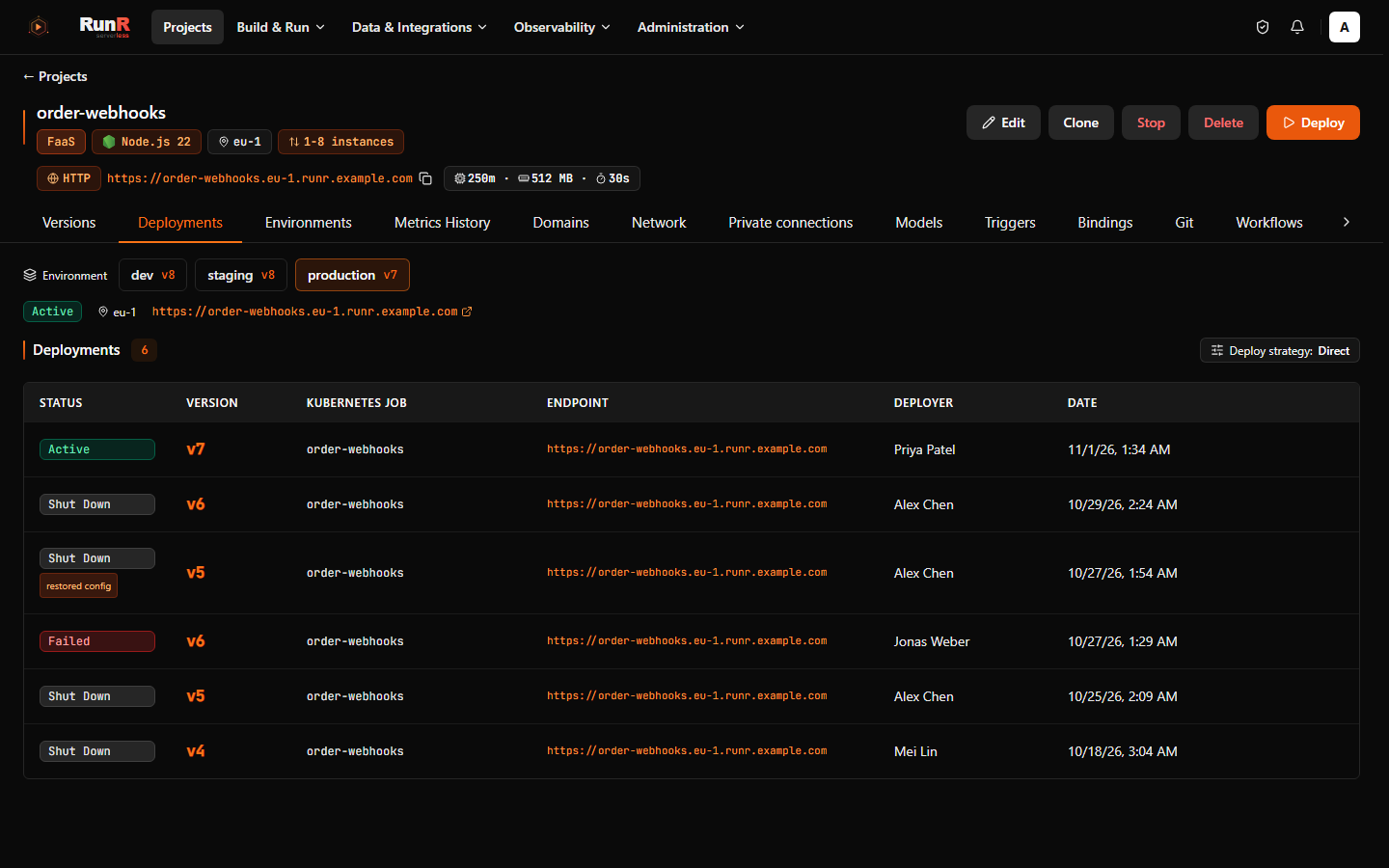
A project at a glanceURL, status, the latest versions, requests and errors of the last hours, and the tabs for code, deployments, triggers, environments, logs and metrics.
IN ONE INSTALL
More than deploy — a complete platform.Deploy, events, environments, data, networking, access control, supply chain, observability, multi-tenancy and billing calculation — all in the same open-source install. Not a single feature behind a paywall. D
Deploygit · CLI · Terraform · GitHub Action · GitLab CI/CDEvery project has its own git remote: push, and it deploys. GitHub App, GitLab and Forgejo / Gitea connections come with commit statuses and a deploy history.
E
Triggers + EventsWebhooks · Topics · Kafka · NATS · CDCEvery project has a list of triggers: HTTP, schedules in a time zone, queues, a webhook inbox, fan-out topics and platform events. The project's event gateway delivers each event as a CloudEvent, with retries and dead letters.
P
Environments + Rolloutsdev · staging · prod · blue-green · canaryA project runs in several environments, each with its own URL, configuration overrides, secrets, bindings and region. Promotion moves the same image to the next environment after a preview of what changes; promotions into production wait for approval.
N
Network + GlobalInternal network · Global DNS · API keysProjects of a region call each other by name on an internal network, admitted only by the callee's allow list. A project is public, public to an IP allow list, or internal only.
B
Data + WorkflowsKV · S3 · Postgres · WorkflowsBindings attached to projects: managed KV (Redis), object storage (Garage or an external S3) and Postgres (CloudNativePG). Credentials arrive as environment variables, with rotation, retention and restore.
R
Access + SecurityRBAC · SSO · Secrets · AuditOne permission catalog: built-in and custom roles, groups, per-project access and API tokens limited to a subset of their owner's permissions. SSO groups map to RunR groups and roles.
S
Supply Chain + ResidencySBOM · Scan · Sign · AdmissionEvery image RunR builds or receives gets an SBOM (SPDX, CycloneDX), a vulnerability scan (also with an offline database) and a cosign signature with the region's key.
O
ObservabilityOpenTelemetry · Tempo · Prometheus · LokiAn OpenTelemetry Collector and Grafana Tempo per region (or your existing backend), auto-instrumented functions and a Traces tab with search and waterfall; metrics and logs per project.
T
Multi-Tenant + White-Label + BillingTenancy · Branding · Billing APIA PostgreSQL schema per tenant, quotas per region. The brand of the installation and of each tenant without a rebuild; self-service signup with e-mail verification.
THE CONSOLE
Everything 0.6 added, as it looks in the console.Scenes from a RunR 0.6 installation. Each one is a feature of the same open-source install; the documentation page of every feature is linked.
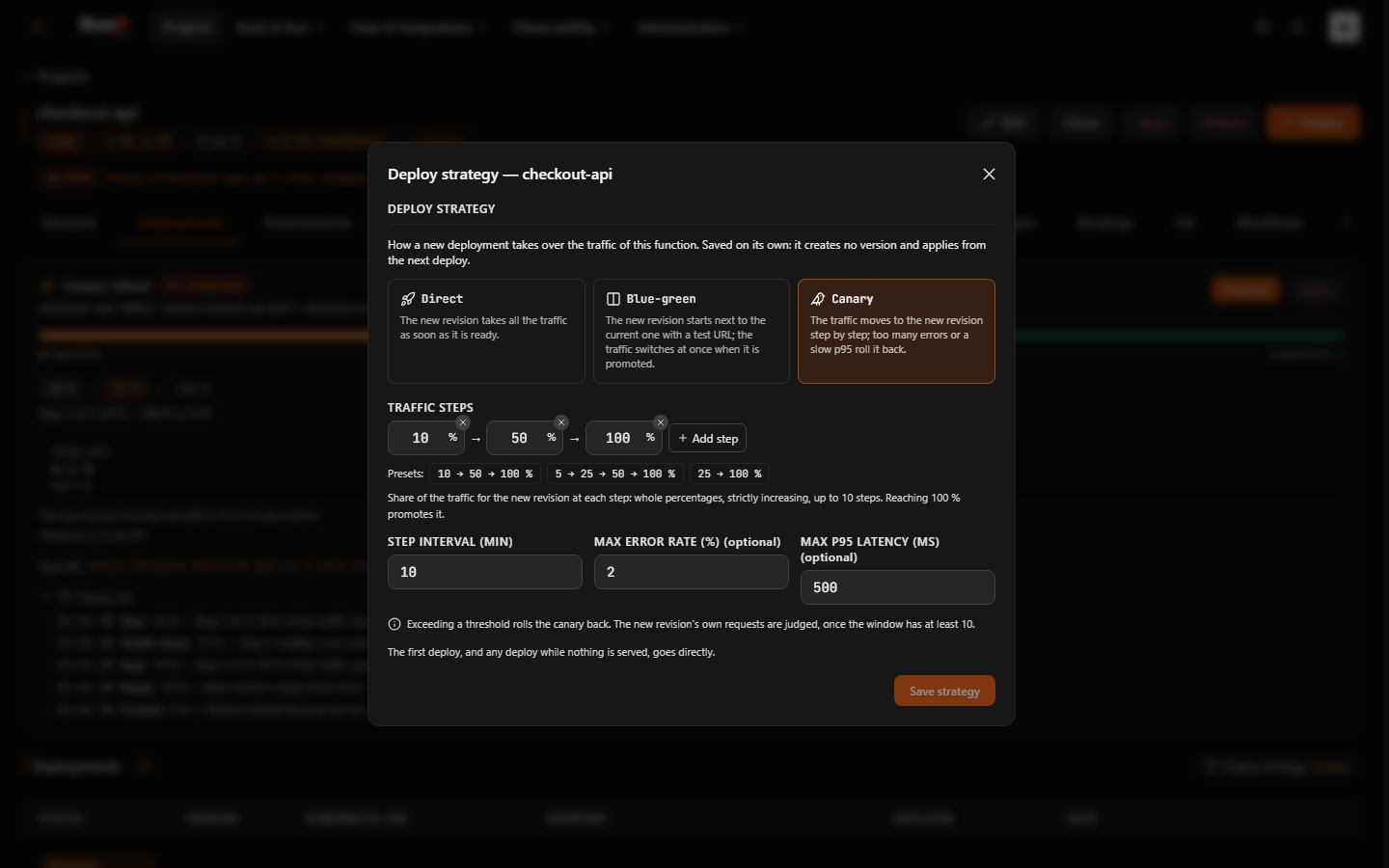
Deploy strategies
Blue-green and canary, with an automatic brake.Pick a strategy per function. Blue-green starts the new revision next to the serving one, with 0 % of the traffic and a test URL of its own, then moves all traffic at once: by hand, or by itself once the health check passes. Canary raises the new revision's share in steps (10 % → 50 % → 100 % by default); when its error rate or p95 latency crosses the threshold during a step, the rollout rolls back on its own.
runr.example.com/projects/checkout-api/deployments
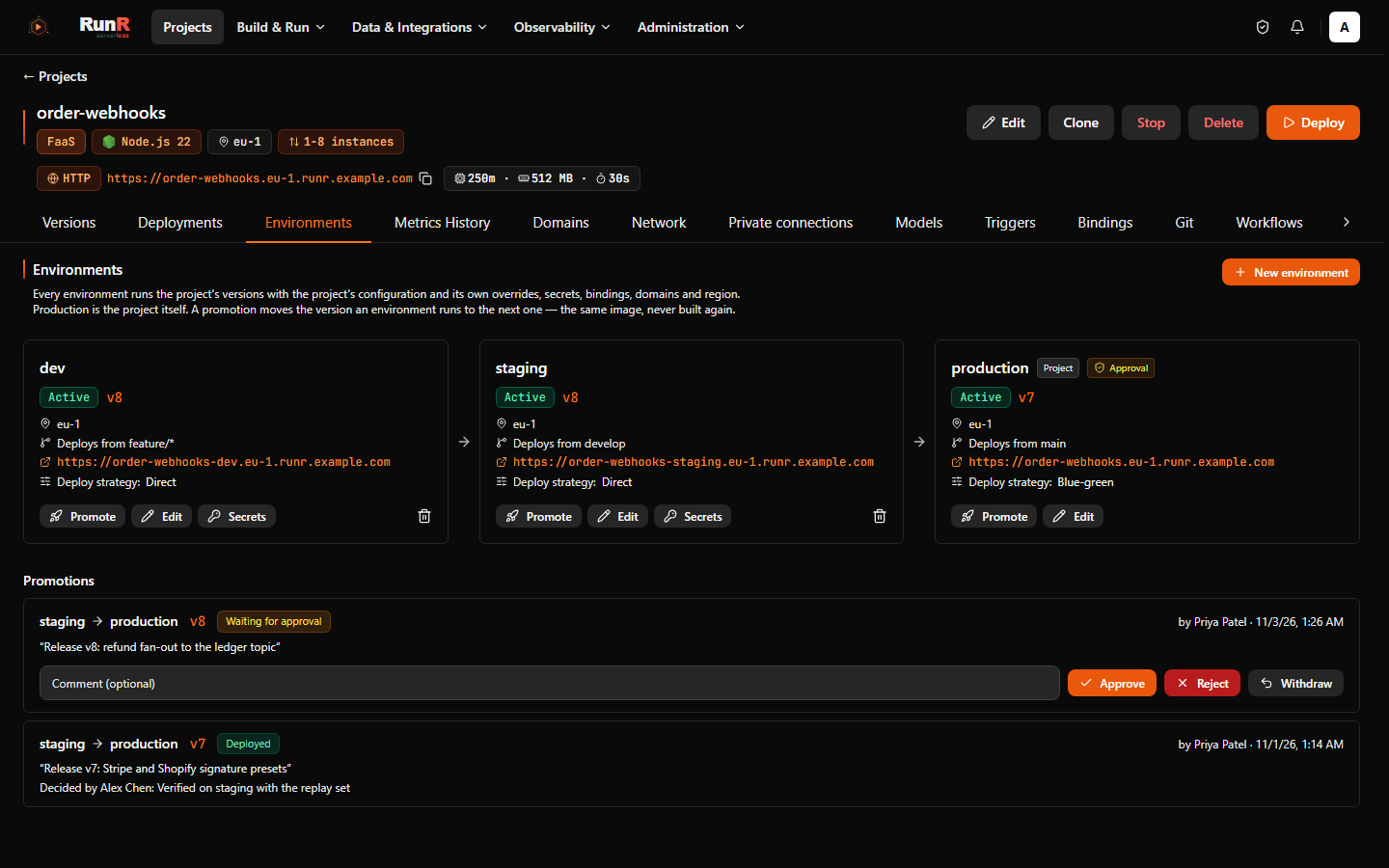
Environments and promotion
dev, staging, production: one project, promoted step by step.A project runs in several environments, each with its own URL, configuration overrides, secret variables, bindings, custom domains, git branch and region. Promotion moves the same code version and image to the next environment, never built again, with the target's own configuration; a preview shows what will change, and promotions into production wait for an approver by default.
runr.example.com/projects/checkout-api/environments
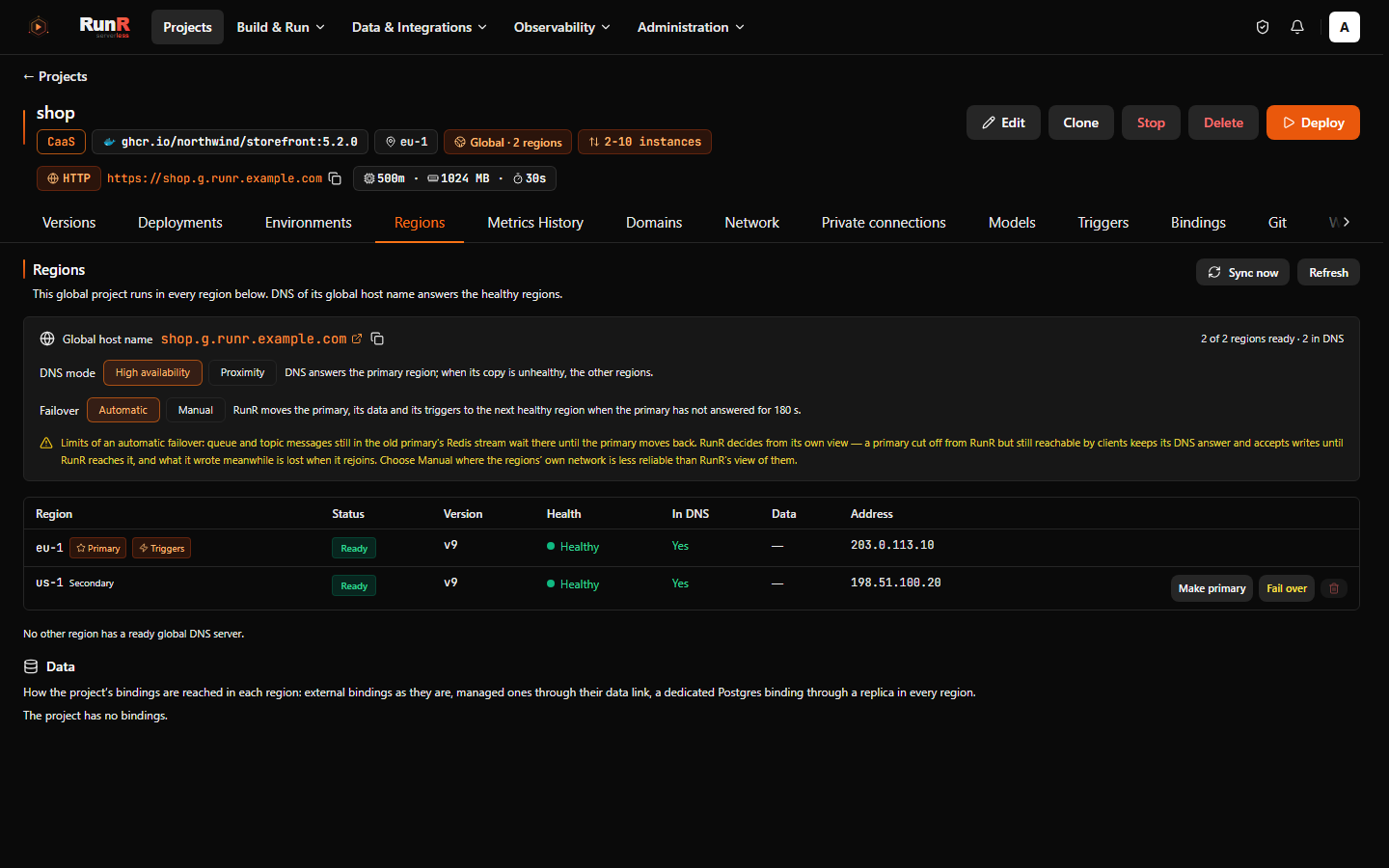
Global projects
One host name, several regions, failover included.A global project runs in several regions behind one host name. In HA mode the primary region answers while it is healthy and the others take over when it is not; in proximity mode the healthy region closest to the client answers. When the primary fails, RunR fails over to the next healthy region: the Postgres replica there is promoted, and the triggers and the DNS follow.
runr.example.com/projects/checkout-api/regions
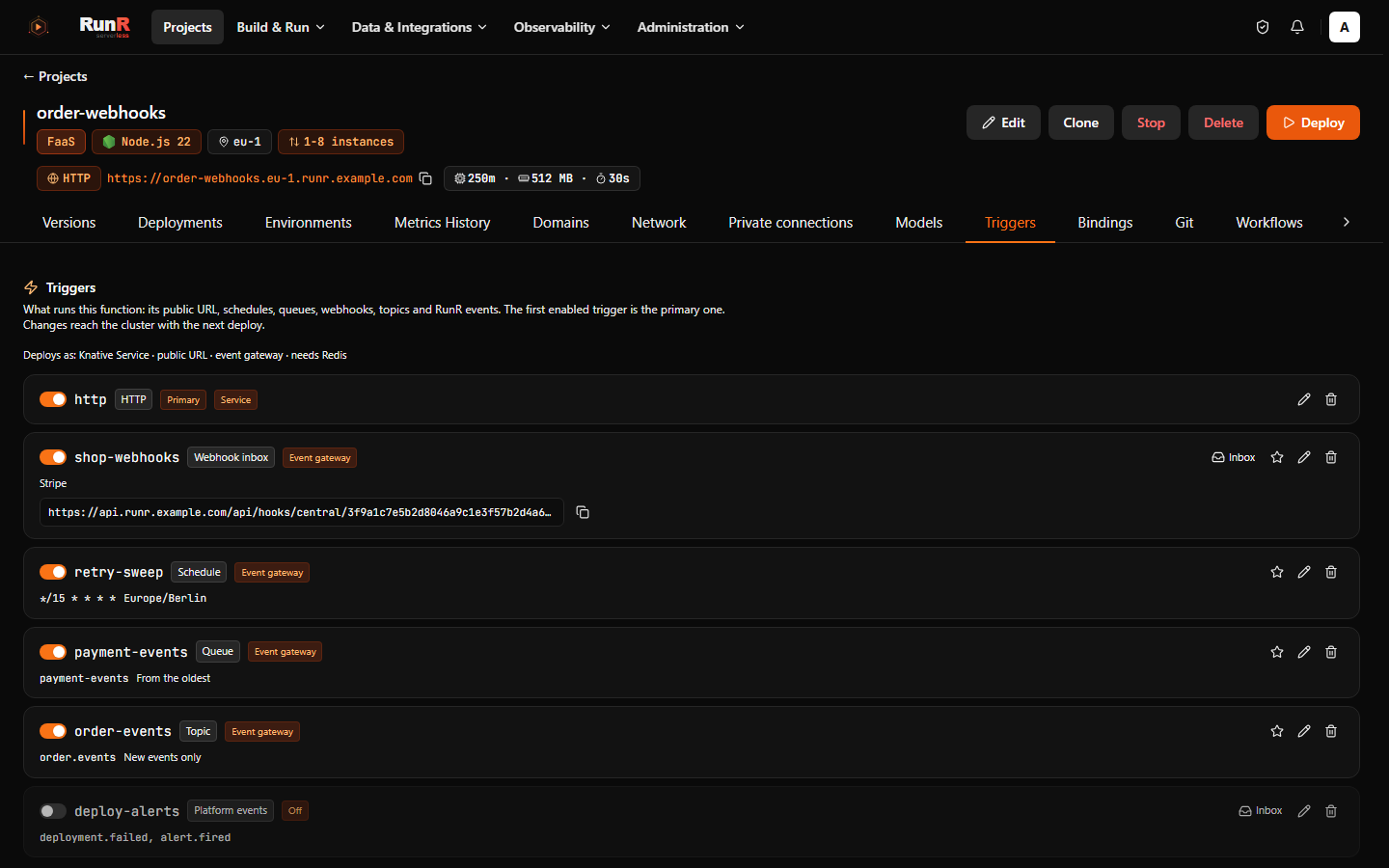
Triggers and the event gateway
Every event a project reacts to, in one list.HTTP, schedules in a time zone, queues, a webhook inbox with signature presets, fan-out topics, platform events, and brokers and external sources: Kafka, NATS JetStream, RabbitMQ, MQTT, Postgres change data capture, S3 buckets and e-mail over IMAP. The project's event gateway delivers each event as a CloudEvent with retries and a dead letter; a message is acknowledged only once it is delivered or dead-lettered.
runr.example.com/projects/orders-webhook/triggers
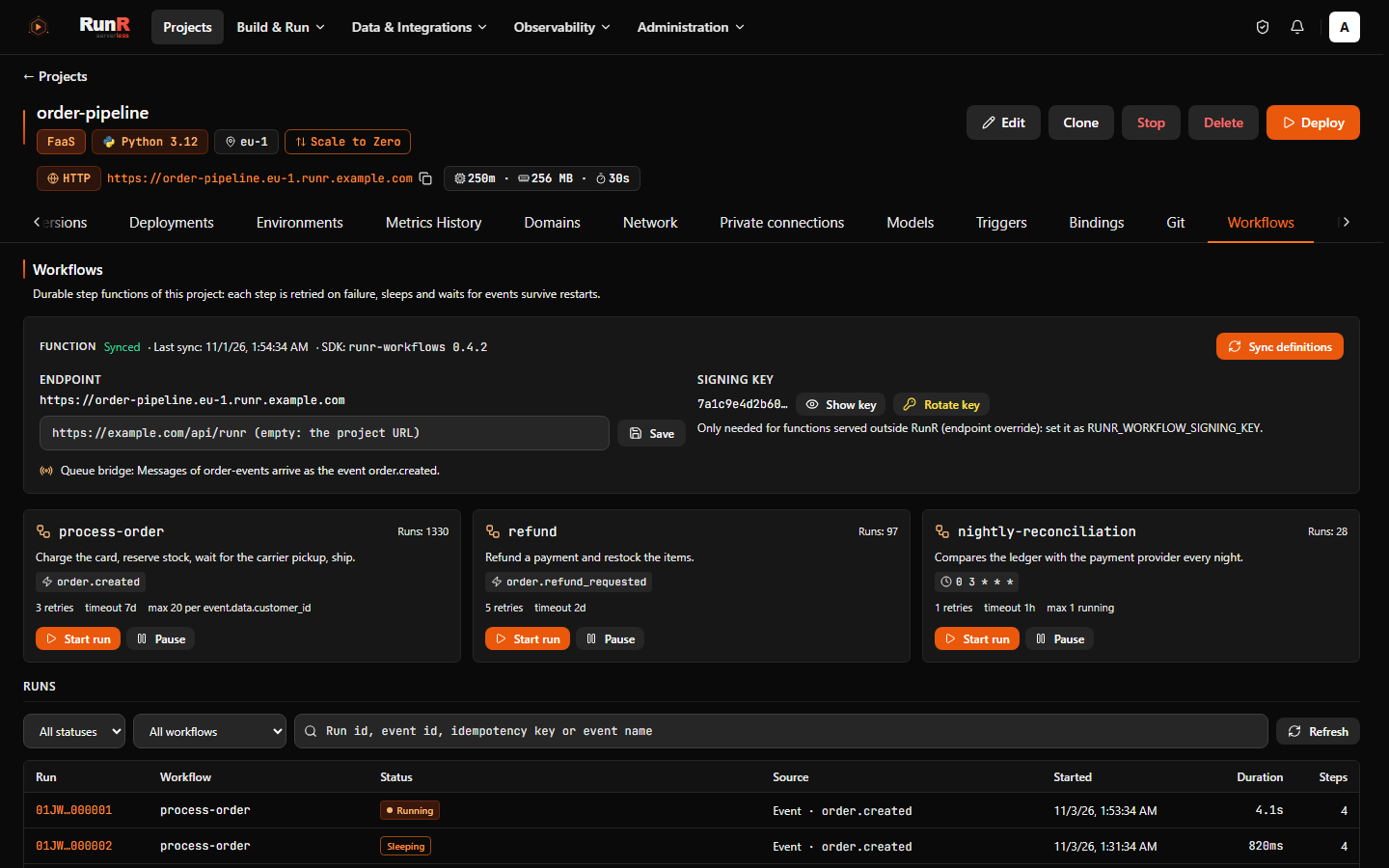
Durable workflows
Functions that outlive crashes, redeploys and sleeps of days.A workflow is an ordinary function in a project, written step by step. Every step's result is recorded, so a run continues where it left off after a crash or a redeploy; a workflow can sleep for ten minutes or ten days, wait for an event, retry a failing step and call other workflows. The console shows every run with its steps and timings.
runr.example.com/projects/fraud-workflow/workflows
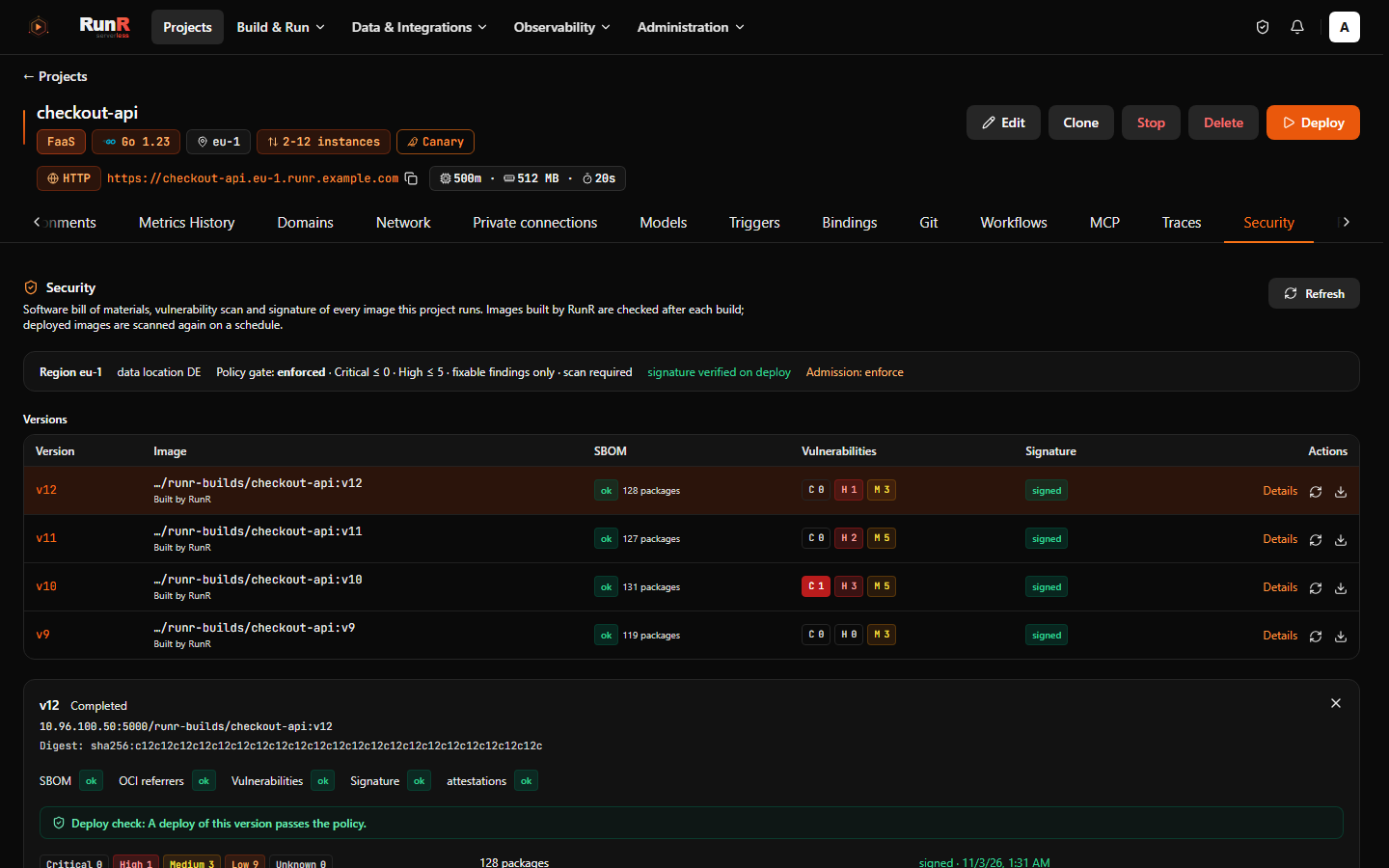
Supply chain and secret stores
Know every image you run; keep secrets out of the database.Every image RunR builds or receives gets an SBOM (SPDX and CycloneDX, attached as OCI referrers), a vulnerability scan that also works with an offline database, and a cosign signature with the region's key. A policy gate decides before deploy, and the region admits only signed images. Secret variables never land in RunR's database: they live in the region's Kubernetes Secrets or in an OpenBao RunR runs there, or stay in your own HashiCorp Vault / OpenBao, AWS Secrets Manager, GCP Secret Manager or Azure Key Vault, read with the region's identity.
runr.example.com/projects/image-resize/supply-chain
More of the consolerunr.example.com/projects/checkout-api/deployments/184
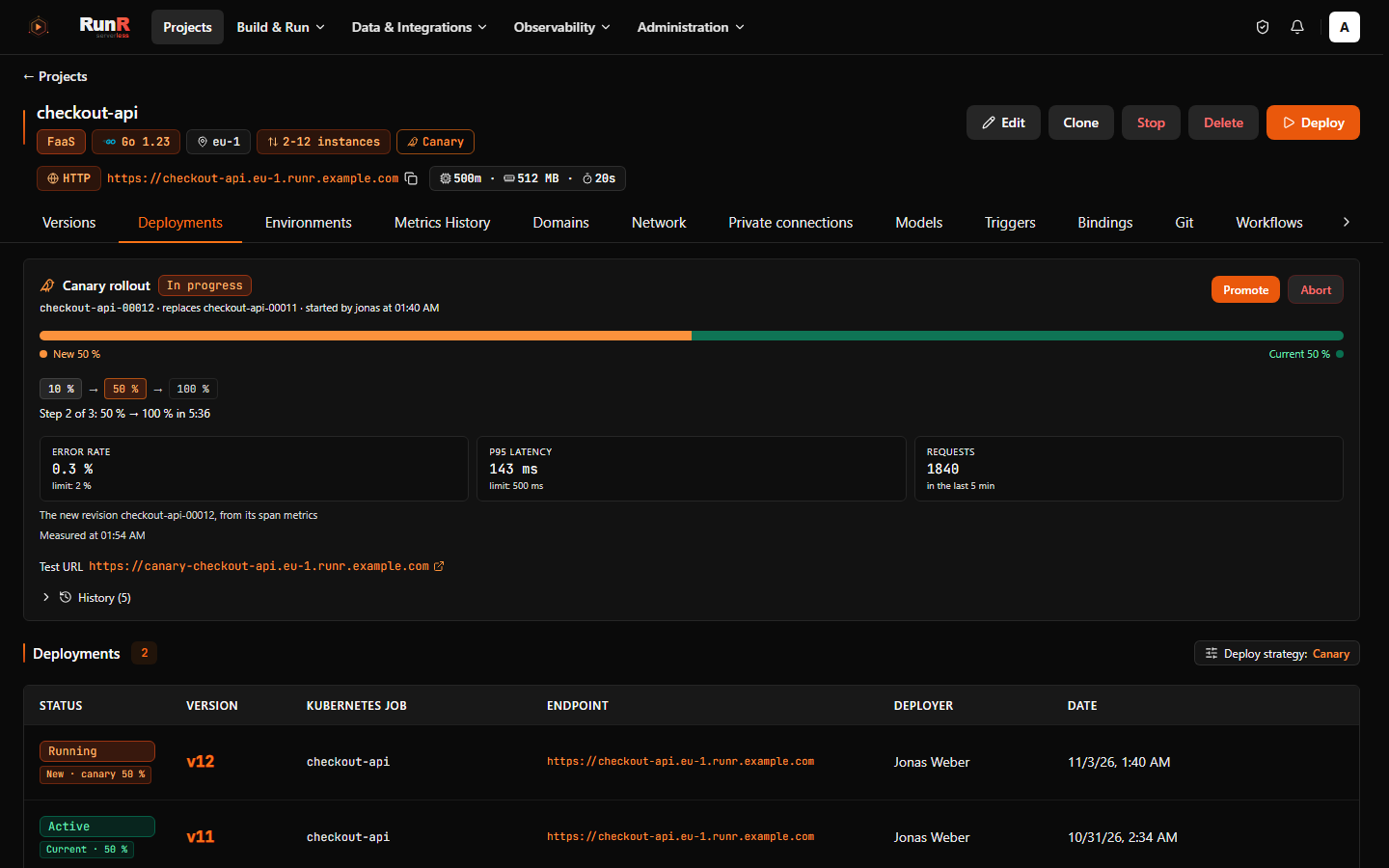
A deployment, liveBuild and rollout steps stream into the console as they happen; every change is a version you can roll back. runr.example.com/projects/checkout-api/logs
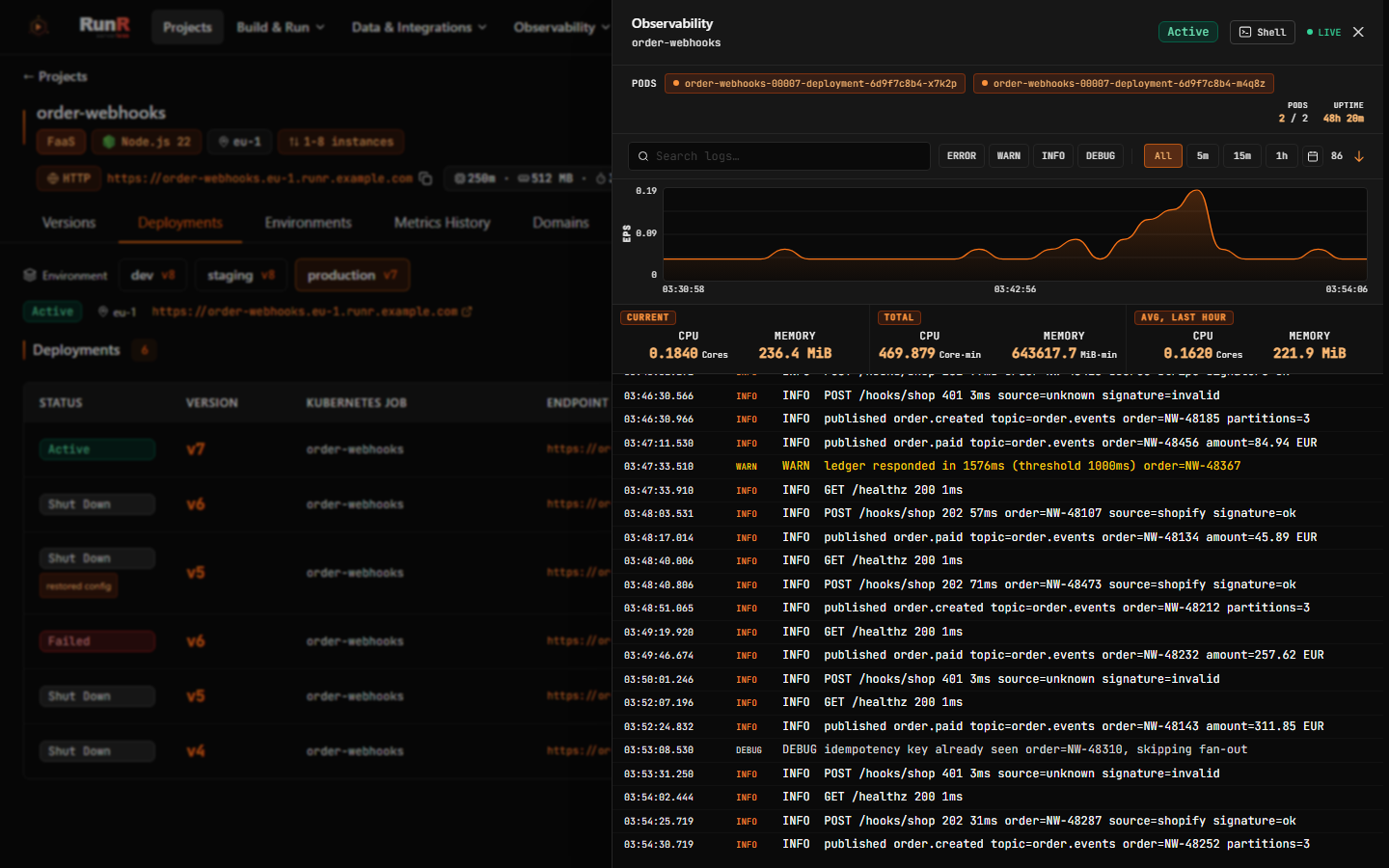
Logs and metrics per projectLive log lines next to request, latency and replica charts; traces with a waterfall in the Traces tab, request replay for failed calls. runr.example.com/settings/roles
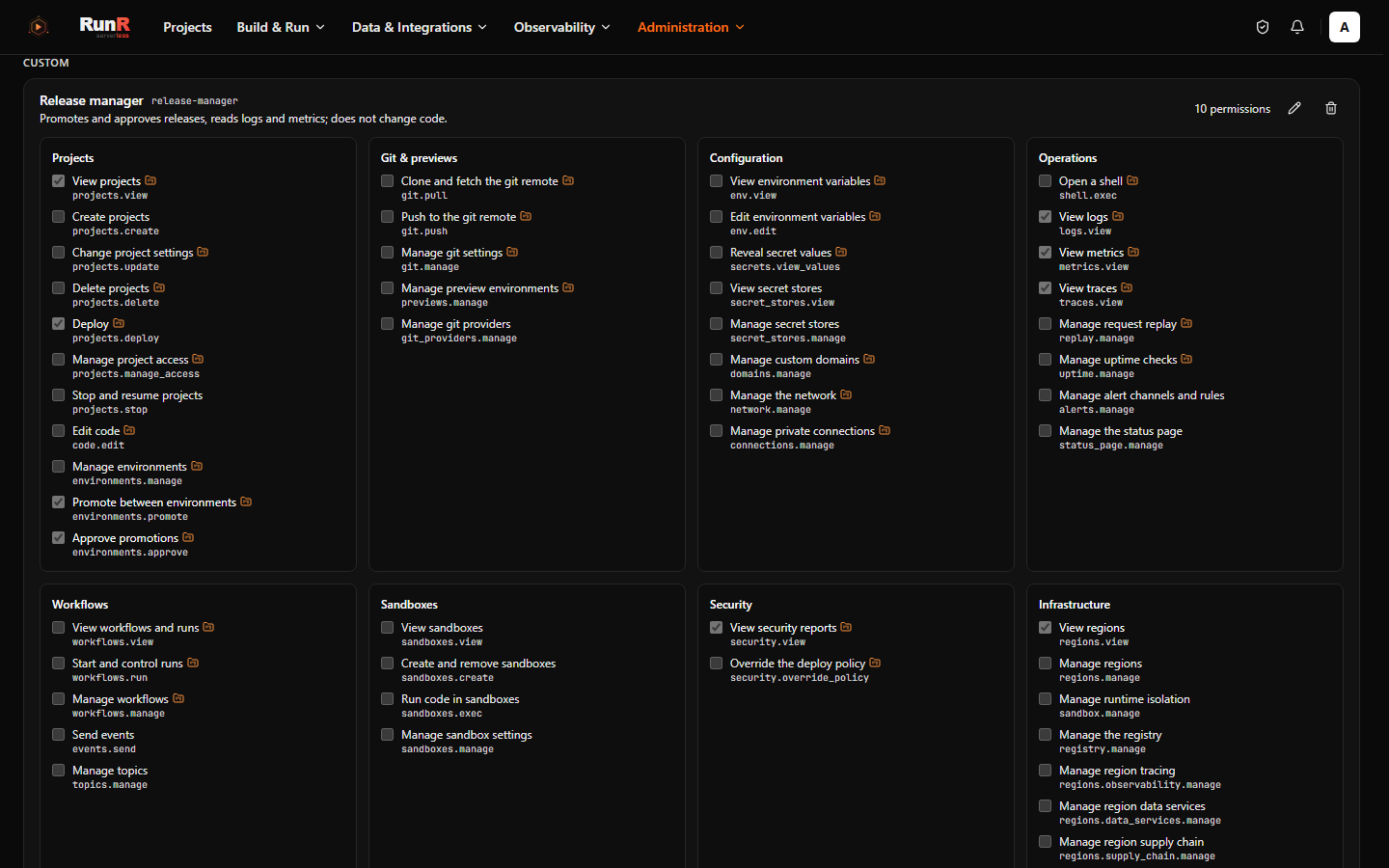
Roles and permissionsOne permission catalog, built-in and custom roles, groups, per-project access and API tokens scoped to a subset of their owner's permissions. runr.example.com/admin/regions/new
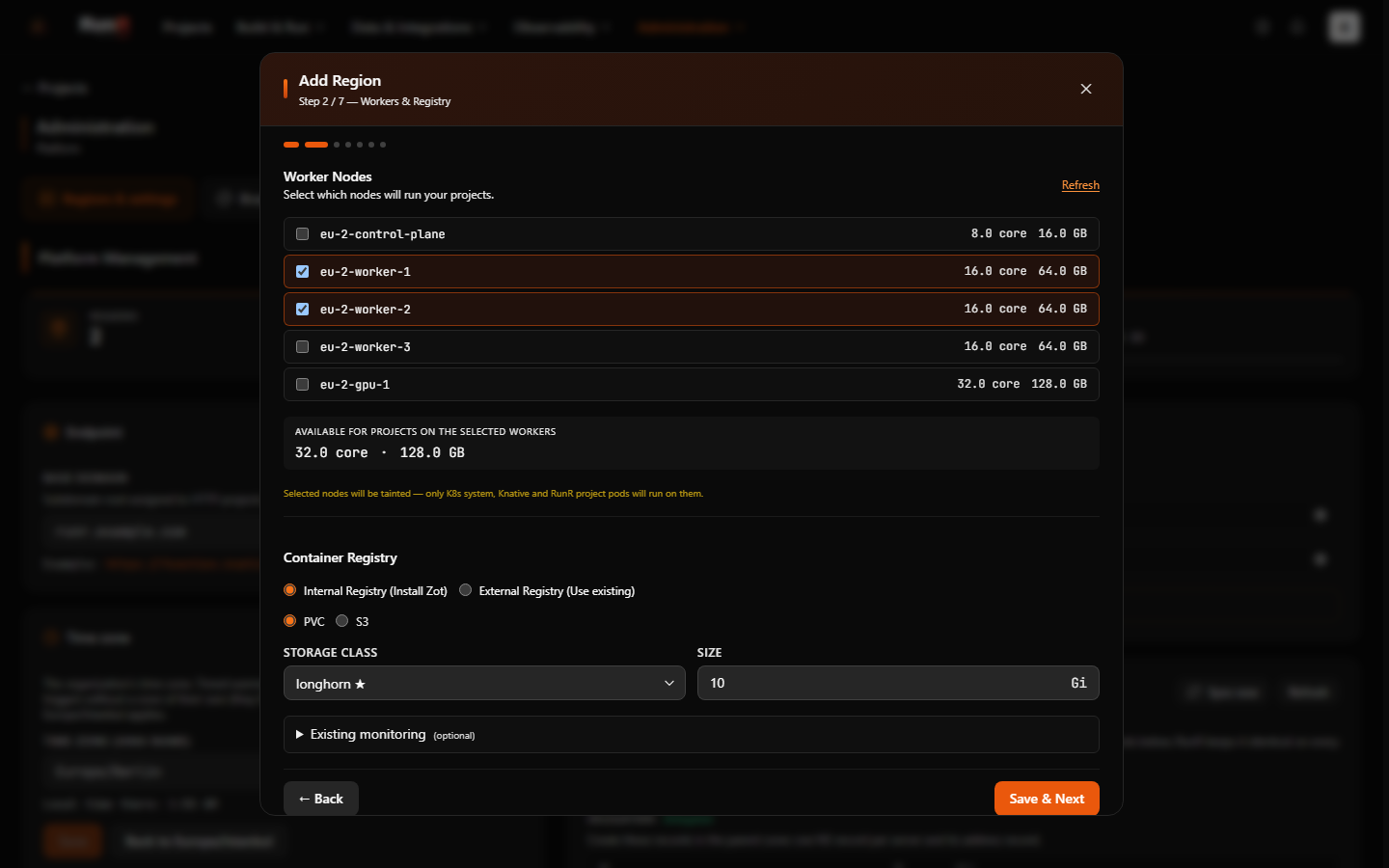
Add a regionPaste a kubeconfig. RunR installs Knative Serving, Traefik, the Zot registry, Redis, Prometheus, Loki and its region agent on the cluster, and keeps them current.
SOURCE TO POD
Source code to pod. No container required.
Write the handler, not the Dockerfile. RunR takes your source — a single file or a whole project, from the web editor,
THE CONTAINER ROUTE
The classic container workflowEvery change: build an image, push it, roll it out. 1Write code
2Write Dockerfile
3docker build (minutes)
4Push to a registry
5Write Deployment / Service / Ingress YAML
6Roll out + tune autoscaling
VS
RunR
Paste code → DeployRunR installs dependencies, compiles Go, builds the image in-cluster with Kaniko and ships it to Knative. 1Write code in the web editor or
git push — every change is a version2Hit deploy, run
runr deploy or let the push deployBehind the scenes: dependency install or Go compile → Kaniko build as a Kubernetes Job (linux/amd64) → push to the region's registry → Knative revision. Code without dependencies skips the build and goes live straight from a ConfigMap. ⚡ ~3 s (no dependencies) · ~23 s (with a build) / changeRunR measurement: v0.4.2, single-node k3s (8 vCPU, 16 GB); median from save until the new code answers (n=3). No dependencies 2.7 s (2.7–3.7 s); with a build 23.0 s (22.0–25.0 s; Kaniko, Node + 1 npm dependency, base images from the region registry cache). A project's first-ever build adds a one-time base-image fetch. Built-in runtimes
Python
Node.js
Go
PHP
Java
.NET (C#)
Ruby
TypeScript (Bun)
PyTorch
TensorFlow
Runtime images track upstream: every version that hasn't reached end-of-life is available, and each project picks its own. Any language: runtime plugins
C
Rust
Bash
Q
your language
A runtime is a WebAssembly (Spin)
Rust
Go (TinyGo)
JavaScript / TypeScript
Python
wasm-exec: C / C++ · Zig · .wasm
Wasm functions run as Spin components on runwasi's Spin shim, installed per region in one click from its Isolation tab. RunR measurement: v0.5.0, 2026-10-15, single-node k3s v1.34.11 on a test VM (8 vCPU Broadwell, nested KVM, 15.6 GiB), Knative 1.21.3; Spin shim, 250m / 128 MiB, image on the node, RunR's default scale-to-zero; HTTPS from inside the VM through Traefik, a new connection per request; median (p90) from zero replicas to the first full HTTPS response, n=12 each: Rust 1.54 s (1.84), JavaScript 2.12 s (2.58); warm request median 9 / 11 ms (n=100).
AI · ON YOUR OWN CLUSTER
Infrastructure for GPUs, models and agents.RunR detects GPU nodes, serves Hugging Face models in one click, gives AI agents permission-scoped access over MCP and runs the code they write in isolated sandboxes. G
GPU WorkersNVIDIA device plugin · GPU OperatorDetects the NVIDIA GPU nodes of a region, installs the device plugin or the GPU Operator and schedules GPU functions and containers there — scaling to zero, metered by GPU time.
H
Hugging Face ModelsvLLM · TGI · TEI · hf-serve
One-click model services from a Hub browser — vLLM, TGI, TEI, RunR's
M
MCP Server + MCP HostingModel Context Protocol · OAuth 2.1
A built-in MCP server at
S
Sandbox APIgVisor · Kata · warm pools · SDKsIsolated, short-lived sandboxes for the code AI agents write: under the region's strongest isolation (a Kata micro-VM on nodes with KVM, otherwise gVisor), without network access by default, with their own CPU, memory and disk limits.
runr.example.com/models
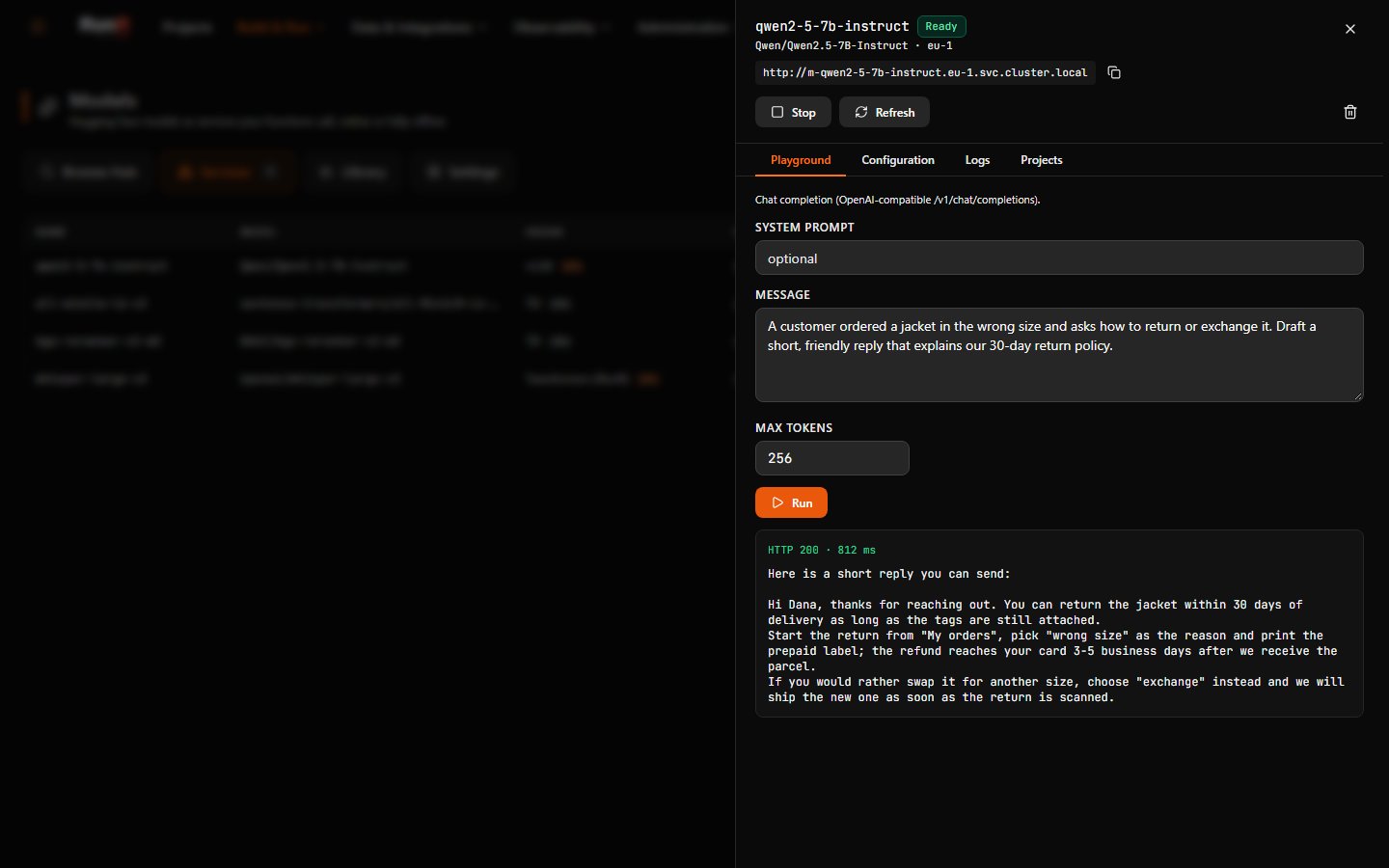
Hugging Face modelsBrowse the Hub in the console and deploy a model service with vLLM, TGI, TEI or hf-serve, online or fully offline, then try it in the playground. runr.example.com/settings/mcp
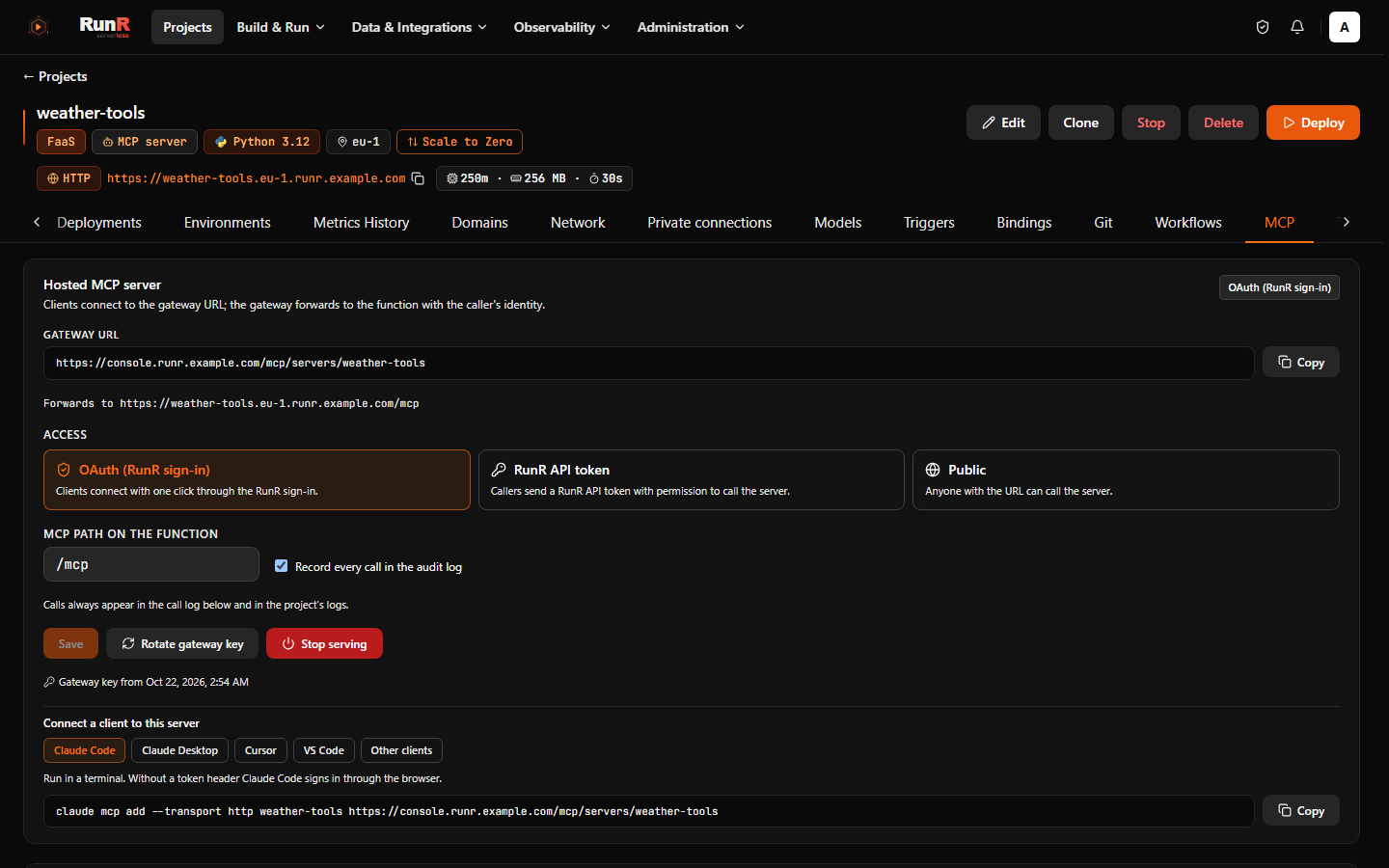
MCP server and MCP hostingThe built-in MCP server at runr.example.com/sandboxes
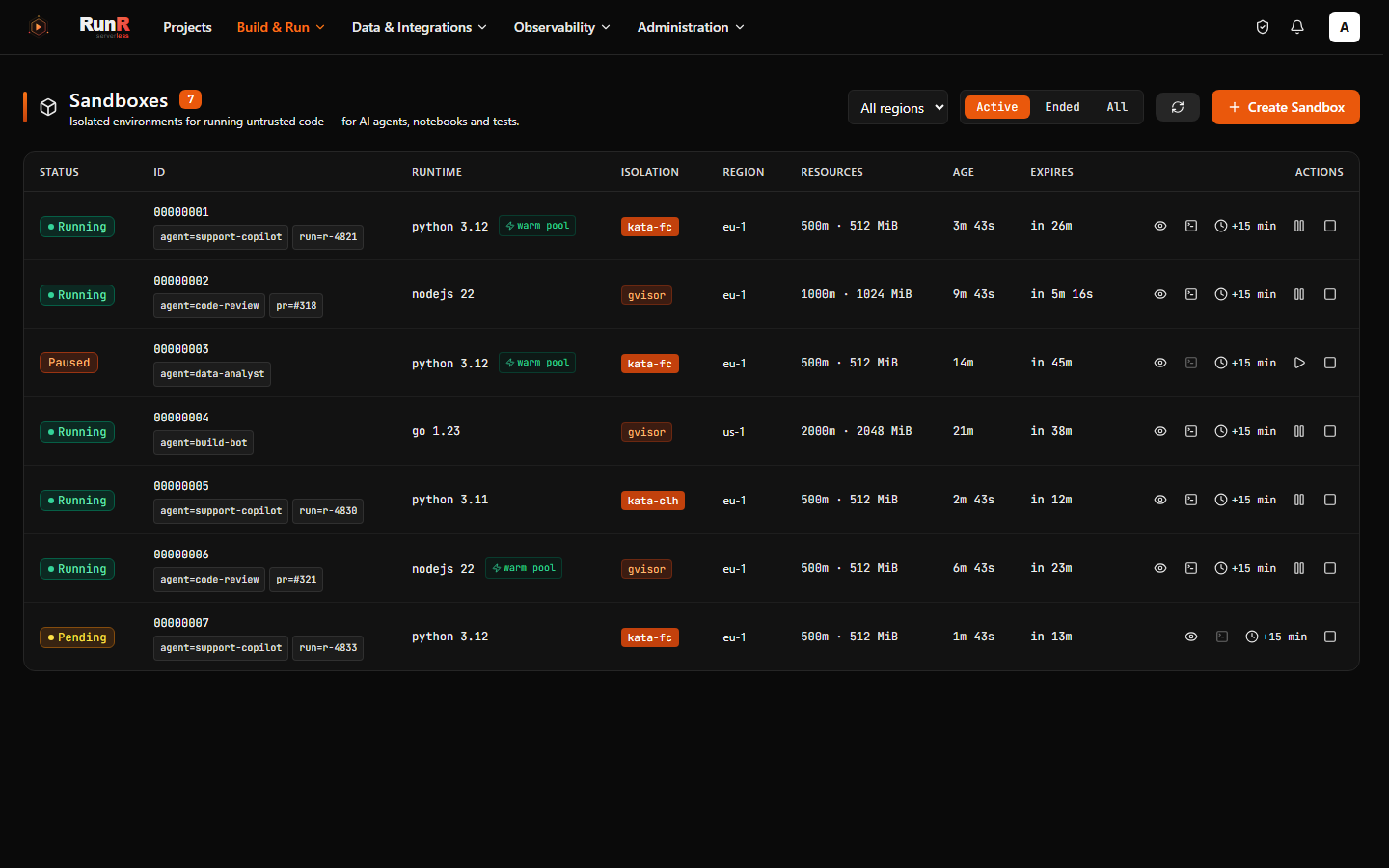
Sandbox APIRunning sandboxes with their class (gVisor or Kata), warm pools and quotas; exec, files, background processes and a code interpreter over the API and the SDKs.
RunR measurement: v0.6.8, 2026-11-08, single-node k3s v1.34.11 on a test VM (8 vCPU Broadwell, nested KVM, 15.6 GiB), Knative 1.21.3, gVisor 20260921.0, Kata Containers 4.3.1; Sandbox API (
WHY RUNR
Serverless experience — on your own metal.Cloud-provider ergonomics, with the freedom of open source. ⚡
100% Open SourceAll code under the MIT license. Self-host, fork, modify. Nothing is locked behind a paywall. MIT license · BRF Teknoloji📉
Scale-to-ZeroKnative-powered: idle pods scale to zero. Replicas reach zero ~60 s after the last request and the pod is gone by ~93 s (RunR v0.4.2 measurement; Knative defaults: 60 s stable window + 30 s grace period). Idle functions hold no resources; the capacity is freed for other workloads. A region admits scale-to-zero projects against an overcommit budget — by default 3× its CPU and 1.5× its memory, set per region — while always-on projects reserve their full size. 🏢
Multi-Tenant + RBACSchema-per-tenant isolation and quotas per region; built-in and custom roles, groups, SSO group mapping and scoped API tokens. 🛡️
Sandbox IsolationChosen per project type in each region: gVisor for syscall-level isolation, Kata Containers micro-VMs (Cloud Hypervisor, QEMU, Dragonball, Firecracker; on nodes with hardware virtualization) or plain runc. 🔓
Zero Vendor Lock-inStandard Knative APIs, OCI images and MIT-licensed code. Your workloads move to any Kubernetes that runs Knative, and the platform itself is yours too. 🌍
On Your Own Clusters
Install the platform with its Helm chart or with Docker Compose on a single host (air-gapped too), then add as many Kubernetes clusters as you like as regions with their kubeconfig — in the console or with
SANDBOX & RUNTIME ISOLATION
When you need to change what's beneath the container.Each region maps XaaS, FaaS, CaaS and build jobs to a container runtime of their own via RuntimeClass: runc by default, gVisor or Kata once installed. gVisor intercepts syscalls, Kata runs each pod in its own micro-VM, and Firecracker (the same Lambda uses) is the most minimal micro-VM of them. The same isolation protects the sandboxes of the Sandbox API. gVisor SYSCALLGoogle · User-space kernel · runsc shim Cold start · Python 2.0 s Mem overhead Low (no VM) Isolation OS Use XaaS · FaaS
Kata + CLH VMKata Containers · Cloud Hypervisor · kata-clh shim Cold start · Python 3.2 s Mem overhead (0.6.6) ~145–160 MiB Isolation Hardware Use CaaS · Build
Firecracker μVMAWS · Rust · firecracker-containerd Cold start · Python 3.2 s Mem overhead (0.6.6) ~145 MiB Isolation Hardware Use High-throughput
RunR measurement: v0.5.0, 2026-10-15, single-node k3s v1.34.11 on a test VM (8 vCPU Broadwell, nested KVM, 15.6 GiB), Knative 1.21.3, gVisor 20260921.0; function 250m CPU / 256 MiB, image on the node, RunR's default scale-to-zero; HTTPS from inside the VM through Traefik, a new connection per request; median (p90) from zero replicas to the first full HTTPS response, n=12 each, Python — runc 1.50 s (2.14); gVisor 1.97 s (2.64). Kata Containers 4.3.1, measured the same way on the same VM with v0.6.6 on 2026-11-06 (Python 3.15): Cloud Hypervisor 3.19 s (3.53), Firecracker 3.17 s (3.52; root filesystem on containerd's devmapper snapshotter), QEMU 3.96 s (4.21), Dragonball 4.15 s (4.48). Kata was measured with Python only. Warm request median 9–12 ms (n=100). Memory overhead (v0.6.6, Kata 4.3.1, the same Python function, n=2): ~145–160 MiB for Cloud Hypervisor and ~145 MiB for Firecracker, the host PSS of shim + VMM (+ virtiofsd with Cloud Hypervisor) per Kata pod idle 30 s after a request, minus the function's own memory in the guest (~28 MiB). ⚙️
Containerd shim selection — per project type
Each region maps XaaS, FaaS, CaaS and build jobs to a runtime of their own — runc by default, gVisor or any Kata hypervisor as soon as it is installed. On deploy the Knative manifest gets the matching 🔧
Cilium sandbox network fix — solved in-platform
Sandbox pods can't reach ClusterIP services from the host-net namespace by default (Cilium upstream bug). RunR auto-applies
TECHNICAL ARCHITECTURE
Not a single box — a 12-layer platform.The control plane — Vue SPA, Laravel API on Octane, queue workers, scheduler and WebSocket server, behind one gateway — ships as a Helm chart or a single-host Compose install. RunR then installs Knative Serving, Traefik, the Zot registry, sandboxes, the Spin shim, GPU support, data services and the observability stack on every region cluster for you. 01
FrontendVue 3 · Vite · runr-ui
100+ component30+ composablePiniaMonacoxterm.jsi18n EN · TR
02
Backend APILaravel 12 · PHP 8.3 · Octane (FrankenPHP)
110+ controller70+ service100+ modelSanctumHorizonScramble
03
Real-TimeReverb WebSocket · runr-reverb
Private channelsShell PTYNotificationsLive metrics
04
KubernetesK8s 1.30+ · Helm
HelmHPAPDBRBACMulti-cluster
05
Knative ServingMatched to K8s · auto-scale
Scale-to-zeroRevisionsMin / max scaleKPACapacity admission
06
SandboxRuntimeClass per project type
runcgVisorKata: CLH · QEMU · Dragonball · FCSpin (Wasm)
07
NetworkTraefik Gateway · Cilium
L7 ingresseBPF dataplaneAPI gatewaySubdomain routing
08
RegistryZot · OCI compliant
Pull-through cacheS3 / PVCNode pre-pullImage uploads
09
ObservabilityOpenTelemetry · Tempo · Prometheus · Loki
TracesReplayUptimeStatus pageAlertsRegion agent
10
Tenancystancl/tenancy v3 + Modules v11
Schema-per-tenantResource syncImpersonationWhite-label
11
Supply ChainSBOM · scan · cosign · admission
SPDX · CycloneDXOffline scan DBPolicy gateSigned admission
12
Migration & DRRegion cutover · DNS flip
Region migrateDNS cutoverAuto redeployRollback
0+ Components 0+ Controllers 0+ Services 0+ Models 0+ Composables 0+ Queued Jobs
HOW IT WORKS
Four steps, live in production.1
Write
Write code in the web editor, 2
Deploy
Every change is a version, built automatically when needed. One click, a push or 3
ScaleAuto scale-to-zero and scale-out. Reacts to traffic in seconds. 4
MonitorLive logs, metrics, traces and cost tracking. Prometheus, Loki and OpenTelemetry built in.
COMPARISON
RunR next to the alternatives.Bare Knative, Knative Functions, OpenFaaS, AWS Lambda and Vercel, feature by feature, from their own documentation.
One at a time, with sources: RunR vs Google Cloud Run · RunR vs AWS Lambda · RunR vs Vercel · RunR vs Knative · RunR vs OpenFaaS Compiled from each project's public documentation on 2026-11-02 (links below); paid-edition notes follow the vendors' own edition pages, and “—” means the documentation describes no such feature. Knative is a CNCF project; OpenFaaS, AWS Lambda and Vercel are trademarks of their owners. RunR is not affiliated with or endorsed by any of them. Sources, read on 2026-11-02: Knative rollouts · Knative Eventing sources · Knative Functions · OpenFaaS editions · OpenFaaS Profiles · OpenFaaS pricing · Lambda container images · Lambda alias routing · Lambda event sources · Lambda code signing · Lambda pricing · Vercel Rolling Releases · Vercel environments · Vercel Sandbox · Vercel Daemons · Vercel pricing · read on 2026-11-03: OpenFaaS CE EULA · Lambda durable functions · Lambda Web Functions endpoints · Vercel Container runtime · Vercel Workflows RunR measurement: v0.5.0, 2026-10-15, single-node k3s v1.34.11 on a test VM (8 vCPU Broadwell, nested KVM, 15.6 GiB), Knative 1.21.3, gVisor 20260921.0; function 250m CPU / 256 MiB (container 500m / 512 MiB, WebAssembly 250m / 128 MiB), image on the node, RunR's default scale-to-zero; HTTPS from inside the VM through Traefik, a new connection per request; median from zero replicas to the first full HTTPS response, n=12 each — runc: Python 1.50, Go 1.54, Node.js 1.62, PHP 1.65 s, container (CaaS) 1.57 s; gVisor: Python 1.97 s; Kata (Python only; v0.6.6 with Kata Containers 4.3.1, 2026-11-06, Python 3.15, the same method): Cloud Hypervisor 3.19, Firecracker 3.17, QEMU 3.96, Dragonball 4.15 s; WebAssembly: Rust 1.54, JavaScript 2.12 s; warm request median 9–12 ms (n=100). The pricing row: official pricing pages as of 2026-10-01 (USD, excluding tax and data transfer); regions and source links in the note below. Full Monthly Cost · Heavy Data Processing5M requests/month · 2 GB, 1 vCPU, 3 s each · per request 2 MB read + 1 MB written to object storage (kept 30 days) · 500 KB response · 1 KB log · list prices, USD, 2026-10-01 RunR Self-HostSoftware: $0 RunR is software, not a hosted service: no per-request, ms×memory, API gateway or log-ingestion fees. It runs on the infrastructure you already have (bare metal or your cloud installation), so you pay only that infrastructure, whatever it costs you. Data that stays in your own data center pays no hyperscaler egress or storage fees. AWS Lambda≈ $876 / mo Lambda ms×GB $501 (30M GB-s + 5M requests) · egress $225 (2,500 GB × $0.09) · S3 storage + requests $142 · API Gateway $5 · CloudWatch logs $3 (us-east-1) GCP Cloud Run≈ $890 / mo Cloud Run vCPU-s + GiB-s $437 (1 vCPU, 2 GiB, 15M s + 5M requests) · egress $285 (2,500 GiB × $0.12–0.11) · Cloud Storage + operations $127 · load balancer $38 · logs $3 (us-central1) Azure Functions≈ $1,142 / mo Flex Consumption ms×GB $782 (30M GB-s × $0.000026 + 5M runs) · egress $217.50 (2,500 GB × $0.087) · Blob storage + operations $131 · Log Analytics $11.50 (East US; Flex, as Consumption stops at 1.5 GB) Light API (1M requests, 256 MB, 200 ms, 5 KB responses): $2.58–$2.75 a month in full on AWS, Azure or Cloud Run's default URL, and the free tiers cover nearly all of it — small APIs are nearly free on the hyperscalers. Heavy workload above: each request is 1 GET + 1 PUT, results kept 30 days (→ 5,000 GB stored), 500 KB out (→ 2,500 GB egress), one request per instance (CPU-bound) and the same duration everywhere; month = 730 h; free tiers not deducted (they would remove $18.52 on AWS, $8.78 on Google Cloud, $22.90 on Azure). HTTP entry: API Gateway HTTP API (AWS), the external Application Load Balancer Google recommends for production custom domains, the function app's own hostname with a free managed certificate (Azure); storage over a free private path (S3 gateway endpoint, Private Google Access, Storage service endpoint); GiB-priced lines use the GB figures. Excluded: tax, support plans, backups, WAF, KMS, cross-zone traffic. Regions: AWS us-east-1 (x86 / Linux), GCP us-central1, Azure East US. Sources (official pricing pages and documentation, read on 2026-10-01): AWS Lambda · API Gateway · S3 · CloudWatch · AWS VPC · Google Cloud Run · GCP network · Cloud Load Balancing · Cloud Storage · Cloud Logging · Cloud Run custom domains · Azure Functions · Flex Consumption · Azure Functions limits · Azure bandwidth · Azure Blob Storage · Azure Monitor · Azure Retail Prices API · Vercel Functions · Vercel plans
MIGRATION
From cloud to RunR — hours, not months.See how much work it takes to migrate your existing workloads to RunR. AWS Lambda→RunRHandlers map 1:1 to XaaS. Remove AWS SDK, paste, deploy. Small code changesGCP Cloud Run→RunRCloud Run is Knative — RunR IS Knative. Containers work as-is. No code changesAzure Functions→RunRStrip SDK bindings, convert to standard HTTP handlers. Moderate code changesVercel→RunRStandard Node.js handlers. Copy to FaaS, add package.json, deploy. Small code changesHeroku→RunRContainerize, deploy as CaaS. Scale-to-zero included; idle capacity goes back to other workloads. Add a DockerfileDocker Compose→RunREach service becomes a CaaS project. Same image, same env. Now with auto-scale. No code changesAWS ECS/Fargate→RunRTask definitions are already container specs. Same image, point to CaaS. No code changesFly.io / Render→RunRStandard Docker works as-is. No fly.toml or render.yaml needed. No code changesK8s YAML→RunRYour images are ready. Deploy from UI, skip the YAML. No code changes
INSTALL
Install it, connect a cluster, deploy.RunR is software you install, not a hosted service: the control plane and every region run on infrastructure you operate — bare metal, a private cloud or managed Kubernetes, connected or air-gapped. Helm KubernetesThe control plane as one Helm chart: gateway, UI, API, workers, scheduler and Reverb, plus PostgreSQL and Redis unless you point it at your own.
The chart is in BRF's public Helm repository: no credentials needed, and Docker Compose single host
A production install on one machine: runr CLI Linux · macOS · WindowsScaffold, run locally on the runtime images and deploy. One command installs it; binaries and checksums are on runr.sh/dl. Terraform brf-tech/runrProjects, variables, domains, deployments, bindings, runtimes, workflow triggers, models, MCP servers, roles and branding — as code. CI/CD GitHub Actions · GitLab CI/CD
Deploy on every push and run preview environments for pull / merge requests: the ready-made Action on GitHub, a job that installs the CLI and runs Documentation
The architecture, a page for every feature, upgrade notes between releases and the changelog — at
OPEN SOURCE
Not ours — yours.RunR is developed by BRF Teknoloji and open source under the MIT license; nothing sits behind a paywall. Run it on your own clusters, on your own terms — fork it, change it, contribute.
✓ MIT license
✓ All features free
✓ On your own infrastructure
✓ Open to contributions
FAQ
Frequently AskedWhat exactly is RunR?
RunR is an open-source serverless platform on Kubernetes and Knative, developed by BRF Teknoloji under the MIT license. You deploy single-file functions (XaaS), multi-file projects (FaaS), containers (CaaS) and WebAssembly from the web console, with
git push, from the CLI, Terraform or a GitHub Action — with sandboxes, durable workflows, bindings, GPUs and MCP built in. Think of it as your own AWS Lambda + ECS, on Kubernetes clusters you control.
Is RunR a hosted service?
No. RunR is software you install: you set up the control plane with Helm or with Docker Compose on a single host, then add your own Kubernetes clusters as regions. Your code, data and logs stay on your infrastructure.
Is it really free? Where does money come from?
Yes. MIT license, no feature gates, not open-core: tenancy, SSO, RBAC, the audit log, billing calculation and observability all ship in the same repository. Revenue comes from enterprise support and SLA guarantees for teams that want them.
How do I install it?
On Kubernetes with the chart from BRF's public Helm repository (
helm repo add brf-tech https://helm.brf.sh, chart brf-tech/runr; Helm install), on a single host with Docker Compose (single-host guide). The runr CLI installs with curl -fsSL https://runr.sh/install.sh | sh or downloads from runr.sh/dl; the Terraform provider is brf-tech/runr on the Terraform Registry (runr.sh/brf-tech/runr for OpenTofu). Details in the install section above and in the documentation.
How is it different from raw Knative?
Knative is the engine; RunR is the car. Knative gives you primitives, but you still write YAML, build images, manage deployments and set up isolation and monitoring. RunR wraps it in a console and an API: versions, one-click or
git push deploys, sandboxes, live logs and traces, roles, billing calculation, multi-tenancy — all included.
Can I run without multi-tenancy?
Yes. Multi-tenancy is a toggleable module (TENANCY_ENABLED=false). When off, the platform runs single-tenant: user management, roles and groups still work and multiple users can use it, just without tenant isolation.
Can one project run in several regions?
Yes. A global project runs in several regions behind one host name: in HA mode the primary region answers while it is healthy, in proximity mode the closest healthy region. A failed primary fails over to the next region with its triggers and data; dedicated Postgres bindings get a replica in every region. Details: global projects.
How secure is code execution?
Every project type runs in the sandbox its region assigns: plain runc, gVisor (a user-space kernel) or Kata Containers (a micro-VM per pod, on nodes with hardware virtualization). On top: RBAC with scoped tokens, secrets encrypted at rest, an append-only audit log, SBOMs, scans, signatures and signed-image admission in the region. Projects are isolated from each other on the internal network too: one project reaches another only through its allow list. Tenants get CPU, memory and GPU quotas per region.
How hard is it to migrate from AWS/GCP/Azure?
Not very. Lambda handlers map 1:1 to XaaS (remove SDK, paste). Cloud Run containers work as-is in CaaS (same Knative base). Azure needs SDK removal. Most migrations take hours, not weeks — the migration cards above show what each platform needs.
Is it production-ready?
Yes. RunR is actively deployed in production on multi-node K8s clusters — multi-tenancy, real workloads, automated CI/CD. PDB, HPA, health checks, automatic migration and rollback support are all included, and installations upgrade in place with
helm upgrade.
How do I report a security issue?
Privately, by e-mail to [email protected] — not in a public issue. We acknowledge reports within three business days; details in the security policy.
RELEASE NEWS
Hear about new releases first.New RunR releases and important announcements in your inbox. No spam, just the important stuff. Your email is only used for RunR updates. Unsubscribe anytime. Enterprise — Get in TouchCapacity-based pricing, dedicated support, SLA guarantees, and custom deployment. We'll get back to you within 48 hours. | ||||||||||||||||||||||||||||||||||||||||||||||||||||||||||||||||||||||||||||||||||||||||||||||||||||||||||||||||||||||||||||||||||||||||||||
| You are visitor 01402792 — GeezerVison does not store the pages you look up. Best viewed with Netscape Navigator 4.7 or Internet Explorer 6 at 800×600. No cookies required. |