GeezerVisonThe World Wide Web, restored to 800 pixels of glory. |
| Home|About|Gaming cabinet|Archives|How it works|Starter sites |
GeezerVison is showing www.techtarget.com — What is big data analytics?
An article from

What is big data analytics?
Published Dec. 2, 2024
By
Wesley Chai, Scott Robinson, Alexander Gillis
Big data analytics is the process of examining big data to uncover information -- such as hidden patterns, correlations, market trends and customer preferences -- that can help organizations make informed business decisions. On a broad scale, data analytics technologies and techniques enable organizations to analyze data sets and gather new information. Big data analytics is a form of advanced analytics that involves more complex methods that include elements such as predictive models, statistical algorithms and what-if analysis powered by analytics systems. An example of big data analytics can be found in the healthcare industry, where millions of patient records, medical claims, clinical results, care management records and other data must be collected, aggregated, processed and analyzed. Traditional data analysis methods can't support this level of complexity at scale, leading to the need for big data analytics systems. Big data analytics is also commonly used for accounting, decision-making, predictive analytics and many other purposes. The data found in big data analytics varies greatly in type, quality and accessibility, presenting significant challenges but also offering tremendous benefits. Why is big data analytics important?Organizations can use big data analytics systems and software to make data-driven decisions to improve business outcomes. The benefits can include more effective marketing, new revenue opportunities, customer personalization and improved operational efficiency. With an effective strategy, these benefits can provide advantages over competitors. How does big data analytics work?Data analysts, data scientists, predictive modelers, statisticians and other analytics professionals collect, process, clean and analyze growing volumes of structured transaction data and other forms of data not used by conventional business intelligence (BI) and analytics programs. The following is an overview of the four steps of the big data analytics process: 1. Data professionals collect data from a variety of different sources. Often, it's a mix of semistructured and unstructured data. While each organization uses different data streams, some common sources include the following:
2. Data is prepared and processed. After data is collected and stored in a data warehouse or data lake, data professionals must organize, configure and partition the data properly for analytical queries. Thorough data preparation and processing results in higher performance from analytical queries. Sometimes this processing is batch processing, where large data sets are analyzed over time; other times, it takes the form of stream processing, where small data sets are analyzed in near real time, which can increase the speed of analysis. 3. Data is cleansed to improve its quality. Data professionals scrub the data using scripting tools or data quality software. They look for any errors or inconsistencies, such as duplications or formatting mistakes, and organize and tidy the data. 4. The collected, processed and cleaned data is analyzed using analytics software. This includes using tools for the following:
The 5V's of big data analyticsThe 5V's are a set of characteristics of big data that defines the opportunities and challenges of big data analytics. These include the following:
There's also sometimes a sixth V added to the list, variability. This V refers to the sometimes inconsistent flow of data, where the data's meaning or structure can change rapidly. This typically makes the data more difficult to analyze. Types of big data analyticsThere are several types of big data analytics, each with its own application within the enterprise.
What's the difference between big data and traditional data?Several characteristics define both big data analytics and traditional data analytics. Some of the largest differences are in the scale, type of data being handled and management. Traditional data analytics typically deals with structured data measured in gigabytes and terabytes. Due to its limited size, the data can be stored in a database on a limited number of servers. Traditional data analytics is typically managed using a conventional database system, such as structured query language, or SQL, databases. Big data analytics, on the other hand, typically deals with a mix of structured, semistructured and unstructured data formats measured in and above the petabyte level. All the data is commonly managed in a distributed computing system across multiple servers to handle large data volumes or in cloud storage. Big data analytics also relies on more advanced tools with machine learning and data mining features to analyze data in or near real time. 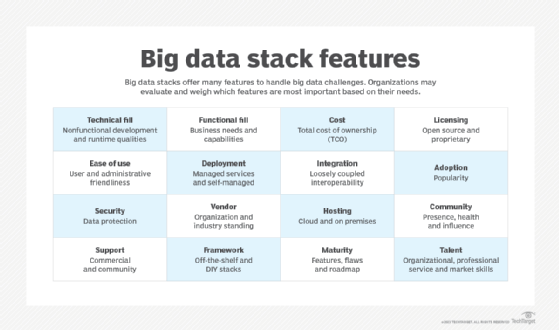
Big data tools analyze, manage and store large volumes of data that are typically too big for traditional databases.
Key big data analytics technologies and toolsThe following tools and technologies are used to support big data analytics processes:
Big data analytics applications often include data from both internal systems and external sources, such as weather data or demographic data on consumers compiled by third-party information service providers. In addition, streaming analytics applications are becoming more common in big data environments as users perform real-time analytics on data fed into Hadoop systems through stream processing engines, such as Spark, Flink and Storm. Early big data systems were mostly deployed on premises, particularly in large organizations that collected, organized and analyzed massive amounts of data. But cloud platform vendors, such as Amazon Web Services (AWS), Google and Microsoft, have made it easier to set up and manage Hadoop clusters in the cloud. The same goes for Hadoop suppliers such as Cloudera, which supports the distribution of the big data framework on AWS, Google and Microsoft Azure clouds. Users can spin up clusters in the cloud, run them for as long as they need and then take them offline with usage-based pricing that doesn't require ongoing software licenses. Big data has become increasingly beneficial in supply chain analytics. Big supply chain analytics uses big data and quantitative methods to enhance decision-making processes across the supply chain. Specifically, big supply chain analytics expands data sets for increased analysis that goes beyond the traditional internal data found on enterprise resource planning and supply chain management systems. Also, big supply chain analytics implements highly effective statistical methods on new and existing data sources. 
Big data can be used for various purposes, depending on an organization's mission and goals.
Big data analytics uses and examplesThe following are some examples of how big data analytics can be used to help organizations:
Big data analytics benefitsThe benefits of using big data analytics include the following:
Big data analytics challengesDespite the wide-reaching benefits that come with using big data analytics, its use also comes with the following challenges:
History and growth of big data analyticsThe term big data was first used to refer to increasing data volumes in the mid-1990s. In 2001, Doug Laney, then an analyst at consultancy Meta Group Inc., expanded the definition of big data. This expansion described the increase of three of the five V's -- volume, velocity and variety. Those three factors became known as the 3V's of big data. Gartner popularized this concept in 2005 after acquiring Meta Group and hiring Laney. Over time, the 3V's became the 5V's. Another significant development in the history of big data was the launch of the Hadoop distributed processing framework. Hadoop was launched in 2006 as an Apache open source project. This planted the seeds for a clustered platform built on top of commodity hardware that could run big data applications. The Hadoop framework of software tools is widely used for managing big data. By 2011, big data analytics began to take a firm hold in organizations and the public eye, along with Hadoop and various related big data technologies. Initially, as the Hadoop ecosystem took shape and started to mature, big data applications were primarily used by large internet and e-commerce companies such as Yahoo, Google and Meta, as well as analytics and marketing services providers. More recently, many users have embraced big data analytics as a key technology driving digital transformation. Users include retailers, financial services firms, insurers, healthcare organizations, manufacturers, energy companies and other enterprises. A number of other trends have also started to appear, such as pairing generative AI with big data analytics. High-quality decision-making using data analysis can help contribute to a high-performance organization. Learn which roles and responsibilities are important to a data management team.
|
| You are visitor 01402503 — GeezerVison does not store the pages you look up. Best viewed with Netscape Navigator 4.7 or Internet Explorer 6 at 800×600. No cookies required. |


