GeezerVisonThe World Wide Web, restored to 800 pixels of glory. | ||||||||||||||||||||||||||||||||||
| Home|About|Gaming cabinet|Archives|How it works|Starter sites | ||||||||||||||||||||||||||||||||||
GeezerVison is showing www.spatialepi.org — MESA: Mapping Epidemiology for Sparse Areas Spatial disease-cluster detection and address geocoding, computed entirely on the local machine.A desktop application for spatial epidemiology. It geocodes case addresses, detects clusters in the resulting point data, and labels how precisely each address was matched, with the geocoder and the statistics running in-process. Windows x64, macOS Apple silicon, Linux x64 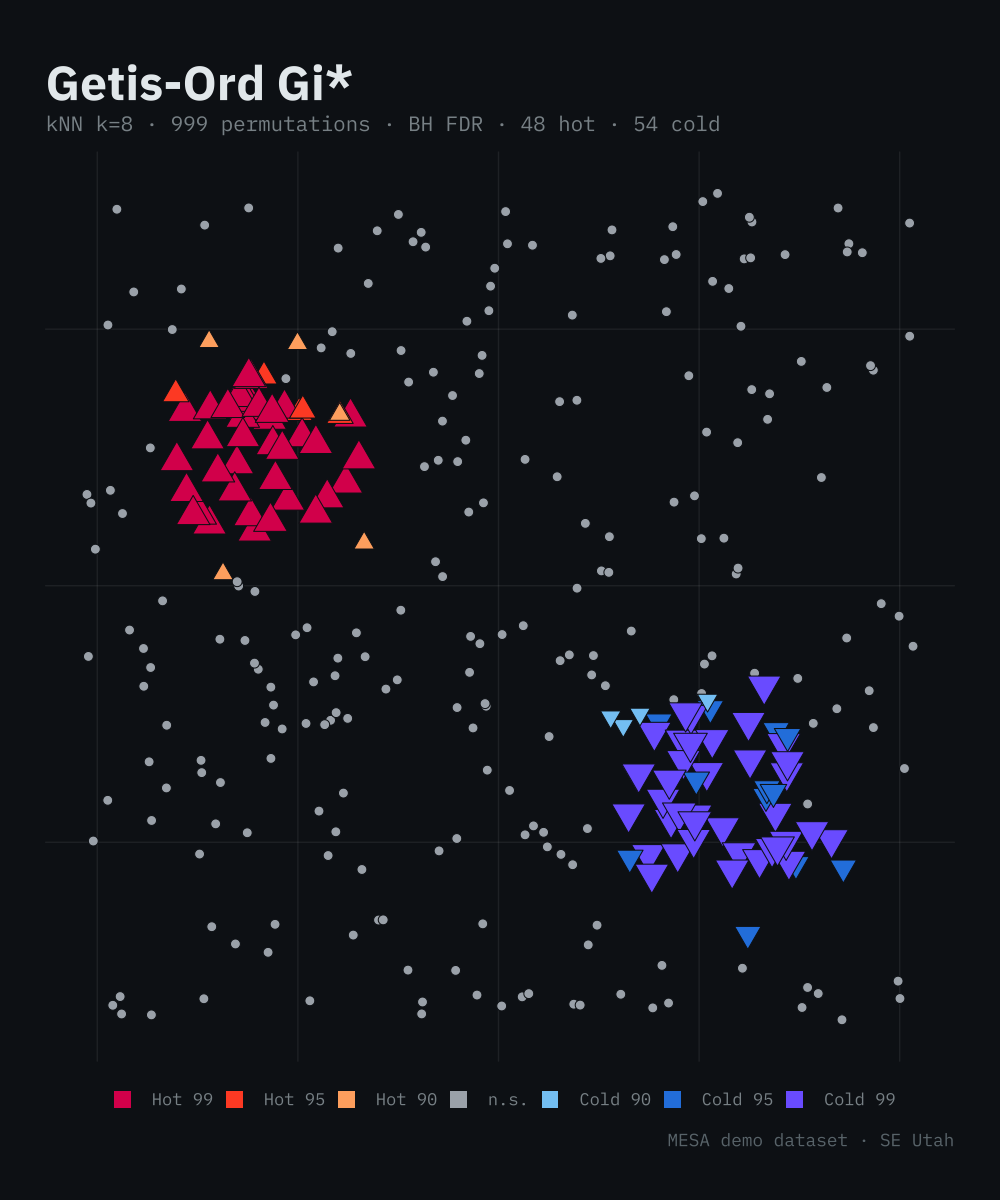
Figure 1. Getis-Ord Gi* on MESA's demo dataset. CapabilitiesCluster detectionLocal hot- and cold-spot detection with Getis-Ord Gi* and a Bernoulli spatial scan, reported alongside a global Moran's I autocorrelation diagnostic. Inference is Monte-Carlo and reproduces bit-for-bit across platforms. Offline address geocodingMESA builds a local SQLite address index that the geocoder matches against, for any US state, from the National Address Database (USDOT, public domain), downloaded directly from the source and never redistributed. Where a state has been prepared in advance, MESA downloads that database instead, which is about a tenth of the bytes and skips the build. You can also load your own locality's authoritative points, and optional supplemental files extend coverage. Small-count suppressionA count small enough to identify someone must not be published, and masking that one cell is not enough: if the row total sits beside it, the hidden number can be subtracted back out. MESA masks a second value as cover and reports how many groups remain recoverable, which should be zero. The threshold is yours to set, because it is local policy rather than a default. Rates, and rates built on almost nobodyCounts become rates per 1,000 or per 100,000. Where a rate cannot honestly be made, the cell is left blank rather than zero, because a zero is a claim about a place. Empirical Bayes smoothing (Marshall, 1991) pulls a rate toward the district mean by an amount set by how little the local population can support, so one case among forty people stops being the loudest number on the map. Protocols you can re-runSteps are wired together on a canvas and saved with the project, so next month's report is a re-run rather than a rebuild. Each run records what it read, what it changed, and which settings produced the result. Table cleaning and joinsReads Cognos MHT, CSV, and Excel exports. Columns can be corrected, tables joined on shared keys, and results exported to CSV, Excel, or spatial formats. No outbound connections during analysisMESA emits no telemetry and opens no outbound connections while analyzing. ArcGIS Pro geocode endpointThe same geocoder can be exposed as a local ArcGIS GeocodeServer endpoint. ArcGIS Pro can batch-geocode tables against it directly, with no ArcGIS Enterprise and no tokens. It binds to localhost by default, so requests do not leave the machine. Workflow
Every coordinate is labeled, because certainty is not accuracy.
pointmatched to the exact authoritative address point
interpolatedestimated along a street, block-level
centroidZIP or city placeholder, locality only
OfflineSpatial epidemiology usually means shipping addresses to a geocoding API. MESA doesn't. The address database lives on your disk and the analysis runs in-process, so you can work on an air-gapped machine and still get reproducible results. Every figure on this page, including the scan below, is real MESA output. 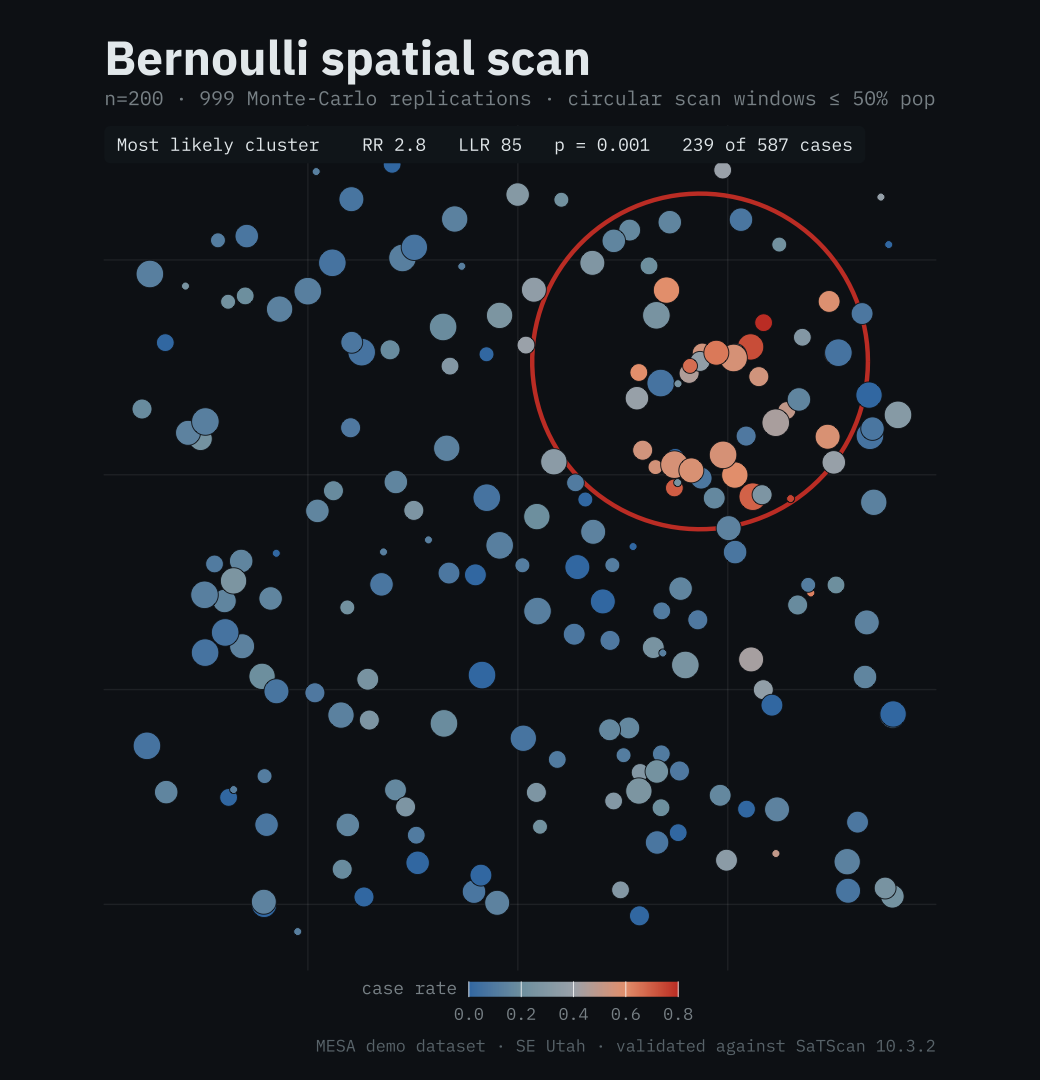
Figure 2. Bernoulli spatial scan on MESA's demo dataset, validated against SaTScan. ValidationThe geocoder matches against authoritative data, the statistics are checked against the standard reference implementations, and every run reproduces byte for byte. reference & reproducibility
spatial statistics
geocoder accuracy (held-out validation)
MESA geocodes anywhere in the US, building a local database for any state from the National Address Database, and is validated nationwide with the adversarial harness below, across eight representative states of differing address styles and data quality.
The adversarial harness scores each match against the record's own authoritative coordinate, with fabricated negative controls and stratified bootstrap intervals; not a synthetic self-benchmark. The figures cover eight states (Alaska, Connecticut, DC, Delaware, Nebraska, Rhode Island, Wisconsin, Wyoming) built from the National Address Database; the scoring was fit on separate development data and applied unchanged, so these are held-out, out-of-distribution results. The specificity shown is the genuine wrong-street rate; the full per-state numbers, both raw and genuine, and the method are in the published validation data, which MESA refreshes as each National Address Database release is validated. Because the geocoder works against whatever authoritative data you load, results depend on that data's coverage and quality, which MESA reports per state before you download. Spatial-statistics cross-validation re-runs in CI against regenerated PySAL, R, and SciPy oracles. Full methodology, parameters, and citations: geocoding, Gi* & Moran's I, Bernoulli scan, or the methods overview. Actively developed: recent work adds k-neighborhood and correction-method sensitivity analysis, so a result can be checked against alternate specifications, plus further cross-platform reproducibility hardening. DownloadNative builds for each platform. Every release is published with a SHA-256 checksum so you can verify it before running.
Per-platform builds are still being set up; this table will show the current version and checksums once they are published. MESA is pre-release. For early access, contact [email protected]. MESA is developed by Ross Wardrup, an MPH Epidemiology candidate at the University of Memphis, with a background in geospatial software and public-health surveillance and an epidemiology practicum at the Southeast Utah Health Department. Publications: ORCID, Google Scholar, GitHub, LinkedIn | ||||||||||||||||||||||||||||||||||
| You are visitor 01402775 — GeezerVison does not store the pages you look up. Best viewed with Netscape Navigator 4.7 or Internet Explorer 6 at 800×600. No cookies required. |