GeezerVison is showing strandgit.com — Strand Git Client — Fast Git GUI for Windows, macOS & Linux
Git client · Windows, macOS & Linuxv1.5.1
Read what your agent wrote. Ship it from the same window.
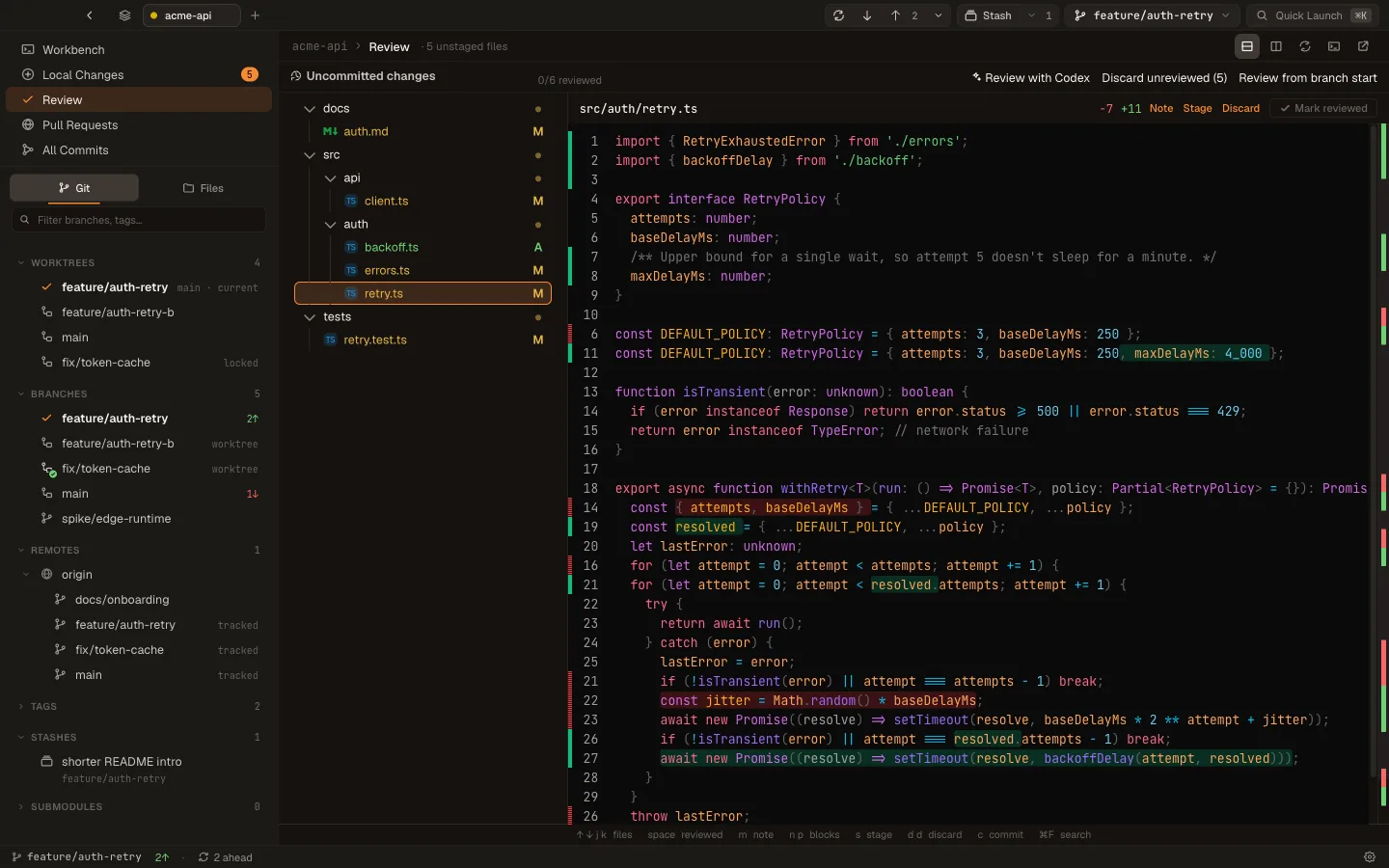
Strand is a fast, keyboard-first Git client with a review surface built for agent diffs:
whole files, a queue, and a baseline that includes what the agent already committed.
Underneath is a complete everyday Git client — staging, graph, rebase, worktrees, pull requests.
Same hue rotation as the app's Appearance settings.
acme-api · feature/auth-retry live demoFull screen ↗
Starting Strand…
It's the real app. Switch surfaces in the sidebar or with ⌘1–⌘6, press ⌘K for the command palette, j / k to step a queue. Restart in the title bar resets the sample repository.
01Try it above. Click Workbench, Review, or a worktree. Nothing you do here touches a real repo.
03Open a repository.⌘O, pick a folder, and Strand works with the Git you already have installed. Getting started →
01 — Review agent changes
The diff is new to you, it's big, and it keeps moving. Review it like that.
Most Git clients show the hunk you already wrote. Strand's Review surface assumes the
opposite: you didn't write it, you need the whole file to judge it, and the agent may
have committed halfway through.
the other pane — your agent
› add retry with backoff to transient auth failures
Every changed file renders in full with the edits inline. A change map beside the
scrollbar shows where every edit sits; click to jump. A file-tree queue tracks what
you've read — j/k to
step, space to mark reviewed.
4/8 reviewed · staged files stay visible
Pin a baseline the agent can't outrun
Review from branch start captures every commit since the detected fork
point — including work the agent already staged or committed — as one diff. Agents
commit as they go; your review shouldn't care.
Session since 9c4e7a1 · committed + staged + unstaged
Notes that travel back to the agent
Leave notes on files as you read. Notes persist with their baseline, so switching
review targets never mixes two agents' feedback. Copy feedback builds one
prompt to paste into the agent, keeping the original code excerpt when later edits
make a note outdated. Stage what you've reviewed.
✎ Copy feedback (3) → paste into your agent
A second reader, on your terms
Your Codex or Claude Code subscription can inspect the exact review set for possible
defects. Findings stay pending until you add them as severity-labelled notes.
AI review never edits repository files.
Review with Claude Code · findings → notes, never edits
02 — Worktrees
One worktree per agent. One dashboard for all of them.
Parallel agents want parallel checkouts. Strand's Worktrees view is the session
dashboard: what each attempt touched, how far it drifted, whether two of them are
about to collide — and one motion to land the winner.
See it in the demo →
Dashboard
Every checkout with branch and session labels, dirty count, ±lines, "touched 3m ago",
disk size, ahead/behind, and one-click Review pinned where the branch diverged from
main. Rows badge merged and unpushed work and warn when parallel
worktrees touch the same files.
Compare
Select two or more attempts and read them side by side — shared files highlighted —
then pick the winner.
Merge & clean up
Land a worktree's branch (squash, merge, or fast-forward, exact commands previewed)
and retire the worktree and branch in one motion. Removal requires a recovery
snapshot with staged and unstaged content preserved separately, including
non-ignored untracked files. An archive failure stops removal.
.worktreeinclude
New worktrees copy the gitignored setup files you list — .env,
local settings — so agents run out of the box. Start from any branch, remote branch,
tag, or commit; remote bases fetch first.
Accepting the agent's work and shipping it never leaves the app: pull requests on
GitHub and Azure DevOps, and every everyday Git operation, with the same keyboard model.
Pull requests GitHub · Azure DevOps
Inbox of the latest 100 PRs — All, Authored, Completed — with the PR for your checked-out branch opened and followed automatically.
Summary, Timeline, and Code tabs: rendered descriptions, newest-first chronology, lazily loaded diffs with viewed/changed progress.
Read review threads beneath their code, reply, resolve, and queue line comments into one draft submitted as Comment, Approve, or Request changes.
A readiness ledger combines review, checks, conflicts, and merge state; merge with merge-commit, squash, or rebase.
Create a PR or draft for the checked-out branch — optionally with a title and description drafted by Codex or Claude Code.
Open any PR's exact head in a new worktree without touching local refs. Auth stays in your signed-in gh / az CLI.
Stage, unstage, or recoverably discard whole change blocks or individually selected lines, inline in the diff.
Commit graph with SVG lanes, branch/tag chips, inline stash nodes, message/author/hash search, and a scrubbable activity timeline.
Interactive rebase entirely from the keyboard — reorder, reword, edit, squash, fixup, drop, and move other local branches in the range — with Continue / Abort on conflicts, and a three-way conflict resolver.
Fetch, pull, and push with streaming progress, explicit pull modes, force-with-lease, and upstream management; branches merged via a completed PR are flagged and bulk-cleanable.
Branches, tags, stashes, remotes, cherry-pick, revert, compare, blame, file history, and a reflog browser for commits a reset orphaned.
Multiple repos as tabs or an icon rail, saveable as workspaces — import a VS Code .code-workspace. Light, dark, and system appearance.
Files, terminals, and your agent in one resizable workspace.
Workbench (⌘1) is where Strand opens. Out of the box
it's one full-size Work surface: editable working-tree files and embedded terminals at
the repository root, as tabs. Claude Code runs there with its complete dashboard.
Drag a tab onto a pane edge for a left/right/top/bottom split. Each pane keeps its own
tabs; dividers keep a wide grab target. ⌘8 enters
layout editing: add Files, Local Changes, Review, history, pull requests, or worktrees
as panes, or start from a template — VS Code workbench, Review station,
Focus, Blank layout. Each workspace auto-saves its layout.
Files that do more
Content, rendered Preview, History, Compare, Blame, image, and directory modes.
Drafts survive navigation and only reach disk through Save. The Files tree lists the
real filesystem with Git-state colors, including muted ignored paths.
Plugins experimental
Settings → Plugins is a bundled marketplace of Workbench surfaces. Heroi is a
repository-scoped chat for background Claude, Codex, and Cursor Agent sessions;
Agent Session Recap lists files, risky paths, and leftover TODOs beside Review;
Quick Notes is a per-repository scratchpad saved in Strand's database.
Plugins render from validated manifests — third-party JavaScript never runs in the
privileged webview.
AI, on your terms
AI drafts. You commit.
Commit messagesSubject and body from staged changes.
PR descriptionsDrafted from the committed branch delta, editable before publishing.
Review findingsStructured, line-validated, and pending until you accept them as notes.
Via the CLIs you already pay forCodex CLI (ChatGPT) or Claude Code — no API key. Generation is cancellable, scans for sensitive files before launch, and never silently edits your repository.
05 — Keyboard
Keyboard-first. Never keyboard-only.
Every surface has a focus model — lists, trees, dialogs, menus — so reviewing an agent
session never makes you reach for the mouse. The mouse stays first-class when you want it.
And when you forget a key, ⌘K finds everything: commands,
branches, tags, files, commits, recent repos.
Every global shortcut is rebindable in Settings → Keyboard. ⌘1…7 jump between surfaces; ⌘ is Ctrl on Windows and Linux. Full list →
jkstep through the review queue
spacemark reviewed — and stay put
npjump between change blocks
sstage the file
dddiscard — recoverably
mleave a note on the file
⌘↵commit
⌘Keverything else, fuzzy
06 — Performance
Fast is the feature.
Strand's prime directive is written into the repo and enforced in review: stable,
fast, performance-first. Reads go through gix, writes through git2 and your system
git, and no change ships if it regresses a hot path.
47ms
to open a 100k-commit repo
discover + first 5,000 commits
42ms
status refresh, 10k-file tree
501 dirty files · the path every agent edit touches
407ms
cold start to shell paint
~568 ms to repo-interactive
0
bytes of Electron
Rust + Tauri 2 + the OS webview
Engine medians on an M1 Pro against synthetic 100k-commit / 10k-file fixtures; cold start measured on Windows 11. Methodology and every number in docs/perf-baseline.md.
git blame says it was you
The commits carry your name.
The agent writes the code, but it ships under your sign-off, in your repo, on your pager
at 2 a.m. A Co-Authored-By trailer won't save you
in the postmortem. Read it before it merges.
You are visitor 01402775 — GeezerVison does not store the pages you look up. Best viewed with Netscape Navigator 4.7 or Internet Explorer 6 at 800×600. No cookies required.