Thinking Forth Project 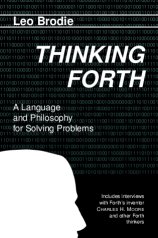
This is the homepage of the
Thinking Forth project.
Thinking Forth captures the philosophy of the language to show users
how to write more readable, better maintainable applications. This
project makes the book available in electronic form (LaTeX and PDF).
The project has two milestones: the reprint and the 21st century
version. The reprint is done, scroll down for the ongoing project.
The Book
Thinking Forth is a book about the philosophy of problem solving and
programming style, applied to the unique programming language
Forth. Published
first in 1984, it could be among the timeless classics of computer
books, such as Fred Brooks' The Mythical Man-Month and Donald
Knuth's The Art of Computer Programming.
Many software engineering principles discussed here have been
rediscovered in eXtreme Programming, including (re)factoring,
modularity, bottom-up and incremental design. Here you'll find all of
those and more - such as the value of analysis and design - described
in Leo Brodie's down-to-earth, humorous style, with
illustrations, code examples, practical real life applications,
illustrative cartoons, and interviews with Forth's inventor,
Charles H. Moore as well as other Forth thinkers.
If you program in Forth, this is a must-read book. If you don't,
the fundamental concepts are universal: Thinking Forth is
meant for anyone interested in writing software to solve problems.
The concepts go beyond Forth, but the simple beauty of
Forth throws those concepts into stark relief.
So flip open the book, and read all about the philosophy of Forth,
analysis, decomposition, problem solving, style and conventions,
factoring, handling data, and minimizing control structures. But be
prepared: you may not be able to put it down.
This book has been scanned, OCR'd, typeset in LaTeX, and brought
back to print (and your monitor) by a collaborative effort under a Creative
Commons license.
Paper version
Release 1.0 also is available as printed book from "Punchy Publising"
(Leo Brodie's single-book publishing company) through
Amazon.
The ISBN number is 0-9764587-0-5.
Adobe Reader tips
If you read the PDF with Adobe Reader, change the following settings in
the Edit -> Preferences -> General... dialog box to improve display
quality:
- Set "Use Greek Text: Below ( xx ) Pixels" off. This just makes some
small print text unreadable for no good reason.
- Set smoothing on for at least Text and Line Art. If you have a TFT
display, use CoolType.
When you cut&paste from Adobe Reader, some special characters (ligatures)
like fi and ff and left/right quotes won't show up as expected. Other
PDF readers like xpdf do a better job here. If you really want to lay
hand on the text, using the sources is probably a much better idea,
anyway.
Things to do: 21st Century
The first step, the reprint, is now done. The open nature of the
license however allows us to update the book to current 21th century
practice, and to add the missing chapters. The plan so far consists of
- Modify the example sources so that they run with ANS Forth systems.
- Update coding style to current practice (lower case and such).
- Add chapters about Forth and OOP, Forth debugging, and maintenance.
- Interview Forth thinkers that didn't have a chance 20 years ago.
- Translate it to other (natural! ;-) languages.
A first  preprint is available.
Resources
Most of the resources available now are for people who participate in
the effort to make the printed Thinking Forth available as LaTeX
sources. Developers need a  Sourceforge Account,
if you have one, send your account name to me
 Bernd Paysan <[email protected]>.
If you want to just read Thinking Forth, you better download the PDF.
export CVS_RSH=ssh

cvs -z3 -d:ext:[email protected]:/cvsroot/thinking-forth co thinking-forth
Once you've checked out that directory, it's sufficient to do
cvs update there to get more recent versions. cvs add filename adds a
new file, and cvs ci checks modified (and added) files into the
repository. More documentation can be found on the
 CVS homepage.
If you like to, you can also use a GUI frontend like
WinCVS on Windows.
Font package: To generate a PDF that is readable with Acroread, we
need the cm-super package. This is necessary, since we use several
fonts that are not part of the usually installed set of Type1 fonts
from Bluesky. You can get it from
ftp://tug.ctan.org/tex-archive/fonts/ps-type1/cm-super.zip
(64MB). You don't need that if you don't want to generate an
Acroread-readable PDF (e.g. just for printing or using alternative
viewers). Since we also use the OT1-encoded cmbtt fonts, I've created
a Type1 fonts for that, too:  cmbtt-type1.tar.gz. I've also created
an OCRB Type1 font for the ISBN number based on the
ocrb9.mf that is part of the EAN package. It's sufficient to have
Ghostscript know about that font in Fontmap.GS, ps2pdf will embed it.
Created 21aug2004. Last modified: 26oct2011 by  Bernd Paysan


 LaTeX Sources
