Method Overview
At a high level, after training the base policy in simulation, we deploy it on the real robot while monitored by
a human
operator. The human interrupts the autonomous execution when necessary and provides online correction through
teleoperation. Such intervention and online correction are collected to train a residual policy, after which
both base and residual policies are deployed to complete contact-rich manipulation tasks.
(a) Base policies are first trained in simulation through action space distillation
with demonstrations generated by RL teacher policies. Base policies take point cloud as input to
reduce perception gap. (b) The acquired base policies are first deployed with a human
operator monitoring the execution. The human intervenes and corrects through teleoperation when
necessary. Such correction data are collected to learn residual policies. Finally, both
residual policies and base policies are integrated during test time to achieve a successful
transfer.
Residual Policy Learning from Human Correction to Bridge Sim-to-Real Gaps
Our key insight is that the human-in-the-loop framework is promising for addressing the sim-to-real gaps as a
whole, in which humans directly assist the physical robots during policy execution by providing online
correction signals. The knowledge required to close sim-to-real gaps can be learned from human signals.
Simulation policies are deployed where a human operator monitors the execution. The human intervenes
and corrects through teleoperation when necessary. Such intervention and correction data are
collected to learn residual policies. Finally, both residual policies and simulation policies
are integrated during test time to achieve successful transfer.
Large-Scale Simulation Training to Acquire Base Policies
Using the state-of-the-art simulation technique, we train base policies in simulation with hundreds of thousands
of frames per second. This greatly alleivates the human burden for data collection. We first train teacher
policies with model-free reinforcement learning (RL) on massively parallelized environments. We then distill RL
teacher policies into student visuomotor policies.
For each manipulation skill, we first train an RL policy and then distill into a visuomotor policy.
We apply domain randomization such that trained simulation policies are robust enough. Several
important design choices are made to facilitate sim-to-real transfer, such as taking point cloud
inputs and adopting joint position actions.
Visuomotor Policies with Point Cloud Observations and Joint Position Actions
We use point cloud as the main visual modality. Typical RGB observation used in visuomotor policy training
suffers from several drawbacks that hinder successful transfer. Well-calibrated point cloud observation can
bypass these issues.
We first train the teacher policy with OSC for the ease of learning and then distill successful
trajectories into the student policy with joint position control. We name this approach as action space
distillation and find it crucial to overcome the sim-to-real controller gap.
We use point cloud as the main visual modality. Simulation polices are trained on downsampled
synthetic point-cloud observations. They are able to transfer to real-world point-cloud observations
captured by standard depth cameras.
Experiments
We seek to answer the following research questions with our experiments:
Research Questions
Q1: Does TRANSIC lead to better transfer
performance while require less real-world data?
Q2: How effective can TRANSIC address
different types of sim-to-real gaps?
Q3: How does TRANSIC scale with human effort?
Q4: Does TRANSIC exhibit intriguing
properties, such as generalization to unseen objects, policy robustness,
ability to solve long-horizon tasks, and other emergent behaviors?
We consider complex contact-rich manipulation tasks in FurnitureBench that require high precision. Specifically,
we divide the assembly of a square table into four independent tasks: Stabilize, Reach and Grasp,
Insert, and Screw.
Average success rates over four benchmarked tasks. TRANSIC significantly outperforms three baseline
groups. They are 1) traditional sim-to-real approaches, such as domain randomization and data
augmentation (“DR. & Data Aug.”) and real-world fine-tuning; 2) interactive imitation learning
methods, such as HG-Dagger and IWR; and 3) approaches that only train on real-robot data, such as
BC, BC-RNN, and IQL. Results are success rates averaged over four tasks. Each evaluation consists of
20 trials with different initial settings. We make our best efforts to ensure the same initial
configuration when evaluating different methods.

Success rates per tasks. TRANSIC
outperforms all baseline methods on all four tasks.
We show that in sim-to-real transfer, a good base policy learned from the simulation can be combined with
limited real-world data to achieve success.
However, effectively utilizing human correction data to address the sim-to-real gap is challenging,
especially when we want to prevent catastrophic forgetting of the base policy (Q1).
Effectiveness in Addressing Different Sim-to-Real Gaps (Q2)
While TRANSIC is a holistic approach to address multiple
sim-to-real gaps simultaneously, we shed light on its ability to close each individual gap. To do so, we create
five different simulation-reality pairs. For each of them, we intentionally create large gaps between the
simulation and the real world. These gaps are applied to the real-world setting and they include perception
error, underactuated controller, embodiment mismatch, dynamics difference, and object
asset mismatch.
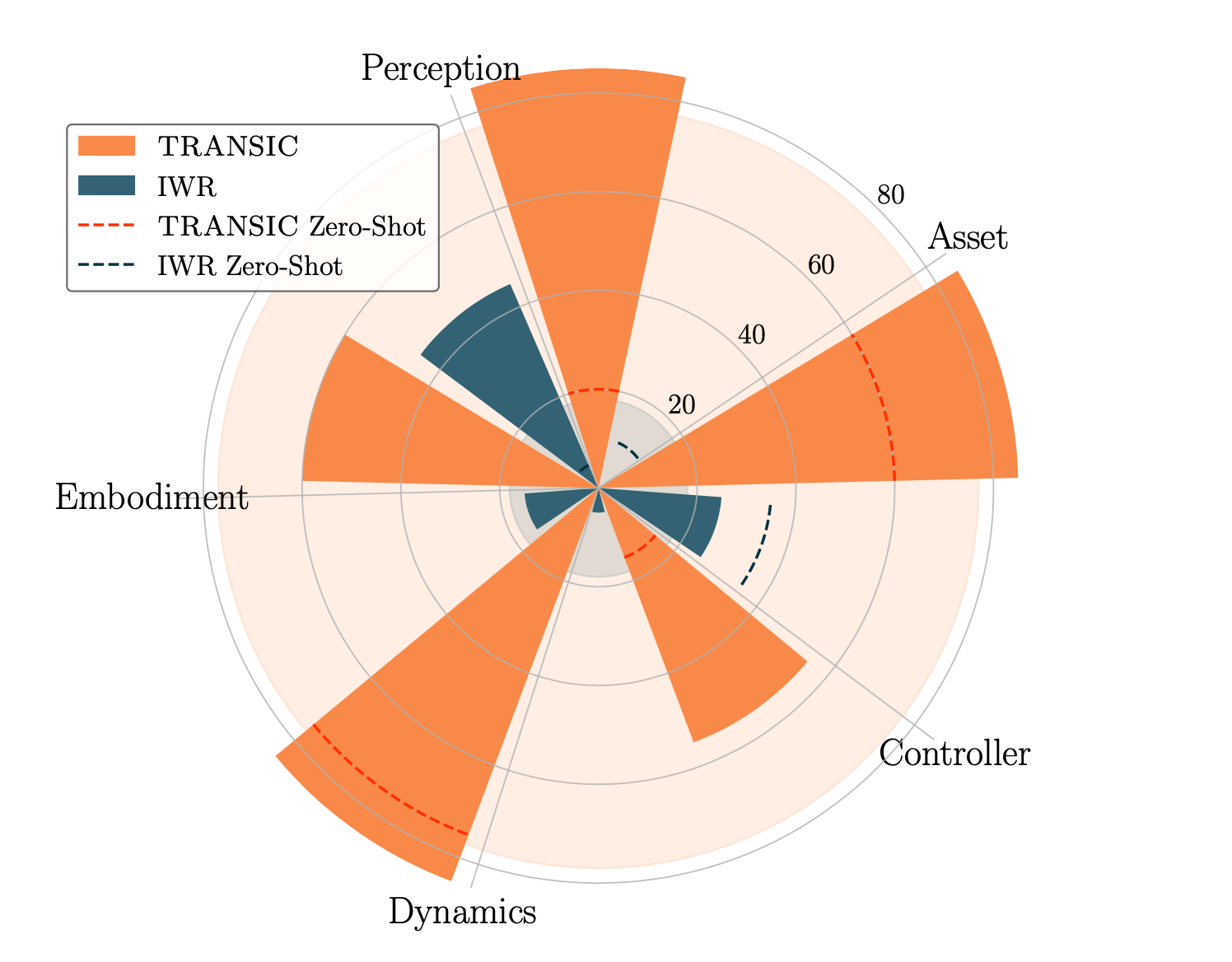
Robustness to different sim-to-real gaps. Numbers are averaged success rates (%). Polar bars
represent performances after training with data collected specifically to address a particular gap.
Dashed lines are zero-shot performances. Shaded circles show average performances across five pairs.
TRANSIC achieves an average success rate of 77% across
five different simulation-reality pairs with deliberately exacerbated sim-to-real gaps. This indicates its
remarkable ability to close these individual gaps. In contrast, the best baseline method, IWR, only achieves an
average success rate of 18%. We attribute this effectiveness in addressing different sim-to-real gaps to the
residual policy design.
Scalability with Human Effort (Q3)
Scaling with human effort is a desired property for human-in-the-loop robot learning methods. We show that
TRANSIC has better human data scalability than the best
baseline IWR. If we increase the size of the correction dataset from 25% to 75% of the full dataset size, TRANSIC achieves a relative improvement of 42% in the
average success rate. In contrast, IWR only achieves 23% relative improvement. Additionally, IWR performance
plateaus at an early stage and even starts to decrease as more human data becomes available. We hypothesize that
IWR suffers from catastrophic forgetting and struggles to properly model the behavioral modes of humans and
trained robots. On the other hand, TRANSIC bypasses these
issues by learning gated residual policies only from human correction.
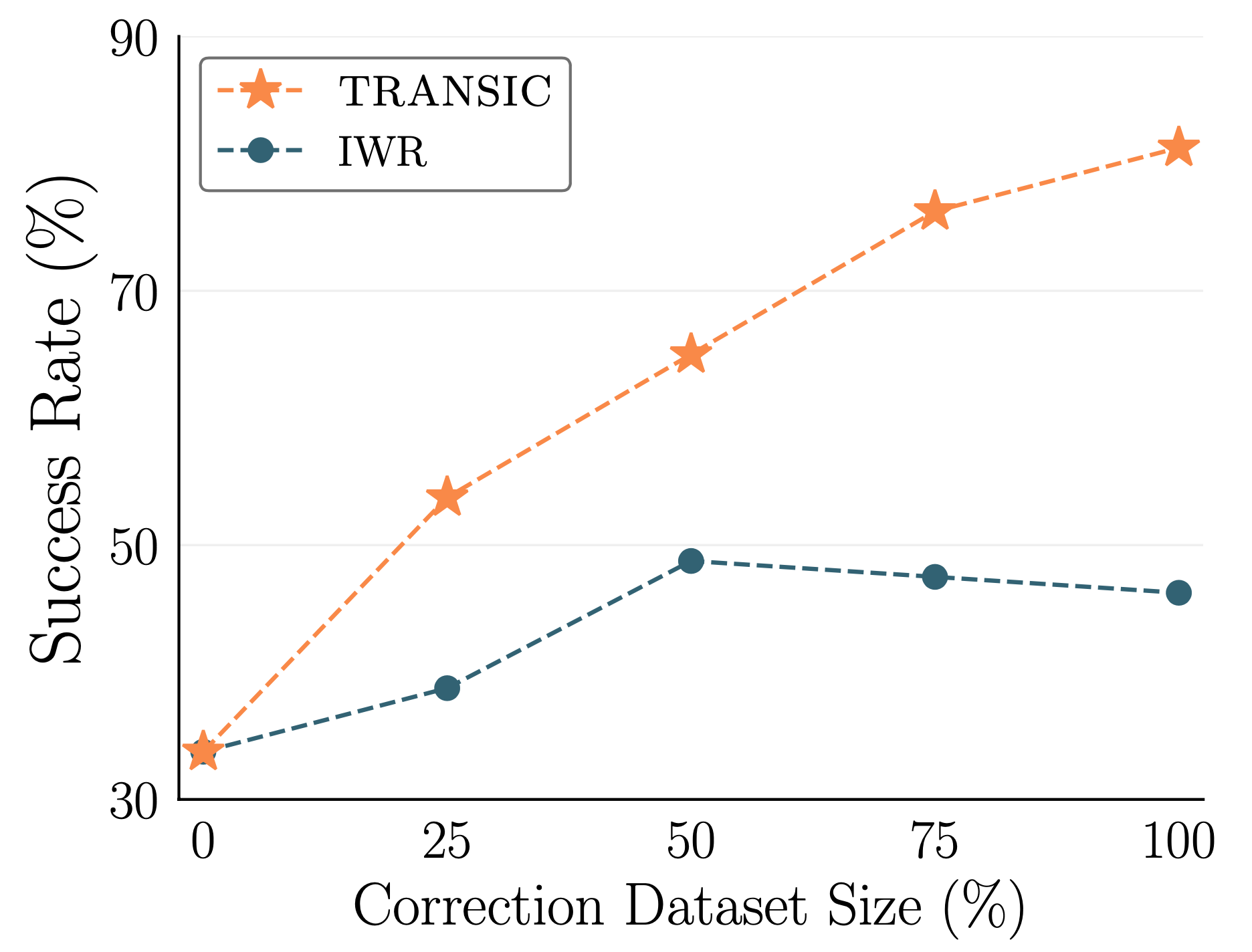
Scalability with human correction data. Numbers are success rates averaged over four tasks
with different amount of human correction data.
Intriguing Properties and Emergent Behaviors (Q4)
We further examine TRANSIC and discuss several emergent
capabilities. We show that 1) TRANSIC has learned
reusable skills for category-level object generalization; 2) TRANSIC
can reliably operate in a fully autonomous setting once the gating mechanism is learned; 3) TRANSIC is robust against partial point cloud observations
and suboptimal correction data; and 4) TRANSIC learns
consistent visual features between the simulation and reality.
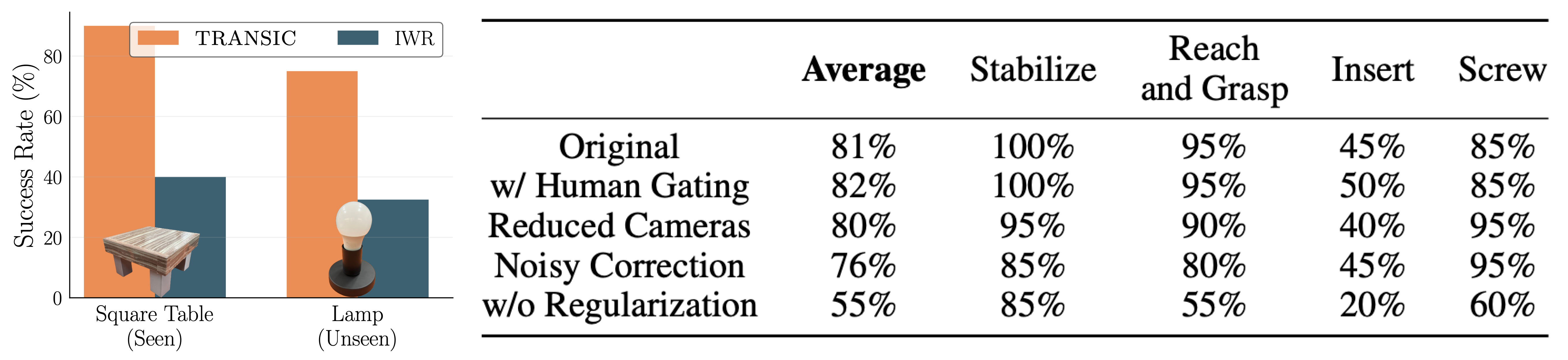
Intriguing properties and emergent behaviors of TRANSIC.
Left: Generalization to unseen objects from a new category. Right: The effects of
different gating mechanisms (learned gating vs human gating), policy robustness against reduced
cameras and suboptimal correction data, and the importance of visual encoder regularization.
Failure Cases
Several failure cases. For instances, they include inaccurate insertion, bended gripper,
unstable grasping pose, and over-screwing.
Conclusion
In this work, we present TRANSIC, a human-in-the-loop
method for sim-to-real transfer in contact-rich
manipulation tasks. We show that combining a strong base policy from simulation with limited real-world data can
be effective. However, utilizing human correction data without causing catastrophic forgetting of the base
policy is challenging. TRANSIC overcomes this by learning
a gated residual policy from a small amount of human
correction data. We show that TRANSIC effectively
addresses various sim-to-real gaps, both collectively and
individually, and scales with human effort.
Acknowledgement
We are grateful to Josiah Wong, Chengshu (Eric) Li, Weiyu Liu, Wenlong Huang, Stephen Tian, Sanjana Srivastava,
and the SVL PAIR group for their helpful feedback and
insightful discussions. This work is in part supported by
the Stanford Institute for Human-Centered AI (HAI), ONR MURI N00014-22-1-2740, ONR MURI N00014-21-1-2801, and
Schmidt Sciences. Ruohan Zhang is supported by Wu Tsai Human Performance Alliance Fellowship.
BibTeX
@inproceedings{jiang2024transic,
title = {TRANSIC: Sim-to-Real Policy Transfer by Learning from Online
Correction},
author = {Yunfan Jiang and Chen Wang and Ruohan Zhang and Jiajun Wu and Li
Fei-Fei},
booktitle = {Conference on Robot Learning},
year = {2024}
}