GV

GeezerVison

The World Wide Web, restored to 800 pixels of glory.

Home|About|Gaming cabinet|Archives|How it works|Starter sites

On this site

  • TZ
  • Uncertainty Quantification
  • Labor Progression

This view

  • Original page
  • New address

GeezerVison is showing tzhoroev.github.io — Discrete Fractional Pharmacokinetics Modeling | Tilekbek Zhoroev

Prominent Nabla Definitions

Backward difference

\[ \nabla x(t) = x(t) - x(t-1) \]

The starting point: a discrete-time analogue of the first derivative. Simple, memoryless, and the building block for everything that follows.

Fractional nabla sum

\[ \nabla_a^{-\alpha} x(t) = \frac{1}{\Gamma(\alpha)} \sum_{s=a+1}^{t} \big(t-\rho(s)\big)^{\overline{\alpha-1}} x(s), \qquad \rho(s)=s-1 \]

This is where memory enters the picture. The fractional sum aggregates all prior states, weighted by a kernel that decays over time. Recent history matters more, but old history is not forgotten.

Fractional nabla difference

\[ \nabla_a^{\alpha} x(t) = \nabla^{n}\,\nabla_a^{-(n-\alpha)}x(t), \qquad n-1 < \alpha < n \]

The key generalization: extending integer-order differencing to non-integer orders \(\alpha\). When \(\alpha = 1\) we recover the standard backward difference; fractional values give tunable control over memory depth.

Modeling setup

To keep the mathematics clean, we work under a few assumptions:

  • Time is sampled on a discrete grid \(t \in \mathbb{N}_a\), natural for dosing schedules and clinical measurements;
  • The fractional order satisfies \(0 < \alpha < 1\), which gives us "partial memory" rather than full or zero memory;
  • State variables represent drug concentrations and tumor volumes whose current values depend on the entire dosing history.
\[ \nabla_a^{\alpha} x(t+1) = A x(t) + B u(t), \qquad y(t) = C x(t) \]

This state-space form is our entry point for studying controllability (can we steer the system to a desired state?) and observability (can we infer hidden states from measurements?) in fractional PK/PD systems.

Real-world application

We applied this framework to discrete and discrete fractional PK/PD models for tumor growth and anti-cancer drug response. The main result is that fractional operators capture the memory effects observed in real pharmacological data without ad hoc assumptions. A patient's response to a drug depends not just on today's dose, but on the cumulative exposure over weeks.

The Kentucky Science and Engineering Foundation supported this work, which led to a published journal paper and my master's thesis at WKU.

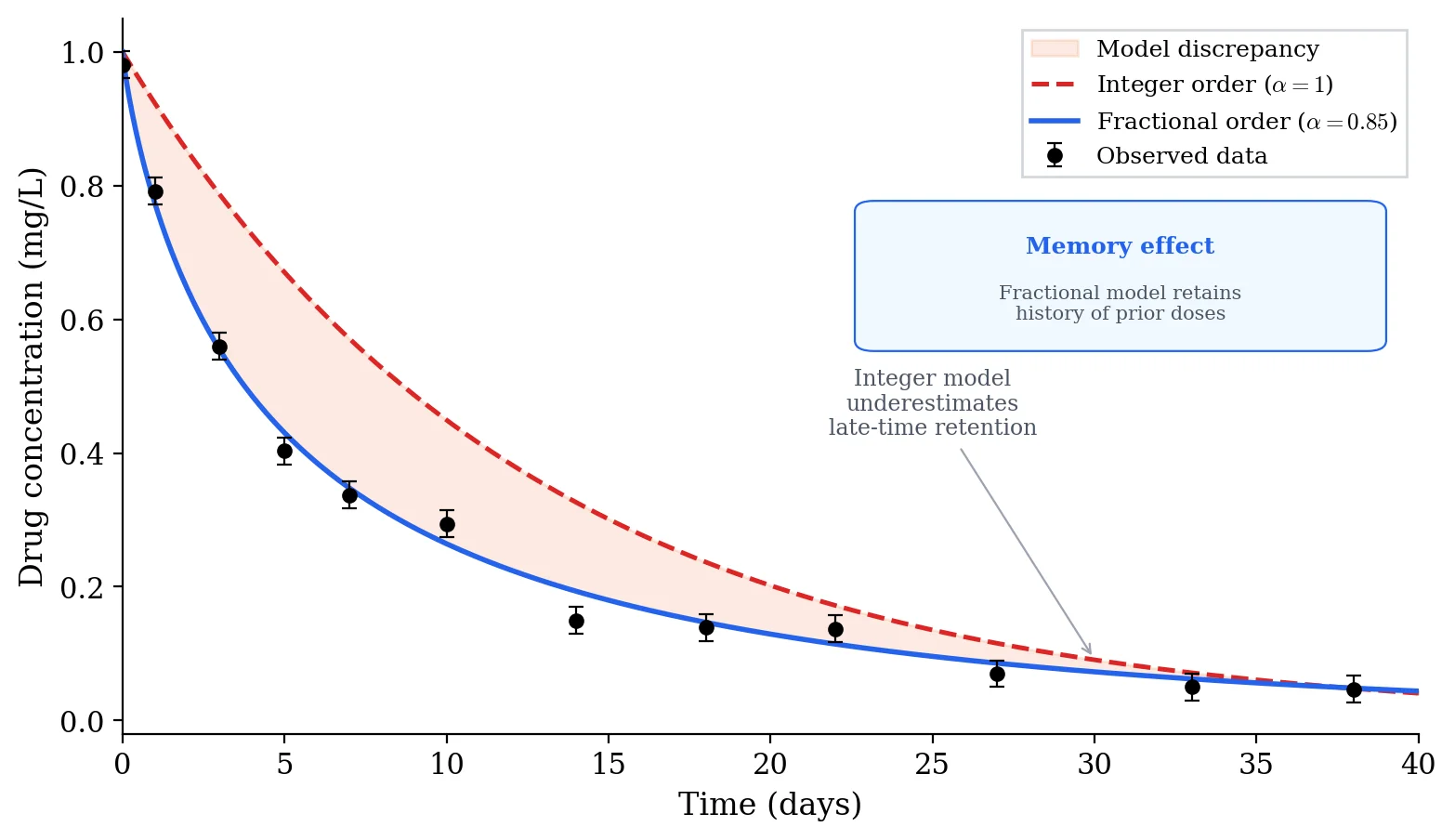
Integer vs. Fractional Order

Comparison of integer-order and fractional-order drug decay models against observed data
Memory effects in drug response. The integer-order model (red dashed, \(\alpha = 1\)) follows standard exponential decay, while the fractional-order model (blue solid, \(\alpha = 0.85\)) retains a heavier tail that better captures the slow elimination observed in clinical data. The fractional model accounts for cumulative drug exposure history.

A study on discrete and discrete fractional pharmacokinetics-pharmacodynamics models for tumor growth and anti-cancer effects

F.M. Atıcı, M. Atıcı, N. Nguyen, T. Zhoroev, G. Koch · Computational and Mathematical Biophysics, 2019 · 61 citations

Read the paper

Controllability and observability of time-invariant linear nabla fractional systems

T. Zhoroev, F.M. Atıcı · Fractional Differential Calculus, 2019 · 4 citations

Read the paper

Controllability and observability of time-varying linear nabla fractional systems

T. Zhoroev, F.M. Atıcı · Fractional Differential Calculus, 2020 · 0 citations

Read the paper

Controllability and Observability of Linear Nabla Discrete Fractional Systems

T. Zhoroev · Master's Thesis, Western Kentucky University, 2019 · 3 citations

Read the thesis
You are visitor 01402792 — GeezerVison does not store the pages you look up.
Best viewed with Netscape Navigator 4.7 or Internet Explorer 6 at 800×600. No cookies required.