BIBLIOGRAPHY OF EARLY OPTICAL
(AUDIO) COMMUNICATIONS
A
work-in-progress by Chris Long and Mike Groth VK7MJ, June 2005.
The
very first form of 'wireless' speech communication was achieved at
optical
wavelengths in 1878, more than 25 years before Reginald Fessenden did
the same
thing with radio. This incomplete bibliography lists all of the
pre-1940
literature on modulated optical communications currently known to the
authors of the 'bluehaze'
web pages.
C.R.
= Comptes Rendu Hebdomadaires des Seances de l'Academie des Sciences
(Paris).
Ann.
Chim. = Annales de Chimie et de Physiques (Paris).
E.T.Z. =
Elektrotechnische Zeitschrift (Berlin).
1. "J.F.W.". "Letter re: usage of selenium
for telephonic purposes written at Kew (London) 3 June 1878" in
Nature, London, 13 June 1878. This appears to be the first
published suggestion of the usage of modulated light for the conveyance
of audio.
2.
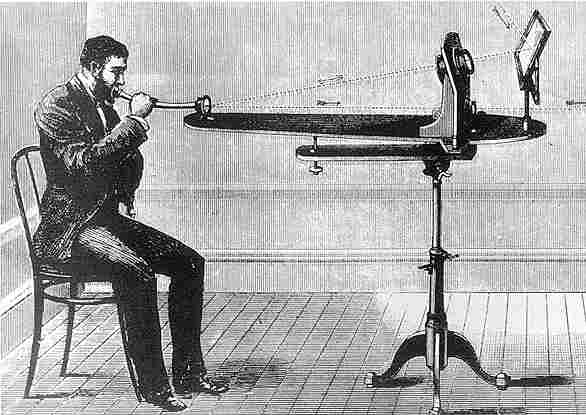
ALEXANDER GRAHAM BELL. "On the Production and Reproduction of Sound
by Light: the Photophone." Am.
Ass. for the Advancement of Sci., Proc., Vol 29., October
1880, pp. 115-136. Also in American Journal of Science, Series
3. No. 20, 1880, pp. 305-324; Eng. L., 30. 1880, pp. 240-242; Electrician,
Vol 5. 1880, pp. 214-215, 220-221, 237 ; Journal of the
Society
of Telegraph Engineers, No. 9, 1880, pps. 404 - 426; Nat. L., Vol
22. 1880, pp. 500-503; Ann.
Chim. Phys., Serie 5. Vol 21. 1880, pp. 399-430; E.T.Z.,
Vol. 1. 1880, pp. 391-396. Discussed at length in Eng. L., Vol
30. 1880, pp. 253-254, 407-409. In these papers, Bell accords
the credit
for the first demonstrations of the transmission of speech by light to
a Mr A C
Brown of London "in September or October 1878".
3.
J. ARMENGAUD. " Le photophone de M.Graham Bell." Soc. Ing. civ.
Mem., year 1880, Vol 2. pp. 513-522.
4.
ALEXANDER GRAHAM BELL. "Sur l'application du photophone a l'etude
des bruits qui ont lieu a la surface solaire." C. R., Vol. 91.
1880, pp. 726-727.
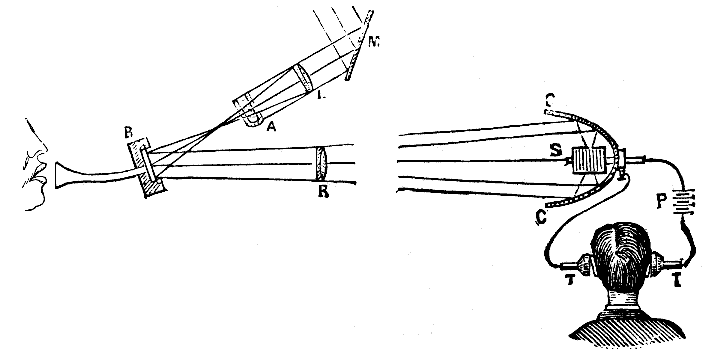
5. A. BREGUET. "Les
recepteurs photophoniques de selenium." Ann. Chim.
Phys., Series 5. Vol 21. 1880, pp..560-563.
6.
A. BREGUET. "Sur les experiences photophonique du Professeur
Alexander
Graham Bell et de M. Sumner Tainter": C.R.; Vol 91., 1880, pp
595-598.
7. A WEINHOLD. "Herstellung
von Selenwiderstanden fur Photophonzwecke." E.T.Z., Vol 1,
1880,
p.423.
8. ALEXANDER GRAHAM BELL. "Professor
A G Bell on Selenium and the Photophone." Pharm. J. and Trans., Series
3. Vol. 11., 1880-1881, pp.
272-276; The Electrician No 5, 18 September 1880, pps 220-221
and 2
October 1880 pps 237; Nature (London) Vol 22, 23 September
1880, pps. 500 -
503; Engineering Vol 30, pps 240-242, 253, 254, 407-409; and Journal
of the Society of Telegraph Engineers Vol 9, pps 375-387.
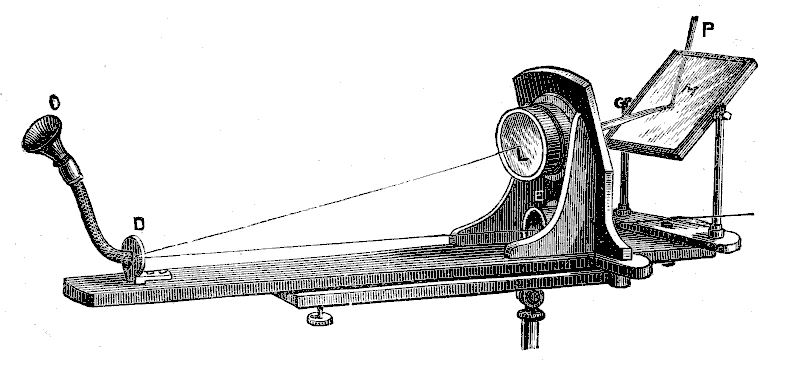
9. SIR WILLIAM H PREECE. "The Photophone
and the conversion of radiant energy into sound." Journal of the
Society of Telegraph Engineers, volume 9, 1880, pps 363 - 375.
10.
ALEXANDER GRAHAM BELL & CHARLES SUMNER-TAINTER - PATENTS (U.S.) Nos.
235199; 235496; 235497; 235590 and 235616, December 1880.
11.
ALEXANDER GRAHAM BELL. "Other papers on the photophone" E.T.Z.
No. 1, 1880, pps 391-396; Journal of the Society for the Arts 1880,
No.
28, pps 847-848 & No. 29 pps 60-62; C.R. No. 91,
1880 - 1881,
pps 595-598, 726, 727, 929-931, 982, 1882 pps 409-412, 450, 451,
1224-1227.
12. "Bell's Photophone." Nature
Vol 24, 4 November 1880; The Electrician, Vol. 6, 1881, pps.
136-138.
13. "The Photophone." Appleton's
Journal, Vol. 10 No. 56, New York, February 1881,
pps.181-182.
14.
SHELFORD BIDWELL: "The Photophone." Nature., 23. 1881,
pp. 58-59.
15. SHELFORD BIDWELL. "Selenium
and Its Applications to the Photophone and Telephotography." Proceedings
of the Royal Institution (G.B.), Vol 9. 1881, pp. 524-535; The
English Mechanic and World Of
Science, Vol.
33, 22 April 1881, pps 158-159 and 29 April 1881 pps. 180-181. Also in Chem.
News, Vol. 44, 1881, pp. 1-3, 18-21. (From a lecture at the Royal
Institution on 11 March 1881).
16.
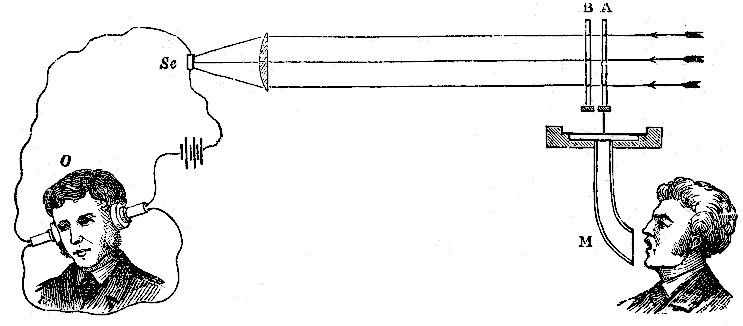
SIR WILLIAM H PREECE, "Radiophony", Engineering Vol. 32,
8 July
1881, pps. 29-33; Journal of the Society of Telegraph Engineers, Vol
10,
1881, pps. 212-228. On the photophone.
17.
S. KALISCHER. "Photophon ohne Batterie." Rep. f. Phys.,
Vol. 17.,
1881, pp.563-570.
18.
E. MERCADIER. "La radiophonie indirecte." Lumiere Electrique,
Vol. 4,
1881,
pps 295-299.
19. E. MERCADIER. "Sur
la radiophonie produite a l'aide du
selenium." C. R., Vol 92,1881, pp.705-707.
20. E. MERCADIER. "Sur la
construction de recepteurs photophoniques a selenium." C. R., Vol
92, 1881, pp.
789-790.
21.
E. MERCADIER. "Sur l'influence de la
temperature
sur les recepteurs radiophoniques a selenium." C. R., Vol. 92,
1881, pp.
1407-1408.
22. MOLERA and CEBRIAN. "The Photophone." Eng. L., Vol. 31, 1881, p. 358.
23. ANDREW JAMIESON: Nat.
L., Vol. 10, 1881, p. 11. This Glasgow scientist seems to
have been the first to suggest the usage of a manometric gas flame for
optical
transmission, demonstrated at a meeting of the Glasgow Philosophical
Society;
"The History of selenium and its action in the Bell Photophone, with
description of recently designed form", Proceedings of the
Philosophical
Society of Glasgow No. 13, 1881, pps 109-121; "Photophone
Experiments", Nature Vol. 23, 10 February 1881 p.354.
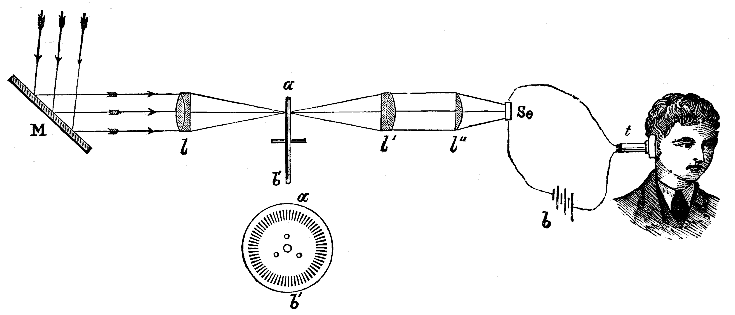
24. J. MOSER. "The
Microphonic Action of Selenium
Cells." Phys. Soc., Proc., Vol. 4, 1881, pp. 348-360.
Also in Phil.
Mag., Series 5, Vol.12, 1881, pps. 212-223.
25.
"Bell's Photophone", Electrician, Vol. 6, 5 February
1881, pps.
136-138,183.
26. SILVANUS P. THOMPSON. "Notes
on the Construction of the Photophone." Phys. Soc.Proc., Vol.
4, 1881, pps.184-190. Also in Phil.
Mag., Vol. 11, 1881, pp. 286-291. Abstracted in Chem. News, Vol.
43, 1881, p.
43; Eng. L., Vol. 31, 1881, p. 96.
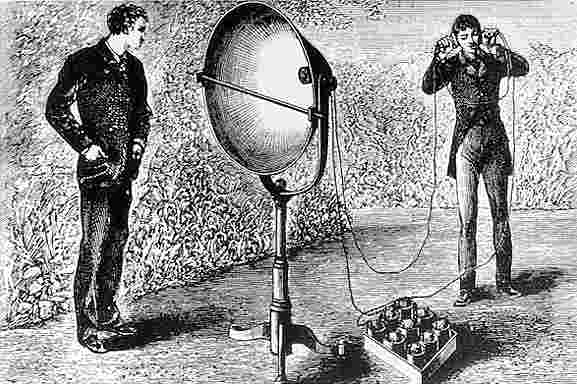
27. H. TOMLINSON. "The
Photophone." Nat. L., Vol. 23, 1881, pps. 457-458.
28. ALEXANDER GRAHAM BELL: "The
Spectrophone", Bull. Phil. Soc. Vol. 4 p 142, 1881.
29.
CHARLES E. FRITTS. "On a New Form of Selenium Cell, and Some
Electrical Discoveries Made by Its Use." Am. Ass. for the
Advancement of Sci., Proc., Vol. 33, 1883, pps. 97-108. Also
in Lumiere
Electrique, Vol. 15,
1885, pps. 226-231. On 22 October 1880 Fritts patented a system (US
Patent
1,203,190) for recording modulated light on moving photographic film.
The patent
was finally granted some years after Fritts' death, in 1916.
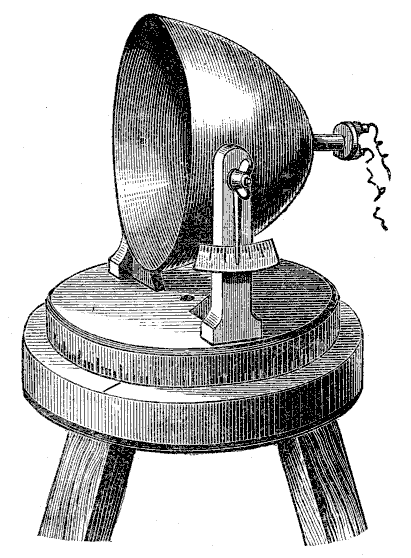
30.
WILLIAM ACKROYD. "The Photophone" in "Science for All",
Vol. 2 (R. Brown, ed.), Cassell & Co., London, circa 1884, pps. 307
- 312. A
popular account, profusely illustrated with steel engravings.
31. HENRY
SUTTON and 'E.R.': "Les problemes de la telephonie." Reviewed
in La Lumiere Electrique, Vol. 38, 1890, pp. 538-541. Sutton
was an
Australian, originally based at the Ballarat School of Mines in the
1880s. He
proposed, but did not construct, an early plan for a television system
in 1890.
32. GEORGE B PRESCOTT: "The Electric
Telephone", D. Appleton-Century Company Inc., New York, pps 320 ff,
second edition, 1890. The first edition of this book, in 1879,
contained no references to the photophone.
33.
FRANTZ DUSSAUD. "Sur la transmission des
sons par les rayons
ultra-violets." C. R., Vol. 128, 1899, p. 171.
34. WILLIAM DU BOIS DUDDELL.
Electrician, Vol. 46, 1900, Nos. 8 and 9.
Control of a modulated DC arc for transmission by placing a carbon
microphone in
the field circuit of the dynamo producing the DC.
35.
WILLIAM DU BOIS DUDDELL. J. Instn. Elect. Engrs., Vol.
30, 1900, p.232
ff. On 'the speaking arc' - DC carbon arc modulated by a
transformer-coupled
carbon microphone.
36. ERNST WALTER RUHMER.
"Der sprechende elektrische Flammenbogen und
seine. Verwendung zur 'drahtlosen Telephonie'." E. T. Z., Vol.
22,
1901, pps.196-198.
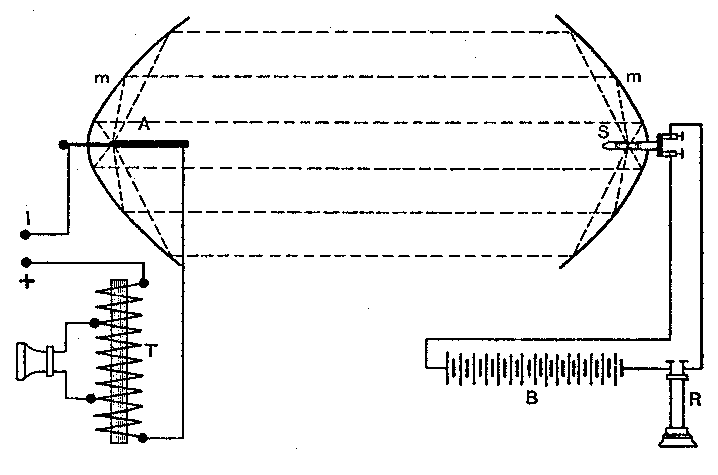
37. ERNST WALTER RUHMER. "Ueber
das sprechende Licht." Phys.
Z., Vol. 2, 1901, pps. 325-328.
38.
ERNST WALTER RUHMER. "Neue Sende-und Empfangsanordnung fur
drahtlose Telephonie." Phys. Z., Vol. 2, 1901, pp. 339-340.
39.
H. T. SIMON. "Tonende Flammen and Flammentelephonie." E. T.
Z., Vol. 22, 1901, pps. 510-514.
40. H. T. SIMON. "Ueber
den sprechenden Flammenbogen und
seine Verwendung zu einer Telephonie ohne Draht". Phys. Z., Vol.
2, 1901,
pps.
253-258.
41. ERNST WALTER RUHMER. "Neuere Versuche mit Lichttelephonie." E.
T. Z., Vol. 23, 1902, pps. 859-862.
42. H. T. SIMON and M. REICH. "Tonende Flammen and Flammen-Telephonie." Phys. Z., Vol.
3, 1902, pps. 278-286.
43. AMERICAN
TELEPHONE AND TELEGRAPH COMPANY:
"The Radiophone", pamphlet
distributed at Louisiana Purchase Exhibition, St Louis, Missouri, 1904.
Describes the photophone work of Hammond V Hayes at the Bell Labs
(patented 1897) and the German
engineer H T Simon in the same year.
44. J. W. GILTAY. "Experimental-Untersuching
uber die
Moglichkeit einer Doppeltelephonie mittels unterbrochener Klange." Amsterdam
Akad., Ver., Sec.1, Deel 9, No.3, 1906. See also English
translation. Giltay
apparently used the pressure-modulated ('manometric') gas flame for
transmission.
45.
G. WEIDHAAS. "Einfache Versuche zur Demonstration der
Licht-telephonie." Z.
phys. u. chem. Unterricht, Vol. 20, 1907, pps.
93-96.
46. ERNST WALTER RUHMER, "Wireless
Telephony in Theory and Practice", Crosby Lockwood and Son,
London,1908. The first major book on the subject of modulated optical
communication in English, with an exhaustive bibliography.
47. B. THIEME. "Flammen
als physikalische Apparate." Phys.
Z., Vol. 17, 1916, pps. 259-260. "Light Wave Telephony." Sci.
Am. Mont., Vol. 1, 1920, pps. 83-84.
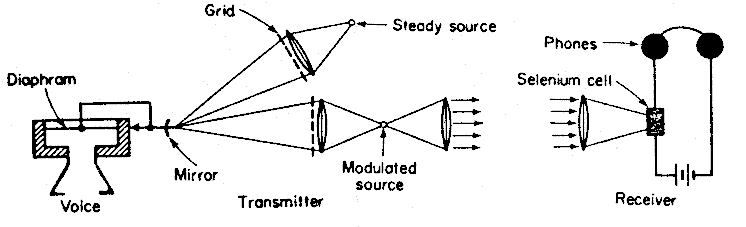
48. A. O. RANKINE. "On
The Transmission of Speech by Light." Physical Society of London,
Proceedings, Vol. 31, 1919, p. 242 - 268.
49.
A. O. RANKINE. "Talking over a Sunbeam." El. Exp. (N. Y.), Vol.
7, 1920, pps. 1265-1316.
50. W. W. COBLENTZ. "Infra-red
signalling." Phys. Rev. Vol. 15, p.340 (1920); S.P.No.398,
Bureau of Standards, p.636, 1920. U.S. Patent 1,345,586. Coblentz
worked at the United States Bureau of Standards during the First World
War, developing methods for covert signal transmission and detection.
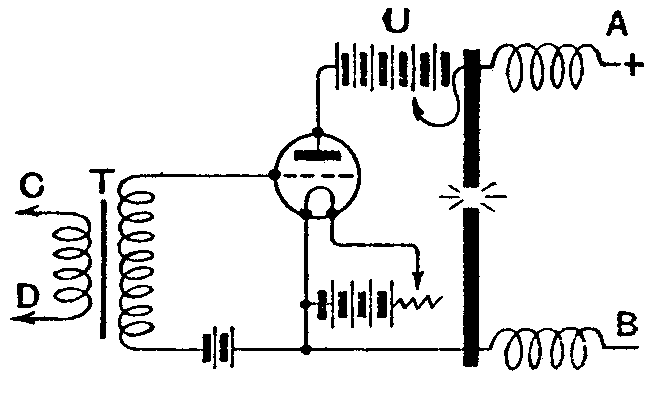
51. H. VON THIRRING. "Neue Apparate fur
Lichttelephonie". Physik. Zeits. Vol. 21, p 67, 1920. Includes
an extensive German bibliography of the subject.
52. E BECKMANN & P KNIPPING. "Suggested
methods of secret signalling". Sitz. Pruess. Akad. Wiss. Vol.
25 p. 443 ff. (1920); Sci. Abs. Vol. 24A, No 858, 1921.
53. THEODORE WILLARD CASE. "Infra-red
Telegraphy and Telephony", J. Opt. Soc. Am., Vol. 6, p 398 ff.
1922. Case had been working on infra-red covert signalling devices
using his 'Thalofide' photo-conductive cell since 1917.
54. H. VON THIRRING. "Selenzellen
und Lichttelephonie." Z. f. technische Phys., Vol. 3, 1922,
pps. 118-120.
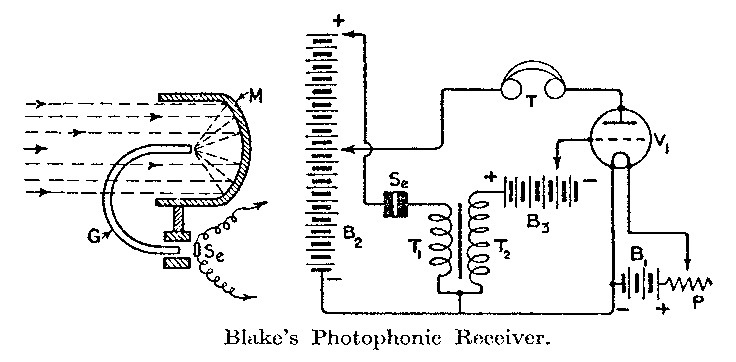
55. G. G. BLAKE.
"Communication on Wave-Lengths Other than Those in
General Use." Exp.
Wireless, Vol. 2, 1925, pps. 561-572. Blake seems to have been the
first to
apply thermionic valve amplification to the output of the receiver's
photocell.
56.
G. G. BLAKE. "Rods of Silica, Glass, CS2, in Tubes,
etc., for the Transmission of Light round Bends for
Photophony." British Patents applied for Nos.
6691 (year 1925), and 5801 (year 1925). These would appear to be
the master
patents anticipating the advent of optical fibre transmission. However,
in an essay published in 1967, Professor A E Karbowiak of the
University of New South Wales refers to two pioneering papers on the
propagation of electromagnetic waves along dielectric cylinders -
neither, unfortunately, so far sighted by the authors of this web
bibliography. These consisted of a theoretical treatment by P Debye and
D Hondres in Ann. Physik, Vol. 32, p.465 (1910); and an
experimental treatment by O Schriever in Ann. Physik, Vol.63,
p.645 (1920). The suggested usage of a glass rod 'light pipe' for
conveying modulated light in television scanning systems dates back at
least to H C Saint-René's
suggestion in Comptes Rendu Vol. 150, pps 446-467, year 1910.
It is also mentioned in one of John Logie Baird's earliest patents, 'Apparatus
for transmitting scenes or representations to a distance' - British
Patent 253,957: 1 January 1925 and 1 July 1926.
57.
R. H. WHITE. "Photophone." Harmsworth's Wireless
Encyclopaedia, Vol.
3, pps. 1541-1544.
58. CATHERINE C MACKENZIE. "Alexander
Graham Bell", Houghton Mifflin Company, Boston, p.226, 1928.
59. UNITED STATES RADIO AND TELEVISION
CORPORATION. "Ultra-violet rays used in Television", New York
Times, 29 May 1929, p.5: Demonstration of transmission of a low
definition (mechanically scanned) video signal over a modulated light
beam. Terminal stations 50 feet apart. Public demonstration at
Bamberger and Company's Store, Newark, New Jersey. Earliest known
usage of modulated light comms for conveying video signals. See
also report "Invisible Ray Transmits Pictures" in Science and
Invention, November 1929, Vol 17, p.629.
60. GEORGE P.
BARNARD. "The Optophone: Photophony, or Light-Telephony", Chapter
8 of "The Selenium Cell: Its Properties and Applications", Constable
& Co. Ltd, London, 1930, pps 240-259.
61. DR E F W ALEXANDERSON. PATENTS:
"Signalling by Light" - unknown American patent dated 19 December 1931
to General Electric Company; British Patent 395,242 dated 29 November
1932 assigned to British Thomson-Houston Company. Light beam
transmission of TV video signals. Camera video modulates an RF
oscillator, which then modulates an arc lamp. Light from the arc
actuates a distant photocell receiver. See also "Light Beam Casts
Television Images" in New York Times 23 December 1931 p.1 -
demonstration of Alexanderson's video/light beam transmitter at
Schenectady, New York. Another report in Citizens Radio Call Book
Magazine, "Television on a Beam of Light", March 1932, p.40.
62. MARCONI COMPANY (UK). "Television
transmission over a light beam at British Association meeting
[Leicester]" in The Electrician, volume 111, 8 September 1933,
p. 299. 50-line TV pics shown on four foot screen after transmission by
modulated light beam by the Marconi Company. See also Television,
London, 6 October 1933, pps 341-343 "Demonstrations at the 'B.A.'".
------------------------------------------------------
If you are
aware of other references on modulated light communication from this
period, please contact Chris Long at the following e-mail address:
[email protected]
Your
addition/s will be acknowledged on this page as it (hopefully) grows!
------------------------------------
 Back to Modulated
Light DX
Last update to this page: Monday 20 June, 2005.
Page count as of 201005: