GeezerVisonThe World Wide Web, restored to 800 pixels of glory. | ||||||||||||||||||||||||||||||||||||||||||||||||||||||||||||||||||||||||||||||||||||||||||||||||||||||||||||||||||||||||||||||||||||||||||||||||||||||||||||||||||||||||||||||||||||||||||||||||||||||||||||||||||||||||||||||||||||||||||||||||||||||||||||||||||||||||||||||||||||||||||||||||||||||||||||||||||||||||||||||||||||||||||||||||||||||||||||||||||||||||||||||||||||||||||||||||||||||||||||||||||||||||||||||||||||||||||||||||||||||||||||||||||||||||||||||||||||||||||||||||||||||||||||||||||||||||||||||||||||||||||||||||||||||||||||||||||||||||||||||||||||||||||||||||||||||||||||||||||||||||||||||||||||||||||||||||||||||||||||||||||||||||||||||||||||||||||||||||||||||||||||||||||||||||||||||||||||||||||||||||||||||||||||||||||||||||||||||||||||||||||||||||||||
| Home|About|Gaming cabinet|Archives|How it works|Starter sites | ||||||||||||||||||||||||||||||||||||||||||||||||||||||||||||||||||||||||||||||||||||||||||||||||||||||||||||||||||||||||||||||||||||||||||||||||||||||||||||||||||||||||||||||||||||||||||||||||||||||||||||||||||||||||||||||||||||||||||||||||||||||||||||||||||||||||||||||||||||||||||||||||||||||||||||||||||||||||||||||||||||||||||||||||||||||||||||||||||||||||||||||||||||||||||||||||||||||||||||||||||||||||||||||||||||||||||||||||||||||||||||||||||||||||||||||||||||||||||||||||||||||||||||||||||||||||||||||||||||||||||||||||||||||||||||||||||||||||||||||||||||||||||||||||||||||||||||||||||||||||||||||||||||||||||||||||||||||||||||||||||||||||||||||||||||||||||||||||||||||||||||||||||||||||||||||||||||||||||||||||||||||||||||||||||||||||||||||||||||||||||||||||||||
GeezerVison is showing www.wise-uranium.org — Uranium Radiation Properties
Uranium Radiation Properties(last updated 11 Jan 2026) Introduction · Uranium Compounds · References
> see also:
IntroductionUranium
Uranium
> see also: Nuclide Mix Calculator
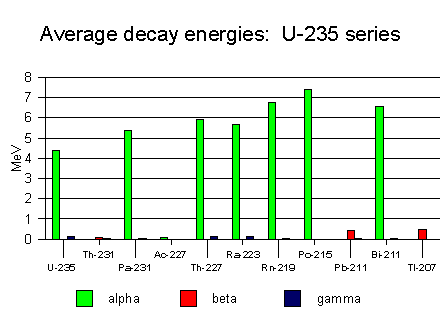
Uranium Decay Series
> See also: Uranium Decay Calculator In natural uranium contained in an undisturbed uranium ore deposit, these decay chains generally are in secular equilibrium. This means that in 1 g of natural uranium (almost) each nuclide of the U-238 series has an activity of 12,356 Bq and each nuclide of the U-235 series an activity of 568 Bq. In the various processing steps of nuclear fuel production, the equilibrium is destroyed:
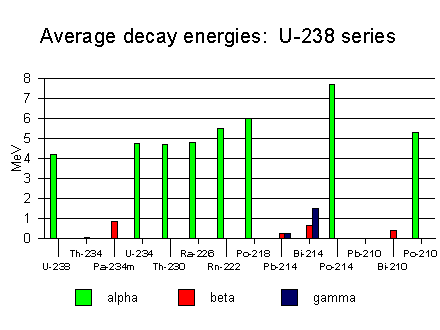
The uranium isotopes (U-238, U-235, and U-234) and many of the decay products mainly emit alpha radiation and only little gamma radiation, while several decay products mainly emit beta radiation. Two of the beta emitters (Pb-214 and Bi-214) moreover are the main source of gamma radiation.
Alpha radiation
Beta radiation
Gamma radiation
The alpha radiation emitted from the decay of uranium can initiate an alpha-neutron reaction in some of the lighter elements contained in a uranium compound (in particular fluorine in UF6, or, to a lesser degree, oxygen in UO2 or U3O8), transforming certain nuclides to others, while emitting a neutron. Such uranium compounds thus produce some neutron radiation, even if not irradiated.
In addition, the isotope U-238 undergoes spontaneous fission at a rather low frequency. Each fission produces approx. 2 neutrons, contributing some neutron radiation independent of the type of uranium compound. Neutron Radiation
In addition to the radiation hazard, the heavy metal uranium also presents a chemical toxicity hazard.
Uranium Compounds(select from process schematic)
Uranium OreUranium ore contains uranium of natural isotopic composition in concentrations ranging from less than 0.03% to over 20%.An ore grade of 1% U3O8 is equivalent to 0.848% U, and 1 million lbs U3O8 are equivalent to 385 metric tonnes of U. (see also Unit Converter: Uranium concentration (wt.) · Uranium weight) In an uranium ore deposit, secular equilibrium obtains between U-238 and its decay products, and between U-235 and its decay products, respectively. The equilibrium may be somewhat disturbed by geochemical migration processes in the ore deposit.
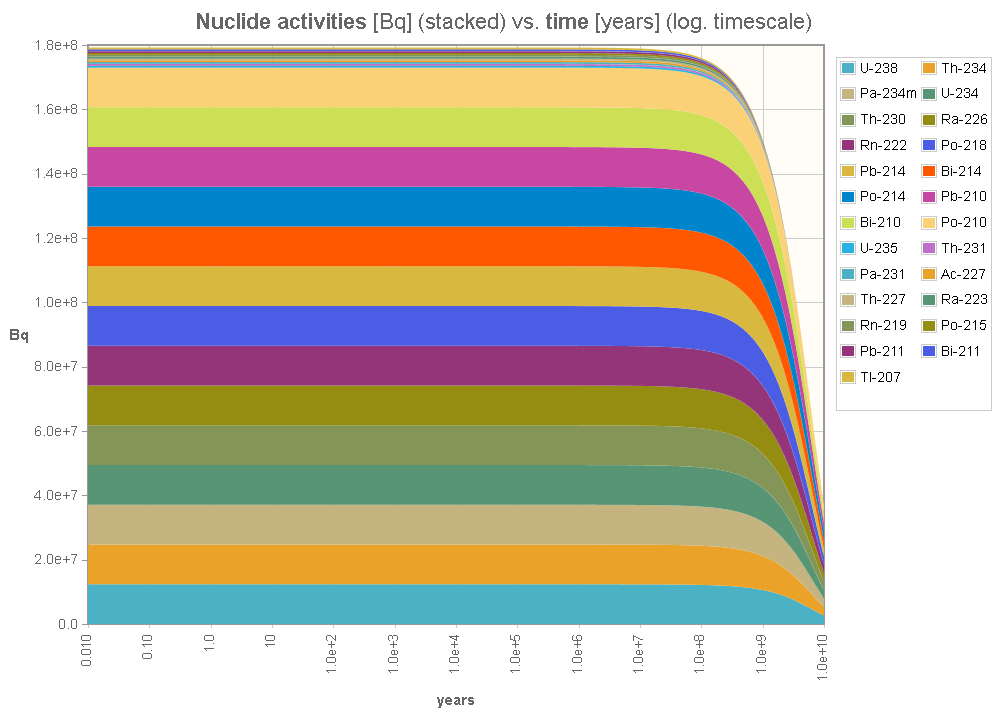
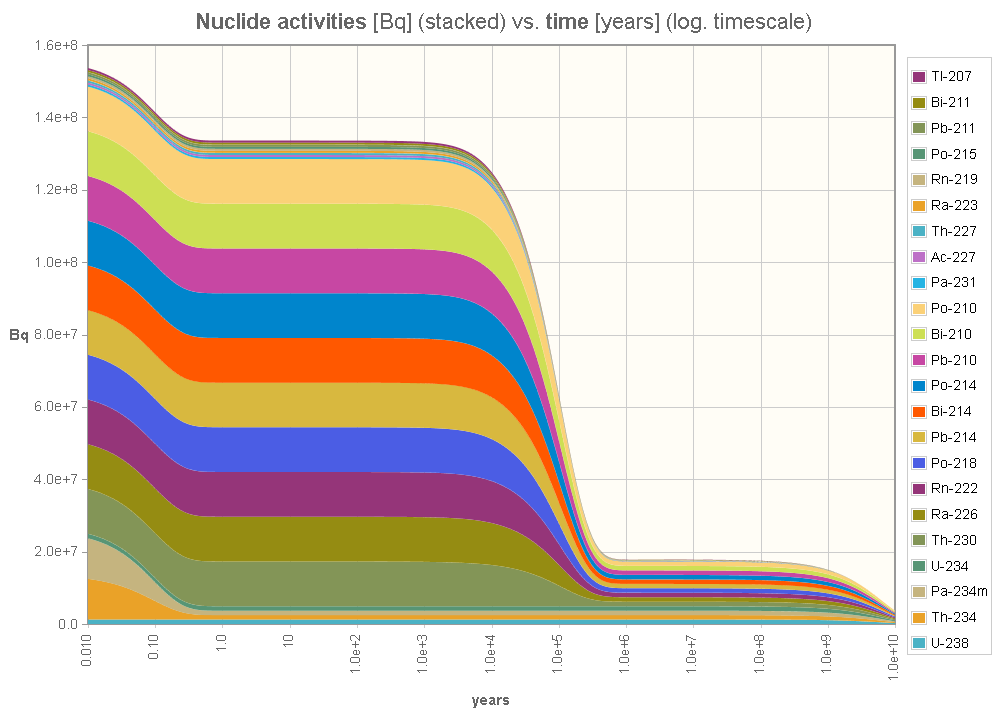
Uranium Ore Activity (1 t ore at grade of 0.1% U)
In case of an undisturbed uranium deposit, the activity of all decay products remains rather constant for hundreds of millions of years. (see also: Universal Decay Calculator
In the ore deposit, the radiation is virtually trapped underground; exposures are only possible if contaminated groundwater, that is circulating through the deposit, is used for drinking. Radon is of no concern for deep deposits, though it can travel through underground fissures, since it decays before it can reach the surface.
The alpha radiation of the 8 alpha emitting nuclides contained in the U-238 series (and to a lesser degree, of the 7 alpha emitters in the U-235 series) presents a radiation hazard on ingestion or inhalation of uranium ore (dust) and radon. The gamma radiation mainly of Pb-214 and Bi-214, together with the beta radiation of Th-234, Pa-234m, Pb-214, Bi-214, and Bi-210, and the neutron radiation, mostly resulting from spontaneous fission of U-238, present an external radiation hazard.
> See also: Radiation Exposure for Workers at Uranium Mine
Waste RockWaste material left from open pit or underground mining:
Ore Sorting RejectLow-grade fraction residue from sorting of mined uranium ore, with a grade too low for economic uranium extraction. The amount of rejected material often is many times over the material accepted for further processing.
> See also: Uranium ore beneficiation
Spent Ore (Ripios)Leached ore remaining from heap leaching of uranium ore.Ripios has many properties in common with uranium mill tailings: like in tailings, the uranium isotopes U-238 and U-235 are no longer in secular equilibrium with their respective decay products. Due to the poorer uranium recovery of the heap leaching process, the fraction of residual uranium remaining in ripios is higher than in tailings, though. In addition, the ripios are coarser than the finely ground tailings. Upon termination of the designated leaching period, the material initially still is saturated with leaching liquid, leading to continued leaching of uranium and other constituents (many of which are radioactive and/or toxic). > See also: Uranium Heap Leaching
Uranium In-situ Leach SolutionThe uranium concentration in the solution produced from in-situ leaching wells depends on a number of parameters, an important one being time from startup. The initial concentration from an individual well soon peaks in a few days at values of typically 300 - 600 mg/l and then declines rapidly. The decline slows down as the concentration reaches 30 - 50 mg/l. The well is usually shut in when the concentration reaches 10 - 20 mg/l after 8 - 18 months operation. Average uranium concentrations are typically 40 - 70 mg/l. [IAEA1989 p.17]Various decay products of uranium are also leached and can reach considerable activities in the leaching solution, depending on the leaching agent used. During processing of the solution, large amounts of the radon contained escape into the atmosphere, while the other decay products are transferred to the waste solutions. Those solutions usually are dumped in deep aquifers through disposal wells, or evaporated in ponds, resulting in a concentrated waste slurry. See also: Impacts of Uranium In-Situ Leaching
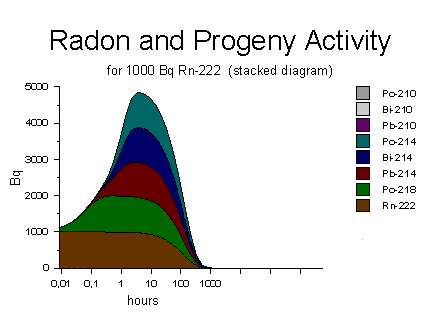
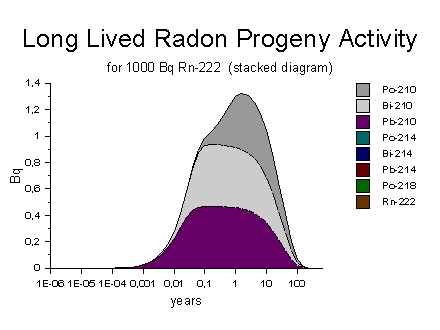
RadonRadon is a gaseous radioactive element generated from the decay of radium contained in uranium ore. The most important isotope is Rn-222 generated from the decay of Ra-226 (a member of the U-238 decay series).Radon presents an inhalation hazard, but a much higher radiation hazard results from the inhalation of the short-lived radon progeny (Po-218, Pb-214, Bi-214, and Po-214). Radon itself is of minor concern, since most of the inhaled radon is exhaled. And, most of the longer-lived Pb-210 (22 year half-life) and its progeny are eliminated from the body before they decay.
There are a number of units in use to describe radon and radon progeny activity concentration in air:
1 WLM (Working Level Month) is defined as the exposure to 1 WL during 170 hours.
The Equilibrium Factor describes the fraction of potential alpha decay energy of the short-lived radon decay products, compared to secular equilibrium. The equilibrium factor is defined as:
> See also: Unit Converter
Uranium Ore Concentrate (UOC)The uranium ore concentrate (UOC) produced in the milling process contains a mixed oxide usually referred to as "U3O8" (UO2 · 2 UO3). It is obtained fromYellow Cake by calcining. Due to a number of impurities contained (UOC contains at least 90% U3O8), it needs further refining before it can be used for nuclear fuel production. 1 t U3O8 is equivalent to 0.848 t U.
Natural Uranium Activity (1 g U)
Initially, it only contains the uranium isotopes. Within a few days, Th-231 (U-235 series), and within a few months, Th-234 and Pa-234m (U-238 series) grow in. The activity then remains rather stable for more than 10,000 years.
The alpha radiation of the uranium isotopes U-238, U-235, and U-234 presents a radiation hazard on ingestion or inhalation, while the beta radiation of the short-lived decay products Th-234 and Pa-234m, together with the weak gamma radiation emitted by all nuclides, presents an external radiation hazard. An additional external radiation hazard is present from neutron radiation, mostly resulting from spontaneous fission of U-238. Uranium ore concentrate is usually packaged in 205 to 250 litre steel drums containing up to approx. 430 kg UOC. These drums are then shipped in twenty foot (20') sea containers.
> See also: Radiation Exposure for Workers at Uranium Mine · Uranium Mill
Uranium Mill Tailings(see also: Introduction: Uranium Mill Tailings Deposits)Uranium mill tailings are the residual waste from the process of uranium extraction from the uranium ore. Since only uranium is extracted, all other members of the uranium decay chains remain in the tailings at their original activities. In addition, small residual amounts of uranium are left in the tailings, depending on the efficiency of the extraction process used.
Uranium Mill Tailings Activity (1 t tailings from ore grade 0.1% U at 90% extraction)
Initially, the total activity in the tailings amounts to about 85% of that in the ore. Within a few months, the isotopes of Th-234 and Pa-234m decay to the value given by the residual activity of the U-238. The total activity in the tailings then remains rather constant for more than 10,000 years at about 75% of that in the ore.
Compared to uranium ore, the alpha radiation of uranium mill tailings and thus the radiation hazard on ingestion or inhalation of tailings (dust) is approx. 25% lower, while the hazard from radon is unchanged. The external radiation hazard from gamma radiation remains nearly unchanged, while that from beta radiation is reduced. The chemical toxicity of uranium plays a minor role only in tailings.
> See also: Radiation Exposure for Workers at Uranium Mill
Refining Waste, Conversion WasteThese wastes arise during the refining and subsequent conversion of Uranium Ore Concentrate (U3O8) to uranium hexafluoride (UF6).Like uranium mill tailings, these wastes also are slurry-like and are held in large impoundments. The waste arisings vary widely with the kind of conversion process used. They contain a variety of nuclides from the uranium decay series and other toxic substances and must be safely managed in the long term.
Heavy Water Reactor Fuel (natural UO2)For use in heavy water reactors (HWR, such as CANDU type, or pressurized heavy water reactors - PHWR), the uranium is needed in the form of UO2. This is obtained from the uranium ore concentrate by refining and conversion. 1 t of UO2 is equivalent to 0.8815 t U.In addition to the radiological and chemical hazards, UO2 presents a hazard from spontaneous ignition of finely divided particles (pyrophoricity). > See also: Radiation Exposure for Workers at Heavy Water Reactor Fuel Fabrication Facilities
Magnox Reactor Fuel (natural U metal)For use in Magnox reactors (graphite moderated, gas cooled), the uranium is needed in the form of uranium metal. This is obtained from the uranium ore concentrate by refining and conversion.In addition to the radiological and chemical hazards, uranium metal presents a hazard from spontaneous ignition of finely divided particles (pyrophoricity). > See also: Radiation Exposure for Workers at Magnox Reactor Fuel Fabrication Facilities
Enriched Uranium> See: Enriched UF6 · Enriched RepU UF6
Depleted Uranium (DU)> See: Depleted UF6 · Depleted RepU UF6 · Depleted Uranium Metal · Depleted Uranium Oxide (UO2 or U3O8)
Uranium Hexafluoride (UF6)General · Natural UF6 · Enriched UF6 · Depleted UF6 · UF6 heelsUF6 - GeneralFor the use in light water reactors (LWR, such as boiling water reactors - BWR, or pressurized water reactors - PWR), the fissile isotope of U-235 contained in the natural uranium has to be enriched. For the enrichment process, uranium is required in the form of uranium hexafluoride (UF6). 1 t of UF6 is equivalent to 0.676 t U.Uranium hexafluoride is obtained from uranium ore concentrate by refining and conversion.
At ambient temperature, UF6 is a crystalline solid, but at a temperature of 56.4°C, it sublimates (becomes a gas).
The alpha radiation of the uranium isotopes U-238, U-235, and U-234 presents a radiation hazard on ingestion or inhalation, while the beta radiation of the short-lived decay products Th-234 and Pa-234m, together with the weak gamma radiation emitted by all nuclides, presents an external radiation hazard. In addition, the beta radiation produces secondary X-rays (Bremsstrahlung) in the UF6 and in the cylinder wall. For ingestion and inhalation, also the chemical toxicity of uranium as a heavy metal has to be taken into account. For uranium hexafluoride made from reprocessed uranium (RepU), see here > See also: Radiation Exposure for Conversion and Enrichment Plant Workers
Natural UF6> For general properties of uranium hexafluoride (UF6), see hereNatural uranium hexafluoride (enrichment feed) is obtained from uranium ore concentrate by refining and conversion.
The natural UF6 is shipped in Type 48Y steel cylinders containing 12,500 kg UF6 (8,452 kg U). If cylinders are involved in long-lasting fires during accidents, large amounts of UF6 can be released within a short time (see also Uranium Hexafluoride Hazards).
Enriched UF6> For general properties of uranium hexafluoride (UF6), see hereEnriched uranium hexafluoride (enrichment product) is obtained by enrichment of natural UF6 or re-enrichment of depleted UF6. For use in light water reactors (LWR), uranium is enriched to between 3 and 5 weight-percent U-235; that is around 4 to 7 times the natural concentration. As a side effect, the concentration of U-234 is enriched at an even higher ratio, according to its lower atomic weight.
 ) The enriched UF6 is shipped in Type 30B steel cylinders containing 2,277 kg UF6 (1,540 kg U). If cylinders are involved in long-lasting fires during accidents, large amounts of UF6 can be released within a short time (see also Uranium Hexafluoride Hazards). In addition to the hazards already described, handling of the enriched uranium presents a criticality hazard: if too large amounts of enriched uranium are accumulated in one place, uncontrolled chain reactions can occur, causing heavy releases of neutron and gamma radiation.
Enriched uranium (hexafluoride) presents a proliferation hazard, as the separative work required to enrich a certain amount of reactor-grade uranium further to bomb-grade (> 90 wt-% U-235) is lower than that required to produce the reactor-grade uranium from natural uranium in the first place.
(see also Uranium Enrichment Calculator
Depleted UF6> For general properties of uranium hexafluoride (UF6), see hereDepleted uranium hexafluoride is a by-product from uranium enrichment, as tails from enrichment of natural UF6, or as secondary tails by re-enrichment of depleted UF6 .
The waste product from the enrichment process is depleted in U-235, it is therefore referred to as "depleted uranium". Typical concentrations of U-235 in depleted uranium (the tails assay) are in the range of 0.15 to 0.3 weight-percent; that is around 21 - 42% of its concentration in natural uranium. The concentration of U-234 is depleted to an even lower ratio, according to its lower atomic weight.
)
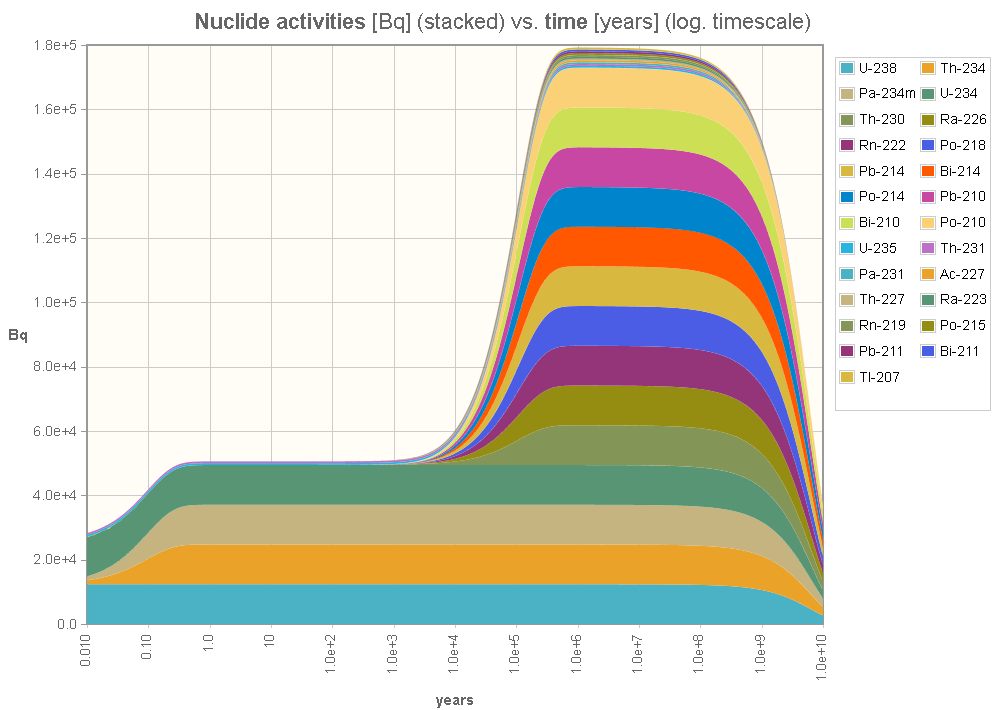
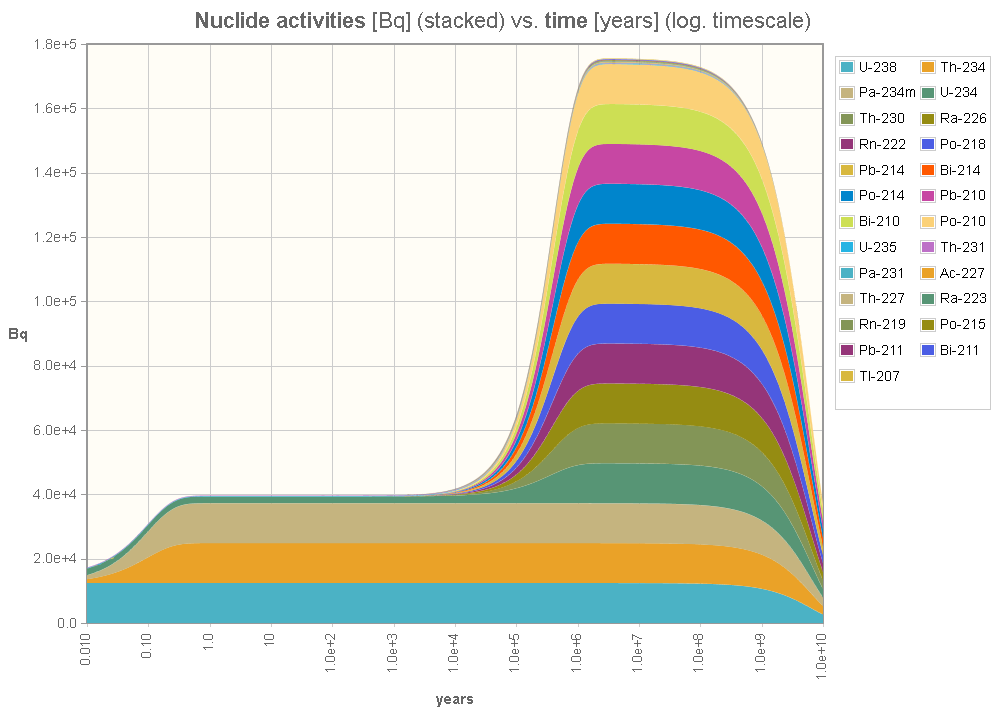
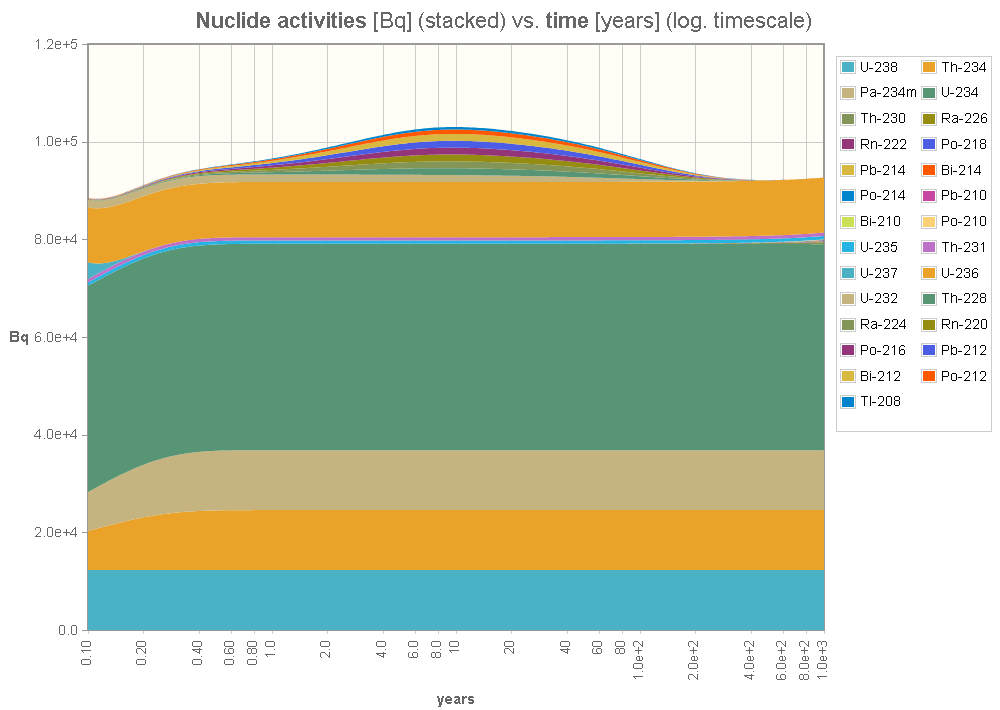
Depleted Uranium Activity (for 1 g DU with tails assay 0.2%)
Within a few months, the isotopes of Th-234 and Pa-234m grow in to the value given by the activity of the U-238. The total activity in the depleted uranium then remains rather constant for around 10,000 years.
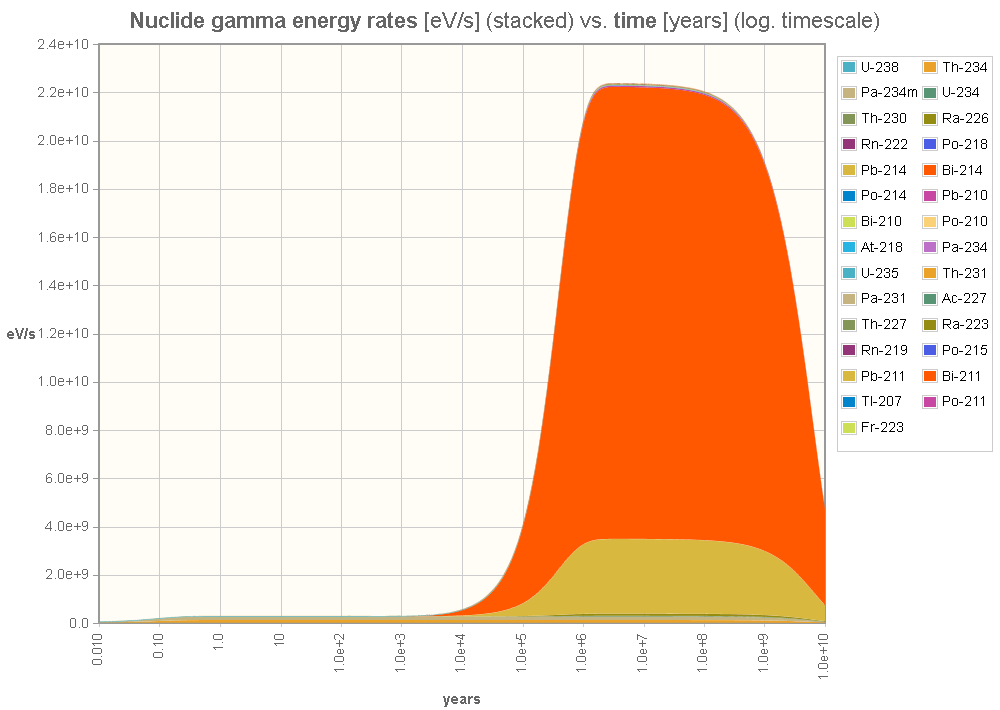
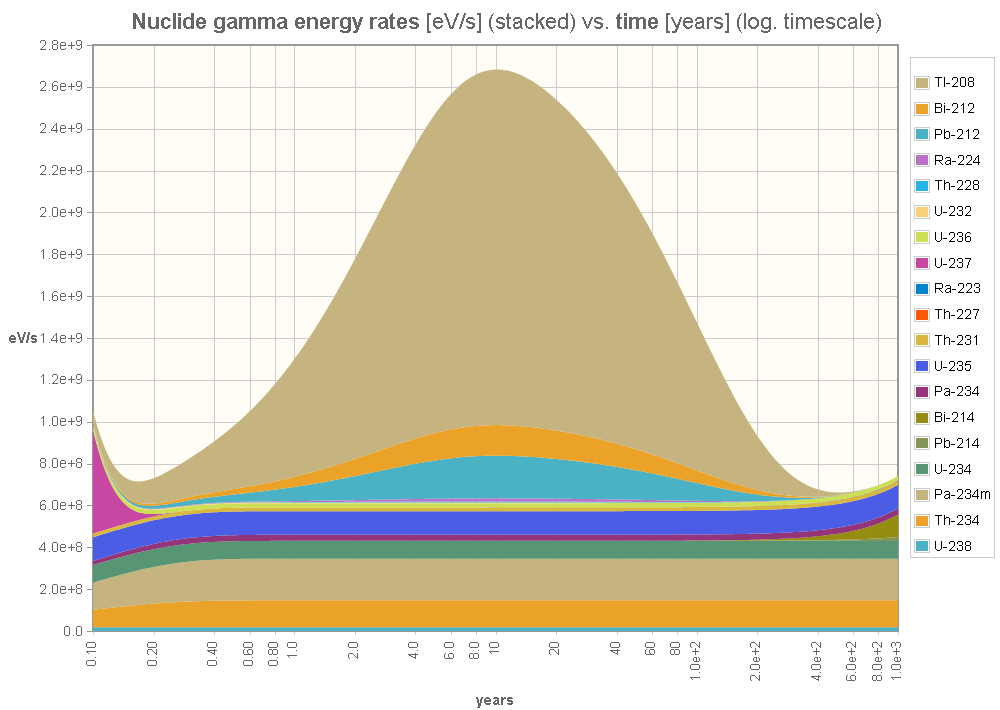
Depleted Uranium Gamma Decay Energy Rate (for 1 g DU with tails assay 0.2%)
The rise of the gamma decay energy rate is even sharper, as the strongest gamma emitters of the series are among the decay products (Pb-214, and in particular Bi-214, see Decay Series). (generated with Uranium Decay Calculator
Depleted uranium thus has the unusual property that it becomes more hazardous with time - an effect that has to be taken into account for its long-term management as a waste.
Most of the depleted UF6 produced so far is being stored in Type 48Y (or similar) steel cylinders containing 12,500 kg UF6 (8,452 kg U) in so-called cylinder yards near the enrichment plants. In the storage yards, the cylinders are subject to corrosion. The integrity of the cylinders must therefore be monitored and the painting must be refreshed from time to time. This maintenance work requires moving of the cylinders, causing further hazards from breaching of corroded cylinders, and from handling errors. (see Cylinder Storage of Depleted UF6)
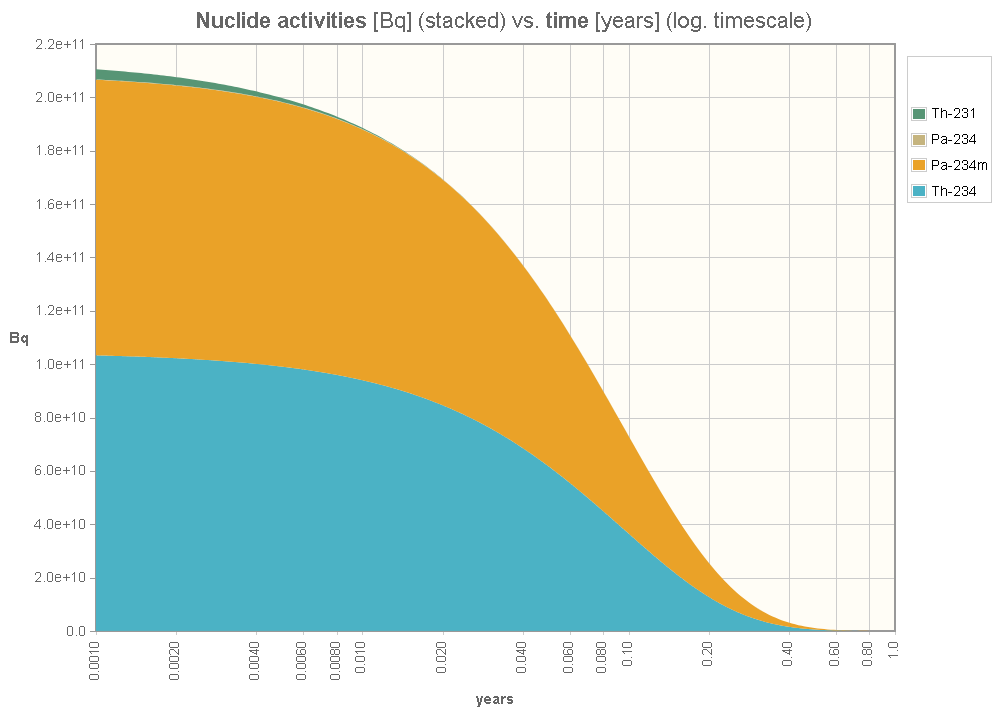
UF6 heels> For general properties of uranium hexafluoride (UF6), see hereUranium hexafluoride heels are obtained as a residue from unloading of containers holding UF6 of any isotopic composition. Unloading of UF6 cylinders usually is accomplished by heating the cylinder in an autoclave. The UF6 then sublimates (becomes a gas) and is fed into the receiving plant. However, there are also gamma-emitting decay products of the U-238 and U-235 present in the cylinder, namely Th-234, Pa-234m, and Th-231. They have grown in within a few months after the chemical separation of the uranium, and they do not form gaseous compounds with fluorine. They rather tend to concentrate in a residue called "heels" which is not removed from the cylinder.
These decay products (in particular Pa-234m) happen to be the major source of gamma radiation in the cylinder; the uranium itself emits only smaller amounts of gamma radiation. In a full cylinder, only a small fraction of the gamma radiation generated reaches the cylinder surface, since most of the gamma radiation is shielded by the uranium contained. In an "empty" cylinder, however, the major source of gamma radiation is still present in the heels and now reaches the cylinder surface nearly unhindered, view animation
UF6 Heels Activity (in 48Y cylinder initially filled with 12,500 kg natural UF6) Only approx. half a year after unloading of the UF6, these decay products have mostly decayed away.
> see also: Universal Decay Calculator
Depleted Uranium MetalIn a de-conversion process, the depleted uranium hexafluoride can be converted to the form of uranium metal.If the UF6 contained reprocessed uranium (RepU), then the depleted uranium may be contaminated with the artificial uranium isotopes U-236 and U-237, and with transuranics such as neptunium-237 and plutonium-239. In addition to the radiological and chemical hazards, (depleted) uranium metal presents a hazard from spontaneous ignition of finely divided particles (pyrophoricity).
Depleted Uranium Oxide (UO2 or U3O8)In a de-conversion process, the depleted uranium hexafluoride can be converted to the oxide form of UO2 or U3O8. In these forms, the depleted uranium is chemically more stable and suitable for long-term storage or disposal (see Waste Management - Depleted Uranium).1 t of UO2 is equivalent to 0.8815 t U, and 1 t U3O8 is equivalent to 0.848 t U.
An external radiation hazard is present from gamma radiation and from neutron radiation (mostly resulting from spontaneous fission of U-238). If the UF6 contained reprocessed uranium (RepU), then the depleted uranium may be contaminated with the artificial uranium nuclides U-236 and U-237, and with transuranics such as neptunium-237 and plutonium-239. In addition to the radiological and chemical hazards, (depleted) UO2 (other than U3O8) presents a hazard from spontaneous ignition of finely divided particles (pyrophoricity). Depleted U3O8 is typically stored in type DV70 steel containers containing 7.8 to 11.8 t U3O8 (6.6 to 10 t U).
Light Water Reactor Fuel (enriched UO2)In a de-conversion process, the enriched uranium hexafluoride is converted to the oxide form of UO2. In this form, the uranium is used for the production of nuclear fuel for light water reactors. 1 t of UO2 is equivalent to 0.8815 t U.If the UF6 contained reprocessed uranium (RepU), then the nuclear fuel may be contamined with the artificial uranium isotopes of U-232, U-233, and U-236, and with fission products such as technetium-99. Production and handling of this material, as of all enriched uranium, presents a criticality hazard: if too large amounts of enriched uranium are accumulated in one place, uncontrolled chain reactions can occur, causing heavy releases of neutron and gamma radiation. In addition to the radiological and chemical hazards, (enriched) UO2 presents a hazard from spontaneous ignition of finely divided particles (pyrophoricity). > See also: Radiation Exposure for Workers at Light Water Reactor Fuel Fabrication Facilities
Spent LWR FuelWhile spent fuel still consists mostly of uranium, the irradiation in the reactor has increased the activity inventory by several orders of magnitude, due to the formation of artificial uranium isotopes, transuranics, activation products, fission products, and all their decay products. During the first time, the activities are so high, that the decay heat keeps the temperature at high levels, necessitating adequate cooling.Spent fuel emits a wide variety of ionizing radiations, including neutron radiation.
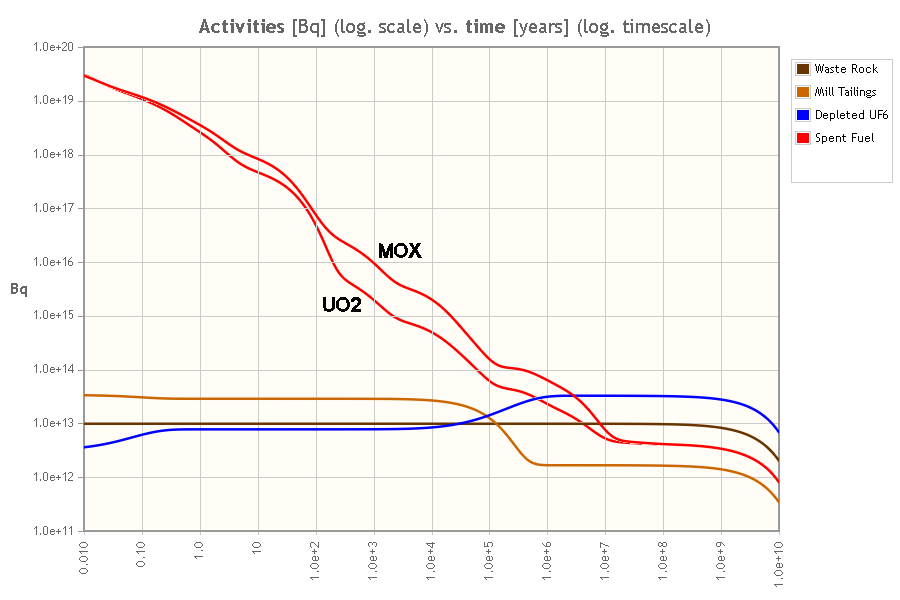
Spent fuel activities:
Comparison of activities in spent fuel and in corresponding amounts of wastes arising in fuel production: In the beginning, the activities in spent fuel exceed the activities in the wastes from fuel production by several orders of magnitude, but after approx. 1 million years, the activities in depleted uranium become highest.
At certain times, the activities in spent fuel generated from MOX fuel are up to 5 times higher than those in spent fuel from UO2 fuel, and it takes up to 10 times longer until the spent fuel from MOX fuel reaches the activity levels in spent fuel from UO2 fuel.
High Level Waste (HLW)Reprocessing of spent fuel recovers only reprocessed uranium (RepU) and plutonium, while all other constituents are discarded as High Level Waste (HLW). HLW still generates heat, and it is a strong emitter of radiation of all sorts. It therefore requires safe storage for hundreds of thousands of years.
High Level Waste activities:
Reprocessed Uranium (RepU)Residual uranium contained in spent nuclear fuel can be recovered in a reprocessing plant.The uranium recovered in the PUREX process (as used in the Sellafield (UK) and La Hague (France) reprocessing plants) has the form of uranyl nitrate (UO2(NO3)2). This has to be converted to the form of UO3 for further use. For long term storage, reprocessed uranium is converted to U3O8 and stored in 213 liter barrels containing 295 kg U3O8 (250 kg U).
Uranium recovered from reprocessing of spent nuclear fuel is contaminated with fission products (mainly ruthenium-106 The radiation hazard to employees thus is much higher in the processing of RepU rather than natural uranium.
RepU Activity (for 1 g RepU, initial enr. 3.5%, 39 GWd/tHM, 5 years after unload)
U-232
RepU Gamma Decay Energy Rate (for 1 g RepU, initial enr. 3.5%, 39 GWd/tHM, 5 years after unload)
"Perfumed" Uranium"Perfumed" or "Blended" uranium is an industry term used for uranium that contains traces of reprocessed uranium (RepU). The traces may have been acquired by processing of unirradiated material in a system that has handled irradiated material before. As a result of the exposure to the system, the uranium that is produced is contaminated with artificial uranium isotopes, fission products and transuranics.
Hexafluoride (UF6) from reprocessed uranium (RepU)General · Raw RepU UF6 · Enriched RepU UF6 · Depleted RepU UF6 · RepU HeelsRepU Hexafluoride (UF6) - General> For general properties of uranium hexafluoride (UF6), see here
Additional hazards exist, if the uranium hexafluoride contains reprocessed uranium (RepU) recovered from spent nuclear fuel. In this case, the uranium hexafluoride may be contaminated with fission products (mainly ruthenium-106 During the conversion process, most of the fission products and transuranics are removed, but residual contamination may remain. > See also: Radiation Exposure for Conversion and Enrichment Plant Workers
Raw RepU Hexafluoride (UF6)> For general properties of reprocessed uranium hexafluoride (UF6), see hereIf the uranium hexafluoride is made from reprocessed uranium (RepU), then it still contains all of the artificial uranium isotopes recovered during reprocessing.
Enriched RepU Hexafluoride (UF6)> For general properties of reprocessed uranium hexafluoride (UF6), see hereIf the UF6 feed contained reprocessed uranium (RepU), then the lighter uranium nuclides U-232 and U-233 mainly and U-236 partly end up in the enriched UF6 product. Any fission products present, such as technetium-99, completely end up in the enriched UF6 product. To obtain the same reactivity, RepU must be enriched higher than natural uranium to compensate for the presence of U-236, a neutron absorber.
)
Depleted RepU Hexafluoride (UF6)> For general properties of reprocessed uranium hexafluoride (UF6), see here
If the UF6 feed contained reprocessed uranium (RepU), then the heavier uranium nuclides U-236 and U-237 partly end up in the depleted UF6 tails. Any transuranics present, such as neptunium-237 and plutonium-239, mainly end up in the tails.
)
RepU Heels> For general properties of reprocessed uranium hexafluoride (UF6), see here
For cylinders carrying UF6 made from reprocessed uranium (RepU), the heels comprise the even stronger gamma emitter thallium-208
RepU fuelReprocessed uranium (RepU) can be used to replace natural uranium in nuclear fuel manufacturing. For this purpose, the uranium recovered in the reprocessing plants by the PUREX process first has to be converted from the form of uranyl nitrate (UO2(NO3)2) to U3O8. Like natural uranium, it then is converted to UF6 and enriched, and finally manufactured into nuclear fuel.There are, however, some caveats, involving the fission products, artificial uranium isotopes, and transuranics contained in RepU:
> See also: Radiation Exposure for Workers at Light Water Reactor Fuel Fabrication Facilities
PlutoniumPlutonium contained in spent nuclear fuel can be recovered in a reprocessing plant. The recovered plutonium consists of several nuclides, only some of which (Pu-239 and Pu-241 ) are fissile.
Due to the shorter half-life of the plutonium isotopes (Pu-239: 24,065 years), the specific activity of plutonium is much higher than that of uranium, leading to a higher radiation hazard. In addition, radiation hazards can result from short-lived plutonium isotopes, in particular Pu-241, which decays with a half-life of 14.4 years to the gamma-emitter Am-241 . Like enriched uranium, plutonium presents a criticality hazard: if too large amounts are accumulated in one place, uncontrolled chain reactions can occur, causing heavy releases of neutron and gamma radiation. Since plutonium mostly consists of fissile material (only comparable to highly enriched uranium), it presents a most serious proliferation hazard.
Mixed Oxide (MOX) fuelPlutonium recovered from spent fuel can be used to replace the fissile uranium isotope U-235 in reactor fuel. The plutonium is mixed with natural or depleted uranium to produce the Mixed Oxide fuel.As only part of the plutonium recovered is fissile (e.g. 66% by weight), and the reactivity of the fissile plutonium (Pu-239 and Pu-241) is lower than that of U-235 (e.g. 66% by weight), approx. twice the amount of plutonium is required to replace the U-235 in the fuel. Due to the higher activity of plutonium, MOX fuel presents a higher radiation hazard than uranium oxide fuel. Like uranium oxide fuel, MOX fuel presents a criticality hazard: if too large amounts are accumulated in one place, uncontrolled chain reactions can occur, causing heavy releases of neutron and gamma radiation. Due to the possibility of recovering the plutonium by chemical processing, MOX fuel presents a proliferation hazard.
REMIX fuelREMIX (regenerated mixture) fuel is made from a mixture of reprocessed uranium (RepU) and plutonium, both extracted from spent nuclear fuel, with addition of small volumes of enriched uranium.
References[Neghabian1991] Verwendung von wiederaufgearbeitetem Uran und von abgereichertem Uran, von A.R. Neghabian, H.J. Becker, A. Baran, H.-W. Binzel, Der Bundesminister für Umwelt, Naturschutz und Reaktorsicherheit  (Hg.), Schriftenreihe Reaktorsicherheit und Strahlenschutz, BMU-1992-332, November 1991, 186 S.
[IAEA1989] In Situ Leaching of Uranium: Technical, Environmental and Economic Aspects
| ||||||||||||||||||||||||||||||||||||||||||||||||||||||||||||||||||||||||||||||||||||||||||||||||||||||||||||||||||||||||||||||||||||||||||||||||||||||||||||||||||||||||||||||||||||||||||||||||||||||||||||||||||||||||||||||||||||||||||||||||||||||||||||||||||||||||||||||||||||||||||||||||||||||||||||||||||||||||||||||||||||||||||||||||||||||||||||||||||||||||||||||||||||||||||||||||||||||||||||||||||||||||||||||||||||||||||||||||||||||||||||||||||||||||||||||||||||||||||||||||||||||||||||||||||||||||||||||||||||||||||||||||||||||||||||||||||||||||||||||||||||||||||||||||||||||||||||||||||||||||||||||||||||||||||||||||||||||||||||||||||||||||||||||||||||||||||||||||||||||||||||||||||||||||||||||||||||||||||||||||||||||||||||||||||||||||||||||||||||||||||||||||||||
| You are visitor 01402503 — GeezerVison does not store the pages you look up. Best viewed with Netscape Navigator 4.7 or Internet Explorer 6 at 800×600. No cookies required. | ||||||||||||||||||||||||||||||||||||||||||||||||||||||||||||||||||||||||||||||||||||||||||||||||||||||||||||||||||||||||||||||||||||||||||||||||||||||||||||||||||||||||||||||||||||||||||||||||||||||||||||||||||||||||||||||||||||||||||||||||||||||||||||||||||||||||||||||||||||||||||||||||||||||||||||||||||||||||||||||||||||||||||||||||||||||||||||||||||||||||||||||||||||||||||||||||||||||||||||||||||||||||||||||||||||||||||||||||||||||||||||||||||||||||||||||||||||||||||||||||||||||||||||||||||||||||||||||||||||||||||||||||||||||||||||||||||||||||||||||||||||||||||||||||||||||||||||||||||||||||||||||||||||||||||||||||||||||||||||||||||||||||||||||||||||||||||||||||||||||||||||||||||||||||||||||||||||||||||||||||||||||||||||||||||||||||||||||||||||||||||||||||||||

 / Underground Mining


 ⚗