GeezerVison is showing acad.garywei.dev — Gary Wei | Machine Learning | About
ByteDance Ltd.
1199 Coleman Ave.
San Jose, CA 95110
My research interests lie at the intersection of machine learning systems, distributed systems, high-performance computing, and AI for science. I am particularly interested in optimization, structured matrices, numerical linear algebra, scientific computing, and the design and correctness of distributed protocols. More broadly, I study how mathematical and systems principles can be used to build efficient, scalable, and reliable learning systems.
At Cornell’s Relax ML Lab, I worked with Prof. Chris De Sa on efficient machine learning algorithms and systems. My recent work has focused on coordination, consistency, and fault tolerance in large-scale distributed systems. I have also collaborated on generative modeling for scientific applications.
I received my M.Eng. in Computer Science from Cornell University and B.S. degrees in Computer Science and Mathematics from the University of Massachusetts Amherst. At UMass, I focused on applied mathematics and scientific computing and completed a minor in Japanese. I also worked with Prof. Hong Yu in the UMass BioNLP Lab on biomedical and clinical NLP for electronic health records.
My personal projects and other work are available at garywei.dev.
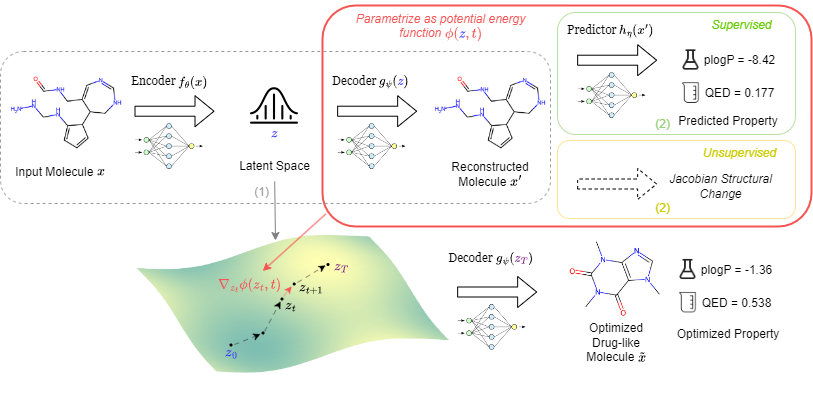
Recent progress of deep generative models in the vision and language domain has stimulated significant interest in more structured data generation such as molecules. However, beyond generating new random molecules, efficient exploration and a comprehensive understanding of the vast chemical space are of great importance to molecular science and applications in drug design and materials discovery. In this paper, we propose a new framework, ChemFlow, to traverse chemical space through navigating the latent space learned by molecule generative models through flows. We introduce a dynamical system perspective that formulates the problem as learning a vector field that transports the mass of the molecular distribution to the region with desired molecular properties or structure diversity. Under this framework, we unify previous approaches on molecule latent space traversal and optimization and propose alternative competing methods incorporating different physical priors. We validate the efficacy of ChemFlow on molecule manipulation and single- and multi-objective molecule optimization tasks under both supervised and unsupervised molecular discovery settings. Codes and demos are publicly available on GitHub at https://github.com/garywei944/ChemFlow.
@inproceedings{wei2024navigating,title={Navigating Chemical Space with Latent Flows},author={Wei, Guanghao and Huang, Yining and Duan, Chenru and Song, Yue and Du, Yuanqi},year={2024},booktitle={Advances in Neural Information Processing Systems},editor={Globerson, A. and Mackey, L. and Belgrave, D. and Fan, A. and Paquet, U. and Tomczak, J. and Zhang, C.},pages={58663--58697},volume={37},publisher={Curran Associates, Inc.},doi={10.52202/079017-1870},archiveprefix={arXiv},primaryclass={cs.LG},url={https://proceedings.neurips.cc/paper_files/paper/2024/file/6bbefb73c0ede70635823a18426b9208-Paper-Conference.pdf},}
The advancement in healthcare has shifted focus toward patient-centric approaches, particularly in self-care and patient education, facilitated by access to Electronic Health Records (EHR). However, medical jargon in EHRs poses significant challenges in patient comprehension. To address this, we introduce a new task of automatically generating lay definitions, aiming to simplify complex medical terms into patient-friendly lay language. We first created the README dataset, an extensive collection of over 50,000 unique (medical term, lay definition) pairs and 300,000 mentions, each offering context-aware lay definitions manually annotated by domain experts. We have also engineered a data-centric Human-AI pipeline that synergizes data filtering, augmentation, and selection to improve data quality. We then used README as the training data for models and leveraged a Retrieval-Augmented Generation method to reduce hallucinations and improve the quality of model outputs. Our extensive automatic and human evaluations demonstrate that open-source mobile-friendly models, when fine-tuned with high-quality data, are capable of matching or even surpassing the performance of state-of-the-art closed-source large language models like ChatGPT. This research represents a significant stride in closing the knowledge gap in patient education and advancing patient-centric healthcare solutions.
@inproceedings{yao-etal-2024-readme,title={README: Bridging Medical Jargon and Lay Understanding for Patient Education through Data-Centric NLP},author={Yao, Zonghai and Kantu, Nandyala Siddharth and Wei, Guanghao and Tran, Hieu and Duan, Zhangqi and Kwon, Sunjae and Yang, Zhichao and annotation team, README and Yu, Hong},year={2024},booktitle={Proceedings of the 2024 Conference on Empirical Methods in Natural Language Processing},editor={Al-Onaizan, Yaser and Bansal, Mohit and Chen, Yun-Nung},pages={12609--12629},volume={37},publisher={Association for Computational Linguistics},doi={10.18653/v1/2024.findings-emnlp.737},archiveprefix={arXiv},primaryclass={cs.CL},url={https://aclanthology.org/2024.findings-emnlp.737/},}
GraB-sampler: Optimal Permutation-based SGD Data Sampler for PyTorch
The online Gradient Balancing (GraB) algorithm greedily choosing the examples ordering by solving the herding problem using per-sample gradients is proved to be the theoretically optimal solution that guarantees to outperform Random Reshuffling. However, there is currently no efficient implementation of GraB for the community to easily use it.
This work presents an efficient Python library, GraB-sampler, that allows the community to easily use GraB algorithms and proposes 5 variants of the GraB algorithm. The best performance result of the GraB-sampler reproduces the training loss and test accuracy results while only in the cost of 8.7% training time overhead and 0.85% peak GPU memory usage overhead.
@misc{wei2023grabsampler,title={GraB-sampler: Optimal Permutation-based SGD Data Sampler for PyTorch},author={Wei, Guanghao},year={2023},doi={10.48550/arXiv.2309.16809},archiveprefix={arXiv},primaryclass={cs.LG},}
The best way to contact me is via email.
You are visitor 01402792 — GeezerVison does not store the pages you look up. Best viewed with Netscape Navigator 4.7 or Internet Explorer 6 at 800×600. No cookies required.