GV

GeezerVison

The World Wide Web, restored to 800 pixels of glory.

Home|About|Gaming cabinet|Archives|How it works|Starter sites

On this site

  • capirenJ
  • In a Nutshell...
  • Bookshop Sample
  • Core Concepts
  • Key Features
  • Learn More
  • Get Help
  • Domain Modeling
  • Services & APIs
  • Serving UIs
  • Databases
  • Protocols
  • Native AI
  • Integration

This view

  • Original page
  • New address

GeezerVison is showing cap.cloud.sap — Learning Sources | capire

Learning Sources ​

Capire, Samples, Tutorials, Podcasts, ...

The capire Documentation ​

This documentation — named 'capire', italian for understand — is the official documentation for CAP. It's organized as follows:

Section Description
  • Get Started
  • Develop
  • Deploy
    Guides that walk you through the most common tasks in CAP-based development and deployment.
  • CDS
  • Node.js
  • Java
  • Tools
    Reference documentation for these respective areas.
  • Plugins
  • Releases
  • Resources
    Curated list of plugins for CAP.
    Release notes and release schedule.
    About support channels, community, ...

Callouts and Alerts ​

We use GitHub-flavored alerts to highlight important information in our documentation. Here are the different types of alerts or callouts you may encounter:

Info

Useful information that users should know, less important than notes.

Note

Useful information that users should know even when skimming content.

Tip

Helpful advice for doing things better or more easily.

Important!

Key information users need to know to achieve their goal.

Warning

Urgent info that needs immediate attention to avoid problems.

Caution!

Advises about risks or negative outcomes of certain actions.

Danger!

Advises about risks or negative outcomes of certain actions.

The capire Samples ​

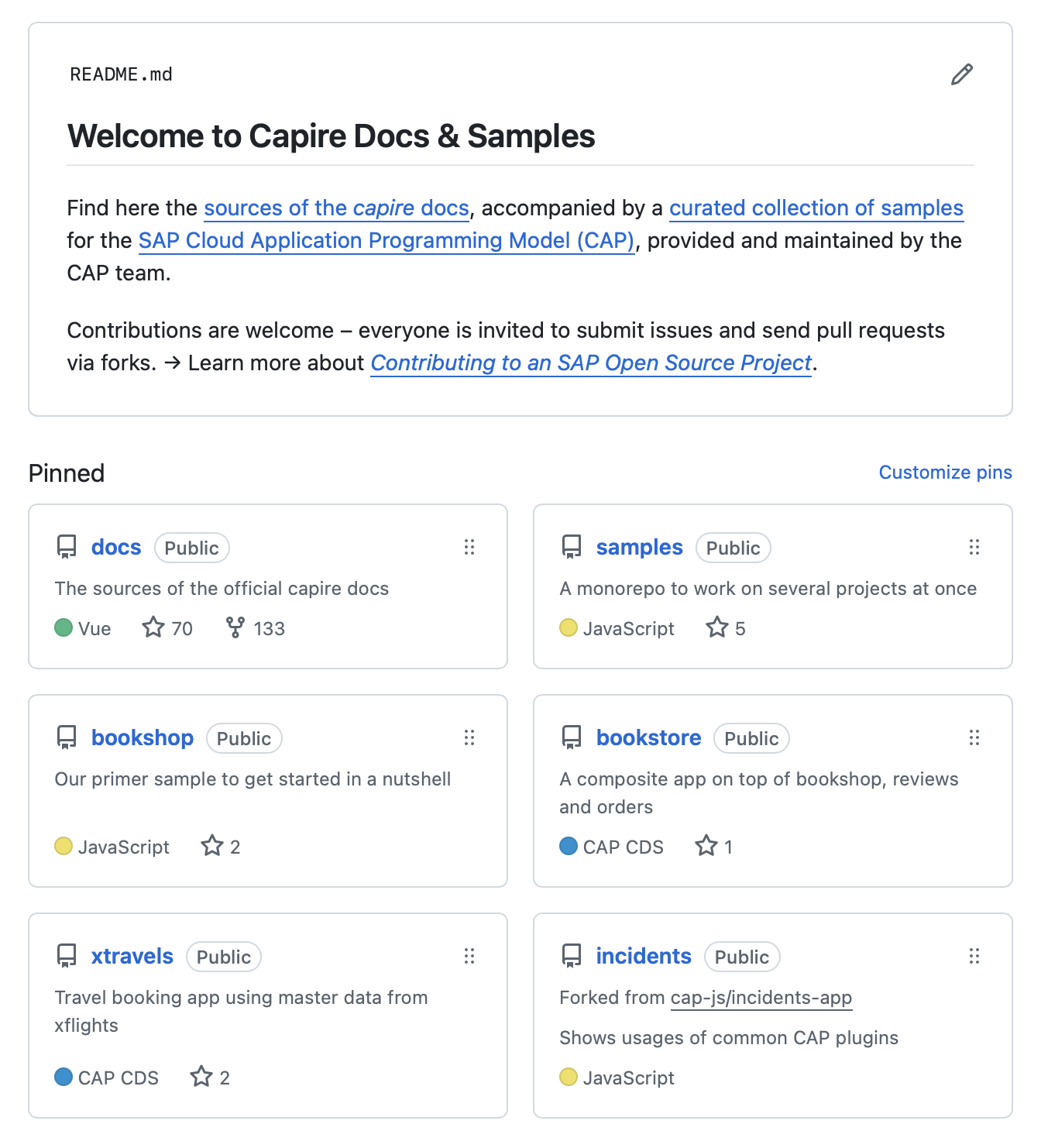
The capire samples at https://github.com/capire are the official and curated collection of samples for the SAP Cloud Application Programming Model, maintained by the CAP team.

Screenshot of the capire GitHub organization page with sample repositories

Featured Samples ​

Partner Reference App ​

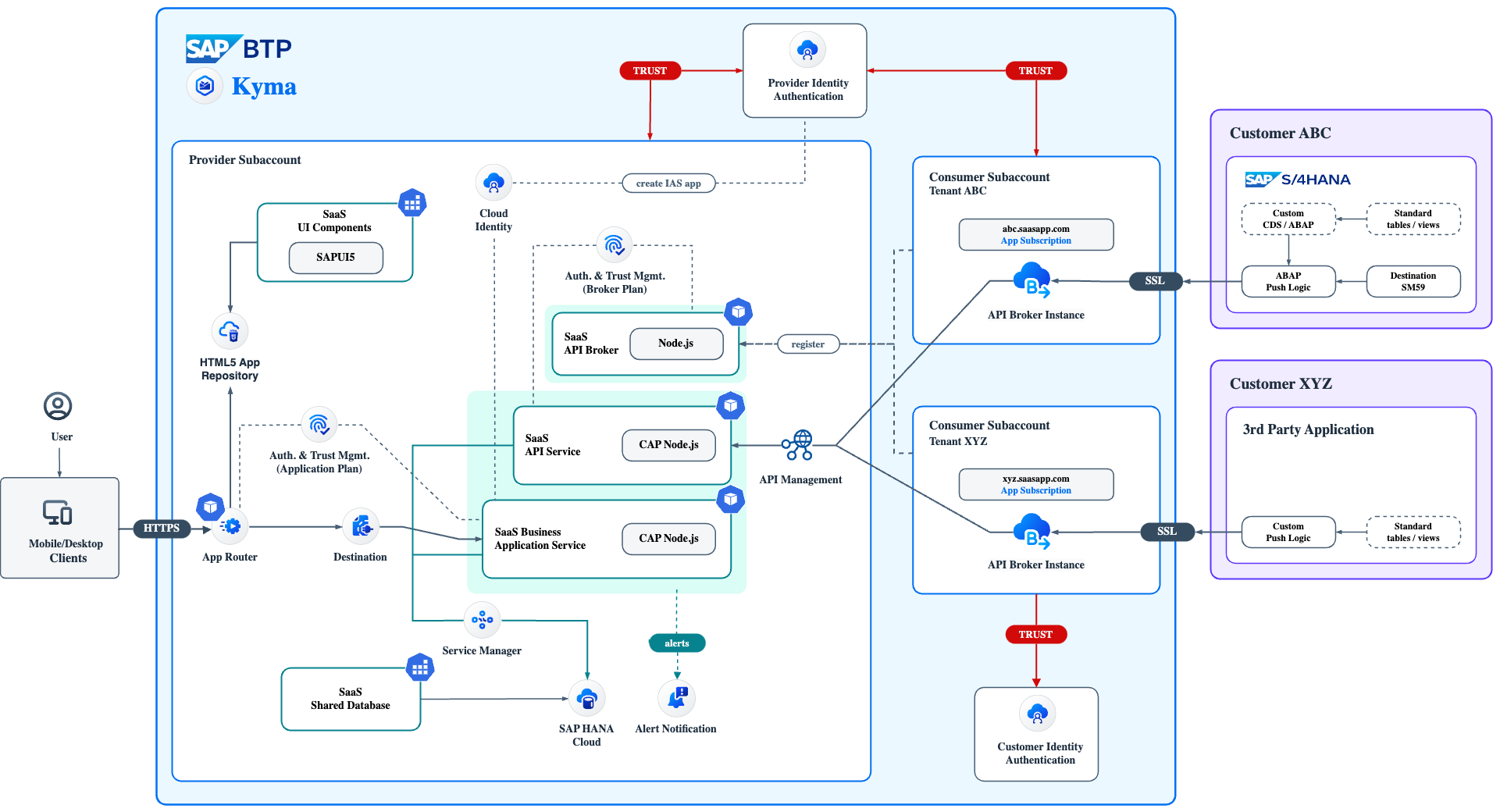
The Partner Reference Application provides a “golden path” for SaaS providers on SAP Business Technology Platform (SAP BTP), featuring:

  • centralized identity and access management,
  • a common launchpad,
  • cross-application front-end navigation,
  • and secure back-channel integration.

You also find the bill of materials and a sizing example. This addresses the question "Which BTP resources do I need to subscribe to and in what quantities?" and serves as a basis for cost calculation.

Star Wars App ​

SWAPI - the Star Wars API, a CAP-based adaptation of swapi.dev, a Python-based app that exposed data from the Star Wars movies. The many bi-directional, many-to-many relationships with the data provide a good basis for an SAP Cloud Application Programming Model and Fiori Draft UI sample.

BTP SuSaaS App ​

The Sustainable SaaS (SuSaaS) sample application has been built in a partner collaboration to help interested developers, partners, and customers in developing multitenant Software as a Service applications using CAP and deploying them to the SAP Business Technology Platform (SAP BTP).

The qmacro Series ​

SAP Developer Advocate DJ Adams has compiled a vast number of learning resources around CAP, published under the umbrella of qmacro, which are most recommended to both beginners and advanced users of CAP:

Videos ​

  • The Art and Science of CAP (with Daniel Hutzel)
  • Under the hood: CDS Expressions in CAP (with Patrice Bender)
  • Expert sessions: Getting started with CAP Node.js (with Daniel Schlachter)
  • CAP in the age of AI (with various CAP team members)
  • Back to basics: CAP Node.js
  • Back to basics: Managed associations in CAP
  • Good to know: CAP Node.js
  • How things work: CAP Node.js plugins
  • Hands-on SAP Dev general live stream series
  • Did you know? featuring CAP topics

Blog post series ​

  • The Art and Science of CAP
  • Local-first dev with CAP Node.js
  • Under the hood: CDS Expressions in CAP
  • Modules, modularity & reuse in CDS models
  • CAP Node.js Plugins
  • All posts tagged with 'cap'

Selected individual articles ​

  • Shift left with CAP
  • Five reasons to use CAP
  • CAP service authentication at design time and in production
  • Flattening the hierarchy with mixins
  • A reCAP intro to the cds REPL
  • A deep dive into OData and CDS annotations
  • Using @capire modules from GitHub Packages
  • Modelling contained-in relationships with compositions in CDS
  • A simple exploration of status transition flows in CAP

Workshop exercise content ​

  • Service integration with SAP Cloud Application Programming Model
  • A hands-on tour of CAP
  • Stay cool, stay local: CAP local development workshop
  • Hands-on with CAP CDS

Miscellaneous ​

  • The 'capref' collection – Axioms, Best Practices and Features
  • Integrating an external API into a CAP service

SAP Learning Sources ​

  • SAP Learning Courses
  • SAP BTP Developers Guide
    • Tutorials featured in there
  • SAP Discovery Center Missions
  • Recently published (Aug 2026) tutorials in the Tutorial Navigator
    • Set up a self-contained development environment for CAP Node.js
    • Use mocking to embrace auth in your domain model from the outset
    • Explore the declarative power of status-transition flows
    • Get an introduction to the cds REPL
    • Add MCP capabilities to a CAP service

Hands-Ons & CodeJams ​

  • TechEd 2023 Hands-On AD264 – Build Extensions with CAP
  • TechEd 2022 Hands-On AD264 – Verticalization, Customization, Composition

Blog Posts & Other Material ​

  • Hybrid Testing and Alternative DBs
    by Thomas Jung
  • Consume External Services
    by Thomas Jung
  • Building a CAP app in 60 min
    by Martin Stenzig
  • Surviving and Thriving with the SAP Cloud Application Programming Model
    by Max Streifeneder (2023)
  • Multitenant SaaS applications on SAP BTP using CAP? Tried-and-True!
    by Martin Frick (2022)
You are visitor 01402520 — GeezerVison does not store the pages you look up.
Best viewed with Netscape Navigator 4.7 or Internet Explorer 6 at 800×600. No cookies required.