GeezerVison is showing cbuelt.github.io — Christopher Bülte
PhD candidate, LMU Munich
I am a PhD candidate at the Bavarian AI Chair for Mathematical Foundations of Artificial Intelligence at LMU Munich under the supervision of Prof. Gitta Kutyniok. Furthermore, I am an associated PhD at the Konrad Zuse School of Excellence in Reliable AI (relAI) and the Munich Center for Machine Learning (MCML). Before the start of my PhD I obtained a Bachelor’s degree in Industrial Engineering and a Master’s degree in Mathematics from Karlsruhe Institute of Technology.
My research revolves around uncertainty quantification, probabilistic modeling, and their applications in the natural sciences. I have a strong interest in the theoretical foundations of such methods, as well as in their practical applications. Furthermore, I am interested in developing novel probabilistic or uncertainty quantification-related methods for neural networks. Applications of the developed methods include meteorology, dynamical systems or energy systems.
Current research interests:
Probabilistic predictions
Probabilistic methods on function spaces
Forecasting of dynamical systems
Proper scoring rules
Uncertainty quantification
Uncertainty in regression tasks
Analysis of uncertainty measures
Physics-informed machine learning
Neural operators and probabilistic predictions
Applications in meteorology and imaging
If you have any questions regarding my research or want to collaborate feel free to contact me anytime.
Our paper What Uncertainties Do We Need for Dynamical Systems? has been accepted at the 2nd Workshop on Epistemic Intelligence in Machine Learning Workshop at ICML 2026. Check out our preprint here.
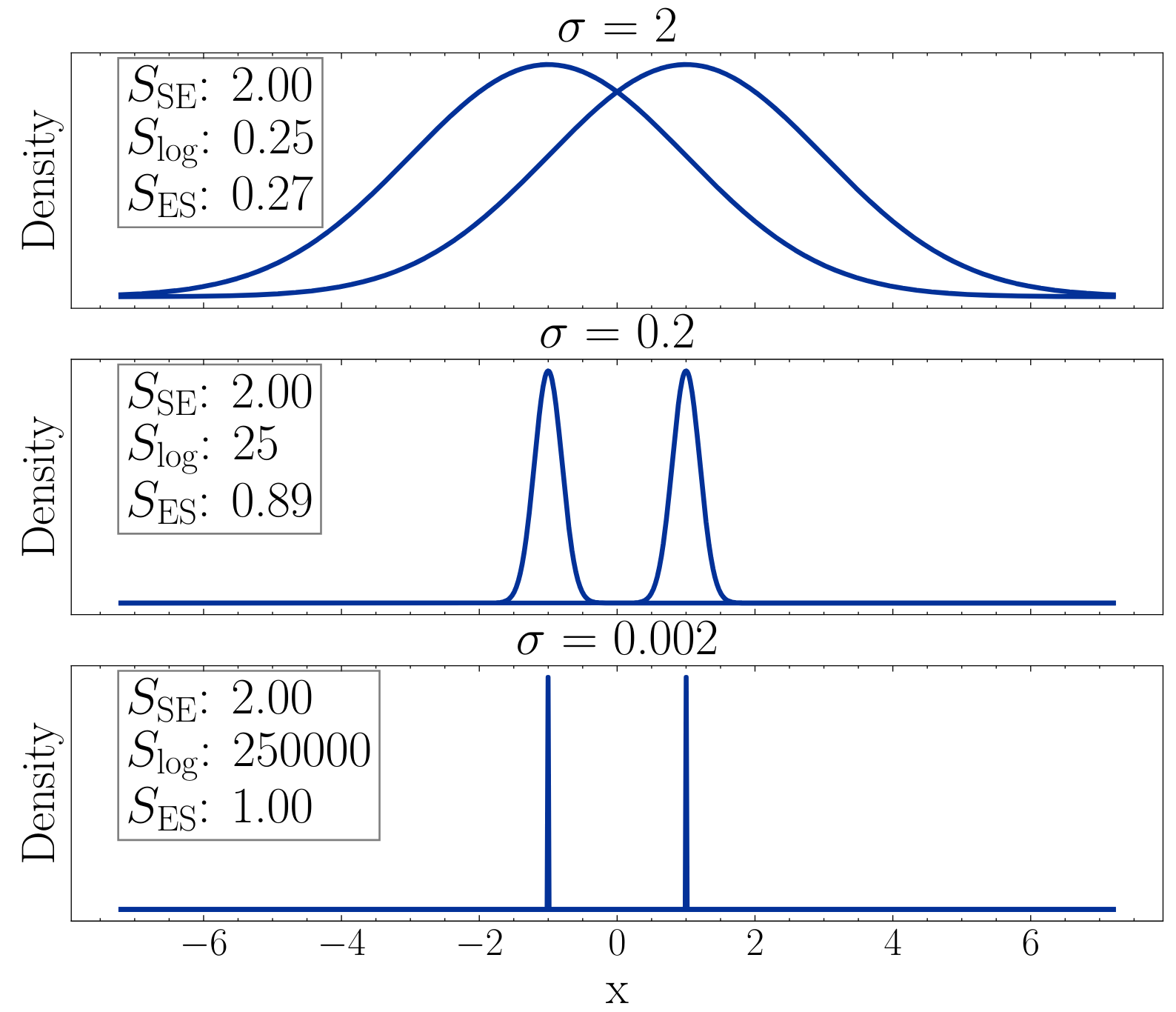
Regression tasks, notably in safety-critical domains, require reliable uncertainty quantification, yet the literature remains largely classification-focused. To address this, we introduce a family of measures for total, aleatoric, and epistemic uncertainty in multivariate regression based on strictly proper kernel scores. The framework provides a principled recipe for designing new uncertainty measures whose behavior, such as tail sensitivity or out-of-distribution responsiveness, is governed by the choice of the underlying kernel, while also encompassing existing measures under a joint analysis. We prove explicit correspondences between properties of the kernel and behavior of resulting uncertainty measures, yielding concrete design guidelines for practitioners. Extensive experiments across structured regression tasks, including spatial and functional domains, demonstrate effectiveness on downstream tasks such as out-of-distribution detection and active learning, and reveal that different kernel choices lead to distinct trade-offs, offering practitioners guidance for task-specific selection.
@article{bülte2025uncertaintyquantificationregressionunified,title={Uncertainty Quantification for Regression: A Unified Framework based on kernel scores},author={Bülte, Christopher and Sale, Yusuf and Kutyniok, Gitta and Hüllermeier, Eyke},journal={Proceedings of the 42nd Conference on Uncertainty in Artificial Intelligence},year={2026},url={https://proceedings.mlr.press/v337/bulte26a.html},}
TMLR
Probabilistic neural operators for functional uncertainty quantification
Christopher Bülte, Philipp Scholl, and Gitta Kutyniok
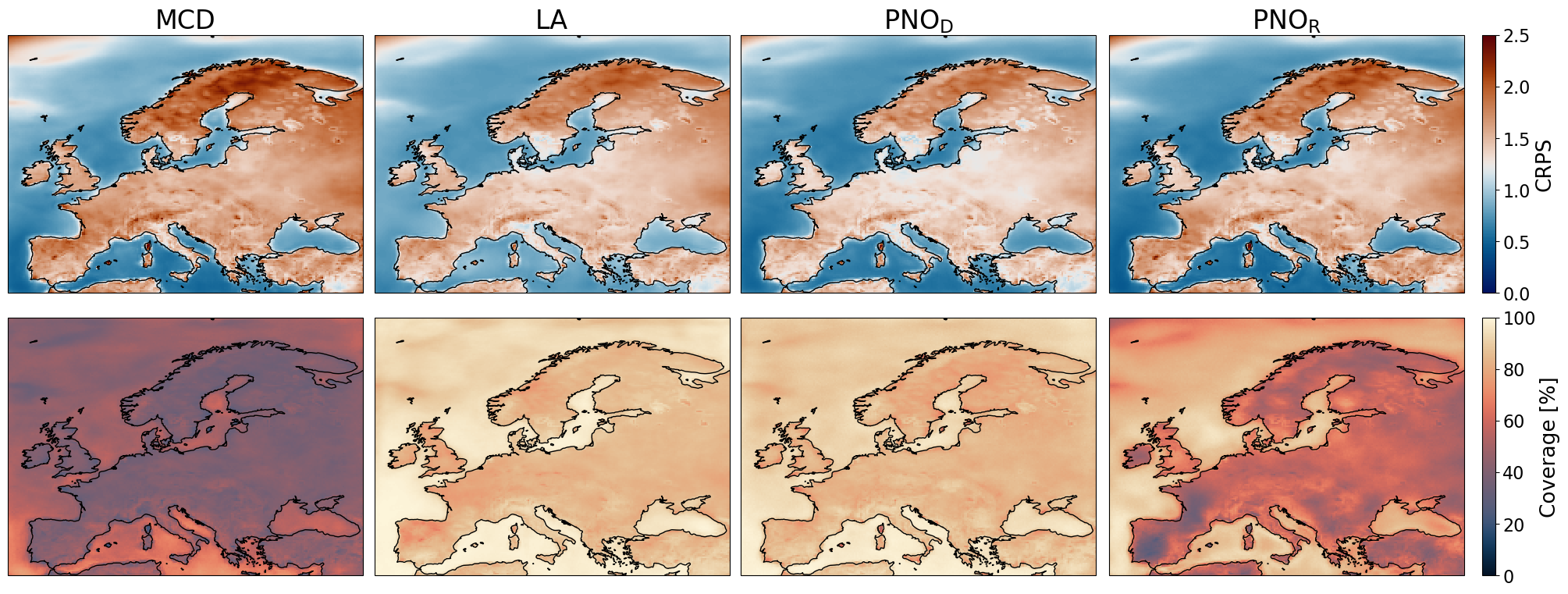
Neural operators aim to approximate the solution operator of a system of differential equations purely from data. They have shown immense success in modeling complex dynamical systems across various domains. However, the occurrence of uncertainties inherent in both model and data has so far rarely been taken into account—a critical limitation in complex, chaotic systems such as weather forecasting. In this paper, we introduce the probabilistic neural operator (PNO), a framework for learning probability distributions over the output function space of neural operators. PNO extends neural operators with generative modeling based on strictly proper scoring rules, integrating uncertainty information directly into the training process. We provide a theoretical justification for the approach and demonstrate improved performance in quantifying uncertainty across different domains and with respect to different baselines. Furthermore, PNO requires minimal adjustment to existing architectures, shows improved performance for most probabilistic prediction tasks, and leads to well-calibrated predictive distributions and adequate uncertainty representations even for long dynamical trajectories. Implementing our approach into large-scale models for physical applications can lead to improvements in corresponding uncertainty quantification and extreme event identification, ultimately leading to a deeper understanding of the prediction of such surrogate models.
@article{bultepno,title={Probabilistic neural operators for functional uncertainty quantification},author={B{\"u}lte, Christopher and Scholl, Philipp and Kutyniok, Gitta},journal={Transactions on Machine Learning Research},issn={2835-8856},year={2025},url={https://openreview.net/forum?id=gangoPXSRw},note={},}
AIES
Uncertainty quantification for data-driven weather models
Christopher Bülte, Nina Horat, Julian Quinting, and Sebastian Lerch
Artificial Intelligence for the Earth Systems, 2026
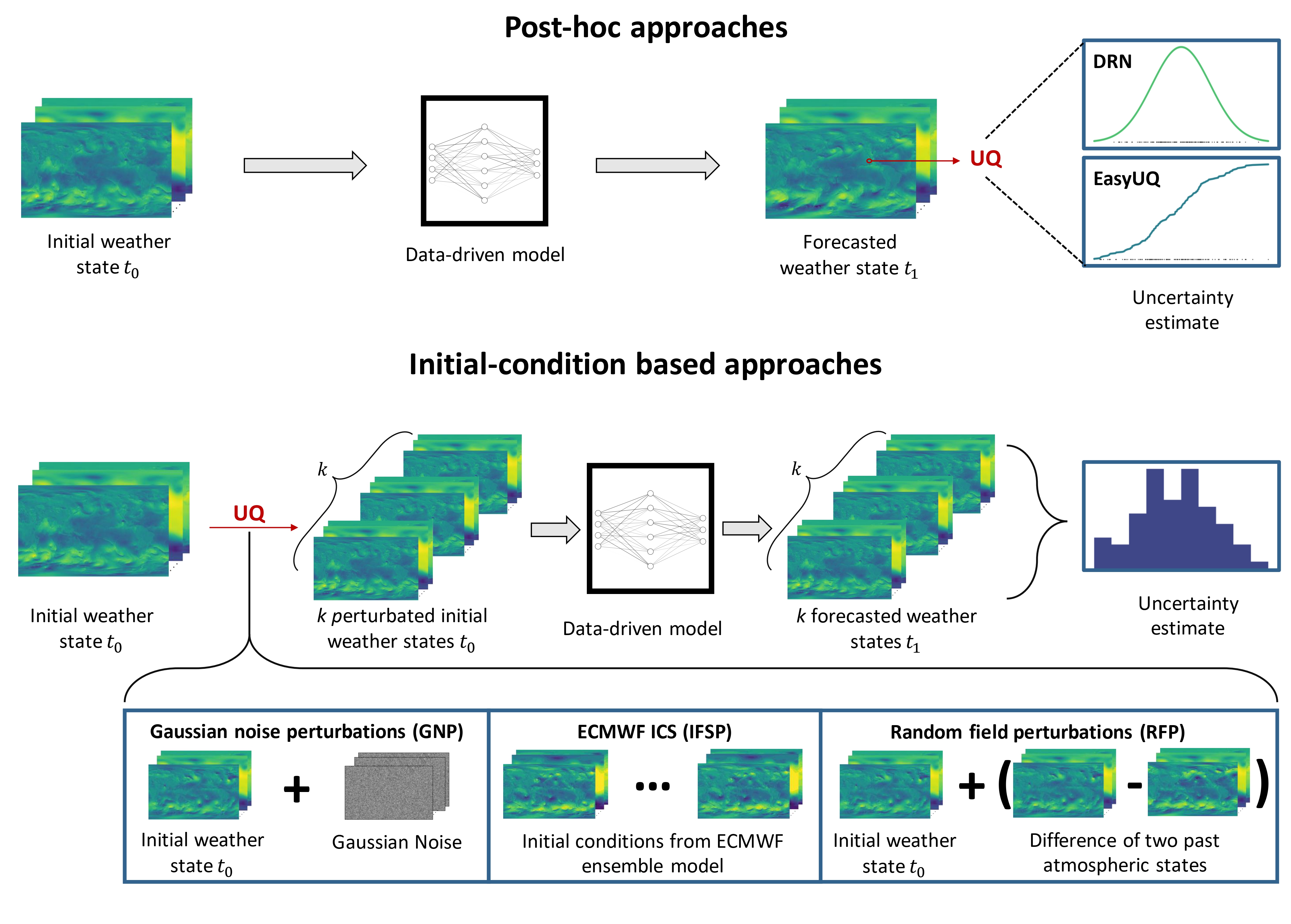
Artificial intelligence (AI)-based data-driven weather forecasting models have experienced rapid progress over the last years. Recent studies, with models trained on reanalysis data, achieve impressive results and demonstrate substantial improvements over state-of-the-art physics-based numerical weather prediction models across a range of variables and evaluation metrics. Beyond improved predictions, the main advantages of data-driven weather models are their substantially lower computational costs and the faster generation of forecasts, once a model has been trained. However, most efforts in data-driven weather forecasting have been limited to deterministic, point-valued predictions, making it impossible to quantify forecast uncertainties, which is crucial in research and for optimal decision making in applications. Our overarching aim is to systematically study and compare uncertainty quantification methods to generate probabilistic weather forecasts from a state-of-the-art deterministic data-driven weather model, Pangu-Weather. Specifically, we compare approaches for quantifying forecast uncertainty based on generating ensemble forecasts via perturbations to the initial conditions, with the use of statistical and machine learning methods for post-hoc uncertainty quantification. In a case study on medium-range forecasts of selected weather variables over Europe, the probabilistic forecasts obtained by using the Pangu-Weather model in concert with uncertainty quantification methods show promising results and provide improvements over ensemble forecasts from the physics-based ensemble weather model of the European Centre for Medium-Range Weather Forecasts for lead times of up to 5 days.
@article{bulteUncertaintyQuantificationDatadriven2024,title={Uncertainty quantification for data-driven weather models},author={Bülte, Christopher and Horat, Nina and Quinting, Julian and Lerch, Sebastian},journal={Artificial Intelligence for the Earth Systems},year={2026},doi={10.1175/AIES-D-24-0049.1},url={https://journals.ametsoc.org/view/journals/aies/aop/AIES-D-24-0049.1/AIES-D-24-0049.1.xml},}
Feel free to reach out to me, if you are interested in my research or working together.
You are visitor 01402775 — GeezerVison does not store the pages you look up. Best viewed with Netscape Navigator 4.7 or Internet Explorer 6 at 800×600. No cookies required.

 .