GV

GeezerVison

The World Wide Web, restored to 800 pixels of glory.

Home|About|Gaming cabinet|Archives|How it works|Starter sites

On this site

  • Overview
  • Package
  • Use
  • Tree
  • Deprecated
  • Index
  • Help
  • Prev Class
  • Next Class
  • Frames
  • No Frames
  • All Classes
  • java.lang.Object
  • java.awt.MenuComponent

This view

  • Original page
  • New address

GeezerVison is showing docs.oracle.com — MenuBar (Java Platform SE 8 )

Skip navigation links
  • Overview
  • Package
  • Class
  • Use
  • Tree
  • Deprecated
  • Index
  • Help
Java™ Platform
Standard Ed. 8
  • Prev Class
  • Next Class
  • Frames
  • No Frames
  • All Classes
  • Summary: 
  • Nested | 
  • Field | 
  • Constr | 
  • Method
  • Detail: 
  • Field | 
  • Constr | 
  • Method
java.awt

Class MenuBar

  • java.lang.Object
    • java.awt.MenuComponent
      • java.awt.MenuBar
  • All Implemented Interfaces:
    MenuContainer, Serializable, Accessible


    public class MenuBar
    extends MenuComponent
    implements MenuContainer, Accessible
    The MenuBar class encapsulates the platform's concept of a menu bar bound to a frame. In order to associate the menu bar with a Frame object, call the frame's setMenuBar method.

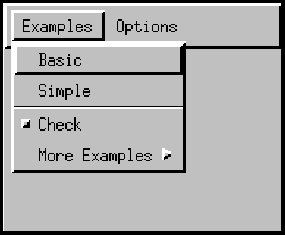
    This is what a menu bar might look like:

    Diagram of MenuBar containing 2 menus: Examples and Options.
 Examples menu is expanded showing items: Basic, Simple, Check, and More Examples.

    A menu bar handles keyboard shortcuts for menu items, passing them along to its child menus. (Keyboard shortcuts, which are optional, provide the user with an alternative to the mouse for invoking a menu item and the action that is associated with it.) Each menu item can maintain an instance of MenuShortcut. The MenuBar class defines several methods, shortcuts() and getShortcutMenuItem(java.awt.MenuShortcut) that retrieve information about the shortcuts a given menu bar is managing.

    Since:
    JDK1.0
    See Also:
    Frame, Frame.setMenuBar(java.awt.MenuBar), Menu, MenuItem, MenuShortcut, Serialized Form
    • Nested Class Summary

      Nested Classes 
      Modifier and Type Class Description
      protected class  MenuBar.AccessibleAWTMenuBar
      Inner class of MenuBar used to provide default support for accessibility.
      • Nested classes/interfaces inherited from class java.awt.MenuComponent

        MenuComponent.AccessibleAWTMenuComponent
    • Constructor Summary

      Constructors 
      Constructor Description
      MenuBar()
      Creates a new menu bar.
    • Method Summary

      All Methods Instance Methods Concrete Methods Deprecated Methods 
      Modifier and Type Method Description
      Menu add(Menu m)
      Adds the specified menu to the menu bar.
      void addNotify()
      Creates the menu bar's peer.
      int countMenus()
      Deprecated. 
      As of JDK version 1.1, replaced by getMenuCount().
      void deleteShortcut(MenuShortcut s)
      Deletes the specified menu shortcut.
      AccessibleContext getAccessibleContext()
      Gets the AccessibleContext associated with this MenuBar.
      Menu getHelpMenu()
      Gets the help menu on the menu bar.
      Menu getMenu(int i)
      Gets the specified menu.
      int getMenuCount()
      Gets the number of menus on the menu bar.
      MenuItem getShortcutMenuItem(MenuShortcut s)
      Gets the instance of MenuItem associated with the specified MenuShortcut object, or null if none of the menu items being managed by this menu bar is associated with the specified menu shortcut.
      void remove(int index)
      Removes the menu located at the specified index from this menu bar.
      void remove(MenuComponent m)
      Removes the specified menu component from this menu bar.
      void removeNotify()
      Removes the menu bar's peer.
      void setHelpMenu(Menu m)
      Sets the specified menu to be this menu bar's help menu.
      Enumeration<MenuShortcut> shortcuts()
      Gets an enumeration of all menu shortcuts this menu bar is managing.
      • Methods inherited from class java.awt.MenuComponent

        dispatchEvent, getFont, getName, getParent, getPeer, getTreeLock, paramString, postEvent, processEvent, setFont, setName, toString
      • Methods inherited from class java.lang.Object

        clone, equals, finalize, getClass, hashCode, notify, notifyAll, wait, wait, wait
      • Methods inherited from interface java.awt.MenuContainer

        getFont, postEvent
    • Constructor Detail

      • MenuBar

        public MenuBar()
                throws HeadlessException
        Creates a new menu bar.
        Throws:
        HeadlessException - if GraphicsEnvironment.isHeadless() returns true.
        See Also:
        GraphicsEnvironment.isHeadless()
    • Method Detail

      • addNotify

        public void addNotify()
        Creates the menu bar's peer. The peer allows us to change the appearance of the menu bar without changing any of the menu bar's functionality.
      • removeNotify

        public void removeNotify()
        Removes the menu bar's peer. The peer allows us to change the appearance of the menu bar without changing any of the menu bar's functionality.
        Overrides:
        removeNotify in class MenuComponent
      • getHelpMenu

        public Menu getHelpMenu()
        Gets the help menu on the menu bar.
        Returns:
        the help menu on this menu bar.
      • setHelpMenu

        public void setHelpMenu(Menu m)
        Sets the specified menu to be this menu bar's help menu. If this menu bar has an existing help menu, the old help menu is removed from the menu bar, and replaced with the specified menu.
        Parameters:
        m - the menu to be set as the help menu
      • add

        public Menu add(Menu m)
        Adds the specified menu to the menu bar. If the menu has been part of another menu bar, removes it from that menu bar.
        Parameters:
        m - the menu to be added
        Returns:
        the menu added
        See Also:
        remove(int), remove(java.awt.MenuComponent)
      • remove

        public void remove(int index)
        Removes the menu located at the specified index from this menu bar.
        Parameters:
        index - the position of the menu to be removed.
        See Also:
        add(java.awt.Menu)
      • remove

        public void remove(MenuComponent m)
        Removes the specified menu component from this menu bar.
        Specified by:
        remove in interface MenuContainer
        Parameters:
        m - the menu component to be removed.
        See Also:
        add(java.awt.Menu)
      • getMenuCount

        public int getMenuCount()
        Gets the number of menus on the menu bar.
        Returns:
        the number of menus on the menu bar.
        Since:
        JDK1.1
      • countMenus

        @Deprecated
        public int countMenus()
        Deprecated. As of JDK version 1.1, replaced by getMenuCount().
      • getMenu

        public Menu getMenu(int i)
        Gets the specified menu.
        Parameters:
        i - the index position of the menu to be returned.
        Returns:
        the menu at the specified index of this menu bar.
      • shortcuts

        public Enumeration<MenuShortcut> shortcuts()
        Gets an enumeration of all menu shortcuts this menu bar is managing.
        Returns:
        an enumeration of menu shortcuts that this menu bar is managing.
        Since:
        JDK1.1
        See Also:
        MenuShortcut
      • getShortcutMenuItem

        public MenuItem getShortcutMenuItem(MenuShortcut s)
        Gets the instance of MenuItem associated with the specified MenuShortcut object, or null if none of the menu items being managed by this menu bar is associated with the specified menu shortcut.
        Parameters:
        s - the specified menu shortcut.
        Since:
        JDK1.1
        See Also:
        MenuItem, MenuShortcut
      • deleteShortcut

        public void deleteShortcut(MenuShortcut s)
        Deletes the specified menu shortcut.
        Parameters:
        s - the menu shortcut to delete.
        Since:
        JDK1.1
      • getAccessibleContext

        public AccessibleContext getAccessibleContext()
        Gets the AccessibleContext associated with this MenuBar. For menu bars, the AccessibleContext takes the form of an AccessibleAWTMenuBar. A new AccessibleAWTMenuBar instance is created if necessary.
        Specified by:
        getAccessibleContext in interface Accessible
        Overrides:
        getAccessibleContext in class MenuComponent
        Returns:
        an AccessibleAWTMenuBar that serves as the AccessibleContext of this MenuBar
        Since:
        1.3
Skip navigation links
  • Overview
  • Package
  • Class
  • Use
  • Tree
  • Deprecated
  • Index
  • Help
Java™ Platform
Standard Ed. 8
  • Prev Class
  • Next Class
  • Frames
  • No Frames
  • All Classes
  • Summary: 
  • Nested | 
  • Field | 
  • Constr | 
  • Method
  • Detail: 
  • Field | 
  • Constr | 
  • Method

Submit a bug or feature
For further API reference and developer documentation, see Java SE Documentation. That documentation contains more detailed, developer-targeted descriptions, with conceptual overviews, definitions of terms, workarounds, and working code examples.
Copyright © 1993, 2026, Oracle and/or its affiliates. All rights reserved. Use is subject to license terms. Also see the documentation redistribution policy.

You are visitor 01402775 — GeezerVison does not store the pages you look up.
Best viewed with Netscape Navigator 4.7 or Internet Explorer 6 at 800×600. No cookies required.