Learn how to use CPD, the copy-paste detector shipped with PMD.
Table of Contents
Overview
Duplicate code can be hard to find, especially in a large project.
But PMD’s Copy/Paste Detector (CPD) can find it for you!
CPD works with Java, JSP, C/C++, C#, Go, Kotlin, Ruby, Swift and many more languages.
It can be used via command-line, or via an Ant task.
It can also be run with Maven by using the cpd-check goal on the Maven PMD Plugin.
Your own language is missing?
See how to add it here.
Why should you care about duplicates?
It’s certainly important to know where to get CPD, and how to call it, but it’s worth stepping back for a moment and
asking yourself why you should care about this, being the occurrence of duplicate code blocks.
Assuming duplicated blocks of code are supposed to do the same thing, any refactoring, even simple, must be duplicated
too – which is unrewarding grunt work, and puts pressure on the developer to find every place in which to perform
the refactoring. Automated tools like CPD can help with that to some extent.
However, failure to keep the code in sync may mean automated tools will no longer recognise these blocks as duplicates.
This means the task of finding duplicates to keep them in sync when doing subsequent refactorings can no longer be
entrusted to an automated tool – adding more burden on the maintainer. Segments of code initially supposed to do the
same thing may grow apart undetected upon further refactoring.
Now, if the code may never change in the future, then this is not a problem.
Otherwise, the most viable solution is to not duplicate. If the duplicates are already there, then they should be
refactored out. We thus advise developers to use CPD to help remove duplicates, not to help keep duplicates in sync.
Refactoring duplicates
Once you have located some duplicates, several refactoring strategies may apply depending on the scope and extent of
the duplication. Here’s a quick summary:
If the duplication is local to a method or single class:
Extract a local variable if the duplicated logic is not prohibitively long
Extract the duplicated logic into a private method
If the duplication occurs in siblings within a class hierarchy:
Extract a method and pull it up in the class hierarchy, along with common fields
If the duplication occurs consistently in unrelated hierarchies:
Introduce a common ancestor to those class hierarchies
Novice as much as advanced readers may want to read on on Refactoring Guru
for more in-depth strategies, use cases and explanations.
Finding more duplicates
For some languages, additional options are supported. E.g. Java supports --ignore-identifiers. This has the
effect, that all identifiers are replaced with the same placeholder value before the comparing. This helps to
identify structurally identical code that only differs in naming (different class names, different method names,
different parameter names).
There are other similar options: --ignore-annotations, --ignore-literals, --ignore-literal-sequences,
--ignore-sequences, --ignore-usings.
Note that these options are disabled by default (e.g. identifiers are not replaced with the same placeholder
value). By default, CPD finds identical duplicates. Using these options, the found duplicates are not anymore
exactly identical.
Required The minimum token length which should be reported as a duplicate.
--language -l
The source code language.
See also Supported Languages.
Using --help will display a full list of supported languages.
java
--debug--verbose-D-v
Debug mode. Prints more log output. See also Logging.
--skip-duplicate-files
Ignore multiple copies of files of the same name and length in comparison.
--skip-lexical-errors
Deprecated (Since 7.3.0) Skip files which can't be tokenized due to invalid characters instead of aborting CPD.
By default, CPD analysis is stopped on the first error. This is deprecated. Use --fail-on-error instead.
--format -f
Output format of the analysis report. The available formats
are described here.
text
--[no-]fail-on-error
Specifies whether CPD exits with non-zero status if recoverable errors occurred.
By default CPD exits with status 5 if recoverable errors occurred (whether there are duplications or not).
Disable this option with --no-fail-on-error to exit with 0 instead. In any case, a report with the found duplications will be written.
--[no-]fail-on-violation
Specifies whether CPD exits with non-zero status if violations are found.
By default CPD exits with status 4 if violations are found.
Disable this feature with --no-fail-on-violation to exit with 0 instead and just output the report.
--ignore-literals
Ignore literal values such as numbers and strings when comparing text.
By default, literals are not ignored.
Java, C++
--ignore-literal-sequences
Ignore sequences of literals such as list initializers.
By default, such sequences of literals are not ignored.
C#, C++, Lua
--ignore-identifiers
Ignore names of classes, methods, variables, constants, etc. when comparing text.
By default, identifier names are not ignored.
Java, C++
--ignore-annotations
Ignore language annotations (Java) or attributes (C#) when comparing text.
By default, annotations are not ignored.
C#, Java
--ignore-sequences
Ignore sequences of identifier and literals.
By default, such sequences are not ignored.
C++
--ignore-usings
Ignore using directives in C# when comparing text.
By default, using directives are not ignored.
C#
--no-skip-blocks
Do not skip code blocks matched by --skip-blocks-pattern
C++
--skip-blocks-pattern
Pattern to find the blocks to skip. It is a string property and contains of two parts,
separated by |. The first part is the start pattern, the second part is the ending pattern.
#if 0|#endif
C++
--help-h
Print help text
Examples
Minimum required options: Just give it the minimum duplicate size and the source directory:
Please note that if CPD detects duplicated source code, it will exit with status 4 (since 5.0) or 5 (since 7.3.0).
This behavior has been introduced to ease CPD integration into scripts or hooks, such as SVN hooks.
0
Everything is fine, no code duplications found and no recoverable errors occurred.
1
CPD exited with an exception.
2
Usage error. Command-line parameters are invalid or missing.
4
At least one code duplication has been detected unless --no-fail-on-violation is set.
Since PMD 5.0.
5
At least one recoverable error has occurred. There might be additionally zero or more duplications detected.
To ignore recoverable errors, use --no-fail-on-error.
Since PMD 7.3.0.
Note:
If PMD exits with 5, then PMD had trouble lexing one or more files.
That means, that no duplications for the entire file are reported. This can be considered as false-negative.
In any case, the root cause should be investigated. If it’s a problem in PMD itself, please create a bug report.
Logging
PMD internally uses slf4j and ships with slf4j-simple as the logging implementation.
Logging messages are printed to System.err.
The configuration for slf4j-simple is in the file conf/simplelogger.properties. There you can enable
logging of specific classes if needed. The --debug command line option configures the default log level
to be “debug”.
Required A positive integer indicating the minimum duplicate size.
encoding
The character set encoding (e.g., UTF-8) to use when reading the source code files, but also when
producing the report. A piece of warning, even if you set properly the encoding value,
let's say to UTF-8, but you are running CPD encoded with CP1252, you may end up with not UTF-8 file.
Indeed, CPD copy piece of source code in its report directly, therefore, the source files
keep their encoding.
If not specified, CPD uses the system default encoding.
failOnError
Whether to fail the build if any errors occurred while processing the files. Since PMD 7.3.0.
true
format
The format of the report (e.g. csv, text, xml).
text
ignoreLiterals
if true, CPD ignores literal value differences when evaluating a duplicate
block. This means that foo=42; and foo=43; will be seen as equivalent. You may want
to run PMD with this option off to start with and then switch it on to see what it turns up.
false
Java
ignoreIdentifiers
Similar to ignoreLiterals but for identifiers; i.e., variable names, methods names, and so forth.
false
Java
ignoreAnnotations
Ignore annotations. More and more modern frameworks use annotations on classes and methods,
which can be very redundant and trigger CPD matches. With J2EE (CDI, Transaction Handling, etc)
and Spring (everything) annotations become very redundant. Often classes or methods have the
same 5-6 lines of annotations. This causes false positives.
false
Java
ignoreUsings
Ignore using directives in C#.
false
C#
skipDuplicateFiles
Ignore multiple copies of files of the same name and length in comparison.
false
skipLexicalErrors
Deprecated Skip files which can't be tokenized
due to invalid characters instead of aborting CPD. This parameter is deprecated and
ignored since PMD 7.3.0. It is now by default true. Use failOnError instead to fail the build.
true
skipBlocks
Enables or disabled skipping of blocks like a pre-processor. See also option skipBlocksPattern.
true
C++
skipBlocksPattern
Configures the pattern, to find the blocks to skip. It is a string property and contains of two parts,
separated by |. The first part is the start pattern, the second part is the ending pattern.
#if 0|#endif
C++
language
Flag to select the appropriate language (e.g. c, cpp, cs, java, jsp, php, ruby, fortranecmascript, and plsql).
java
outputfile
The destination file for the report. If not specified the console will be used instead.
Also, you can get verbose output from this task by running ant with the -v flag; i.e.:
ant -v -f mybuildfile.xml cpd
Also, you can get an HTML report from CPD by using the XSLT script in pmd/etc/xslt/cpdhtml.xslt. Just run
the CPD task as usual and right after it invoke the Ant XSLT script like this:
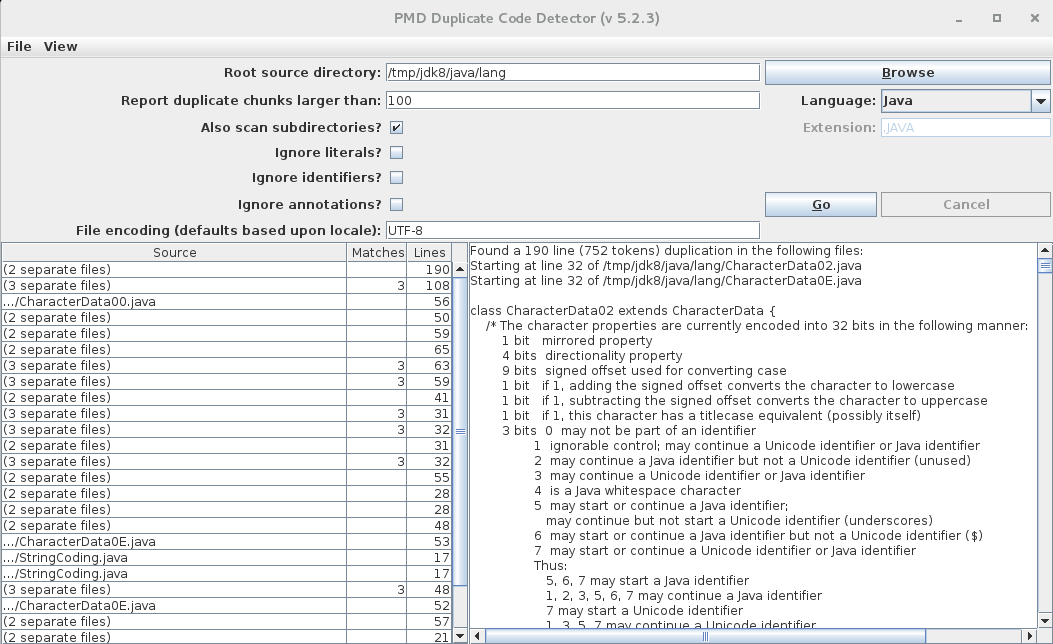
Here’s a screenshot of CPD after running on the JDK 8 java.lang package:
Suppression
Arbitrary blocks of code can be ignored through comments on Java, C/C++, Dart, Go, Groovy, Javascript,
Kotlin, Lua, Matlab, Objective-C, PL/SQL, Python, Scala, Swift and C# by including the keywords CPD-OFF and CPD-ON.
publicObjectsomeParameterizedFactoryMethod(intx)throwsException{// some unignored code// tell cpd to start ignoring code - CPD-OFF// mission critical code, manually loop unrollgoDoSomethingAwesome(x+x/2);goDoSomethingAwesome(x+x/2);goDoSomethingAwesome(x+x/2);goDoSomethingAwesome(x+x/2);goDoSomethingAwesome(x+x/2);goDoSomethingAwesome(x+x/2);// resume CPD analysis - CPD-ON// further code will *not* be ignored}
Additionally, Java allows to toggle suppression by adding the annotations
@SuppressWarnings("CPD-START") and @SuppressWarnings("CPD-END")
all code within will be ignored by CPD.
This approach however, is limited to the locations were @SuppressWarnings is accepted.
It is legacy and the new comment based approach should be favored.
//enable suppression@SuppressWarnings("CPD-START")publicObjectsomeParameterizedFactoryMethod(intx)throwsException{// any code here will be ignored for the duplication detection}//disable suppression@SuppressWarnings("CPD-END")publicvoidnextMethod(){}
Other languages currently have no support to suppress CPD reports. In the future,
the comment based approach will be extended to those of them that can support it.
Credits
CPD has been through three major incarnations:
First we wrote it using a variant of Michael Wise’s Greedy String Tiling algorithm (our variant is described
here).
You are visitor 01402775 — GeezerVison does not store the pages you look up. Best viewed with Netscape Navigator 4.7 or Internet Explorer 6 at 800×600. No cookies required.