GeezerVisonThe World Wide Web, restored to 800 pixels of glory. |
| Home|About|Gaming cabinet|Archives|How it works|Starter sites |
GeezerVison is showing flatcoding.com — PHP Multidimensional Arrays: Data Manipulation - FlatCoding Home PHP Multidimensional Arrays: Data Manipulation
Table of ContentIn web development, managing and manipulating data is one of the most common tasks. When it comes to storing complex data structures, PHP multidimensional arrays provide an essential tool. In this article, we will explore the benefits of utilizing PHP multidimensional arrays, delve into their creation, and learn how to effectively work with them. Let’s start by defining what a PHP multidimensional array is. 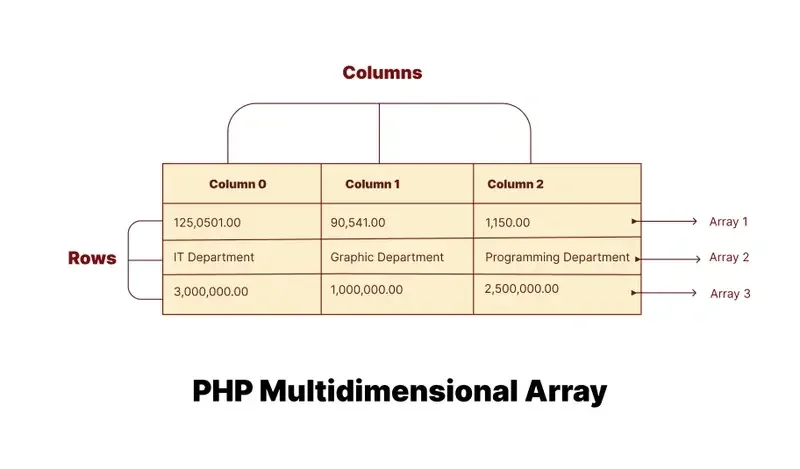 What is PHP Multidimensional Array?The PHP multidimensional array is essentially an array that includes one or more arrays. Each array within the multidimensional array is referred to as a dimension. In simpler terms, a multidimensional array is, in fact, an array of arrays. 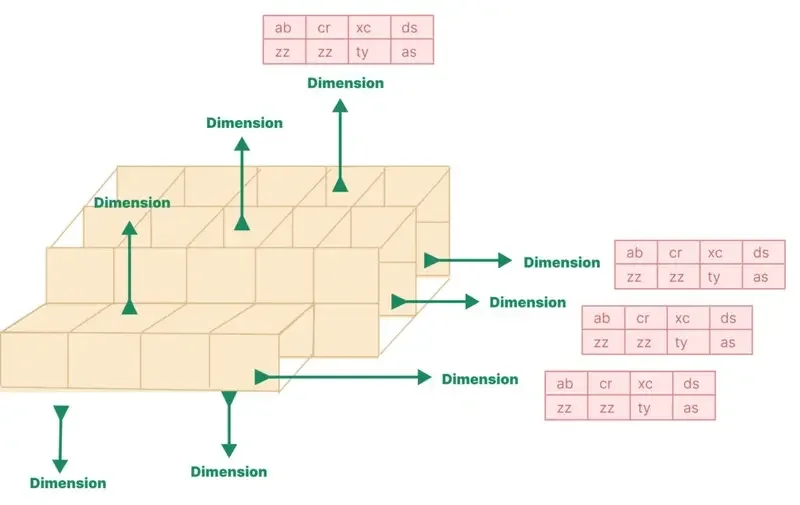 The beauty of multidimensional arrays is that they allow developers to store and organize complex data structures in a way that is easy to manage and manipulate. For example, imagine you have an e-commerce website, and you want to store all the products and their corresponding information. Each product has several attributes such as name, price, description, and image. Instead of creating separate arrays for each attribute, you can create a multidimensional array that contains all of the information for each product in a single array. Now that you grasp the concept of a multidimensional array and recognize its utility, let’s delve into the process of creating one. To do so, you can simply initiate an array and then assign it to another array. Let’s examine an example: In this example, we created a multidimensional array called $products that contains three arrays, each representing a product. Additionally, each product array comprises four key-value pairs, representing the product name, price, description, and image. Now, let’s access this array using loop iteration in PHP. Accessing the PHP Multidimensional ArraysTo work with the multidimensional array, the most common approach is using nested loops. Let’s look at an example: In this example, we used two nested loops to access each key-value pair in the multidimensional array. The outer loop iterates through each product array, while the inner loop iterates through each key-value pair within the product array. We then print out each key-value pair and add a separator between each product. Another method to access the array is by directly referencing the values through the index name or number. Let’s see an example. In this example, we accessed the second product in the Let’s explore how nested arrays work in PHP. Using Nested Arrays in PHP Multidimensional ArraysWhen working with multidimensional arrays, it’s important to keep in mind that you can nest arrays to an arbitrary level. This implies the ability to create arrays within arrays within arrays, and so forth. Let’s illustrate this with an example: In this example, we created a nested multidimensional array called To retrieve the project names for each employee, we can employ another nested loop. Let’s see an example: In this example, we used two nested loops to access each project name for each employee. The outer loop iterates through each employee array, while the inner loop iterates through each project in the employee’s Let’s summarize it. Wrapping UpMultidimensional arrays are an essential tool for managing complex data structures in PHP. They allow developers to store and organize data in a way that is easy to manage and manipulate. When working with multidimensional arrays, it is important to keep in mind that you can nest arrays to an arbitrary level. This allows for even more flexibility and control when managing data. In this article, we explored the benefits of using multidimensional arrays in PHP, how to create them, and how to work with them. By using the examples provided and understanding the key concepts, you should now have a solid foundation for using multidimensional arrays in your PHP applications. Similar ReadsPHP MySQL CRUD: Understanding Database Operations PHP and MySQL have become an inseparable pair for web developers. One handles the logic, while the other stores the… Understanding the PHP Operator Precedence The PHP operator precedence refers to when doing a calculation for three or more numbers, they are calculating its values… PHP MySQL Create Database: MySQLi & PDO Examples If you are working with PHP and MySQL, one of the first tasks you may need is to create a… How to Select Data Using PHP and MySQL? In this article, You will understand everything you need to know about how to use PHP to select data from… PHP Assign Function to Variable – Examples and Explanation PHP variable function is a variable that is used to assign a function name with parentheses (). However, the PHP interpreter… PHP foreach Loop: How to Access Keys & Values in Arrays PHP foreach loop came to help work with array data in a simple way. Arrays and objects grew more common… PHP While Loop: Iterating Through Code Blocks The PHP “while” loop is a simple tool that repeatedly runs a block of code as long as a certain… Understanding the PHP Enumerable Actually, the PHP enumerable is a new feature of 8.1 which allows you to define a new type. This feature… PHP array_find_key: How it Works with Examples The PHP array_find_key function finds a key in an array by a condition. It checks each element and returns the… PHP array_merge_recursive: Merge Arrays Deeply PHP array_merge_recursive joins two or more arrays into one nested array and keeps all values with their keys. Syntax of… onMarch 30, 2025
Write a Comment
|
| You are visitor 01402503 — GeezerVison does not store the pages you look up. Best viewed with Netscape Navigator 4.7 or Internet Explorer 6 at 800×600. No cookies required. |