GeezerVisonThe World Wide Web, restored to 800 pixels of glory. |
| Home|About|Gaming cabinet|Archives|How it works|Starter sites |
GeezerVison is showing gameprogrammingpatterns.com — State · Design Patterns Revisited · Game Programming Patterns StateGame Programming PatternsDesign Patterns RevisitedConfession time: I went a little overboard and packed way too much into this chapter. It’s ostensibly about the State design pattern, but I can’t talk about that and games without going into the more fundamental concept of finite state machines (or “FSMs”). But then once I went there, I figured I might as well introduce hierarchical state machines and pushdown automata. That’s a lot to cover, so to keep things as short as possible, the code samples here leave out a few details that you’ll have to fill in on your own. I hope they’re still clear enough for you to get the big picture. Don’t feel sad if you’ve never heard of a state machine. While well known to AI and compiler hackers, they aren’t that familiar to other programming circles. I think they should be more widely known, so I’m going to throw them at a different kind of problem here. We’ve All Been ThereWe’re working on a little side-scrolling platformer. Our job is to implement the heroine that is the player’s avatar in the game world. That means making her respond to user input. Push the B button and she should jump. Simple enough: Spot the bug? There’s nothing to prevent “air jumping” — keep hammering B while she’s in the
air, and she will float forever. The simple fix is to
add an Next, we want the heroine to duck if the player presses down while she’s on the ground and stand back up when the button is released: Spot the bug this time? With this code, the player could:
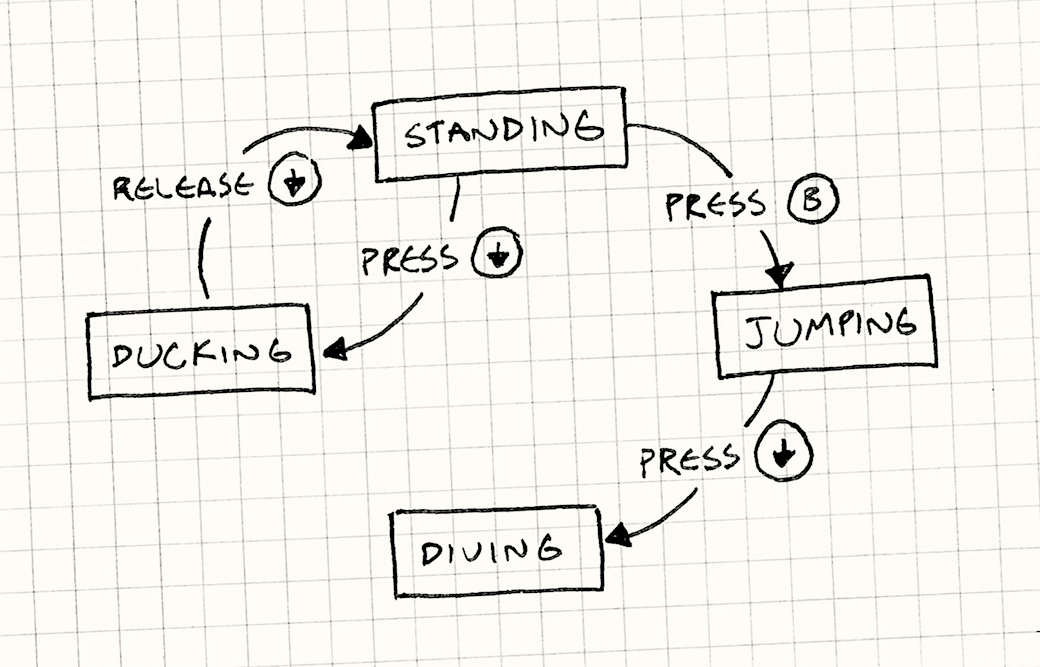
The heroine will switch to her standing graphic in the middle of the jump. Time for another flag… Next, it would be cool if the heroine did a dive attack if the player presses down in the middle of a jump: Bug hunting time again. Find it? We check that you can’t air jump while jumping, but not while diving. Yet another field… Something is clearly wrong with our approach. Every time we touch this handful of code, we break something. We need to add a bunch more moves — we haven’t even added walking yet — but at this rate, it will collapse into a heap of bugs before we’re done with it. Finite State Machines to the RescueIn a fit of frustration, you sweep everything off your desk except a pen and paper and start drawing a flowchart. You draw a box for each thing the heroine can be doing: standing, jumping, ducking, and diving. When she can respond to a button press in one of those states, you draw an arrow from that box, label it with that button, and connect it to the state she changes to.
Congratulations, you’ve just created a finite state machine. These came out of a branch of computer science called automata theory whose family of data structures also includes the famous Turing machine. FSMs are the simplest member of that family. The gist is:
In their pure form, that’s the whole banana: states, inputs, and transitions. You can draw it out like a little flowchart. Unfortunately, the compiler doesn’t recognize our scribbles, so how do we go about implementing one? The Gang of Four’s State pattern is one method — which we’ll get to — but let’s start simpler. Enums and SwitchesOne problem our In this case, that Instead of a bunch of flags, This seems trivial, but it’s a real improvement over the previous code. We still have some conditional branching, but we simplified the mutable state to a single field. All of the code for handling a single state is now nicely lumped together. This is the simplest way to implement a state machine and is fine for some uses. Your problem may outgrow this solution, though. Say we want to add a move where our heroine can duck for a while to charge up and unleash a special attack. While she’s ducking, we need to track the charge time. We add a We need to reset the timer when she starts ducking, so we modify
All in all, to add this charge attack, we had to modify two methods and add a
The State PatternFor people deeply into the object-oriented mindset, every conditional branch is an opportunity to use dynamic dispatch (in other
words a virtual method call in C++). I think you can go too far down that
rabbit hole. Sometimes an But in our example, we’ve reached a tipping point where something object-oriented is a better fit. That gets us to the State pattern. In the words of the Gang of Four:
That doesn’t tell us much. Heck, our A state interfaceFirst, we define an interface for the state. Every bit of behavior that is
state-dependent — every place we had a Classes for each stateFor each state, we define a class that implements the interface. Its methods
define the heroine’s behavior when in that state. In other words, take each Note that we also moved Delegate to the stateNext, we give the
In order to “change state”, we just need to assign Where Are the State Objects?I did gloss over one bit here. To change states, we need to assign Static statesIf the state object doesn’t have any other fields, then the only data it stores is a pointer to the internal virtual method table so that its methods can be called. In that case, there’s no reason to ever have more than one instance of it. Every instance would be identical anyway. In that case, you can make a single static instance. Even if you have a bunch of FSMs all going at the same time in that same state, they can all point to the same instance since it has nothing machine-specific about it. Where you put that static instance is up to you. Find a place that makes sense. For no particular reason, let’s put ours inside the base state class: Each of those static fields is the one instance of that state that the game uses. To make the heroine jump, the standing state would do something like: Instantiated statesSometimes, though, this doesn’t fly. A static state won’t work for the ducking
state. It has a In that case, we have to create a state
object when we transition to it. This lets each FSM have its own instance of the state. Of course, if we’re allocating a new state, that means we need to free the current one. We have to be careful here, since the code that’s triggering the change is in a method in the current state. We don’t want to delete Instead, we’ll allow That way, we don’t delete the previous state until we’ve returned from its method. Now, the standing state can transition to ducking by creating a new instance: When I can, I prefer to use static states since they don’t burn memory and CPU cycles allocating objects each state change. For states that are more, uh, stateful, though, this is the way to go. Enter and Exit ActionsThe goal of the State pattern is to encapsulate all of the behavior and data for one state in a single class. We’re partway there, but we still have some loose ends. When the heroine changes state, we also switch her sprite. Right now, that code is owned by the state she’s switching from. When she goes from ducking to standing, the ducking state sets her image: What we really want is each state to control its own graphics. We can handle that by giving the state an entry action: Back in This lets us simplify the ducking code to: All it does is switch to standing and the standing state takes care of the graphics. Now our states really are encapsulated. One particularly nice thing about entry actions is that they run when you enter the state regardless of which state you’re coming from. Most real-world state graphs have multiple transitions into the same state. For example, our heroine will also end up standing after she lands a jump or dive. That means we would end up duplicating some code everywhere that transition occurs. Entry actions give us a place to consolidate that. We can, of course, also extend this to support an exit action. This is just a method we call on the state we’re leaving right before we switch to the new state. What’s the Catch?I’ve spent all this time selling you on FSMs, and now I’m going to pull the rug out from under you. Everything I’ve said so far is true, and FSMs are a good fit for some problems. But their greatest virtue is also their greatest flaw. State machines help you untangle hairy code by enforcing a very constrained structure on it. All you’ve got is a fixed set of states, a single current state, and some hardcoded transitions. If you try using a state machine for something more complex like game AI, you will slam face-first into the limitations of that model. Thankfully, our forebears have found ways to dodge some of those barriers. I’ll close this chapter out by walking you through a couple of them. Concurrent State MachinesWe’ve decided to give our heroine the ability to carry a gun. When she’s packing heat, she can still do everything she could before: run, jump, duck, etc. But she also needs to be able to fire her weapon while doing it. If we want to stick to the confines of an FSM, we have to double the number of states we have. For each existing state, we’ll need another one for doing the same thing while she’s armed: standing, standing with gun, jumping, jumping with gun, you get the idea. Add a couple of more weapons and the number of states explodes combinatorially. Not only is it a huge number of states, it’s a huge amount of redundancy: the unarmed and armed states are almost identical except for the little bit of code to handle firing. The problem is that we’ve jammed two pieces of state — what she’s doing and what she’s carrying — into a single machine. To model all possible combinations, we would need a state for each pair. The fix is obvious: have two separate state machines. We keep our original state machine for what she’s doing and leave it alone. Then
we define a separate state machine for what she’s carrying.
When the heroine delegates inputs to the states, she hands it to both of them:
Each state machine can then respond to inputs, spawn behavior, and change its state independently of the other machine. When the two sets of states are mostly unrelated, this works well. In practice, you’ll find a few cases where the states do interact. For example,
maybe she can’t fire while jumping, or maybe she can’t do a dive attack if she’s
armed. To handle that, in the code for one state, you’ll probably just do some
crude Hierarchical State MachinesAfter fleshing out our heroine’s behavior some more, she’ll likely have a bunch of similar states. For example, she may have standing, walking, running, and sliding states. In any of those, pressing B jumps and pressing down ducks. With a simple state machine implementation, we have to duplicate that code in each of those states. It would be better if we could implement that once and reuse it across all of the states. If this was just object-oriented code instead of a state machine, one way to share code across those states would be using inheritance. We could define a class for an “on ground” state that handles jumping and ducking. Standing, walking, running, and sliding would then inherit from that and add their own additional behavior. It turns out, this is a common structure called a hierarchical state machine. A state can have a superstate (making itself a substate). When an event comes in, if the substate doesn’t handle it, it rolls up the chain of superstates. In other words, it works just like overriding inherited methods. In fact, if we’re using the State pattern to implement our FSM, we can use class inheritance to implement the hierarchy. Define a base class for the superstate: And then each substate inherits it: This isn’t the only way to implement the hierarchy, of course. If you aren’t using the Gang of Four’s State pattern, this won’t work. Instead, you can model the current state’s chain of superstates explicitly using a stack of states instead of a single state in the main class. The current state is the one on the top of the stack, under that is its immediate superstate, and then that state’s superstate and so on. When you dish out some state-specific behavior, you start at the top of the stack and walk down until one of the states handles it. (If none do, you ignore it.) Pushdown AutomataThere’s another common extension to finite state machines that also uses a stack of states. Confusingly, the stack represents something entirely different, and is used to solve a different problem. The problem is that finite state machines have no concept of history. You know what state you are in, but have no memory of what state you were in. There’s no easy way to go back to a previous state. Here’s an example: Earlier, we let our fearless heroine arm herself to the
teeth. When she fires her gun, we need a new state that plays the firing
animation and spawns the bullet and any visual effects. So we slap together a
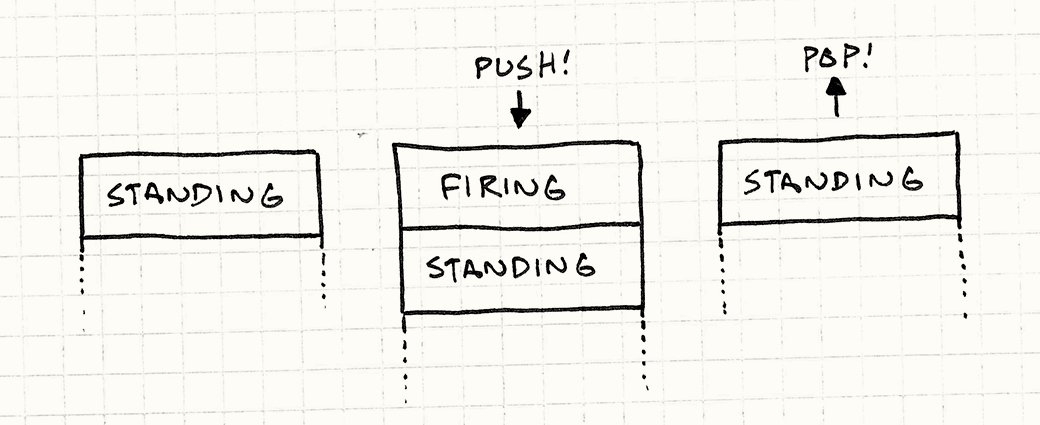
The tricky part is what state she transitions to after firing. She can pop off a round while standing, running, jumping, and ducking. When the firing sequence is complete, she should transition back to what she was doing before. If we’re sticking with a vanilla FSM, we’ve already forgotten what state she was in. To keep track of it, we’d have to define a slew of nearly identical states — firing while standing, firing while running, firing while jumping, and so on — just so that each one can have a hardcoded transition that goes back to the right state when it’s done. What we’d really like is a way to store the state she was in before firing and then recall it later. Again, automata theory is here to help. The relevant data structure is called a pushdown automaton. Where a finite state machine has a single pointer to a state, a pushdown automaton has a stack of them. In an FSM, transitioning to a new state replaces the previous one. A pushdown automaton lets you do that, but it also gives you two additional operations:
This is just what we need for firing. We create a single firing state. When the fire button is pressed while in any other state, we push the firing state onto the stack. When the firing animation is done, we pop that state off, and the pushdown automaton automatically transitions us right back to the state we were in before. So How Useful Are They?Even with those common extensions to state machines, they are still pretty limited. The trend these days in game AI is more toward exciting things like behavior trees and planning systems. If complex AI is what you’re interested in, all this chapter has done is whet your appetite. You’ll want to read other books to satisfy it. This doesn’t mean finite state machines, pushdown automata, and other simple systems aren’t useful. They’re a good modeling tool for certain kinds of problems. Finite state machines are useful when:
In games, they are most known for being used in AI, but they are also common in implementations of user input handling, navigating menu screens, parsing text, network protocols, and other asynchronous behavior. |
| You are visitor 01402503 — GeezerVison does not store the pages you look up. Best viewed with Netscape Navigator 4.7 or Internet Explorer 6 at 800×600. No cookies required. |