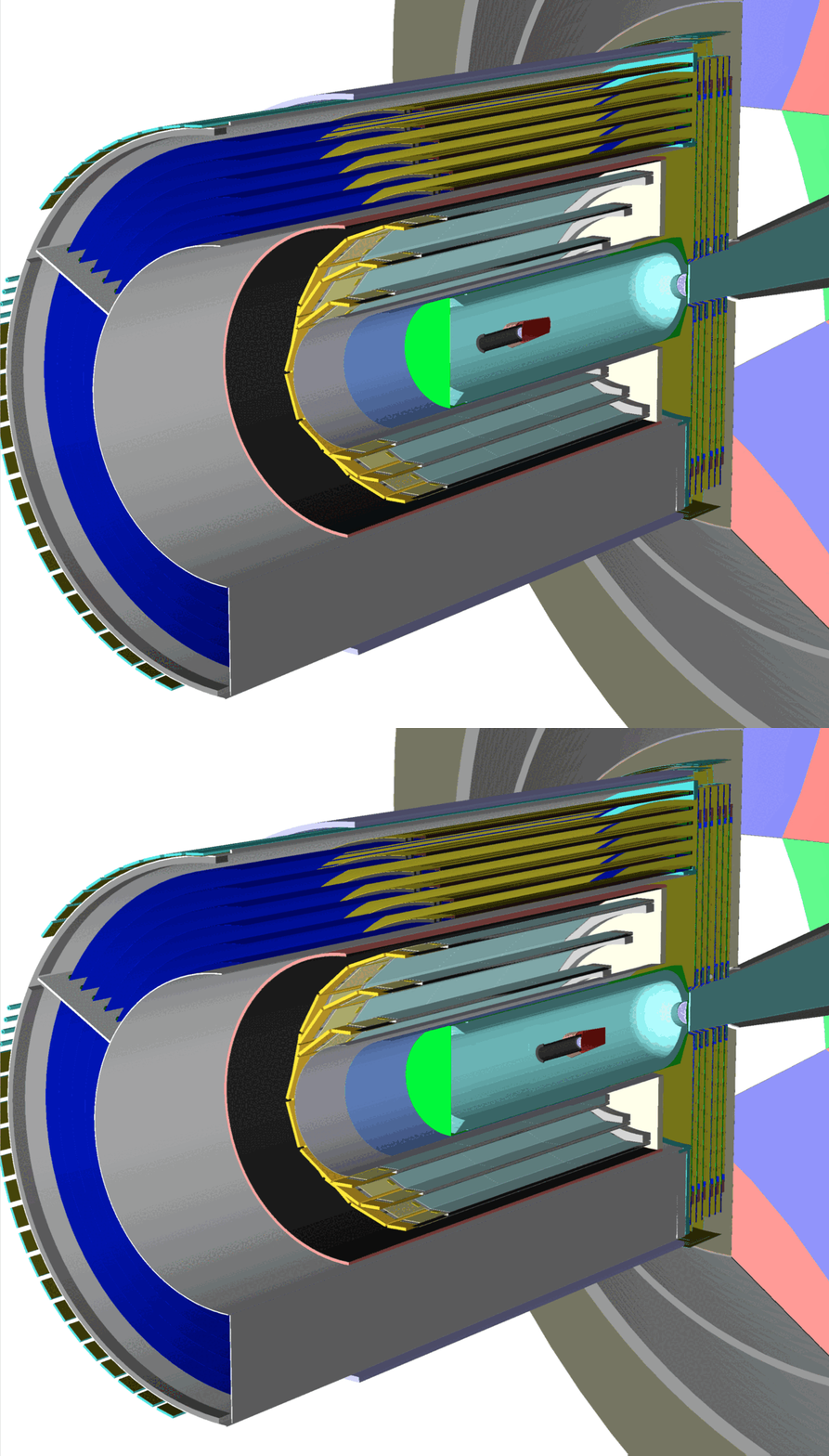
geant4 basic/b2
Reproduces the Geant4 basic B2 example
GeezerVisonThe World Wide Web, restored to 800 pixels of glory. | ||||||||||||||||||||||
| Home|About|Gaming cabinet|Archives|How it works|Starter sites | ||||||||||||||||||||||
GeezerVison is showing gemc.github.io — Home This site documents GEMC version 3 and later. For CLAS12 simulations, use the GEMC2 clas12Tags repository. Database-driven Geant4 simulations with a Python APIGEMC is a database-driven Geant4 application for detector and radiation-transport simulations. Its Python API lets you define complex detector setups without writing Geant4 code. Detector descriptions stay separate from the executable: you create them in Python, store them in ASCII or SQLite databases, and GEMC loads them at run time to execute the Geant4 simulation. Highlights
The goal is to help users prototype detector systems without writing a custom Geant4 application, while C++ plugins support custom detector response, magnetic fields, event generators, and output formats. Try GEMCNo installation needed. Click a badge to launch a live JupyterLab session in your browser:
Container imageFor a local or HPC JupyterLab session, use the prebuilt multi-architecture image: Interactive 3D GalleryRotate the camera with the mouse wheel or use the arrow keys within each thumbnail. Click on the title link for the documentation. geant4 basic/b2Reproduces the Geant4 basic B2 example CADImports STL organ meshes with the CAD factory and records dose per organ Generator Manipulations11 verified vertex and angular cases with Analyzer plots Boolean SolidsBuilds subtraction, union, and intersection solids from reusable component volumes MaterialsDemonstrates Geant4 built-in materials, custom compositions, and optical properties Scintillator Barrel48 trapezoidal scintillator paddles tiling a cylindrical barrel using distribute_on_circle CherenkovShowcases the activation of the Cherenkov radiation in a GEMC detector MirrorsShowcases polished, rough, and semi-transparent optical mirrors under identical conditions Parabolic MirrorFocus optical photons with a thin G4Paraboloid mirror shell DCCLAS12 drift chamber geometry built from the clas12-systems geometry source ECCLAS12 electromagnetic calorimeter geometry built from the clas12-systems geometry source PCALCLAS12 preshower calorimeter geometry built from the clas12-systems geometry source FTOFCLAS12 forward time-of-flight geometry built from the clas12-systems geometry source LTCCCLAS12 low-threshold Cherenkov counter combining native mirror optics with CAD Winston cones HTCCCLAS12 high-threshold Cherenkov counter combining native mirror optics with CAD beamline cones FTCLAS12 forward tagger: PbWO4 calorimeter, scintillator hodoscope, and Micromegas tracker
|
| Quality | Deploy | Docs |
|---|---|---|


|


|


|
Please make sure to cite the following paper if you use GEMC:
M. Ungaro and the CLAS Collaboration, “The CLAS12 Geant4 simulation,” Nuclear Instruments and Methods in Physics Research Section A: Accelerators, Spectrometers, Detectors and Associated Equipment 959, 163422 (2020). https://doi.org/10.1016/j.nima.2020.163422
BibTeX:
@article{UNGARO2020163422,
  title = {The CLAS12 Geant4 simulation},
  journal = {Nuclear Instruments and Methods in Physics Research Section A: Accelerators,
             Spectrometers, Detectors and Associated Equipment},
  volume = {959},
  pages = {163422},
  year = {2020},
  issn = {0168-9002},
  doi = {https://doi.org/10.1016/j.nima.2020.163422},
  url = {https://www.sciencedirect.com/science/article/pii/S0168900220300279},
  author = {M. Ungaro and {CLAS Collaboration}},
  keywords = {Geant4, GEMC, Simulation, Software, Database, Monte Carlo, CAD, STL, GDML, MYSQL, C++}
}
Bibitem:
\bibitem{UNGARO2020163422}
M. Ungaro and the CLAS Collaboration,
\newblock The CLAS12 Geant4 simulation.
\newblock Nuclear Instruments and Methods in Physics Research Section A \textbf{959}, 163422 (2020).
\newblock \doi{10.1016/j.nima.2020.163422}
The GEMC source code is licensed under the Apache License, Version 2.0; see NOTICE for attribution and third-party acknowledgments. The software also depends on separately licensed third-party components, including Geant4, CLHEP, Qt, ROOT, SQLite, and Assimp.