Release notes for the Genode OS Framework 21.05
The most prominent user-visible features of Genode 21.05 are the support for
webcams and an easy-to-use component for file encryption on
Sculpt OS. Both topics greatly benefit
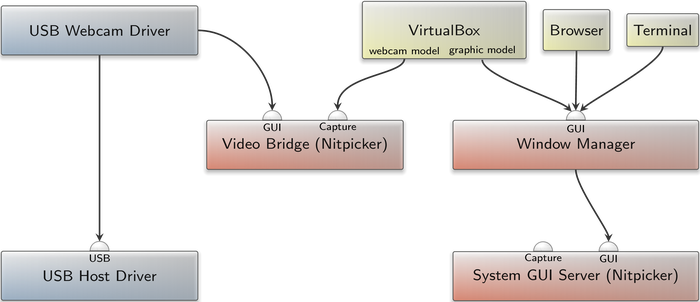
from Genode's component architecture. The video-conferencing scenario
described in Section Webcam support sandboxes the webcam driver in a
disposable Genode component while using a second instance of the nitpicker GUI
server as a video bridge. This design strikes a beautiful combination of
simplicity, robustness, and flexibility.
The new file vault described in Section
File vault based on the CBE block encrypter leverages Genode's dynamic
sandboxing capabilities to manage the creation and operation of an encrypted
file store. Even though the underpinnings can be described as nothing less
than sophisticated machinery, the package presented to the user combines ease
of use with a great sense of control.
The second focus of the current release are the manifold improvements of
Genode's driver and platform support as described in Sections Device drivers
and Platforms. Our USB support received the attention needed to accommodate
the webcam scenario, the arsenal of i.MX8 drivers got enriched with I2C and
power-domain control, the Pine-A64 board support is growing, Genode has become
able to run on 64-bit ARM Linux, and we enabled principle networking for
RISC-V.
Speaking of platforms, this release features the first version of a new
"Genode Platforms" documentation (Section Updated and new documentation)
that aids the porting of Genode to new ARM SoCs. With this document, we share
our former in-house know-how and methodology about the porting and development
of drivers with developers outside of Genode Labs.
The release is rounded up by several performance optimizations
(Section Performance optimizations) to the benefit of most Genode system
scenarios. Furthermore, it is accompanied with an updated tool chain,
following our established two-years rhythm
(Section Tool-chain update to GCC 10.3 and binutils 2.36).
Webcam support
During 2020, the amount of home office and remote work took an unexpected turn.
Video conferences and video chats have become the norm, which people and
companies rely upon. Even though, not to be found on our
road map for 2021, this development
prompted the Genode team to explore the field of webcam and video chat support
on Genode.
Webcams are generally connected via USB to a host device and implement the USB
video device class
(UVC spec).
Therefore, it is possible to drive many different webcam devices using the
same USB interface. To support this protocol, we enabled
libuvc, which offers fine-grained control
over UVC exporting USB devices. In order to enable libuvc on Genode, we
simply integrated the library into Genode's port system with no further
changes required. libuvc depends on libusb as a back
end to access the actual webcam device. While there exists a port of libusb
for Genode - that connects through Genode's USB session interface to the USB
host controller - the port still lacked support for isochronous USB transfers
as required by UVC devices. Isochronous transfers represent a continuous
stream of data (either input or output) with a constant rate without delivery
guarantees. We extended libusb to handle isochronous transfers, which were
already supported by Genode's USB session. Observing that this kind of
transfers can cause high load within the USB host driver, we optimized
isochronous transfer support at the host driver level (Section USB).
At the front-end side, we created a small usb_webcam component that uses
libuvc in order to enable, disable, and configure the camera. The component
connects to a GUI session, and thus, can be interfaced directly, for example,
to the Nitpicker component for rendering webcam images natively on screen.
Whereas Genode's pixel format is 32 bit RGB, webcams stream data in the YUV2,
MJPEG, or H.264 formats. To handle the conversion of these formats to Genode's
pixel format, we utilize the
libyuv library and thereby
support the YUV2 as well as the MJPEG pixel format for webcams.
Additionally, we wanted to be able to transfer the webcam data directly into
our VirtualBox port, thus enabling, sophisticated video conference systems
like Jitsi or Skype.
Our USB host-controller support for VirtualBox is based on the ported Qemu USB
3.0 (XHCI) controller model. Since no USB webcam device model is available for
Qemu, we were required to develop a one from scratch. The new USB webcam model
is attached to the QEMU USB XHCI controller and operates as a bulk endpoint.
In contrast to an isochronous endpoint, the model causes less CPU load and
fewer virtual interrupts. The supported formats offered to the guest are YUV2
and BGR3. By enabling the USB webcam model within the Genode VirtualBox
configuration, a Capture session is used to capture pictures at the rate of
a configured fps value. The following snippet shows the default values of
the supported configuration attributes.
<config ...>
  ...
  <webcam width="640" height="480" fps="15" vertical_flip="false"
          screen_size="false" report="false"/>
  ...
</config>
If the screen_size attribute is set to true, the device model determines
the resolution from the established capture session. Otherwise, the specified
width and height values are used. The vertical_flip attribute is useful
for the BGR3 format, which is - when interpreted by Linux guests - flipped
vertically and can be flipped back by setting the attribute to true.
If the report attribute is set to true, a report will be generated
whenever the guest changes the state of the webcam model, either by switching
capturing on/off or by changing the pixel format.
<capture enabled="true/false" format="YUV2/BGR3"/>
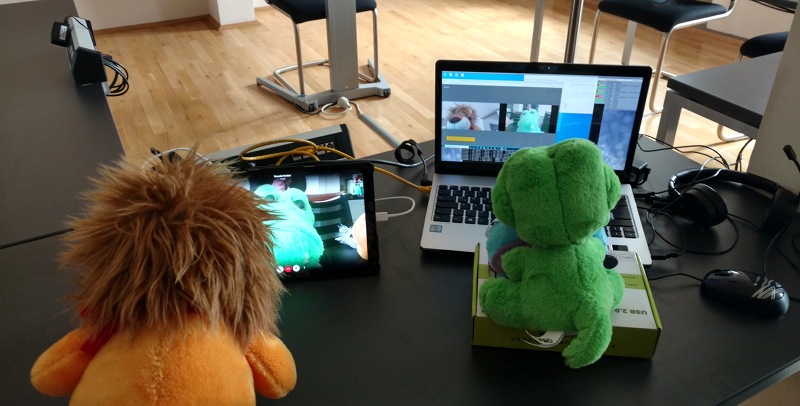
Finally, our developers, croc and lion, setup the Webcam scenario in Sculpt
and test drive the new feature fascinated. The picture shows a session via
Jitsi, on the right side croc participates at the meeting via a Win10 VM on
Sculpt and lion sitting left joined via an Android tablet.
Performance optimizations
One of the overarching topics of this year's
roadmap is optimization.
As part of working on the Sculpt OS
version 21.03,
we identified several optimization vectors with the potential for user-visible
improvements. In particular, while interacting with the system, a few effects
made us curious.
Operations that involved changes to the runtime subsystem, e.g., adding or
reconfiguring a component, seemed to interfere with multi-media workloads.
When running a graphical animation, we could see it stutter in such
situations. Another direction of our curiosity was the boot time of the
system. The boot time of Sculpt OS has always been relatively quick compared
to commodity operating systems. E.g., on a 5-years old laptop like a Lenovo
x260, the system used to boot in about 5 seconds to the graphical user
interface. However, with the anticipation of Sculpt OS on lower-end platforms
like the PinePhone and with the vision of instant-on systems, we wondered
about the potential for improvement.
While gathering a CPU-load profile of the boot process using the top tool, we
learned that the boot time was bounded not by I/O but by the CPU load (the
kernel's idle thread did not appear in the profile). Interestingly, a
significant portion of the cycles were consumed by various instances of the
init component, which prompted us to turn our attention to the implementation
of init.
Clock-cycle measurements
The next natural step was the benchmarking of various code paths of init using
a cycle-accurate time-stamp counter (TSC). Even though Genode has a
Trace::timestamp utility readily available, it remains barely used for
manual instrumentation because such instrumentations require too much labor:
allocation of state variables for gathering the statistics, computing time
differences, traffic-shaping of the debug noise (needed whenever investigating
highly frequently called code). These tasks should better be covered by a
utility so that friction-less performance analysis can become a regular part
of our development work. As a side effect of our investigation, we came up
with a new utility called GENODE_LOG_TSC. This utility is covered by a
dedicated article.
Thanks to GENODE_LOG_TSC, we were able to identify three concrete
opportunities for optimization in a course of one evening. First, the dynamic
reconfiguration of init apparently did not scale well with a growing number of
components. The code for analysing differences of configuration versions
relied on doubly nested loops in order to stay as simple as possible. With the
typical number of 30 or more components/subsystems hosted in Sculpt's runtime,
we passed a tipping point where quadratic time complexity is justifiable.
Second, during a configuration update, the XML data is evaluated in multiple
passes, which puts pressure on the efficiency of Genode's XML parser. This
pressure could in principle be relieved. Third, the process of taking
session-routing decisions involved XML parsing. In scenarios as sophisticated
as Sculpt, the routing rules can become quite elaborate. Since the rules are
consulted for each session route, the costs for the rule evaluations stack up.
Init optimizations
These realizations motivated us to replace the hand-crafted configuration
processing by the use of Genode's generic List_model utility. This way, the
parsing follows a common formalism that makes the code easier to maintain and
to understand while reducing the XML parsing to a single pass. The increased
formality cleared the way for further optimizations. In particular, init
became able to skip the re-evaluation of the session routing whenever no
service is affected by the configuration change. This is actually the common
case in Sculpt.
To alleviate the costs for evaluating session routes, we introduced an
internal data model for the routing rules that is optimized for the matching
of routes. With this model, the detection of a definite mismatch (the common
case) comes down to a comparison of a single numeric value.
Combined, those optimizations yield a great effect. In a typical Sculpt
system, the time of a dynamic reconfiguration got reduced by factor 10 to the
order of 10 to 20 milliseconds. Hence, the visual stuttering we observed
during structural changes of the runtime are completely eliminated.
Besides the major optimization of init, we were able to shave off a few
milliseconds from the boot procedure here and there. For example, by deferring
the initialization of the real-time clock driver to its first use, we avoid a
potentially expensive active polling loop during the highly contended boot
phase. Another obvious heuristic improvement is the skipping of the GUI
handling until the framebuffer driver is up because all the nice pixels would
not be visible anyway.
Combined, these optimizations were able to reduce the boot time of Sculpt from
the entering of the kernel up to the graphical user interface down to only 2.3
seconds. The improved performance of init is impactful beyond Sculpt OS
because it is a central component of all Genode systems large and small.
Updated and new documentation
Genode Platforms
We are proud to introduce the first version of a new "Genode Platforms"
document, which complements the existing Genode Foundations book with
low-level hardware-related topics. It is primarily intended for integrators
and developers of device drivers.
In this first edition, the document features a practical guide for the steps
needed to bring Genode to a new ARM SoC. The content is based on the ongoing
Pine Fun article series at Genodians.org.
We plan to continuously extend it with further practical topics as we go.
Genode Foundations
The "Genode Foundations" book received its annual update. It is available at
the https://genode.org website as a PDF document and an online version.
The most noteworthy additions and changes are:
-
Adaptation to the re-stacked GUI stack introduced in
version 20.08
-
Coverage of the new uplink, capture, and event session interfaces
-
Updated API documentation
To examine the changes in detail, please refer to the book's
revision history.
Base framework and OS-level infrastructure
API refinements
VFS-access utilities
Low-complexity native Genode components do not depend on a C runtime. To allow
such components to still enjoy the power and flexibility of the Genode's VFS
infrastructure, we provide an evolving front-end API
os/vfs.h
first introduced in version
19.11.
The API is tailored and refined according to the relatively simple use cases
of low-complexity Genode components. The current release introduces a new
utility for the creation of new files, appropriately named New_file. The
change is accompanied by a new Directory::create_sub_directory method for
the easy creation of directory hierarchies.
Safeguarded arrays
To handle arrays in a safe and C++-like fashion, a new helper class has become
available at base/include/util/array.h. It accommodates an increasingly used
pattern where elements are dynamically added at construction time but stay the
same once the array is constructed.
Cosmetic changes
We refined the Range_allocator::alloc_aligned interface to make it more
safe. The former from and to arguments are replaced by a single range
argument. The distinction of the use cases of regular allocations vs.
address-constrained allocations is now covered by a dedicated overload instead
of relying on a default argument. The align argument has been changed from
int to unsigned to be better compatible with addr_t and size_t.
The Cache_attribute type has been renamed to Cache.
Input-event handling
A central component for Genode's input-event handling functionality is the
event filter. It merges input events from multiple event sources and passes
them to the event sink (typically the GUI server). In between, it performs
low-level key remapping and applies character mapping rules. Character mapping
rules are essential for supporting different keyboard layouts (including
dead-key sequences). Low-level key remapping is, for instance, used for
changing the emitted key codes of the Num Pad keys according to the Num Lock
state. The different filter functionalities can be arbitrarily assembled into
a filter chain and provided as a dynamic config ROM to the event filter
component. The event sink then receives and processes the filtered events.
Some input devices emit unusual and/or extra key codes in certain situations,
which impedes the event sink's ability to detect key combos correctly. We
therefore added the functionality to completely mute certain key codes. In
order to ignore all unknown key codes for instance, we can now add an
<ignore-key> node to the config of the event filter.
 <remap>
   <ignore-key name="KEY_UNKNOWN"/>
   ...
 </remap>
Note, that <ignore-key> is part of the <remap> filter. The name attribute
refers to the low-level key name before any remapping rule has been applied.
As a second addition, we implemented a <log> filter that allows low-level
debugging of the event-filter component and its configuration. The <log>
filter can appear at each stage in the filter chain. For instance, we can log
the input events before and after the remap filter as follows.
 <log prefix="REMAPPED ">
   <remap>
     <log prefix="RAW ">
       ...
     </log>
   </remap>
 </log>
The optional prefix attribute thereby helps to distinguish the log output
from different stages.
File-system helpers
The
fs_query
component is a simple helper to query information from a file system. E.g., it
is used by the file browser of Sculpt OS to obtain the directory structure.
The component received two welcomed improvements. First, directory content is
now reported in alphabetic order. Thereby, all consumers of the reports become
able to rely on deterministic output. For example, the file browser of Sculpt
OS, the launcher menu items, and the depot-selection items will appear in a
predictable way. Second, the size of files can be queried now. By adding an
attribute size="yes" to a query, fs_query is instructed to report the size
of each queried file as attribute size of the corresponding file node.
Whereas fs_query inspects a file system without changing it, its sister
component fs_tool is able to perform file-system modifications. The new
version adds a <new-file path="..."> operation, which writes the content of
the XML node into the file specified as path attribute. The directory
structure leading to the file is implicitly created if needed. Should a file
with the specified name already exist, the original file will be overwritten.
Applications
File vault based on the CBE block encrypter
Over several releases
(19.11,
20.05,
20.08,
20.11),
we persistently worked at a native solution for modern block encryption - the
SPARK-based CBE-library - and its integration into Genode's VFS. Even though,
this work was already suitable for real-world scenarios like
hosting a Linux VM on top of an encrypted block device,
it still lacked stress-testing by a regular user base because its integration
into an end-user system - like Sculpt - required tedious low-level wizardry.
This situation had to change because we want to encourage as many people as
possible to expose the codebase around the CBE to their workflows and let it
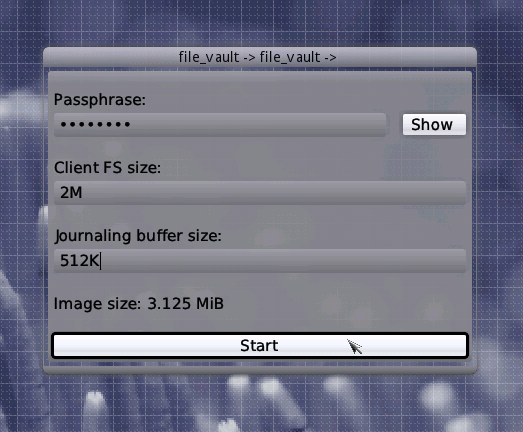
mature. Therefore, we came up with a new package called file vault that can be
readily deployed on Sculpt OS. It is a graphical front end that aims at making
the creation, use, and maintenance of a CBE-based encrypted file store as
intuitive and secure as possible.
The file vault only requires two file-system sessions from you (the trust
anchor is stored separately from the payload data). With that, it will
automatically create and connect a trust anchor, set up a CBE image, prepare
an ext2 FS on top of the CBE image and provide it through a file system
service - ready to be used like a simple directory. The directory can be
locked by closing the file vault and unlocked by starting the file vault on
the same trust anchor and entering the correct user passphrase. All controls
for the file vault's underlying CBE encrypter - like for its re-sizing and
re-keying functionality - are presented through a simple and guiding UI that
also provides you with the most relevant status information of your vault.
The file vault package is accompanied by some notable improvements regarding
CBE's key management. Whereas in the previous release, this aspect was still
merely a prototype with almost no protective value, the current implementation
embraces well-known algorithms to generate and encrypt the keys used within
the CBE respectively the file vault. This is explained in detail in the
aforementioned article.
As a note of caution, the primary purpose of the current version of the file
vault is to lift native block encryption in Genode from the development stage
to product quality. At the current stage, it is neither time-tested nor
reviewed by independent cryptography experts. Consequently, you should use it
with a healthy dose of suspicion, for non-critical data only! We would be more
than happy to receive feedback on your experience with the file vault.
VirtualBox
Since the previous release, we continued the enablement of VirtualBox 6 on
Genode and put efforts into stabilizing the port. Therefore, we updated to
version 6.1.18 and reorganized the internal structure for a more
comprehensible execution model with fewer threads. Further, we improved
synchronization in multi-processor use cases and added a Sculpt runtime
package for vbox6.
Finally, as a little treat, our ports of VirtualBox now support to pass extra
buttons of five-button mice to the guest.
Device drivers
Platform driver on ARM
The current release streamlines Genode's API for interacting with the platform
driver on ARM platforms. It eases the access to memory-mapped I/O registers
and interrupts by introducing the notions of
- Platform::Device
-
one device obtained from a platform session
- Platform::Device::Mmio
-
locally-mapped MMIO registers of a device
- Platform::Device::Irq
-
interface for receiving device interrupts
The API is covered in detail by the following article.
It goes without saying that this change touches most ARM-specific drivers.
Closely related, we also revised the concept of the XML based device-info
mechanism provided by the platform driver to accommodate both complex drivers
operating on multiple devices simultaneously such as driver stacks ported from
Linux as well as low-complexity drivers for simple devices. In the new
version, the device XML-information dataspace is only provided if the client's
session policy states info="yes". The format of the XML information got
refined to include the physical resource names (I/O memory and IRQ addresses)
instead of virtual IDs and page offsets and by using a type attribute
instead of a <compatible> node to uniquely identify devices.
Changes specific to i.MX8
The platform driver incarnation specific to i.MX8 got slightly improved. It
can handle the configuration of reset-pins now. Analogously to the already
existent power domains, one can assign reset domains per device. Whenever a
device with a reset domain gets acquired, its reset-pins are de-asserted. When
the device gets released again, its reset-pins are asserted to put it into
reset state. A sample configuration looks as follows:
 <device name="mipi_dsi>
   <reset-domain name="mipi_dsi_pclk"/>
   ...
 </device>
Technically, those reset domains map to pin settings of the System Reset
Controller (SRC) that is part of the i.MX8 SoC. The SRC is under control of
the platform driver now. Currently, only the pins for the MIPI DSI Phy get
exported. They are used by the graphical subsystem to handle panels connected
via MIPI DSI.
I2C driver for i.MX8
Thanks to Jean-Adrien Domage from gapfruit, an
API for I2C bus transactions and a new I2C bus driver for the i.MX8 SoC
entered our framework. Coincidentally, the need to use the new I2C API more
intensively arose soon after his initial contribution. As a consequence, the
API got extended a bit. The result is a nice joint venture, and looks like the
following:
void transmit(Transaction & t);
Hereby a Transaction is a simple array of Message objects, and a Message
is an array of bytes that are either read or written. For very simple
use-cases, e.g., a client that polls single bytes from a temperature sensor,
some convenience utilities are incorporated into the I2c::Connection.
USB
The USB-driver system has received quite a few refinements, performance
improvements, and robustness handling efforts during the current release
cycle. The HID subsystem is now capable of handling devices where the HID USB
interface is at an arbitrary location within the device descriptors - as
opposed to the assumption that the HID interface is always at the first
position in the interface list of the device. Also, the HID driver now handles
session destruction more gracefully and supports unlimited plug and unplug
events of an associated HID device.
For the USB host driver, various fixes of newer Linux kernel versions have
been back ported, which concern the handling of DMA memory. Error code and
timeout handling have been improved in order to support more corner cases, and
the USB session handles outstanding USB requests (synchronous and
asynchronous) on sudden session disconnects gracefully now.
The CPU usage of the host driver for isochronous transfers has been reduced
significantly for Intel XHCI controllers by adding a fix that reduces the
triggering of an interrupt for every completed isochronous packet to one
interrupt per eight packets, bringing the worst case scenario down to 1000
interrupts per second from a possible 8000 IRQs before.
NIC drivers
Drivers for iPXE-supported Ethernet devices, Wifi adapters, and Linux TAP
devices now support the reporting of the MAC address of detected adapters.
The feature can be enabled by a <report> node in the driver configuration as
follows, prompting the driver to request a report session with the label
devices.
 <config>
   <report mac_address="true"/>
 </config>
The resulting report is depicted below.
 <devices>
   <nic mac_address="02:00:00:00:00:01"/>
 </devices>
Platforms
Genode/Linux on 64-bit ARM
The release introduces the support for running the Linux version of Genode on
64-bit ARM platforms. As a part of this line of work, Genode's system call
bindings for Linux underwent a modernization to harmonize the system calls
across the supported CPU architectures. Furthermore, we took the opportunity
to simplify the use of the clone system call by eliminating the need for
passing a TLS pointer.
Expecting that the 64-bit Genode/Linux version will remain a niche use case of
Genode in the foreseeable future, we do not provide a pre-built tool chain.
Hence, as a preparatory step for using this version of Genode, the tool chain
must be built manually via Genode's tool/tool_chain script.
As a known limitation, Genode's Trace::timestamp function is not available
on this version of Genode because Linux prevents the user land from accessing
the cycle counter (pmccntr_el0). So the accuracy of timing is somewhat impeded
to the order of milliseconds. Also, the jitterentropy random-number generator
cannot be used.
Those limitations notwithstanding, one can successfully execute scenarios as
complex as leitzentrale.run. When using AARCH64 Linux as host, run scripts
can be executed with the same convenience as on Linux on a PC.
$ make run/<script> KERNEL=linux BOARD=linux
Pine-A64-LTS single board computer
The current release continues
our story
of porting Genode to the
Pine-A64-LTS
board. We document the progress in great detail as we go.
-
Kernel packaging and testing
-
Device access from the user level
-
One Platform driver to rule them all
-
Taking Linux out for a Walk
-
Pruning device trees
The accumulated material forms the basis for the evolving Genode Platforms
document introduced in Section Updated and new documentation.
The code of this line of work is available at a dedicated repository:
RISC-V
The support for the RISC-V architecture has further been developed into the
direction of a fully supported Genode platform. With this release, we wanted
to enable basic device driver support, which requires a working interrupt
controller. Since the "platform-level interrupt controller" (PLIC) is now
present on most hardware as well as on the Qemu emulator, we have added
support for the PLIC within our base-hw kernel.
With the interrupt controller in place, we implemented a driver for the
OpenCores Ethernet device as present on the
MiG-V board. The driver component runs on
Qemu (with OpenCores enabled) as well as on the MiG-V board itself. Our RISC-V
board specific line of work can now be found within a separate
repository.
With driver support in place, the final step for full RISC-V support in Genode
is to extend our C library for this architecture.
Build system and tools
Tool-chain update to GCC 10.3 and binutils 2.36
About every two years, we update our tailored Genode tool chain to recent
versions. This year's update includes GCC 10.3.0, binutils 2.36.1 and GDB 10.2
together with their corresponding Genode libraries and tools (stdcxx, ADA
runtime, libsparkcrypto, gcov, sanitizer).
Feature-wise, changes are not as significant this time as with the
previous update,
nevertheless we had to overcome some hurdles worth noting.
-
The gprbuild tool, which is needed to build the ali2dep
tool had a bug in the version provided by Ubuntu 18.04, which prevented it
from building ali2dep with GCC/GNAT 10. To still be able to build the
tool chain on Ubuntu 18.04, the gprbuild tool is now built from
source (of a newer version) when running the tool_chain script.
-
When building the tool chain on armhf Linux, errors occurred because
of mismatching float-abi compiler flags used when building the
dependency libraries (gmp, mpc, mpfr) with the host tool chain and
when building the Genode tool chain with the intermediate bootstrap
tool chain. To solve this problem, the dependency libraries are now
downloaded and built using the GCC build system. This also had the
effect that the mpc and mpfr Genode ports were not needed anymore
and got removed.
-
GCC 10 reports more compile errors, which had to be fixed. The most common
errors related to narrowing conversions and potential unaligned pointers
from packed members.
-
GCC 10 has the -fno-common option set by default, which caused link
errors especially with some 3rd party ports.
-
GCC 10 generated memset() calls in implementations of memset(),
which caused stack overflows from this recursion.
-
The ARM compiler generates more VFP instructions now, especially when
building for armv6, so we had to update the setjmp() and longjmp()
functions used by dde_linux drivers to additionally save and restore the
FPU registers on ARM.
-
With the new binutils version, linker sections with the same name in
multiple linker scripts are not merged anymore. Since we rely on this
behavior when building core for NOVA, we reverted the corresponding change
with a patch.
-
With the new binutils version, executable files are not allowed as input
when linking executable output files anymore. The build process of the
Fiasco.OC kernel relied on this behavior and needed to be adapted by the
upstream developers.
The new tool chain has not been enabled for RISC-V yet, because of an unsolved
issue on initialization (resp. initial relocation) of our dynamic linker.
Until we finalized the RISC-V support, we recommend using the tool chain
version 19.05 for this CPU architecture by adding the following two lines to
your build directory's etc/tools.conf.
 CROSS_DEV_PREFIX = /usr/local/genode/tool/19.05/bin/genode-riscv-
 REQUIRED_GCC_VERSION = 8.3.0
The updated tool chain can be built from source or downloaded in binary form
as described in this document.
Utilities for porting Linux drivers
Dummy-function generator
While porting device drivers from the Linux kernel to Genode, one has to
tailor the environment that replaces the original kernel code. Thereby, tons
of missing function and variable implementations have to be written. Most of
them won't even be called by the driver under normal circumstances, but
nonetheless they are needed to link the executable binary.
The production of these dummy functions in the first place is a tiresome and
somewhat annoying work. To free developers from this burden, a new tool
entered the Genode framework under tool/dde_linux/create_dummies. Apart from
the creation of missing kernel functions and variables, it can also be used to
easily summarize all missing symbols during the porting work.
For a more detailed explanation of the new tool, please have a look at the
following article.
Device-tree source processing
Device-tree source files as featured in the source tree of the Linux kernel
contain valuable information about the structure and parameters of SoCs and
boards. The porting and implementation of device drivers for Genode calls for
tooling that is able to extract and convert this information into digestible
forms. The current release introduces the first version of a new tool set at
tools/dts/ for this purpose.
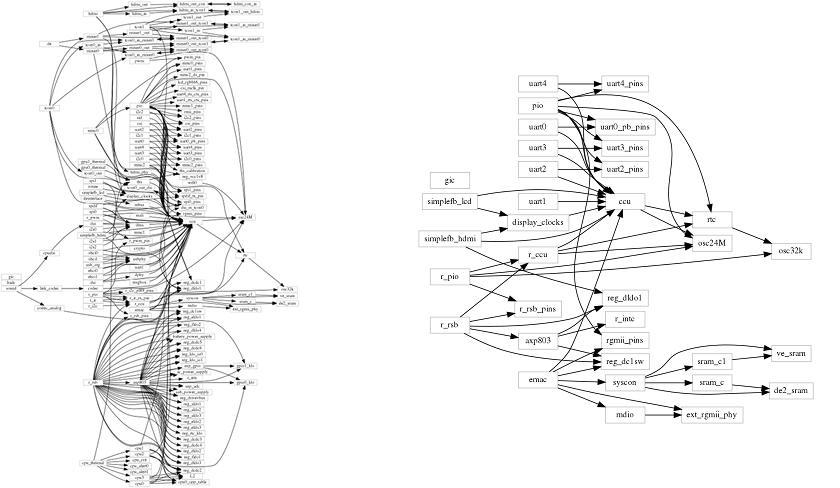
The tool aids the understanding of the hardware and allows for the pruning of
device trees down to a manageable complexity. As an illustration, the
spiderweb on the left shows the device-interdependencies of the Pine-A64-LTS
board. On the right, the device tree is pruned to cover only what's needed to
use Ethernet. The tool is covered in more detail by the following dedicated
article.
Cache for downloaded ports
When working with ports, it is not uncommon that a port hash is changed due to
some minor change like the addition of a patch. A subsequent call of
prepare_port would download the same files that were already downloaded
while preparing a previous version of the port even if the downloaded content
remains the same. This wastes internet bandwidth and developer time. The
current release introduces a simple cache for downloaded archives, which
alleviates these costs.
Thanks to Tomasz Gajewski for his continuous contributions to improve our
development workflows.
Common hook for custom build rules
There are cases that call for building custom targets in addition to a regular
library or program. For example, the executable binary of an application may
be accompanied by generated data files. The creation of such build artifacts
can be expressed by custom make rules. However, a rule is triggered only if it
is a dependency of the build target. This can now be achieved by adding the
rule to the CUSTOM_TARGET_DEPS variable. For example,
 CUSTOM_TARGET_DEPS += menu_view_styles.tar

 menu_view_styles.tar:
   $(VERBOSE)cd $(PRG_DIR); tar cf $(PWD)/bin/$@ styles
Thanks to Tomasz Gajewski for this welcome contribution.