A calorie and macro tracker that estimates a meal from a photo, a voice note or a sentence, and tells you how sure it is.
Try the demo ·
Open the app ·
The story so far ·
Docs ·
Engineering notes
Free hosting: the first visit after a quiet spell can take 30–60 s while the server wakes up.

|
🔍 AI analysis was down for three days Six hypotheses were ruled out before the real one: Gemini's free tier is geo-blocked in the EEA, and the server was in Frankfurt. |
📐 Photo size chosen by an A/B test 1024 px moved the model's estimates upward, so 1536 px shipped. The AI bill turned out not to depend on photo size at all. |
|
1,544 backend and 190 frontend, including a cross-account suite that checks no user can read another's data. |
FastAPI + PostgreSQL behind a React PWA, with migrations, nightly backups and AI quotas sized to a free tier. |
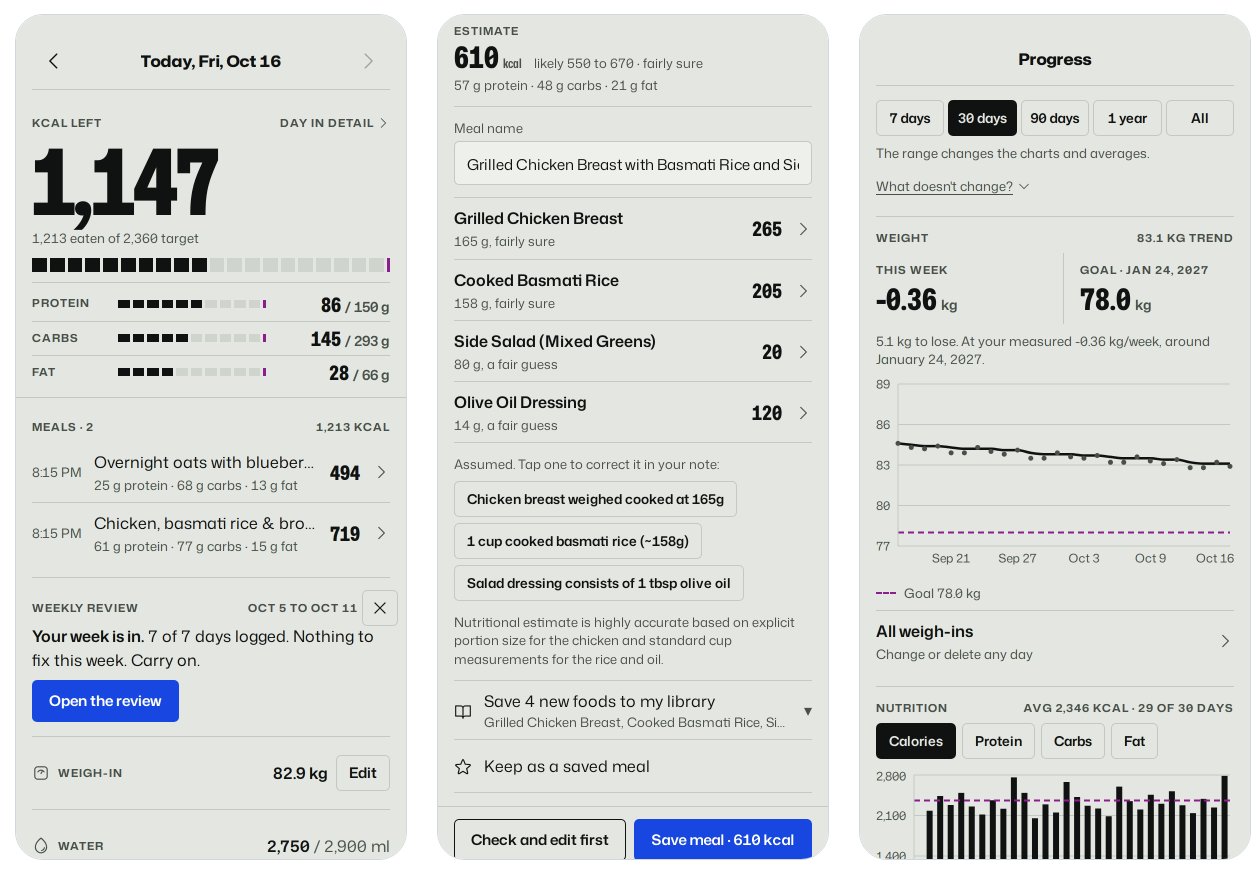
- Log a meal from a photo, a voice note or a sentence. The AI returns a calorie range, how sure it is, and every assumption it made, so you can correct it before saving.
- Or type it. Ingredients fill in from your own food library, five national food tables (USDA, UK, France, Australia, Canada) and Open Food Facts.
- A daily target worked out from you: your body, then your real burn, measured from your own weigh-ins and logs.
- Progress over any range: weight trend, goal date and nutrition charts, from 7 days to all time.
- A weekly review computed from the week you actually logged.
- Optional trackers for water, steps (with a Samsung Health import) and supplements, plus calorie banking across the week.
- Saved meals, copy a recent meal, share a meal by code.
- A demo with no sign-up: a temporary account with a month of made-up data, and sample plates whose AI estimates are saved real runs, shown beside what each plate weighed in at.
- Installs on your phone as an app, nine colour palettes in light and dark, and your data is yours: meals out as CSV, everything as JSON.
Everything, in detail: docs/features.md.
- AI meal analysis down for three days — a post-mortem. The feature failed for every input; the API key was valid, the model existed, and the deployed code worked fine from a laptop. Six hypotheses were eliminated before the real one: Gemini's free tier is geo-blocked in the EEA, and the backend was hosted in Frankfurt. Covers the diagnosis, the region migration, what remains unproven, and the two further failures the migration caused.
- Picking a photo size with an A/B instead of a hunch — the plan was to shrink photos to 1024 px because "the model downsamples anyway". Measured first: the AI bill turned out not to depend on photo size at all, and 1024 px shifted the model's estimates upward on every plate it changed. Covers the experiment design (run against the model's own run-to-run noise), why 1536 px shipped instead, and exactly what the numbers can and cannot claim.
- Setting a calorie target from sources, not round numbers — every rule behind a day-one target checked against a primary source before the first-use screens were built. Five proposed rules didn't survive and were replaced; the activity multipliers turned out to be a decades-old convention that set desk workers' targets too low; and four everyday gaps turned up, from a goal weight that changed nothing to typed macros that couldn't add up. Covers each rule with its source, three decisions in detail, how it's tested, and where a competitor is still ahead.
| All features | everything the app does, in detail |
| Screenshots | every screen, phone and desktop, light and dark |
| Install it on your phone | iPhone, Android, desktop |
| Architecture | how the frontend, API, database and AI fit together |
| Running locally | setup, tests and the six CI gates |
| Deployment | Neon, Render and Vercel, and keeping the free server awake |
| API | every endpoint |
| Data sources and credits | the food tables, fonts and icons, and their licences |
React 19 + TypeScript 6 (an installable PWA) · Python 3.14 + FastAPI + SQLAlchemy · PostgreSQL on Neon, with Alembic migrations · Gemini for the meal estimates · hosted on Vercel and Render.
Formerly Macros Calculator; renamed in October 2026, and moved from macros-calculator-mu.vercel.app to trackaholic.app the same month. It started as a Streamlit app, which lives on in legacy/.
MIT. Contributions are welcome. Read CONTRIBUTING.md first: opening a pull request means agreeing to its licence terms. Your contribution is MIT-licensed, and I may also relicense it in the future.
Abdulla · github.com/Abdulla1x