GeezerVisonThe World Wide Web, restored to 800 pixels of glory. |
| Home|About|Gaming cabinet|Archives|How it works|Starter sites |
GeezerVison is showing github.com — Backpressure Backpressure
akarnokd edited this page
In RxJava it is not difficult to get into a situation in which an Observable is emitting items more rapidly than an operator or subscriber can consume them. This presents the problem of what to do with such a growing backlog of unconsumed items. For example, imagine using the There are a variety of strategies with which you can exercise flow control and backpressure in RxJava in order to alleviate the problems caused when a quickly-producing Observable meets a slow-consuming observer. This page explains some of these strategies, and also shows you how you can design your own Observables and Observable operators to respect requests for flow control. A cold Observable emits a particular sequence of items, but can begin emitting this sequence when its Observer finds it to be convenient, and at whatever rate the Observer desires, without disrupting the integrity of the sequence. For example if you convert a static Iterable into an Observable, that Observable will emit the same sequence of items no matter when it is later subscribed to or how frequently those items are observed. Examples of items emitted by a cold Observable might include the results of a database query, file retrieval, or web request. A hot Observable begins generating items to emit immediately when it is created. Subscribers typically begin observing the sequence of items emitted by a hot Observable from somewhere in the middle of the sequence, beginning with the first item emitted by the Observable subsequent to the establishment of the subscription. Such an Observable emits items at its own pace, and it is up to its observers to keep up. Examples of items emitted by a hot Observable might include mouse & keyboard events, system events, or stock prices. When a cold Observable is multicast (when it is converted into a Cold Observables are ideal for the reactive pull model of backpressure described below. Hot Observables typically do not cope well with a reactive pull model, and are better candidates for some of the other flow control strategies discussed on this page, such as the use of the Your first line of defense against the problems of over-producing Observables is to use some of the ordinary set of Observable operators to reduce the number of emitted items to a more manageable number. The examples in this section will show how you might use such operators to handle a bursty Observable like the one illustrated in the following marble diagram:
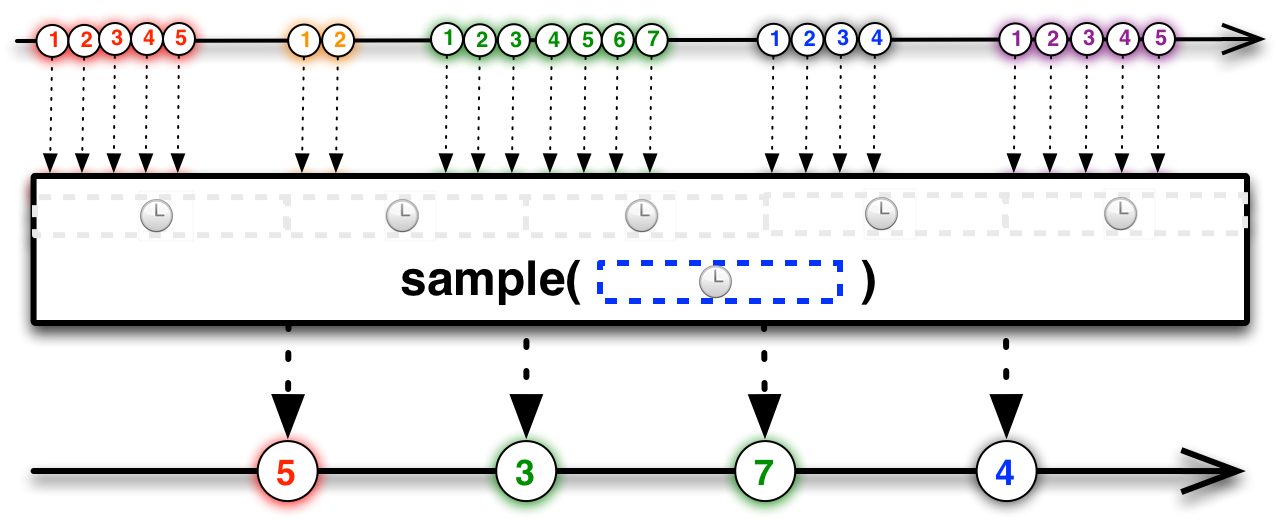
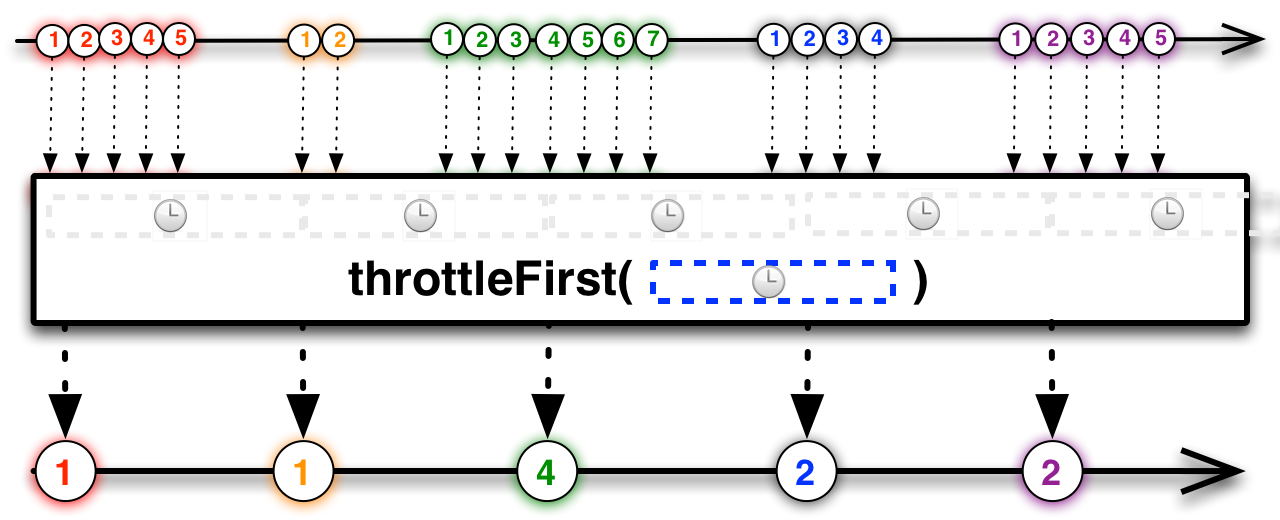
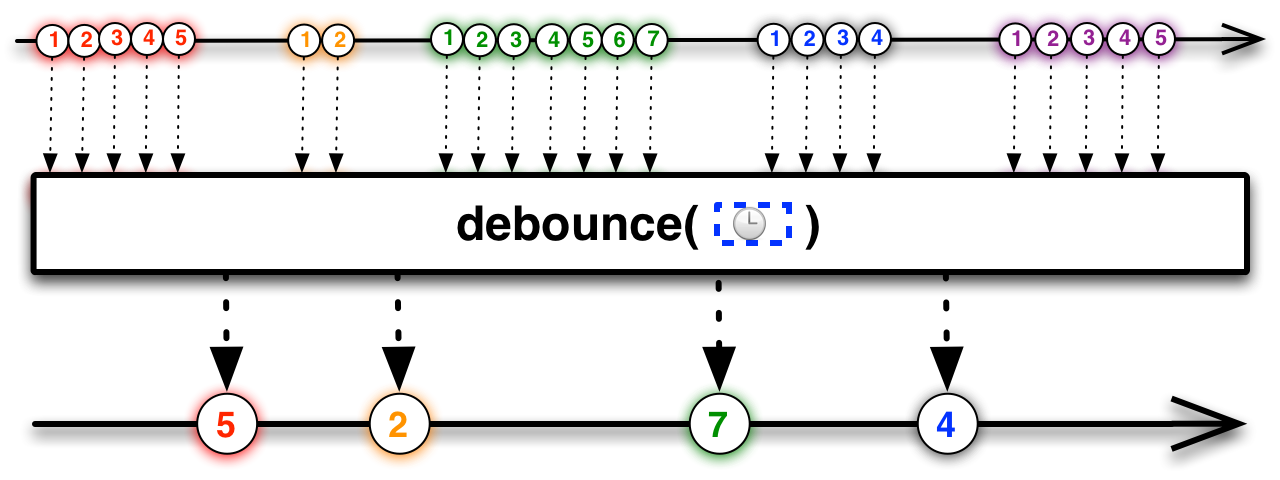
By fine-tuning the parameters to these operators you can ensure that a slow-consuming observer is not overwhelmed by a fast-producing Observable. Operators like The following diagrams show how you could use each of these operators on the bursty Observable shown above. The
Observable<Integer> burstySampled = bursty.sample(500, TimeUnit.MILLISECONDS); The
Observable<Integer> burstyThrottled = bursty.throttleFirst(500, TimeUnit.MILLISECONDS); The
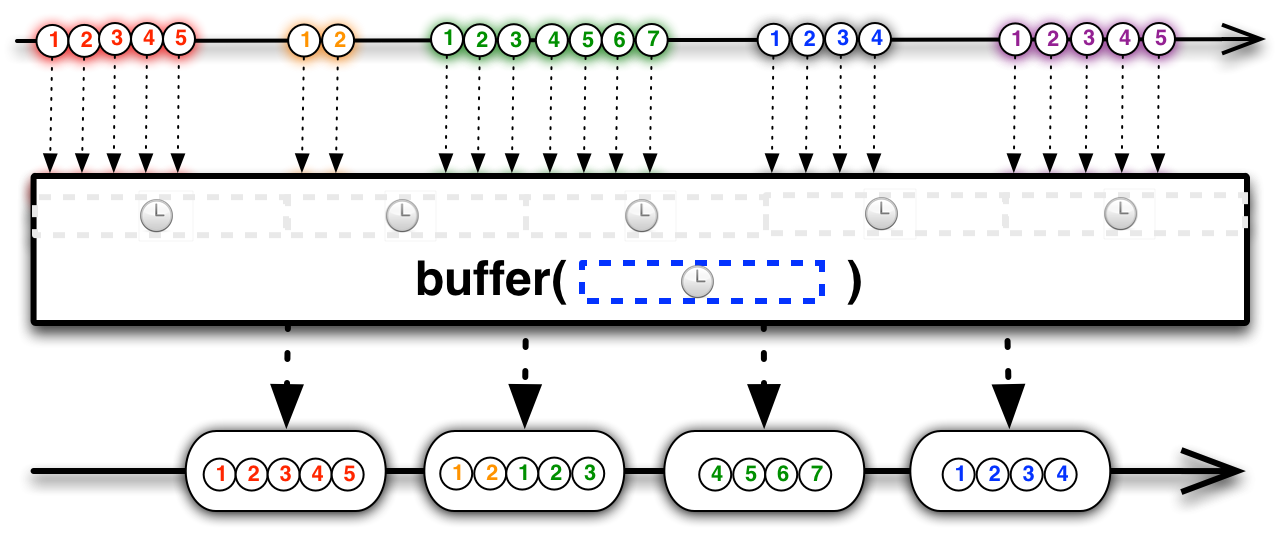
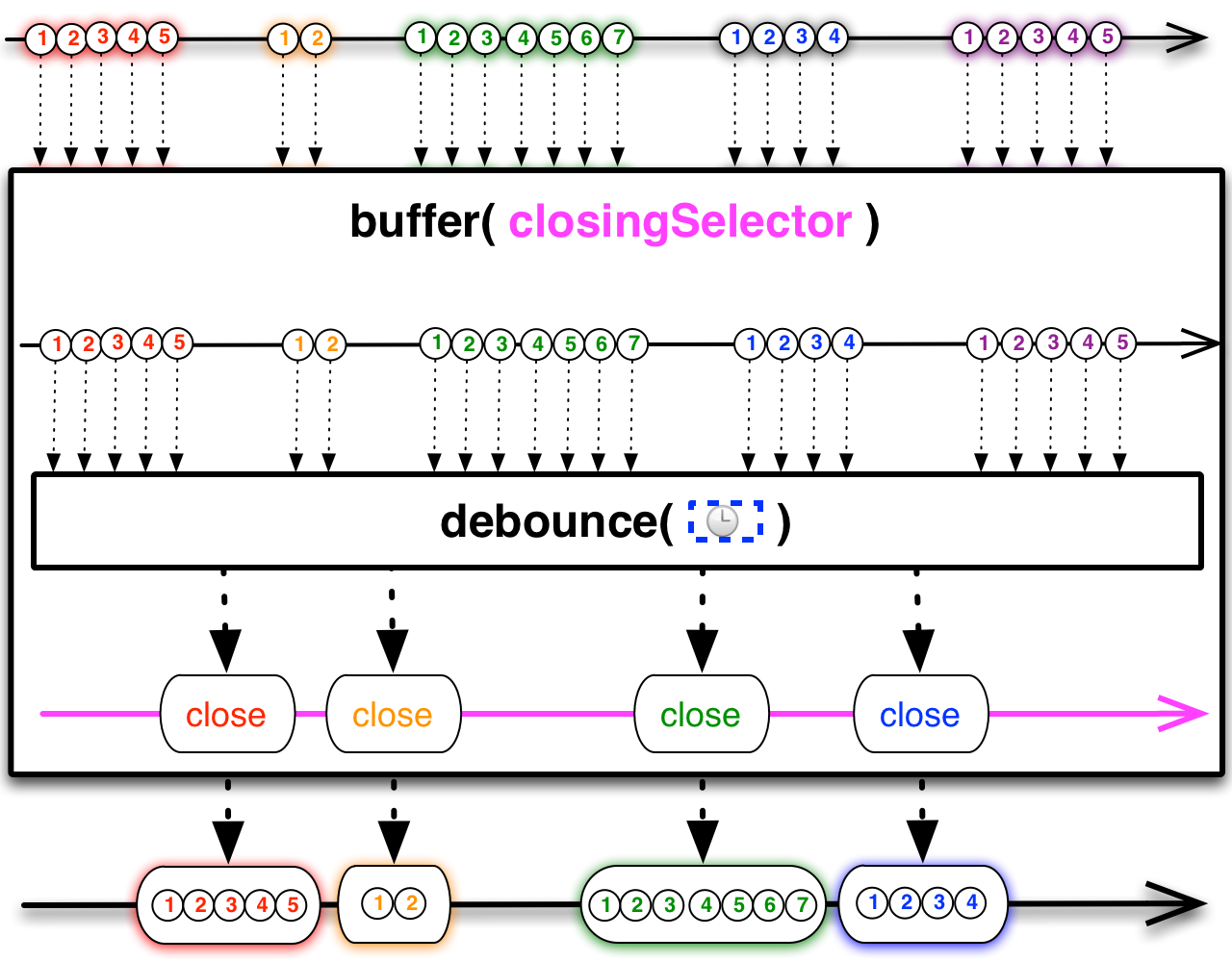
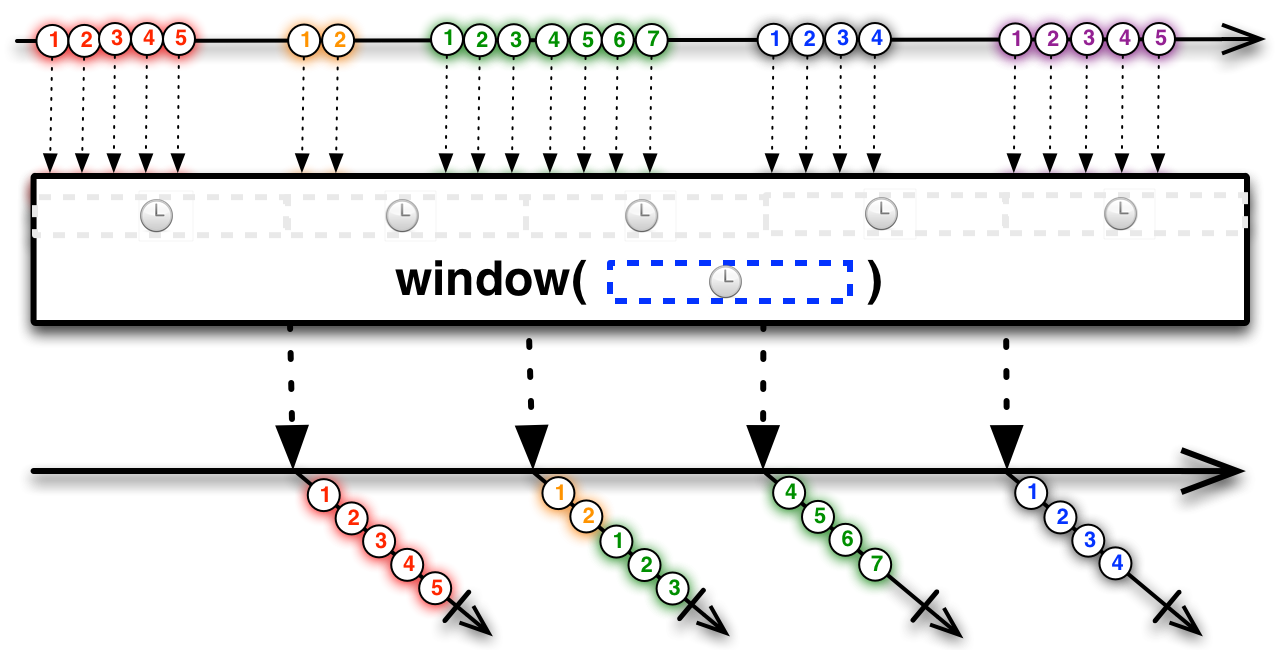
Observable<Integer> burstyDebounced = bursty.debounce(10, TimeUnit.MILLISECONDS); You can also use an operator like The following diagrams show how you could use each of these operators on the bursty Observable shown above. You could, for example, close and emit a buffer of items from the bursty Observable periodically, at a regular interval of time:
Observable<List<Integer>> burstyBuffered = bursty.buffer(500, TimeUnit.MILLISECONDS); Or you could get fancy, and collect items in buffers during the bursty periods and emit them at the end of each burst, by using the
// we have to multicast the original bursty Observable so we can use it
// both as our source and as the source for our buffer closing selector:
Observable<Integer> burstyMulticast = bursty.publish().refCount();
// burstyDebounced will be our buffer closing selector:
Observable<Integer> burstyDebounced = burstMulticast.debounce(10, TimeUnit.MILLISECONDS);
// and this, finally, is the Observable of buffers we're interested in:
Observable<List<Integer>> burstyBuffered = burstyMulticast.buffer(burstyDebounced);
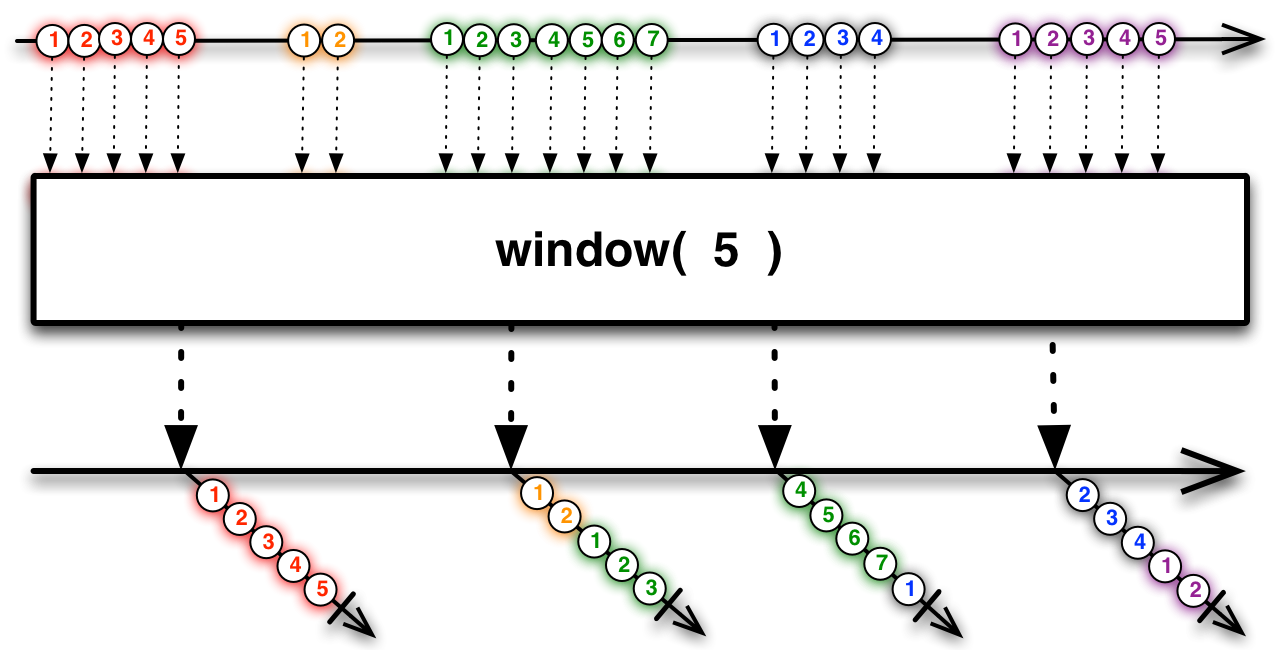
Observable<Observable<Integer>> burstyWindowed = bursty.window(500, TimeUnit.MILLISECONDS); You could also choose to emit a new window each time you have collected a particular number of items from the source Observable:
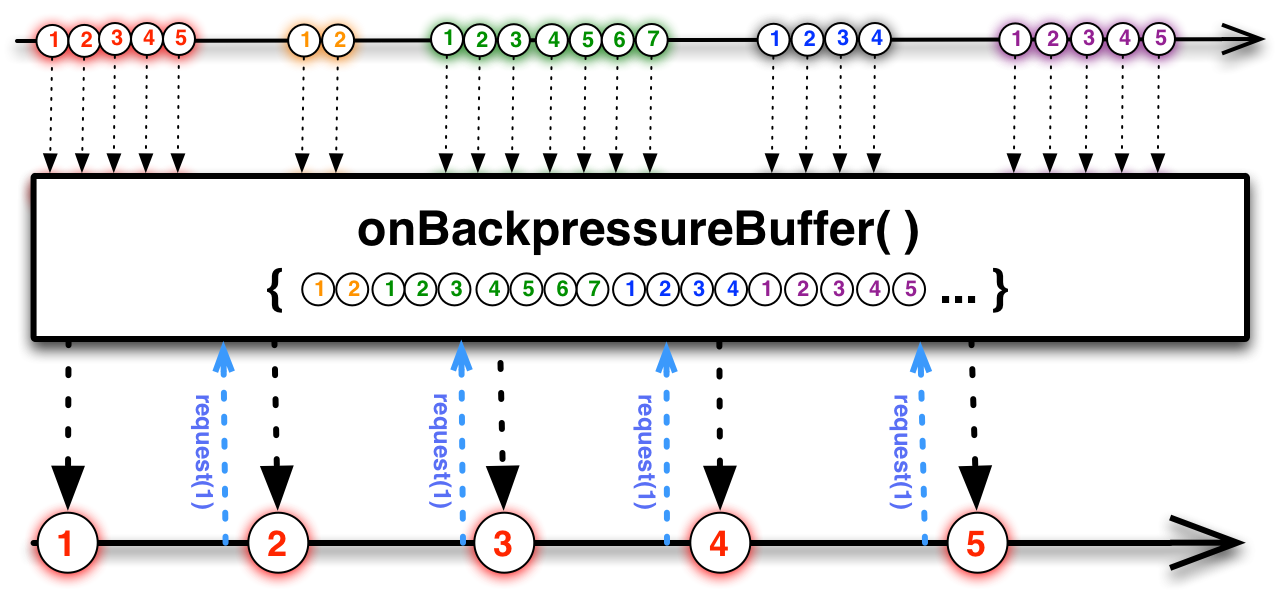
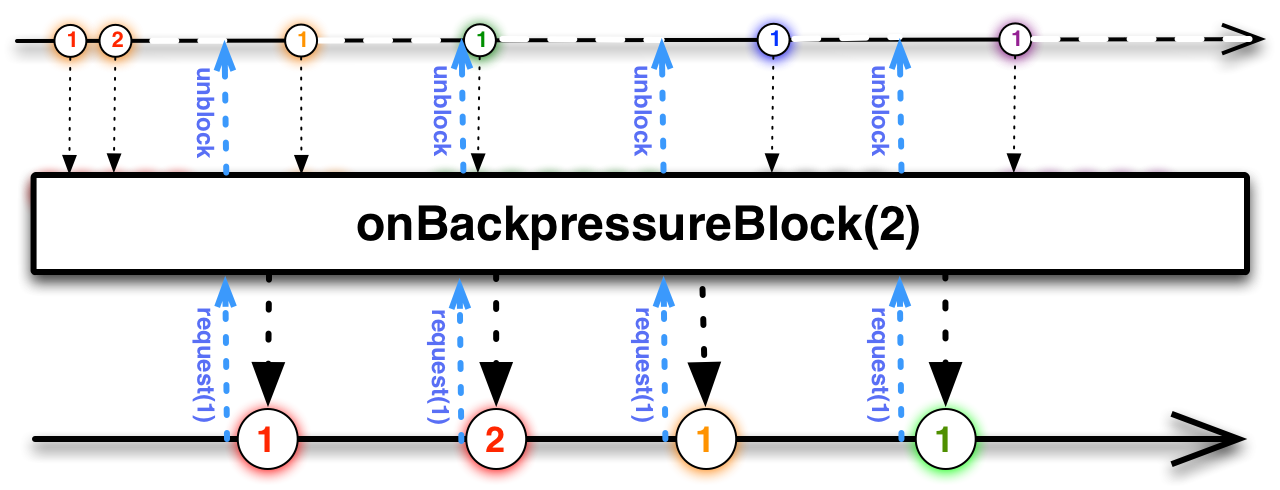
Observable<Observable<Integer>> burstyWindowed = bursty.window(5); Another way of handling an overproductive Observable is to block the callstack (parking the thread that governs the overproductive Observable). This has the disadvantage of going against the “reactive” and non-blocking model of Rx. However this can be a viable option if the problematic Observable is on a thread that can be blocked safely. Currently RxJava does not expose any operators to facilitate this. If the Observable, all of the operators that operate on it, and the observer that is subscribed to it, are all operating in the same thread, this effectively establishes a form of backpressure by means of callstack blocking. But be aware that many Observable operators do operate in distinct threads by default (the javadocs for those operators will indicate this). When you subscribe to an Then, after handling this item (or these items) in someObservable.subscribe(new Subscriber<T>() { @Override public void onStart() { request(1); } @Override public void onCompleted() { // gracefully handle sequence-complete } @Override public void onError(Throwable e) { // gracefully handle error } @Override public void onNext(T n) { // do something with the emitted item "n" // request another item: request(1); } }); You can pass a magic number to Backpressure doesn’t make the problem of an overproducing Observable or an underconsuming Subscriber go away. It just moves the problem up the chain of operators to a point where it can be handled better. Let’s take a closer look at the problem of the uneven You have two Observables, A and B, where B is inclined to emit items more frequently than A. When you try to You could attach a throttling operator to B, but this would mean ignoring some of the items B emits, which might not be appropriate. What you’d really like to do is to signal to B that it needs to slow down and then let B decide how to do this in a way that maintains the integrity of its emissions. The reactive pull backpressure model lets you do this. It creates a sort of active pull from the Subscriber in contrast to the normal passive push Observable behavior. The (Many RxJava operators exercise reactive pull backpressure. Some operators do not need to use this variety of backpressure, as they operate in the same thread as the Observable they operate on, and so they exert a form of blocking backpressure simply by not giving the Observable the opportunity to emit another item until they have finished processing the previous one. For other operators, backpressure is inappropriate as they have been explicitly designed to deal with flow control in other ways. The RxJava javadocs for those operators that are methods of the Observable class indicate which ones do not use reactive pull backpressure and why.) For this to work, though, Observables A and B must respond correctly to the
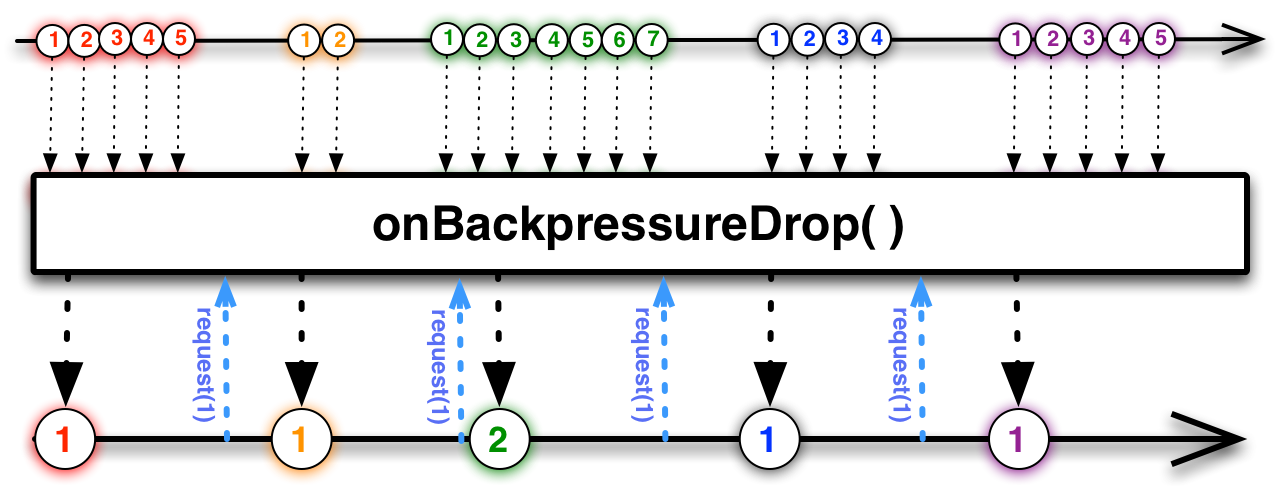
If you do not apply any of these operators to an Observable that does not support backpressure, and if either you as the Subscriber or some operator between you and the Observable attempts to apply reactive pull backpressure, you will encounter a If the standard operators aren't providing the expected behavior, one can write custom operators in RxJava. Copyright (c) 2016-present, RxJava Contributors. Clone this wiki locally |
| You are visitor 01402775 — GeezerVison does not store the pages you look up. Best viewed with Netscape Navigator 4.7 or Internet Explorer 6 at 800×600. No cookies required. |